
Fire Risk Assessment Legal Requirements in England and Wales
Fire safety is a fundamental legal responsibility for businesses, employers, property owners and organisations responsible for managing buildings in England and Wales. Understanding the Fire Risk Assessment Legal Requirements is essential because a fire can cause serious injuries, loss of life, property damage and significant disruption to business operations. Fire safety legislation requires responsible persons to identify potential fire hazards, assess the risks to relevant individuals and implement appropriate preventative and protective measures. A fire risk assessment is an essential part of meeting these responsibilities and maintaining a safe environment for employees, visitors, residents and other people who may be affected by a fire.
The principal legislation governing fire risk assessments in England and Wales is the Regulatory Reform (Fire Safety) Order 2005. It establishes duties for responsible persons, including carrying out suitable and sufficient fire risk assessments, implementing appropriate fire precautions, maintaining fire safety arrangements and reviewing assessments when necessary. Subsequent legislation, particularly the Fire Safety Act 2021 and Section 156 of the Building Safety Act 2022, has clarified and strengthened important aspects of fire safety compliance. Wales has also introduced a separate building safety framework through the Building Safety (Wales) Act 2026, with phased commencement.
Understanding these legal requirements is essential for business owners, employers, landlords, facilities managers, building managers and fire safety professionals. This guide explains the legislation, responsibilities, assessment requirements, written records, review arrangements and potential consequences of non-compliance in England and Wales.
What Is a Fire Risk Assessment?
A fire risk assessment is a systematic examination of a building, workplace or other relevant premises to identify potential fire hazards, evaluate the likelihood and consequences of a fire, and determine the measures needed to protect people. It considers how a fire could start, how it might spread, who could be affected and whether suitable arrangements are in place to prevent fires and support safe evacuation.
The purpose of a fire risk assessment is not simply to produce a written report. It is to help the responsible person understand the actual fire risks within their premises and take appropriate action to eliminate or reduce those risks. An effective assessment also considers the suitability of fire detection systems, emergency exits, escape routes, firefighting equipment, staff training and emergency procedures.
For example, a warehouse storing combustible materials may have different fire risks from a small office or a hotel providing sleeping accommodation. Similarly, a healthcare facility may need to consider patients who cannot evacuate without assistance. Each assessment should reflect the building’s design, activities, occupancy, fire protection arrangements and the characteristics of the people who use it.
A suitable and sufficient fire risk assessment should therefore be specific to the premises rather than relying on a generic checklist that does not consider the actual conditions.
Is a Fire Risk Assessment a Legal Requirement in England and Wales?
Yes. A fire risk assessment is a legal requirement for premises covered by the Regulatory Reform (Fire Safety) Order 2005. This legislation applies in England and Wales and establishes the principal legal framework for managing fire safety in non-domestic premises.
Article 9 of the Fire Safety Order requires the responsible person to make a suitable and sufficient assessment of the risks to which relevant persons are exposed for the purpose of identifying the general fire precautions needed to comply with the Order.
Relevant persons include individuals who may lawfully be on the premises and people in the immediate vicinity who may be affected by a fire. This can include employees, customers, visitors, contractors and other occupants.
The assessment must identify the fire precautions necessary to protect these individuals. Where five or more people are employed, the responsible person must also record the arrangements required under Article 11, although the wider recording requirements introduced by Section 156 now mean that the full assessment and fire safety arrangements must be recorded in all circumstances.
The legislation applies to a wide range of environments, including:
- Commercial buildings and business premises.
- Offices and retail establishments.
- Factories, workshops and warehouses.
- Educational institutions and schools.
- Hotels, guesthouses and other sleeping accommodation.
- Restaurants, cafés and hospitality premises.
- Healthcare facilities and relevant care premises.
- Public buildings and places of assembly.
- Common areas of multi-occupied residential buildings.
The Fire Safety Order does not generally apply inside individual private domestic dwellings. However, its scope includes relevant common parts of multi-occupied residential buildings and certain other areas and structures associated with domestic premises. Business owners and property managers should therefore establish which parts of their premises fall within the legislation rather than assuming that every residential or commercial space is treated identically.
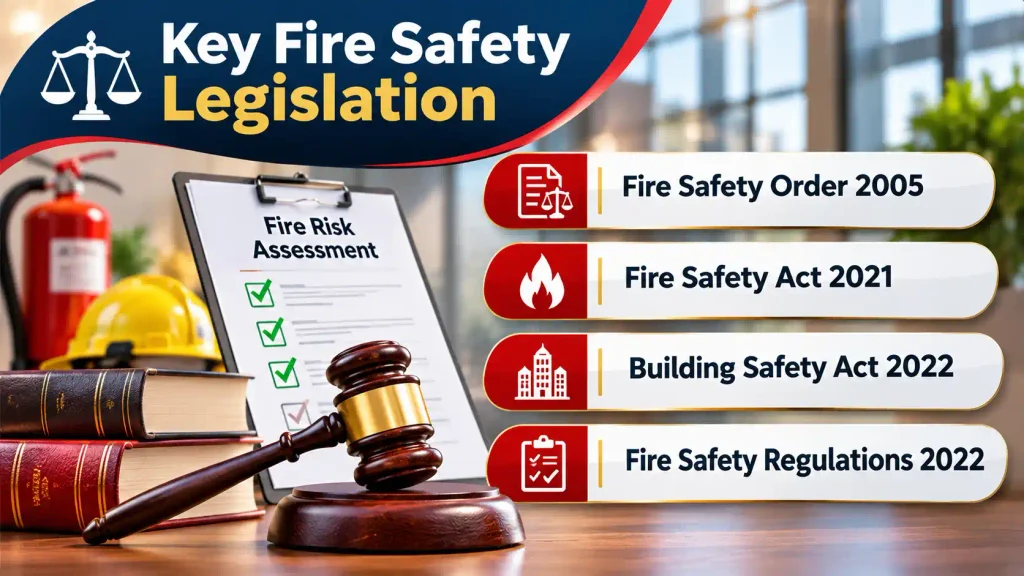
Key Legislation Governing Fire Risk Assessments in England and Wales
Several pieces of legislation establish the responsibilities and additional requirements associated with fire risk assessments. Understanding their individual purposes helps organisations identify which legal duties apply to their premises.
Regulatory Reform (Fire Safety) Order 2005
The Regulatory Reform (Fire Safety) Order 2005 is the principal legislation governing fire safety in England and Wales. It places duties on responsible persons to assess fire risks, implement appropriate fire precautions and maintain effective fire safety arrangements.
Important provisions include:
| Article | Legal requirement |
|---|---|
| Article 3 | Defines the responsible person |
| Article 5 | Establishes general duties under the Order |
| Article 8 | Requires general fire precautions |
| Article 9 | Requires a suitable and sufficient fire risk assessment |
| Article 11 | Requires effective fire safety arrangements |
| Article 13 | Covers firefighting and fire detection measures |
| Article 14 | Addresses emergency routes and exits |
| Article 15 | Covers procedures for serious and imminent danger |
| Article 17 | Requires maintenance of fire safety measures |
| Article 19 | Addresses employee information |
| Article 21 | Requires employee fire safety training |
| Article 22 | Requires cooperation and coordination between responsible persons |
These provisions work together to establish a framework for identifying, preventing and managing fire risks.
A fire risk assessment is therefore one part of a wider fire safety management system. Completing an assessment without implementing its necessary recommendations does not satisfy the broader legal responsibilities.
Fire Safety Act 2021
The Fire Safety Act 2021 clarified the application of the Fire Safety Order to certain parts of multi-occupied residential buildings. It confirmed that the Fire Safety Order applies to the structure and external walls of relevant buildings, including doors between domestic premises and common parts, and to specified items attached to external walls, such as balconies. This clarification is particularly important for responsible persons managing blocks of flats and other multi-occupied residential buildings.
For example, a building manager may need to consider external wall construction, cladding, balconies and flat entrance doors when evaluating fire safety arrangements. The legislation does not mean that every internal area of an individual flat automatically becomes subject to the Fire Safety Order. Its application must be understood alongside the legal definition of domestic premises and the building’s shared areas.
Building Safety Act 2022 – Section 156
Section 156 of the Building Safety Act 2022 introduced important amendments to the Fire Safety Order, with the relevant main requirements coming into force on 1 October 2023 in England and Wales. These changes strengthened documentation, information-sharing and cooperation responsibilities.
The most significant changes for fire risk assessment compliance include:
- Recording the complete fire risk assessment, including its findings.
- Recording the fire safety arrangements for the premises.
- Recording the identity of any person and, where applicable, organisation engaged to assist with the assessment or its review.
- Keeping responsible person contact details, including a UK address for receiving notices.
- Cooperating with other responsible persons who share duties for the premises.
- Providing relevant fire safety information to incoming responsible persons.
- Sharing relevant fire safety information with residents of buildings containing two or more sets of domestic premises.
These requirements apply to relevant non-domestic premises, including the non-domestic parts of multi-occupied residential buildings. Section 156 also inserted Article 9A, which provides for a legal competence requirement when appointing someone to assist with making or reviewing an assessment. However, this particular provision had not been brought into force as at 25 October 2026. Responsible persons should nevertheless continue to appoint appropriately competent assistance and ensure that the assessment is suitable and sufficient.
Fire Safety (England) Regulations 2022
The Fire Safety (England) Regulations 2022 introduce additional requirements for responsible persons managing specified multi-occupied residential buildings in England.
They came into force on 23 January 2023.
Depending on the building’s height and characteristics, these regulations require measures such as:
- Providing information about the building’s external wall system to the fire and rescue service.
- Providing floor plans and building plans.
- Maintaining secure information boxes in relevant high-rise buildings.
- Providing suitable wayfinding signage.
- Carrying out specified checks of firefighting lifts and equipment.
- Conducting quarterly checks of communal fire doors in relevant buildings over 11 metres.
- Arranging annual checks of flat entrance doors in relevant buildings over 11 metres.
- Providing residents with fire safety instructions and information about fire doors.
These additional requirements apply in England, not Wales.
Businesses and residential building managers must therefore distinguish between the shared requirements of the Fire Safety Order and the additional English regulations.
Building Safety (Wales) Act 2026
Wales has introduced a separate building safety framework through the Building Safety (Wales) Act 2026, which received Royal Assent on 27 April 2026. The Act establishes a new approach to assessing and managing building safety risks in multi-occupied residential buildings in Wales.
Its provisions include:
- A framework for identifying regulated buildings.
- New building safety authority functions.
- Duties relating to the assessment and management of fire safety risks.
- Additional structural safety requirements for specified buildings.
- New resident rights and responsibilities.
- An enforcement framework for relevant building safety duties.
Some provisions came into force on 28 April 2026, while other provisions require further commencement orders. The Act does not replace the Regulatory Reform (Fire Safety) Order 2005. Responsible persons must continue meeting their existing Fire Safety Order obligations while monitoring the phased implementation of the Welsh building safety regime.
Who is Legally Responsible for a Fire Risk Assessment?
The person legally responsible for fire safety is generally known as the responsible person.
Under Article 3 of the Regulatory Reform (Fire Safety) Order 2005, the responsible person will usually be:
- The employer, where the workplace is under their control.
- The person who has control of the premises in connection with a business or undertaking.
- The owner, where the premises are not otherwise controlled in that way.
- A person with relevant control over a particular area or activity.
The responsible person must ensure that a suitable and sufficient fire risk assessment is completed and that appropriate fire safety measures are implemented. Different arrangements may apply depending on ownership, occupation, contractual responsibilities and the extent of control over the premises.
Responsibilities of Employers
Employers must ensure that workplaces are assessed for fire risks and that employees are protected through appropriate preventative and protective measures. Their responsibilities include identifying hazards, providing suitable fire safety arrangements, maintaining equipment, developing emergency procedures and providing appropriate employee training.
Responsibilities of Landlords and Property Owners
Landlords and property owners may be responsible for fire safety where they have control over relevant premises or shared areas. For example, a landlord managing a block of flats may have responsibilities for communal corridors, staircases, shared entrances and other areas covered by the Fire Safety Order. They should ensure that appropriate assessments are completed and that identified deficiencies are addressed.
Responsibilities of Managing Agents
Managing agents may have responsibilities where they exercise control over building management or fire safety arrangements. Their duties may include coordinating assessments, arranging maintenance, communicating with contractors and ensuring that fire safety information is shared with other responsible persons. Appointing a managing agent does not automatically remove the legal responsibilities of the owner or another responsible person.
Shared Responsibilities in Multi-Occupancy Buildings
In buildings occupied by several businesses or organisations, more than one responsible person may have duties. For example, a shopping centre may have a building owner, a managing agent and multiple commercial tenants. Each responsible person must understand their responsibilities and cooperate with others to maintain an effective whole-building approach to fire safety.
What Must a Legally Compliant Fire Risk Assessment Include?
A suitable and sufficient fire risk assessment must identify the relevant hazards, evaluate the risks and establish the precautions required to protect people. The precise scope depends on the premises and the activities taking place. The assessment should generally address the following areas.
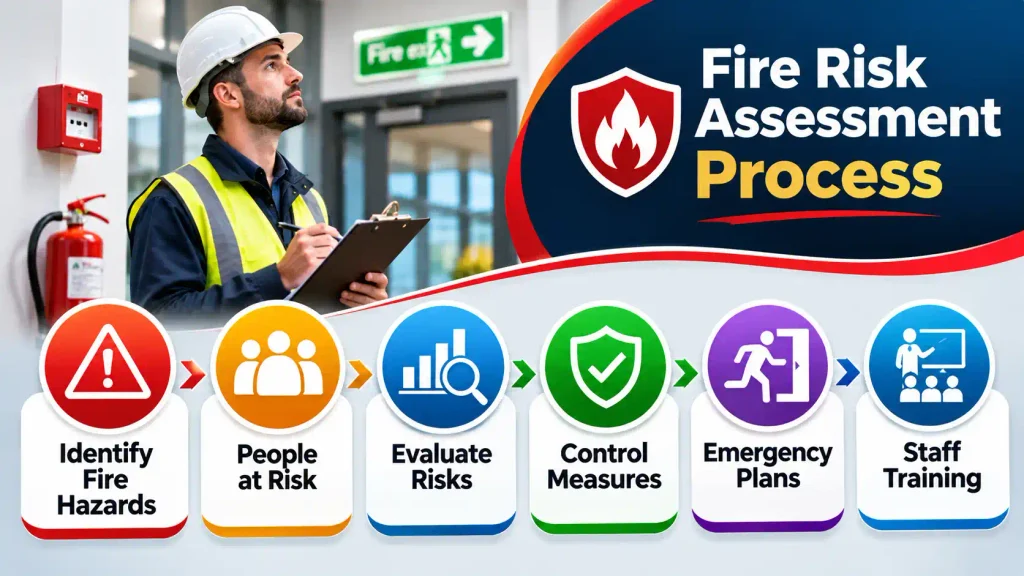
Identification of Fire Hazards
The assessor should identify potential sources of ignition, combustible materials and conditions that could allow a fire to start.
Examples include:
- Electrical equipment and defective wiring.
- Overloaded electrical sockets.
- Cooking equipment.
- Heating systems.
- Smoking materials.
- Flammable liquids and gases.
- Hot work activities.
- Accumulated waste and combustible storage.
- Poor housekeeping and inadequate maintenance.
Identification of People at Risk
The assessment must consider who could be affected if a fire occurs.
This may include:
- Employees and temporary workers.
- Customers and visitors.
- Contractors and maintenance staff.
- Residents and occupants.
- Children and older people.
- Individuals with mobility, sensory or other relevant disabilities.
- People working alone or in isolated areas.
The assessor should consider how different individuals would receive warnings and evacuate safely.
Evaluation of Fire Risks
Identified hazards should be evaluated to determine the likelihood of a fire and the potential consequences. The assessment should consider existing control measures and whether additional precautions are necessary.
For example, a warehouse storing combustible materials may require improved separation, better housekeeping, suitable detection arrangements and changes to storage practices.
Fire Prevention and Protection Measures
The responsible person must ensure that appropriate preventative and protective measures are implemented.
These may include:
- Suitable fire detection and alarm systems.
- Appropriate firefighting equipment.
- Protected escape routes.
- Adequate emergency exits.
- Fire doors and suitable compartmentation.
- Emergency lighting where required.
- Safe storage of dangerous substances.
- Appropriate fire safety signage.
- Suitable evacuation procedures.
The assessment should identify deficiencies and recommend appropriate corrective actions.
Emergency Procedures and Training
A fire risk assessment should consider the emergency arrangements required for the premises. These include evacuation procedures, arrangements for raising the alarm, contacting emergency services and assisting individuals who may need additional support. Employees should receive appropriate fire safety information and instruction, with training repeated when necessary to maintain understanding and competence.
Written Fire Risk Assessment Requirements Under Section 156
One of the most important changes to fire risk assessment law concerns written documentation. Before Section 156 of the Building Safety Act 2022 came into force, the recording requirements were subject to certain thresholds, including premises employing five or more people and particular licensing or alterations notice circumstances.
These limitations have been removed. Since 1 October 2023, responsible persons must record the full fire risk assessment, including its findings, and the fire safety arrangements in all circumstances covered by the Fire Safety Order. This means that small businesses and organisations with fewer than five employees must also maintain written fire risk assessment records.
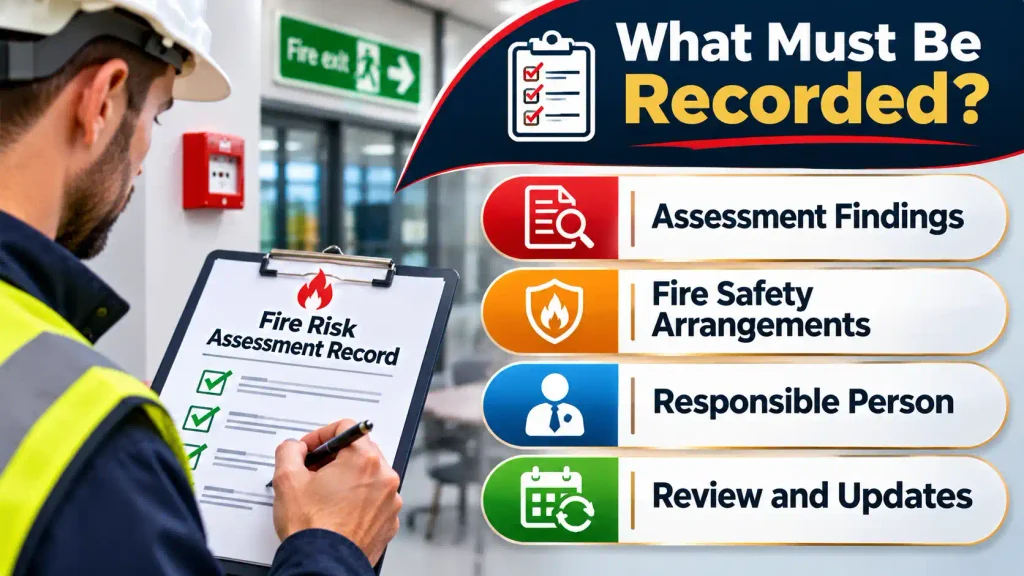
The documentation should include:
- The full fire risk assessment and its findings.
- Identified fire hazards and people at risk.
- Preventative and protective measures.
- Identified deficiencies and recommended actions.
- Fire safety management arrangements.
- The identity of any person or organisation appointed to assist with the assessment or review.
- Relevant responsible person contact information.
- Records of assessment reviews and updates.
Where a building contains two or more sets of domestic premises, additional information-sharing duties apply to residents. The responsible person must also take reasonably practicable steps to identify other responsible persons and coordinate fire safety arrangements. Keeping complete and accessible records helps demonstrate how fire safety is being managed and provides important information for future reviews, building management changes and enforcement inspections.
How Often Must a Fire Risk Assessment Be Reviewed?
The Regulatory Reform (Fire Safety) Order 2005 requires responsible persons to review fire risk assessments regularly and whenever there is reason to suspect that the existing assessment is no longer valid or significant changes have occurred. There is no universal statutory requirement for every business to commission a completely new fire risk assessment every 12 months. The appropriate review frequency depends on the nature of the premises, the level of risk and the circumstances affecting fire safety.
A review should be considered when:
- Building layouts or structures are altered.
- New equipment or machinery is introduced.
- The purpose or use of the premises changes.
- Occupancy levels increase significantly.
- New hazardous substances are introduced.
- Fire safety equipment or systems are modified.
- Escape routes become obstructed or inadequate.
- A fire, near miss or other relevant incident occurs.
- Previous control measures are found to be ineffective.
- Significant changes affect the people using the premises.
For example, if an office is converted into a restaurant, the original assessment may no longer reflect the new cooking hazards, equipment, occupancy arrangements and evacuation requirements.
Similarly, a warehouse that begins storing additional combustible materials may require a review of its fire prevention and protection measures. Responsible persons should establish a suitable review schedule and ensure that assessments remain relevant to the actual conditions of the premises.
Fire Risk Assessment Legal Requirements in England vs Wales
Although England and Wales share the Regulatory Reform (Fire Safety) Order 2005, certain additional legal requirements differ between the two jurisdictions. Understanding these differences is particularly important for organisations managing properties in both countries.
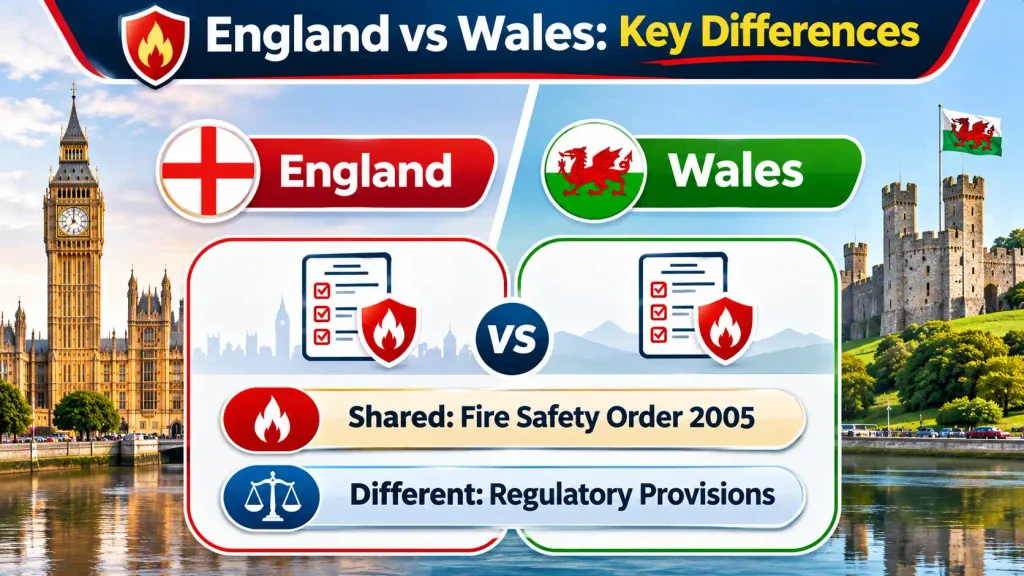
| Legal requirement | England | Wales |
|---|---|---|
| Regulatory Reform (Fire Safety) Order 2005 | Applies | Applies |
| Fire Safety Act 2021 | Applies | Applies |
| Section 156 of Building Safety Act 2022 | Applies | Applies |
| Fire Safety (England) Regulations 2022 | Applies | Does not apply |
| Building Safety (Wales) Act 2026 | Does not apply | Applies, with phased commencement |
| Fire and rescue authority enforcement | Applies | Applies |
Fire Safety Requirements in England
In England, responsible persons must comply with the Fire Safety Order and relevant amendments. Those managing specified multi-occupied residential buildings must also consider the Fire Safety (England) Regulations 2022. These requirements introduce additional responsibilities relating to fire doors, resident information, building plans, wayfinding and firefighting facilities, depending on building characteristics.
Fire Safety Requirements in Wales
In Wales, the Fire Safety Order remains the principal framework for fire risk assessment duties. Responsible persons must also consider relevant Welsh building safety legislation and its phased implementation.
The Building Safety (Wales) Act 2026 introduces a separate framework for specified multi-occupied residential buildings, including requirements relating to the assessment and management of fire safety risks. Organisations operating across both countries should maintain separate compliance arrangements where additional national requirements apply.
Can You Carry Out Your Own Fire Risk Assessment?
Yes. The responsible person may carry out a fire risk assessment themselves if they have sufficient knowledge, understanding and experience to complete a suitable and sufficient assessment. The legislation does not require every organisation to appoint an external fire risk assessment consultant.
However, the assessment must properly identify hazards, evaluate risks and establish appropriate protective measures. Where a premises has complex fire safety arrangements, high occupancy, sleeping accommodation, specialist equipment or vulnerable occupants, professional assistance may be necessary.
A competent fire risk assessor should have relevant training, practical experience, technical understanding and the ability to evaluate the specific premises. The responsible person should consider the assessor’s experience with similar building types, professional development, references and any relevant professional recognition or accreditation.
Importantly, commissioning an external assessment does not remove the responsible person’s legal duties. They remain responsible for ensuring that the assessment is suitable and sufficient and that its recommendations are properly addressed.
Individuals seeking to develop professional knowledge and practical skills in this area may consider the ProQual Level 4 Certificate in Fire Risk Assessment. Experienced practitioners may also explore the ProQual Level 5 Diploma in Fire Risk Assessment to develop more advanced occupational competence.
What Happens If You Do Not Have a Fire Risk Assessment?
Failure to meet fire safety responsibilities can expose employees, visitors and other relevant persons to serious danger. Fire and rescue authorities are responsible for enforcing the Fire Safety Order in most ordinary workplaces and commercial premises. Other enforcing authorities apply to certain specialised premises. Where deficiencies are identified, enforcement authorities may take different actions depending on the seriousness of the situation.
These may include:
- Informal advice: An enforcing authority may explain identified shortcomings and recommend corrective action.
- Enforcement notice: A formal notice may be issued where the responsible person has failed to comply with legal requirements. It identifies the relevant breaches and specifies the remedial action required.
- Prohibition notice: Where there is a serious risk to people, an authority may restrict or prohibit the use of premises until the dangerous conditions have been addressed.
- Alterations notice: This may be issued where premises are considered high risk or could become high risk following changes. It can require the responsible person to notify the enforcing authority about specified proposed alterations.
- Prosecution: Serious breaches can result in criminal proceedings.
Under the Fire Safety Order, offences involving serious risks to life or failure to comply with statutory notices can carry an unlimited fine and, on conviction in the Crown Court, imprisonment of up to two years. The potential consequences depend on the nature of the offence and the circumstances of the case.
Non-compliance can also lead to operational disruption, reputational damage, increased insurance difficulties and significant financial consequences. The best approach is to identify deficiencies early, implement appropriate control measures and maintain accurate fire safety documentation.
Fire Risk Assessment Legal Compliance Checklist
Business owners, landlords, facilities managers and fire safety professionals can use the following checklist to review their arrangements.
Fire Risk Assessment Compliance Checklist
Follow these key checks to review workplace fire safety compliance.
Responsible Person
Has the legally responsible person been identified?
Fire Risk Assessment
Is a suitable and sufficient assessment available?
Fire Hazards
Have ignition sources and combustible materials been identified?
People at Risk
Have employees, visitors and vulnerable occupants been considered?
Fire Precautions
Are suitable prevention and protection measures implemented?
Emergency Exits
Are escape routes accessible, suitable and maintained?
Fire Detection
Are appropriate fire warning arrangements provided?
Firefighting Equipment
Is suitable firefighting equipment available and maintained?
Written Records
Is the complete fire risk assessment documented?
Fire Safety Arrangements
Are fire safety management arrangements recorded?
Staff Training
Do employees receive appropriate fire safety instruction?
Review Arrangements
Is the assessment reviewed regularly and when circumstances change?
Shared Responsibilities
Are relevant responsible persons cooperating?
Corrective Actions
Have identified deficiencies been addressed?
Compliance Review Completed
Address outstanding issues and maintain ongoing fire safety compliance.
Important: This checklist supports compliance reviews. It does not replace a suitable and sufficient fire risk assessment.
This checklist is a practical starting point rather than a substitute for a full assessment. Additional requirements may apply depending on the building type, occupancy and legal framework.
Frequently Asked Questions
Find answers to common questions about fire risk assessment legal requirements in England and Wales.
Is a fire risk assessment a legal requirement in England and Wales?
Yes. Under Article 9 of the Regulatory Reform (Fire Safety) Order 2005, responsible persons must ensure that a suitable and sufficient fire risk assessment is completed for premises covered by the legislation.
Do small businesses need a fire risk assessment?
Yes. Small businesses must comply with applicable fire safety requirements regardless of how many employees they employ. The responsible person must ensure that the assessment is completed and recorded in full.
Does every fire risk assessment need to be written?
Yes. Following Section 156 of the Building Safety Act 2022, responsible persons must record the full fire risk assessment and fire safety arrangements in all circumstances covered by the Fire Safety Order.
Is an annual fire risk assessment legally required?
There is no universal statutory requirement to commission a new assessment every year. However, responsible persons must review assessments regularly and when significant changes occur or there is reason to believe the assessment is no longer valid.
Can a landlord complete their own fire risk assessment?
A landlord may complete an assessment if they have sufficient knowledge and experience to do so. Their responsibilities depend on the premises and the extent of their control. Where specialist expertise is needed, appropriate professional assistance should be obtained.
Who can carry out a fire risk assessment?
The responsible person can carry out the assessment themselves if they are capable of completing it properly. Alternatively, they may appoint an appropriately competent person to assist. The responsible person remains accountable for ensuring that the assessment is suitable and sufficient.
Are fire risk assessments required for residential flats?
The Fire Safety Order generally does not apply inside individual private domestic flats. However, it applies to relevant common parts of multi-occupied residential buildings and, following the Fire Safety Act 2021, specified structures, external walls and flat entrance doors.
What happens if a business does not have a fire risk assessment?
The responsible person may face enforcement action, including enforcement notices, prohibition notices and prosecution, depending on the nature and seriousness of the breach. Serious offences can carry unlimited fines and imprisonment.
Which legislation covers fire risk assessments in England and Wales?
The principal legislation is the Regulatory Reform (Fire Safety) Order 2005. Other relevant legislation includes the Fire Safety Act 2021 and the Building Safety Act 2022. Additional requirements apply under the Fire Safety (England) Regulations 2022 in England and the phased Building Safety (Wales) Act 2026 framework in Wales.
Do fire risk assessments apply to offices, shops and warehouses?
Yes. Offices, shops, warehouses and other workplaces are generally covered by the Fire Safety Order. The assessment should reflect the activities, fire hazards, occupancy and protective measures specific to each premises.