Quality Assurance vs Quality Control
Delivering high-quality products and services is no longer just a competitive advantage it is an essential requirement for organizations operating in today’s global marketplace. Customers expect reliable products, regulatory authorities demand compliance with established standards, and businesses strive to reduce costs associated with defects, rework, and customer complaints. To achieve these objectives, organizations rely on two closely related but distinct quality management approaches: Quality Assurance (QA) and Quality Control (QC).
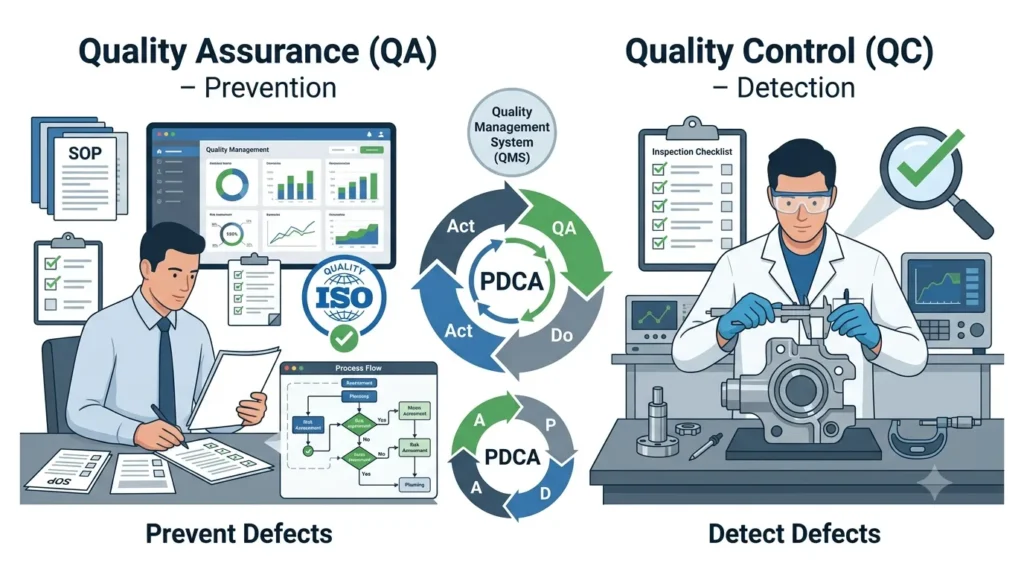
Although the terms are often used interchangeably, they represent different aspects of quality management. Quality Assurance focuses on designing and improving processes to prevent defects before they occur, while Quality Control concentrates on inspecting, testing, and verifying products or services to identify defects before they reach customers. Together, QA and QC create a comprehensive quality management system that enhances customer satisfaction, improves operational efficiency, and supports continuous improvement.
Whether you work in manufacturing, construction, mechanical engineering, civil engineering, healthcare, pharmaceuticals, food production, software development, or any other industry, understanding the differences between Quality Assurance and Quality Control is essential. Organizations that successfully integrate both approaches are better equipped to meet customer expectations, comply with international standards such as ISO 9001, reduce operational risks, and maintain long-term business success.
This comprehensive guide explains the concepts of Quality Assurance and Quality Control, highlights their differences and similarities, provides practical examples, and demonstrates how they work together to ensure quality throughout the entire product or service lifecycle.
What Is Quality?
Before exploring the differences between Quality Assurance and Quality Control, it is important to understand what quality means.
Quality refers to the ability of a product, service, process, or system to consistently meet specified requirements, customer expectations, and applicable regulatory standards. A high-quality product performs as intended, satisfies customer needs, complies with relevant standards, and delivers value throughout its lifecycle.
Quality is not limited to the final product. It encompasses every stage of planning, design, procurement, production, inspection, delivery, and customer support. Organizations that prioritize quality establish processes that ensure consistency, minimize errors, and continuously improve performance.
Key characteristics of quality include:
- Fitness for purpose
- Conformance to requirements
- Reliability and consistency
- Safety and compliance
- Customer satisfaction
- Continuous improvement
- Value for money
Quality is therefore a shared responsibility involving leadership, managers, engineers, technicians, inspectors, suppliers, and employees across the organization.
Understanding Quality Management
Quality management is the coordinated approach organizations use to ensure products and services consistently meet customer and regulatory requirements. It integrates planning, process management, inspection, performance evaluation, and continual improvement into a single framework.
Modern quality management consists of four interconnected elements:
| Element | Purpose |
|---|---|
| Quality Planning | Defines quality objectives, standards, specifications, and processes. |
| Quality Assurance | Prevents defects by improving and controlling processes. |
| Quality Control | Detects defects through inspection and testing. |
| Quality Improvement | Continuously enhances processes based on performance data and lessons learned. |
Quality Assurance and Quality Control are therefore complementary components of an effective Quality Management System (QMS), not competing concepts.
What Is Quality Assurance (QA)?
Quality Assurance (QA) is a proactive, process-oriented approach that focuses on preventing defects by ensuring that appropriate systems, procedures, and standards are established and consistently followed throughout the production or service delivery process.
Rather than identifying problems after they occur, QA aims to eliminate the root causes of errors before they affect the final product.
Simply put:
Quality Assurance ensures that the right processes are in place to produce quality outcomes consistently.
QA emphasizes planning, prevention, standardization, documentation, training, auditing, risk management, and continuous improvement.
Objectives of Quality Assurance
The primary objectives of Quality Assurance include:
- Prevent defects before production begins.
- Improve process consistency.
- Standardize work procedures.
- Ensure compliance with regulations and standards.
- Increase customer confidence.
- Reduce operational risks.
- Minimize waste and rework.
- Promote continuous improvement.
- Improve organizational efficiency.
Characteristics of Quality Assurance
Quality Assurance has several defining characteristics.
Process-Oriented
QA focuses on improving how work is performed rather than inspecting finished products.
Preventive
The primary goal is preventing problems rather than correcting them later.
Continuous
Quality Assurance is implemented throughout the project or production lifecycle.
Systematic
QA follows documented procedures, quality manuals, policies, and standards.
Improvement-Focused
QA encourages continual evaluation and optimization of processes.
Quality Assurance Activities
Organizations perform numerous QA activities to maintain process quality.
Some common Quality Assurance activities include:
Developing Standard Operating Procedures (SOPs)
Clear procedures ensure employees perform tasks consistently.
Establishing Quality Policies
Organizations define measurable quality objectives aligned with business goals.
Employee Training
Well-trained employees are less likely to introduce defects.
Internal Audits
Regular audits verify compliance with quality procedures.
Supplier Qualification
Evaluating suppliers ensures raw materials meet quality requirements.
Risk Assessment
Potential quality risks are identified before work begins.
Process Validation
Processes are verified to consistently produce acceptable results.
Document Control
Quality documentation is reviewed, approved, updated, and controlled.
Corrective and Preventive Actions (CAPA)
Organizations investigate root causes and implement actions to prevent recurrence.
Continuous Improvement
Performance data is analyzed to identify improvement opportunities.
Benefits of Quality Assurance
Implementing Quality Assurance offers numerous organizational benefits.
Reduced Defects
Better processes naturally produce fewer defects.
Lower Costs
Preventing errors is less expensive than correcting them later.
Improved Customer Satisfaction
Consistent quality increases customer trust and loyalty.
Better Regulatory Compliance
Organizations more easily meet ISO standards and industry regulations.
Increased Productivity
Standardized processes reduce delays and confusion.
Enhanced Reputation
Reliable quality strengthens brand credibility.
Better Decision-Making
Documented processes provide measurable performance data.
Sustainable Growth
Organizations become more competitive through continual improvement.
Practical Examples of Quality Assurance
Understanding QA becomes easier through practical examples.
Manufacturing
Before production starts, engineers develop manufacturing procedures, train machine operators, approve suppliers, validate equipment, and create inspection plans.
These preventive measures represent Quality Assurance.
Mechanical Engineering
A mechanical engineering company develops welding procedures, qualifies welders, calibrates equipment, and reviews engineering drawings before fabrication begins.
These activities reduce the likelihood of defects during production.
Construction
Construction companies prepare Inspection and Test Plans (ITPs), approve material suppliers, verify contractor qualifications, conduct method statement reviews, and perform quality audits before construction activities commence.
These activities are examples of QA.
Software Development
Software organizations establish coding standards, conduct design reviews, implement version control, and follow secure software development methodologies.
The objective is preventing software defects during development.
Healthcare
Hospitals implement clinical protocols, staff competency training, infection control procedures, and patient safety guidelines.
These standardized systems improve healthcare quality before patient treatment occurs.
What Is Quality Control (QC)?
Quality Control (QC) is a reactive, product-oriented approach that focuses on identifying defects in products or services through inspection, testing, measurement, and verification.
Instead of preventing defects, QC ensures defective products are detected before reaching customers.
Simply stated:
Quality Control verifies that the final output meets specified quality requirements.
QC confirms whether products comply with technical specifications, customer expectations, contractual obligations, and regulatory standards.
Objectives of Quality Control
Quality Control aims to:
- Detect defects
- Verify compliance
- Confirm product specifications
- Prevent defective products from reaching customers
- Improve customer satisfaction
- Reduce warranty claims
- Support continuous improvement through inspection data
Characteristics of Quality Control
Product-Oriented
QC evaluates finished products or completed work.
Detective
QC identifies existing defects.
Inspection-Based
Inspection and testing form the foundation of QC.
Measurement-Focused
Products are measured against specifications.
Acceptance-Based
Products either pass or fail established acceptance criteria.
Quality Control Activities
Typical Quality Control activities include:
Incoming Material Inspection
Raw materials are inspected before use.
Dimensional Inspection
Product dimensions are verified against engineering drawings.
Visual Inspection
Inspectors examine products for visible defects.
Functional Testing
Products are tested under operating conditions.
Laboratory Testing
Materials undergo chemical, mechanical, or physical testing.
Non-Destructive Testing (NDT)
Methods such as ultrasonic testing, radiographic testing, magnetic particle inspection, and dye penetrant testing identify hidden defects.
Final Inspection
Finished products undergo comprehensive verification before delivery.
Sampling Inspection
Representative samples are inspected instead of every product.
Acceptance Testing
Products are approved only if they satisfy specified requirements.
Benefits of Quality Control
Organizations benefit significantly from effective Quality Control.
Major advantages include:
- Early detection of defects
- Improved product reliability
- Reduced customer complaints
- Better compliance
- Lower warranty costs
- Enhanced customer confidence
- Improved product consistency
- Valuable performance data for process improvement
Practical Examples of Quality Control
Manufacturing
Inspectors measure product dimensions using precision instruments before shipment.
Mechanical Engineering
Welds are examined using ultrasonic testing to detect internal defects.
Civil Engineering
Concrete cubes are tested for compressive strength before structural approval.
Construction
Completed reinforcement work is inspected before concrete placement.
Food Industry
Finished food products undergo microbiological testing before market release.
Software Development
Test engineers execute software test cases to identify bugs before deployment.
Quality Assurance vs Quality Control: Quick Comparison
| Feature | Quality Assurance (QA) | Quality Control (QC) |
|---|---|---|
| Primary Focus | Process | Product |
| Objective | Prevent defects | Detect defects |
| Nature | Proactive | Reactive |
| Timing | Before and during production | During and after production |
| Orientation | Process improvement | Product verification |
| Responsibility | Everyone involved | Quality inspectors and testers |
| Method | Audits, procedures, standards | Inspection, testing, measurement |
| Outcome | Better processes | Better products |
| Cost Impact | Reduces prevention costs | Reduces failure costs |
| Customer Focus | Long-term confidence | Immediate product acceptance |
20 Key Differences Between Quality Assurance and Quality Control
| Quality Assurance | Quality Control |
|---|---|
| Prevents defects | Detects defects |
| Process-oriented | Product-oriented |
| Proactive | Reactive |
| Preventive approach | Detective approach |
| Begins before production | Occurs during or after production |
| Uses audits | Uses inspections |
| Improves systems | Evaluates outputs |
| Focuses on process quality | Focuses on product quality |
| Everyone participates | Mainly inspectors and testers |
| Establishes procedures | Verifies compliance |
| Uses documentation extensively | Uses inspection reports |
| Emphasizes training | Emphasizes testing |
| Improves consistency | Confirms conformity |
| Long-term improvement | Immediate defect identification |
| Supports continuous improvement | Supports acceptance decisions |
| Reduces process variation | Identifies product variation |
| Prevents rework | Finds items requiring rework |
| Uses preventive actions | Uses corrective actions |
| Driven by management systems | Driven by inspection results |
| Builds quality into processes | Checks quality after processesInstructor |
Similarities Between Quality Assurance and Quality Contro
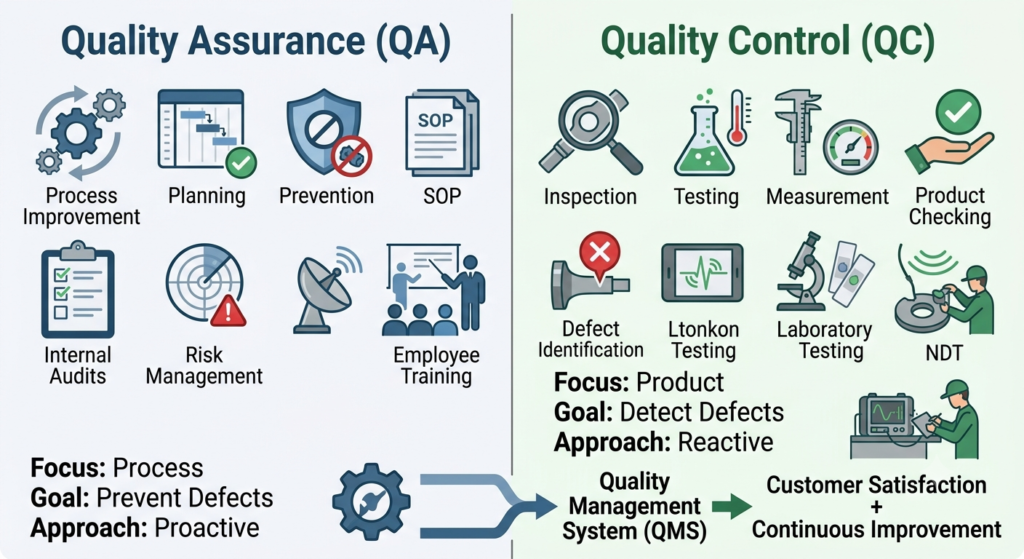
Although QA and QC have different objectives and methods, they share several important characteristics:
- Both aim to deliver high-quality products and services.
- Both support customer satisfaction.
- Both contribute to organizational success.
- Both rely on documented procedures and standards.
- Both promote compliance with regulations and industry requirements.
- Both generate valuable data for continuous improvement.
- Both are essential components of a Quality Management System (QMS).
- Both help reduce costs associated with defects, rework, and customer complaints.
- Both require collaboration across departments, including management, engineering, production, procurement, and operations.
- Both contribute to building trust with customers, stakeholders, and regulatory bodies.
Why Both Quality Assurance and Quality Control Matter
Quality Assurance and Quality Control are most effective when implemented together rather than treated as separate functions. QA establishes robust processes designed to prevent errors, while QC verifies that the outputs of those processes meet the required quality standards.
For example, in a manufacturing environment, QA ensures that production procedures, equipment calibration, employee training, and supplier management are all in place before production begins. QC then inspects raw materials, monitors production outputs, performs product testing, and confirms that finished goods meet customer specifications.
Without QA, organizations risk producing inconsistent results due to weak or poorly controlled processes. Without QC, defects may go undetected and reach customers, resulting in complaints, returns, warranty claims, and reputational damage.
When QA and QC work together as part of an integrated Quality Management System, organizations can achieve higher efficiency, lower costs, improved compliance, greater customer satisfaction, and long-term business success.
QA vs Quality Control Across Different Industries
Although the principles of Quality Assurance and Quality Control remain the same, their implementation varies across industries depending on products, services, regulations, customer expectations, and operational risks. Organizations tailor their quality management systems to meet industry-specific requirements while maintaining consistent quality standards.
Manufacturing Industry
Manufacturing organizations rely heavily on QA and QC to produce products that meet design specifications and customer requirements.
Quality Assurance focuses on establishing standardized production processes, developing work instructions, qualifying suppliers, calibrating machinery, training employees, implementing preventive maintenance programmes, and conducting internal audits. These activities help reduce process variation and prevent production errors.
Quality Control involves inspecting incoming raw materials, monitoring products during manufacturing, measuring dimensions, performing functional tests, checking product appearance, and conducting final inspections before shipment. Any product that fails inspection is repaired, reworked, or rejected.
Example:
A company manufacturing industrial pumps creates detailed production procedures, trains technicians, and qualifies suppliers before production begins. During manufacturing, inspectors verify dimensions, pressure performance, and leakage to ensure every pump meets specifications.
Mechanical Engineering
Mechanical engineering projects require strict quality management because equipment often operates under demanding conditions involving pressure, temperature, vibration, and mechanical loads.
Quality Assurance includes:
- Reviewing engineering drawings
- Preparing Inspection and Test Plans (ITPs)
- Approving welding procedures
- Qualifying welders
- Calibrating measuring instruments
- Reviewing material certifications
- Monitoring fabrication procedures
Quality Control includes:
- Material inspection
- Dimensional verification
- Welding inspection
- Non-Destructive Testing (NDT)
- Pressure testing
- Functional testing
- Final acceptance inspection
Example:
During pressure vessel fabrication, QA ensures qualified welding procedures and approved materials are used. QC performs radiographic testing, ultrasonic testing, hydrostatic testing, and dimensional inspections before delivery.
Civil Engineering
Civil engineering projects involve roads, bridges, tunnels, dams, airports, and buildings where structural integrity is critical.
Quality Assurance activities include:
- Reviewing design calculations
- Verifying contractor competence
- Developing construction quality plans
- Approving construction methodologies
- Auditing project documentation
- Supplier evaluation
- Material approval
Quality Control activities include:
- Soil testing
- Concrete slump tests
- Concrete compressive strength tests
- Reinforcement inspection
- Asphalt density testing
- Survey verification
- Structural inspections
Example:
During bridge construction, QA develops quality procedures and approves suppliers. QC performs concrete cube testing, reinforcement inspections, and structural measurements before approving each construction stage.
Construction Industry
Construction projects involve multiple contractors, materials, equipment, and stakeholders, making quality management essential.
Quality Assurance includes planning activities before construction begins, such as reviewing contract requirements, approving construction methods, preparing quality documentation, verifying subcontractor qualifications, and conducting internal audits.
Quality Control focuses on daily inspections including:
- Excavation inspection
- Reinforcement verification
- Concrete testing
- Structural alignment
- Finishing inspections
- Material verification
- Final handover inspection
Construction quality management ensures buildings remain safe, durable, and compliant throughout their design life.
Oil and Gas Industry
The oil and gas sector demands extremely high quality standards because equipment failures may cause environmental damage, production losses, injuries, or fatalities.
Quality Assurance focuses on:
- Supplier qualification
- Material traceability
- Procedure qualification
- Personnel certification
- Risk assessment
- Equipment calibration
- Documentation control
Quality Control includes:
- Welding inspection
- NDT
- Pressure testing
- Coating inspection
- Valve testing
- Material identification
- Pipeline inspection
Example:
Before pipeline installation, QA develops quality procedures and approves contractors. QC inspects welds using ultrasonic testing and verifies coating thickness before commissioning.
Pharmaceutical Industry
The pharmaceutical industry operates under strict regulatory requirements to ensure medicines remain safe and effective.
Quality Assurance ensures compliance with Good Manufacturing Practices (GMP), validates manufacturing processes, controls documentation, qualifies equipment, trains employees, and manages deviations.
Quality Control performs:
- Raw material testing
- Chemical analysis
- Microbiological testing
- Stability testing
- Batch testing
- Packaging inspection
- Product release testing
Both QA and QC protect patient safety while maintaining regulatory compliance.
Food Industry
Food manufacturers implement QA and QC to protect consumers and comply with food safety regulations.
Quality Assurance activities include:
- Supplier approval
- Hygiene procedures
- HACCP implementation
- Staff training
- Cleaning validation
- Risk assessment
- Process monitoring
Quality Control activities include:
- Raw material inspection
- Microbiological testing
- Moisture testing
- Temperature monitoring
- Packaging inspection
- Shelf-life testing
- Final product inspection
These practices help prevent contamination while ensuring consistent product quality.
Healthcare Industry
Healthcare organizations must consistently provide safe, reliable, and patient-centred services.
Quality Assurance focuses on:
- Clinical protocols
- Staff competency
- Infection prevention
- Patient safety systems
- Equipment maintenance
- Policy development
- Internal audits
Quality Control includes:
- Laboratory testing
- Equipment calibration
- Medication verification
- Patient identification checks
- Clinical record reviews
- Diagnostic testing
- Performance monitoring
Both approaches improve patient outcomes while reducing clinical risks.
Software Development
Although software products differ from physical goods, quality management principles remain applicable.
Quality Assurance includes:
- Software development methodologies
- Coding standards
- Design reviews
- Version control
- Security guidelines
- Risk management
- Continuous integration
Quality Control includes:
- Unit testing
- Integration testing
- System testing
- User acceptance testing
- Performance testing
- Security testing
- Bug verification
Modern software organizations integrate QA and QC throughout the development lifecycle.
How Quality Assurance and Quality Control Work Together
Many people mistakenly believe organizations must choose between QA and QC. In reality, successful organizations integrate both approaches into a single Quality Management System.
Quality Assurance creates the foundation by designing reliable processes, establishing standards, and preventing defects before work begins. Quality Control then verifies that products or services produced through those processes meet all specified requirements.
Consider a construction project as an example. Before any concrete is poured, QA activities include approving suppliers, reviewing mix designs, preparing inspection plans, and training workers. During construction, QC inspectors perform slump tests, reinforcement inspections, and concrete strength tests to confirm compliance with project specifications.
Without QA, poor planning and inconsistent processes increase the likelihood of defects. Without QC, defective work may remain undetected until after completion, resulting in costly repairs or safety issues. Together, QA and QC provide a balanced approach that improves quality, reduces risk, and increases customer confidence.
Common Tools Used in Quality Assurance
Quality Assurance professionals use various tools to improve processes and prevent defects.
Some of the most widely used tools include:
- Process Flowcharts
- Standard Operating Procedures (SOPs)
- Quality Manuals
- Risk Assessment Matrices
- Internal Audit Checklists
- Failure Mode and Effects Analysis (FMEA)
- Root Cause Analysis
- Corrective and Preventive Action (CAPA)
- Process Mapping
- PDCA (Plan-Do-Check-Act) Cycle
- Statistical Process Control (SPC)
- Quality Management Software
These tools help organizations establish standardized processes, identify potential risks, and drive continual improvement.
Common Tools Used in Quality Control
Quality Control professionals rely on inspection and testing tools to verify product quality.
Common QC tools include:
- Vernier Calipers
- Micrometers
- Coordinate Measuring Machines (CMM)
- Pressure Gauges
- Hardness Testers
- Surface Roughness Testers
- Ultrasonic Testing Equipment
- Radiographic Testing Equipment
- Magnetic Particle Testing
- Dye Penetrant Testing
- Tensile Testing Machines
- Compression Testing Machines
- Laboratory Testing Equipment
Statistical quality tools are also widely used, including:
- Check Sheets
- Histograms
- Pareto Charts
- Scatter Diagrams
- Cause-and-Effect (Fishbone) Diagrams
- Control Charts
- Sampling Plans
These tools enable organizations to identify defects, monitor quality trends, and make data-driven decisions.
Essential QA and QC Documentation
Effective documentation is fundamental to a successful Quality Management System. Accurate records ensure consistency, traceability, accountability, and compliance with customer and regulatory requirements.
Typical Quality Assurance documents include:
- Quality Policy
- Quality Objectives
- Quality Manual
- Standard Operating Procedures (SOPs)
- Inspection and Test Plans (ITPs)
- Risk Assessments
- Method Statements
- Audit Reports
- Training Records
- Supplier Evaluation Records
- CAPA Reports
- Document Control Registers
Typical Quality Control records include:
- Inspection Reports
- Material Receiving Reports
- Test Certificates
- Calibration Certificates
- Laboratory Reports
- Non-Conformance Reports (NCRs)
- Punch Lists
- Acceptance Reports
- Product Release Records
- Final Inspection Reports
Maintaining complete and accurate documentation supports transparency, facilitates audits, and provides evidence that quality requirements have been met.
International Standards Supporting QA and QC
Many organizations adopt internationally recognised standards to strengthen their quality management practices and demonstrate commitment to consistent quality.
ISO 9001
ISO 9001 is the world’s most widely adopted Quality Management System standard. It provides a structured framework for establishing quality policies, managing processes, monitoring performance, and driving continual improvement. Both Quality Assurance and Quality Control play important roles in meeting ISO 9001 requirements.
ISO 17025
ISO/IEC 17025 specifies the competence requirements for testing and calibration laboratories. It ensures laboratory results are accurate, reliable, and technically valid through controlled processes and verified testing activities.
Good Manufacturing Practices (GMP)
GMP is widely applied in pharmaceutical, food, and medical device industries. It requires organizations to implement robust Quality Assurance systems while carrying out Quality Control testing to ensure products are safe, effective, and consistently manufactured.
Six Sigma
Six Sigma is a data-driven improvement methodology that aims to reduce process variation and defects. It uses statistical analysis to improve process capability and supports both preventive quality assurance and defect reduction.
Lean Manufacturing
Lean focuses on eliminating waste, improving efficiency, and creating value for customers. When combined with QA and QC, Lean helps organizations streamline operations, reduce costs, and improve product quality.
Best Practices for Effective Quality Assurance and Quality Control
Organizations that consistently achieve high quality share several common practices.
- Establish clear quality objectives aligned with business goals.
- Develop standardized procedures for all critical activities.
- Train employees regularly to maintain competency.
- Conduct periodic internal and external audits.
- Qualify suppliers based on quality performance.
- Calibrate inspection and testing equipment on schedule.
- Use risk-based thinking to prevent potential problems.
- Analyse quality data to identify trends and improvement opportunities.
- Encourage open communication and employee involvement.
- Implement corrective and preventive actions promptly.
- Review the effectiveness of the Quality Management System regularly.
- Foster a culture where quality is everyone’s responsibility rather than the responsibility of a single department.
Organizations that integrate these best practices into daily operations are more likely to achieve consistent performance, enhance customer satisfaction, comply with regulatory requirements, and maintain a strong competitive advantage.
In today’s highly competitive business environment, Quality Assurance and Quality Control should not be viewed as isolated activities. Instead, they should function together as complementary components of an integrated Quality Management System that supports operational excellence, continuous improvement, and long-term organizational success.
Career Opportunities in Quality Assurance and Quality Control
As industries continue to prioritize quality, safety, and regulatory compliance, the demand for skilled Quality Assurance (QA) and Quality Control (QC) professionals continues to grow. Organizations across manufacturing, construction, engineering, healthcare, pharmaceuticals, food production, aerospace, automotive, oil and gas, and software development rely on qualified professionals to maintain high standards and improve business performance.
While both fields focus on quality, career paths differ based on responsibilities. QA professionals typically develop and improve quality systems, whereas QC professionals inspect, test, and verify products or services.
Some of the most common career opportunities include:
- Quality Assurance Engineer
- Quality Control Engineer
- QA/QC Engineer
- Quality Assurance Manager
- Quality Control Manager
- Quality Manager
- Quality Inspector
- Quality Auditor
- Supplier Quality Engineer
- Manufacturing Quality Engineer
- Process Improvement Specialist
- Reliability Engineer
- Compliance Officer
- Laboratory Quality Analyst
- Testing Engineer
- Validation Engineer
- Inspection Engineer
- Continuous Improvement Manager
These professionals play a vital role in helping organizations improve product quality, reduce operational risks, achieve customer satisfaction, and comply with international standards.
Skills Required for QA and QC Professionals
Success in Quality Assurance and Quality Control requires a combination of technical knowledge, analytical thinking, communication skills, and problem-solving abilities.
Key technical skills include:
- Understanding Quality Management Systems (QMS)
- Knowledge of ISO standards
- Inspection and testing techniques
- Statistical analysis
- Root Cause Analysis
- Risk assessment
- Process improvement methodologies
- Documentation management
- Internal auditing
- Calibration principles
- Quality planning
- Data analysis
Equally important are soft skills such as:
- Attention to detail
- Critical thinking
- Communication
- Leadership
- Teamwork
- Decision-making
- Time management
- Report writing
- Problem-solving
- Continuous learning
Professionals who combine strong technical expertise with excellent interpersonal skills are often well-positioned for leadership roles within quality management.
Certifications That Can Advance Your Career
Professional certifications demonstrate competence, enhance credibility, and improve career prospects in the quality field. Employers often value certified professionals because they possess recognized knowledge of quality principles and best practices.
Popular certifications include:
- ISO 9001 Quality Management System Lead Auditor
- ISO 9001 Internal Auditor
- Certified Quality Engineer (CQE)
- Certified Quality Auditor (CQA)
- Certified Manager of Quality/Organizational Excellence (CMQ/OE)
- Six Sigma Yellow Belt
- Six Sigma Green Belt
- Six Sigma Black Belt
- Lean Practitioner Certification
- Quality Management Diploma
- QA/QC Engineering Certifications
- Non-Destructive Testing (NDT) Certifications
- Welding Inspection Certifications
- Laboratory Quality Management Certifications
Selecting the right certification depends on your industry, experience level, and long-term career goals.
Future Trends in Quality Assurance and Quality Control
The field of quality management continues to evolve as organizations adopt new technologies and respond to changing customer expectations.
Some of the most significant trends include:
Artificial Intelligence (AI)
AI-powered quality systems can analyze large volumes of production data, identify patterns, predict equipment failures, and detect anomalies with greater speed and accuracy.
Automation
Automated inspection systems using robotics and machine vision improve inspection consistency while reducing human error.
Internet of Things (IoT)
Connected sensors continuously monitor equipment performance, environmental conditions, and production processes, allowing organizations to identify potential issues before they become defects.
Data Analytics
Advanced analytics enables organizations to make evidence-based decisions, monitor quality performance, and improve process capability.
Digital Quality Management Systems
Cloud-based QMS platforms improve document control, audit management, corrective actions, and collaboration across multiple locations.
Sustainability
Organizations increasingly integrate quality management with environmental responsibility, waste reduction, and sustainable manufacturing practices.
Predictive Quality
Instead of simply identifying defects, organizations are using predictive analytics to anticipate quality issues and implement preventive actions before problems occur.
Professionals who remain informed about these emerging technologies will be better prepared for the future of quality management.
Conclusion
Quality Assurance and Quality Control are fundamental components of an effective Quality Management System. Although they are often mentioned together, they serve distinct yet complementary purposes. Quality Assurance focuses on building reliable processes that prevent defects, while Quality Control verifies that products and services meet specified requirements through inspection and testing.
Organizations that integrate both approaches benefit from improved efficiency, reduced waste, enhanced compliance, greater customer satisfaction, and stronger business performance. Whether producing manufactured goods, constructing infrastructure, developing software, delivering healthcare services, or providing professional services, combining proactive quality assurance with effective quality control creates a culture of continuous improvement and operational excellence.
For professionals, understanding the differences between QA and QC is essential for career development. As industries continue to adopt advanced technologies, digital quality systems, and data-driven decision-making, skilled quality professionals will remain in high demand. Investing in quality knowledge, practical experience, and professional certifications can open the door to rewarding career opportunities across a wide range of industries.
Ultimately, quality is not achieved through inspection alone or by documentation alone—it is the result of well-designed processes, competent people, continuous monitoring, and a shared commitment to excellence. By implementing both Quality Assurance and Quality Control effectively, organizations can consistently deliver products and services that meet customer expectations, comply with international standards, and support long-term success.