
Fire Safety Responsibilities of Managing Agents and Property Managers
Managing agents and property managers play an important role in maintaining safe residential, commercial and mixed-use buildings. Their responsibilities extend beyond arranging property maintenance and responding to tenant concerns. They may also have significant responsibilities for managing fire risks, coordinating inspections, maintaining fire protection systems, communicating safety information and ensuring that appropriate corrective actions are completed.
Understanding the Fire Safety Responsibilities of Managing Agents and Property Managers is essential for professionals responsible for managing buildings across the UK. Effective fire safety management helps protect residents, employees, visitors and contractors while supporting compliance with relevant fire safety requirements.
However, appointing a managing agent does not automatically transfer every legal responsibility from a landlord or building owner. The actual responsibilities depend on the nature of the premises, the level of control exercised, contractual arrangements and the applicable legislation.
This guide explains the UK requirements for fire safety responsibilities of managing agents and property managers, including their legal position, operational duties, fire risk assessments, maintenance activities, record keeping and coordination with other responsible parties.
What are the Fire Safety Responsibilities of Managing Agents and Property Managers?
Fire safety responsibilities of managing agents and property managers refer to the duties and activities involved in identifying, controlling and monitoring fire risks within buildings under their management or control.
Managing agents may act on behalf of landlords, freeholders, residents’ management companies or commercial property owners. Their role often includes coordinating fire safety arrangements, appointing competent contractors, arranging inspections, monitoring maintenance and ensuring that identified fire safety problems receive appropriate attention.
Depending on their actual control and responsibilities, managing agents may also have direct legal duties under applicable fire safety legislation.
The main responsibilities generally include:
- Arranging and coordinating suitable fire risk assessments.
- Ensuring that relevant fire safety recommendations are addressed.
- Monitoring fire detection and alarm systems.
- Coordinating the inspection and maintenance of fire doors.
- Keeping communal escape routes clear and accessible.
- Arranging appropriate emergency lighting inspections.
- Coordinating fire safety equipment maintenance.
- Maintaining relevant fire safety documentation.
- Communicating fire safety information to residents and occupants.
- Monitoring contractors carrying out fire safety work.
- Reviewing outstanding fire safety issues and corrective actions.
- Supporting emergency preparedness and evacuation arrangements.
The main objective is to ensure that fire safety is actively managed rather than treated as a one-time compliance exercise.
Who is Legally Responsible for Fire Safety in Managed Properties?
One of the most important aspects of fire safety management is identifying the legally responsible parties. In the UK, the person or organisation responsible for fire safety depends on the building’s legal status, the activities taking place and who has control over the relevant premises or areas.
Under the Regulatory Reform (Fire Safety) Order 2005, the Responsible Person is generally the employer, person with control of the premises or owner, depending on the circumstances. More than one Responsible Person can have duties in the same building.
A managing agent may become a Responsible Person where they have sufficient control over relevant premises. However, performing administrative tasks or arranging contractors does not automatically make an agent the Responsible Person.
Responsibilities of Landlords and Freeholders
Landlords and freeholders may retain significant responsibilities for fire safety, particularly where they control building structures, communal facilities or fire protection arrangements.
Their responsibilities may include:
- Ensuring that appropriate fire safety arrangements are established.
- Providing resources for necessary fire safety improvements.
- Addressing structural fire safety defects.
- Cooperating with other responsible parties.
- Ensuring that relevant contractual arrangements support effective fire safety management.
Responsibilities of Managing Agents
Managing agents may have delegated responsibilities under management agreements and may also have direct legal duties where they exercise relevant control.
Their activities may include arranging assessments, coordinating maintenance, monitoring contractors, managing communal areas and reporting significant fire safety problems to property owners.
Responsibilities of Property Managers
Property managers generally oversee the day-to-day operation of buildings. They may coordinate inspections, monitor escape routes, communicate with occupants and follow up on identified hazards.
Their legal responsibilities depend on their actual role and control, not simply their job title.
Responsibilities of Tenants and Residents
Residents and tenants also contribute to building fire safety by following applicable safety instructions, avoiding obstruction of escape routes, reporting defects and using building facilities responsibly.
Fire Safety Responsibility Matrix
| Responsible party | Typical responsibilities |
|---|---|
| Landlord or freeholder | Building ownership, resources, structural responsibilities and applicable fire safety duties |
| Managing agent | Coordinating management activities, inspections, contractors and corrective actions within their authority |
| Property manager | Monitoring daily conditions, reporting hazards and following up on maintenance |
| Fire safety contractor | Carrying out agreed inspection, testing and maintenance work competently |
| Residents and tenants | Following safety arrangements and reporting hazards |
| Employer or business occupier | Managing workplace fire safety duties where applicable |
These responsibilities may overlap. The actual allocation must be established through applicable legislation, property control arrangements, leases and management agreements.
Understanding UK Fire Safety Laws and Regulations
Managing agents and property managers should understand the legislation relevant to the buildings they manage. The UK does not have one identical fire safety framework for every nation.
The regulatory position differs between England and Wales, Scotland and Northern Ireland. Consequently, property management professionals should identify the relevant national requirements before arranging compliance activities.
Regulatory Reform (Fire Safety) Order 2005
The Regulatory Reform (Fire Safety) Order 2005 is the principal fire safety legislation applying to non-domestic premises in England and Wales, including relevant common areas of multi-occupied residential buildings.
It establishes responsibilities for the Responsible Person and other relevant dutyholders.
Important requirements include:
- Carrying out a suitable and sufficient fire risk assessment.
- Implementing appropriate fire safety precautions.
- Maintaining relevant fire protection measures.
- Providing appropriate fire safety information and training.
- Establishing suitable emergency procedures.
- Cooperating and coordinating with other responsible parties.
Managing agents should understand which duties apply to their areas of control and ensure that delegated arrangements are properly implemented.
Fire Safety Act 2021
The Fire Safety Act 2021 clarified the scope of the Fire Safety Order in relation to the external walls of relevant multi-occupied residential buildings, including doors between domestic premises and common parts.
This is particularly important for managing agents responsible for residential blocks.
Property managers should ensure that relevant fire risk assessments consider applicable building elements and that identified issues are escalated to the appropriate responsible parties.
Building Safety Act 2022
The Building Safety Act 2022 introduced a wider building safety framework, including additional requirements for higher-risk buildings in England.
Property management professionals involved with relevant buildings should understand the relationship between fire safety management, building safety responsibilities, information management and cooperation with other dutyholders.
Fire Safety (England) Regulations 2022
These regulations introduced additional fire safety requirements for relevant residential buildings in England.
Depending on building characteristics, requirements may include:
- Providing information to residents about fire doors.
- Conducting checks of fire doors in relevant buildings.
- Providing information to fire and rescue services.
- Providing and maintaining building plans.
- Providing external wall information.
- Installing and maintaining relevant wayfinding signage.
Managing agents should determine which requirements apply to the properties they manage rather than assuming that every requirement applies to every residential building.
Differences Across the UK
| UK nation | Relevant fire safety framework |
|---|---|
| England | Regulatory Reform (Fire Safety) Order 2005, Fire Safety Act 2021 and relevant subsequent regulations |
| Wales | Regulatory Reform (Fire Safety) Order 2005 and applicable Welsh requirements |
| Scotland | Fire (Scotland) Act 2005 and Fire Safety (Scotland) Regulations 2006 |
| Northern Ireland | Fire and Rescue Services (Northern Ireland) Order 2006 and Fire Safety Regulations (Northern Ireland) 2010 |
For more information, read our guide to Fire Safety Regulations in England, Wales, Scotland and Northern Ireland: Key Differences.
Property managers should consult the relevant national guidance and competent fire safety professionals when determining the requirements applicable to a particular building.
Key Fire Safety Responsibilities of Managing Agents and Property Managers
Managing agents and property managers should establish a structured approach to fire safety management. This involves identifying potential hazards, arranging appropriate preventive measures, monitoring building conditions and ensuring that problems are resolved.
The following responsibilities are particularly important when managing residential, commercial and mixed-use properties.
Arranging and Managing Fire Risk Assessments

A fire risk assessment is a fundamental part of fire safety management. It identifies potential fire hazards, evaluates risks to people and establishes the measures required to reduce those risks.
Managing agents should arrange suitable fire risk assessments where required and ensure that the assessment is carried out by a competent person.
Their responsibilities may include:
- Identifying the premises and areas requiring assessment.
- Providing the assessor with relevant building information.
- Arranging access to communal areas and relevant facilities.
- Sharing information about previous fire incidents and known defects.
- Reviewing the completed assessment.
- Ensuring that significant findings are communicated to relevant parties.
- Coordinating corrective actions.
- Monitoring outstanding recommendations.
A fire risk assessment should not simply be filed away after completion. Managing agents should establish a system for reviewing recommendations and confirming that appropriate action has been taken.
Implementing Fire Risk Assessment Recommendations
One of the most important responsibilities is ensuring that identified fire safety issues are addressed.
For example, an assessment may identify damaged fire doors, inadequate emergency lighting, blocked escape routes or defects in fire separation.
Managing agents should:
- Record each identified issue.
- Assess its significance and urgency.
- Allocate responsibility for corrective action.
- Arrange competent contractors where required.
- Monitor progress and completion dates.
- Retain supporting evidence.
- Escalate unresolved or serious issues.
A recommendation should only be marked as completed when the required corrective work has been verified.
Maintaining Fire Detection and Alarm Systems
Fire detection and alarm systems help occupants identify fire emergencies and take appropriate action. Managing agents should ensure that relevant fire detection and alarm systems are appropriately inspected, tested and maintained according to the building’s fire risk assessment, system design and applicable standards.
Typical management activities include:
- Arranging servicing by competent specialists.
- Coordinating routine testing where applicable.
- Recording faults and maintenance activities.
- Responding promptly to reported alarm problems.
- Ensuring that repairs are completed.
- Reviewing service reports.
- Arranging appropriate temporary safety measures when a system is impaired.
Property managers should never assume that a fire alarm is functioning correctly simply because no fault has been reported.
Inspecting and Maintaining Fire Doors
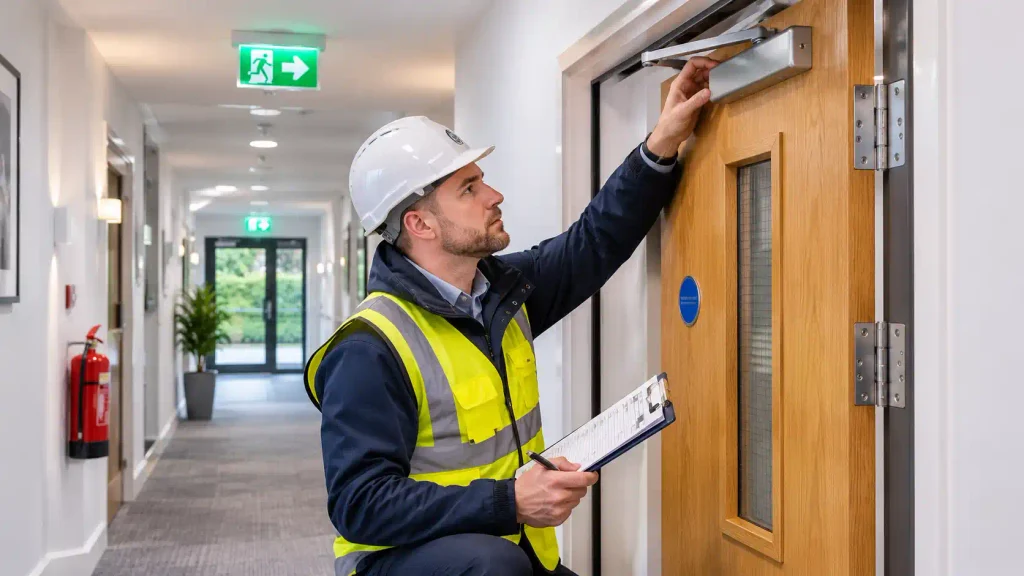
Fire doors help restrict the spread of fire and smoke, protect escape routes and support the building’s fire compartmentation strategy. Managing agents responsible for relevant communal areas should ensure that fire doors are appropriately inspected and maintained.
Important inspection considerations include:
- Door condition and visible damage.
- Door closers and closing mechanisms.
- Hinges and ironmongery.
- Seals and intumescent strips.
- Gaps around the door.
- Latches and locking arrangements.
- Signs of unauthorised alterations.
- Obstructions preventing doors from closing.
Where defects are identified, managing agents should arrange appropriate assessment and repair by competent professionals. They should also communicate with residents about the importance of keeping fire doors closed where required and avoiding unauthorised modifications.
Keeping Escape Routes Clear and Accessible
Escape routes must remain suitable and available for occupants to use during an emergency. Managing agents should monitor communal corridors, staircases, entrances, exits and other designated escape routes.
Common issues include:
- Furniture and personal belongings in corridors.
- Bicycles and pushchairs obstructing escape routes.
- Waste materials stored near exits.
- Damaged emergency exit doors.
- Inadequate access to escape staircases.
- Poorly maintained external escape routes.
Property managers should arrange regular checks and take appropriate action when obstructions are identified.
Important: Evacuation arrangements must be appropriate for the specific building. A stay-put strategy may be appropriate in some purpose-built residential blocks, while other buildings require different arrangements. Managing agents should not introduce alternative evacuation instructions without an appropriate assessment and competent advice.
Coordinating Emergency Lighting Maintenance
Emergency lighting supports safe evacuation when normal lighting fails. Managing agents should ensure that relevant emergency lighting systems receive appropriate inspection, testing and maintenance.
Their responsibilities may include:
- Arranging scheduled inspections.
- Coordinating functional and duration testing as applicable.
- Recording identified defects.
- Monitoring battery and lighting failures.
- Arranging repairs.
- Retaining maintenance documentation.
Emergency lighting should be considered as part of the building’s overall fire safety arrangements rather than an isolated maintenance item.
Managing Fire Extinguishers and Other Fire Protection Equipment
Some managed premises require fire extinguishers, fire blankets, hose reels or other firefighting equipment. Managing agents should establish which equipment is required based on the premises, fire risk assessment and applicable arrangements.
They should coordinate appropriate inspections, servicing and replacement where necessary. Equipment should remain accessible, clearly identified and suitable for its intended purpose.
Property managers should also avoid placing firefighting equipment in locations where it obstructs escape routes or creates additional hazards.
Coordinating Fire Safety Contractors
Managing agents frequently work with specialist contractors to maintain building fire safety systems.
These contractors may include:
- Fire risk assessors.
- Fire alarm maintenance specialists.
- Emergency lighting contractors.
- Fire door inspection professionals.
- Passive fire protection specialists.
- Fire extinguisher servicing providers.
- Fire stopping and compartmentation contractors.
Managing agents should check that contractors have suitable competence, experience and insurance for the work being undertaken. They should also establish clear arrangements for access, work supervision, reporting, defect escalation and completion verification.
Communicating Fire Safety Information to Residents
Effective communication is essential because residents and occupants need to understand the fire safety arrangements applicable to their building.
Managing agents should communicate relevant information about:
- Building evacuation arrangements.
- Fire door safety.
- Reporting fire hazards.
- Keeping communal areas clear.
- Fire alarm arrangements.
- Emergency contact procedures.
- Relevant building safety information.
Communication should be accessible and appropriate for the occupants, including people who may require additional assistance to understand or follow emergency arrangements.
Managing Fire Safety During Building Maintenance and Refurbishment
Maintenance and refurbishment work can introduce additional fire risks. Examples include hot works, temporary electrical installations, damaged fire protection systems, open service penetrations and changes to building layouts.
Managing agents should ensure that relevant work is properly planned and that appropriate fire precautions are established. Where work affects fire compartmentation, escape routes, alarm systems or other protective measures, the relevant responsible parties should assess the implications before work begins.
How to Manage Fire Safety Responsibilities: A Practical Workflow
A structured workflow helps managing agents maintain oversight of fire safety activities and ensures that identified problems are not overlooked.
Fire Safety Management Process
Figure: A continuous fire safety management workflow for property managers.
This process should operate continuously. Fire safety management does not end when an inspection or maintenance visit is completed.
Fire Safety Responsibilities in Different Types of Properties
The responsibilities of managing agents can vary depending on the type of building and its occupancy arrangements.
Residential Blocks and Apartment Buildings
Residential buildings often contain shared spaces, communal facilities and multiple domestic premises.
Managing agents may coordinate fire safety activities involving:
- Communal corridors and staircases.
- Shared entrances and exits.
- Fire doors in common areas.
- Fire detection and alarm arrangements.
- Emergency lighting.
- Fire separation and compartmentation.
- Resident safety communication.
- Relevant building information.
In England, additional requirements may apply to relevant residential buildings under the Fire Safety (England) Regulations 2022.
Houses in Multiple Occupation
Houses in Multiple Occupation (HMOs) may have specific fire safety considerations because multiple households share facilities and common areas.
Managing agents should understand the relevant requirements, including applicable housing standards, licensing conditions and fire safety arrangements.
They may need to coordinate:
- Suitable fire detection arrangements.
- Escape route management.
- Fire doors where required.
- Emergency lighting where appropriate.
- Fire safety information for occupants.
- Maintenance of communal facilities.
The precise requirements depend on the property, occupancy, applicable legislation and local authority conditions.
Commercial Buildings
Commercial properties may contain offices, shops, warehouses and other workplaces.
Managing agents may coordinate building-level fire safety arrangements while employers and occupiers retain their own responsibilities for activities within their control.
Important considerations include:
- Fire alarm systems.
- Escape routes and exit access.
- Emergency lighting.
- Fire protection equipment.
- Contractor activities.
- Fire safety information.
- Coordination between different occupiers.
Mixed-Use Developments
Mixed-use buildings combine residential, commercial and other uses.
They can present additional challenges because different occupants may have different activities, access arrangements and emergency procedures.
Managing agents should coordinate relevant fire safety information and ensure that responsible parties cooperate where their duties overlap.
Fire Safety Inspections and Maintenance: What Should Property Managers Monitor?
Regular monitoring helps identify defects before they become more serious problems.
However, not every fire safety activity follows the same inspection frequency. The correct arrangements should be determined by applicable requirements, system specifications, risk assessments and competent professional advice.
Property Manager Fire Safety Inspection Checklist
| Area or equipment | What to monitor | Recommended management action |
|---|---|---|
| Fire doors | Damage, closing mechanisms and visible defects | Arrange inspection and appropriate repairs |
| Escape routes | Obstructions and accessibility | Remove hazards and record findings |
| Fire alarms | Fault indicators and reported problems | Arrange competent servicing and repairs |
| Emergency lighting | Visible defects and test records | Coordinate appropriate testing |
| Fire extinguishers | Accessibility, condition and service status | Arrange inspection and servicing |
| Fire separation | Visible damage or unauthorised openings | Escalate for competent assessment |
| Fire safety signage | Visibility and condition | Arrange replacement where necessary |
| Communal electrical areas | Visible hazards and unsafe storage | Report and arrange appropriate corrective action |
This checklist is a management aid, not a substitute for a formal fire risk assessment or specialist inspection.
Managing Fire Safety Defects
When a fire safety defect is identified, property managers should have a clear process for recording, prioritising, assigning and resolving it.
For example, if a fire door fails to close properly, the property manager should record the defect, assess the immediate implications, notify the relevant responsible party and arrange suitable corrective work.
Where a serious defect affects fire protection or evacuation arrangements, it should be escalated promptly and appropriate interim precautions should be determined by competent persons.
Fire Safety Documentation and Record-Keeping Responsibilities

Maintaining accurate fire safety documentation is an essential part of effective property management. Records help demonstrate that relevant fire safety activities have been arranged, completed and reviewed.
Managing agents should establish a reliable record-management process that identifies important documents, responsible individuals, inspection dates, outstanding actions and completion evidence.
Essential Fire Safety Records
The following records may be relevant, depending on the property and applicable legal requirements:
- Current fire risk assessment.
- Previous fire risk assessments and review records.
- Fire safety action plans.
- Fire alarm inspection and maintenance reports.
- Emergency lighting test records.
- Fire door inspection reports.
- Fire extinguisher servicing records.
- Fire safety equipment maintenance documentation.
- Fire safety contractor details.
- Records of identified defects and corrective actions.
- Relevant resident fire safety communications.
- Emergency procedures and evacuation information.
- Records of fire incidents and investigations.
- Relevant building plans and fire safety information.
How to Maintain an Effective Fire Safety Record System
Property managers should use an organised system that allows relevant information to be retrieved when needed.
A practical approach includes:
- Create a central fire safety document register.
- Categorise records according to the building and equipment.
- Record inspection and maintenance dates.
- Identify outstanding defects and recommendations.
- Allocate responsibility for each corrective action.
- Retain reports, certificates and supporting evidence.
- Review records regularly.
- Update documentation when building conditions or fire safety arrangements change.
Digital record-management systems can make this process easier by providing reminders, document storage and action-tracking facilities.
However, storing a document does not demonstrate that the identified risks have been addressed. Property managers must ensure that records reflect actual work completed and outstanding issues.
Fire Safety Action Tracking and Accountability
A common weakness in property management is failing to follow up on recommendations identified during inspections and assessments. An effective action-tracking system should identify the problem, explain its significance, assign responsibility and establish a process for verifying completion.
Example Fire Safety Action Register
| Identified issue | Priority | Responsible party | Required action | Status |
|---|---|---|---|---|
| Damaged communal fire door | Risk-based assessment | Managing agent / appointed contractor | Arrange competent inspection and repair | Open |
| Obstructed escape corridor | Immediate attention | Property management team | Remove obstruction and investigate recurrence | Open |
| Fire alarm fault | Urgent assessment | Alarm maintenance contractor | Investigate and restore system operation | In progress |
| Missing fire safety signage | Risk-based assessment | Managing agent | Arrange suitable replacement | Open |
| Defective emergency lighting | Risk-based assessment | Electrical contractor | Investigate and complete repairs | In progress |
The priority assigned to each issue should reflect the actual risk, building arrangements and competent advice rather than a generic ranking.
Managing Fire Safety Problems and Emergencies
Property managers should have arrangements for responding to fire safety problems and supporting emergency preparedness. An effective response process helps ensure that hazards are reported, appropriate people are notified and corrective measures are implemented.
Example: What Should a Property Manager Do When a Fire Alarm Develops a Fault?
Suppose a property manager receives a report that the communal fire alarm system in an apartment building is not functioning correctly.
The manager should:
- Record the reported fault and establish which part of the system is affected.
- Notify the relevant responsible parties.
- Contact the competent alarm maintenance provider.
- Arrange an appropriate assessment and repair.
- Obtain advice on suitable interim fire precautions.
- Communicate relevant safety information to affected occupants.
- Monitor the repair until the system is restored.
- Retain the service report and completion evidence.
The property manager should not independently decide that a defective system can remain out of service without additional precautions.
Fire Safety Incident Management Process
A structured approach to responding to fire safety incidents
Figure: Example fire safety incident response and corrective action process.
If a fire occurs, residents and staff should follow the building’s applicable emergency procedures and the instructions of the fire and rescue service. Property management staff should never delay an emergency call while attempting to investigate or resolve the incident themselves.
Common Fire Safety Mistakes Made by Managing Agents and Property Managers
Even experienced property management professionals can encounter problems when fire safety responsibilities are not properly organised. Recognising common mistakes can help prevent avoidable risks and improve compliance.
Assuming That Appointing a Contractor Transfers All Responsibility
A managing agent may appoint a fire safety contractor to inspect equipment or carry out maintenance. However, appointing a contractor does not automatically remove the legal duties of the relevant Responsible Person. Managing agents should establish clear arrangements for contractor competence, work quality, reporting and corrective action.
Treating Fire Risk Assessments as One-Time Documents
A fire risk assessment should be reviewed when there is reason to believe it is no longer valid or following significant changes, and at appropriate intervals. Changes to building layouts, occupancy, fire protection systems or building use may affect the existing assessment.
Ignoring Fire Safety Recommendations
An inspection report may identify serious defects, but the value of the report is limited if recommendations are not implemented. Managing agents should use action registers and escalation procedures to monitor outstanding work.
Failing to Monitor Communal Areas
Blocked corridors, damaged doors and unsafe storage can undermine fire safety arrangements. Property managers should establish appropriate inspection and reporting procedures for communal spaces.
Poor Communication with Residents
Residents may not understand the building’s fire safety arrangements or know how to report defects. Managing agents should provide relevant, accessible information and communicate significant changes to safety arrangements.
Inadequate Record Keeping
Missing inspection reports, incomplete maintenance records and undocumented corrective actions can make it difficult to demonstrate effective fire safety management. A centralised and regularly updated document register can help prevent these problems.
Not Understanding the Difference Between UK Fire Safety Requirements
The fire safety framework differs between England, Wales, Scotland and Northern Ireland. Managing agents who operate across multiple locations should identify the applicable national legislation rather than relying on one generic compliance procedure.
What Happens When Managing Agents Fail to Meet Fire Safety Responsibilities?
Failure to manage relevant fire safety duties can create serious consequences for residents, building occupants, property owners and management organisations. The consequences depend on the circumstances, applicable legislation, nature of the failure and the responsibilities of the parties involved.
Legal and Enforcement Consequences
Where applicable legal requirements are not met, enforcing authorities may investigate and take appropriate action.
Depending on the circumstances, this may include:
- Formal enforcement notices.
- Requirements to implement corrective measures.
- Restrictions on the use of unsafe premises.
- Prosecution for relevant offences.
- Financial penalties.
- Potential personal liability where an individual has committed an offence.
Increased Risk to Occupants
Poor fire safety management can increase the likelihood of fire spreading, delay evacuation and expose residents, visitors and employees to serious danger.
Examples include defective fire doors, inadequate fire detection arrangements and obstructed escape routes.
Financial and Property Management Consequences
Failure to manage fire safety can result in additional repair costs, emergency contractor expenses, disruption to building operations and potential insurance complications.
It may also damage the reputation of managing agents and reduce confidence among landlords, residents and commercial occupiers.
Increased Professional Accountability
Managing agents and property managers may face scrutiny when they fail to carry out responsibilities within their control.
Maintaining clear records, escalating serious defects and demonstrating appropriate management processes can help establish what actions were taken and when.
How Can Managing Agents Improve Fire Safety Compliance?

Effective fire safety management requires a combination of planning, competent support, communication and continuous monitoring. Managing agents should establish a management framework that makes responsibilities clear and ensures that safety activities are completed consistently.
The following steps provide a practical approach.
Establish Clear Responsibility Arrangements
Identify the Responsible Person and other relevant dutyholders for each property. Review management agreements and establish which activities are delegated to the managing agent, which remain with the owner and which require cooperation with other parties.
Maintain an Updated Fire Safety Management Plan
Develop a property-specific management plan covering assessments, inspections, maintenance, emergency arrangements and corrective actions. The plan should reflect the building’s actual fire risks and applicable requirements.
Appoint Competent Fire Safety Professionals
Use suitably competent specialists for fire risk assessments, system inspections, fire door work and other technical activities. The competence required will depend on the nature and complexity of the work.
Establish an Inspection and Maintenance Programme
Maintain an organised schedule for relevant fire protection systems and communal areas. Use reminders and maintenance registers to reduce the likelihood of missed activities.
Monitor and Verify Corrective Actions
Every significant defect should have an identified owner and a clear resolution process. Property managers should obtain appropriate completion evidence and ensure that unresolved issues are escalated.
Improve Resident and Occupant Communication
Provide understandable information about relevant emergency procedures, fire doors, reporting arrangements and building safety. Where appropriate, review communication arrangements to support residents who may need additional assistance.
Review Fire Safety Arrangements Regularly
Reassess the effectiveness of fire safety management following relevant incidents, building alterations, changes in occupancy and other significant developments.
Fire Safety Continuous Improvement Cycle
Regularly reviewing fire safety arrangements helps property managers identify changing risks, improve preventive measures and maintain effective fire safety management.
Figure: Continuous improvement cycle for fire safety management in managed properties.
Fire Safety Responsibilities Checklist for Managing Agents
The following checklist provides a practical reference for property management professionals who want to improve their building fire safety arrangements.
Property Management Checklist
Use these 16 practical checks to review and monitor fire safety responsibilities within managed properties.
Professional Training and Development for Managing Agents and Property Managers
Managing fire safety responsibilities requires an understanding of building risks, fire protection systems, compliance management and effective coordination with competent professionals.
Property managers, facilities managers, managing agents and building management teams can benefit from professional development that strengthens their understanding of fire safety principles and building risk management.
Training can help professionals develop the knowledge required to identify potential hazards, understand fire protection arrangements, interpret technical information and support effective safety management.
Recommended Fire Safety Courses at Inspire College
Inspire College provides professional learning opportunities for individuals interested in developing their knowledge of fire safety engineering, building risk management and fire protection design.
The following qualifications are particularly relevant to professionals seeking advanced technical knowledge.
Advanced fire safety and building risk management
This qualification is relevant to professionals seeking advanced knowledge of fire safety design, building risks and fire protection management.
ProQual Level 5 Diploma in Fire Engineering Design
This qualification is relevant to learners interested in developing knowledge of fire engineering principles and the design of fire protection solutions.
These qualifications are particularly relevant to individuals seeking technical knowledge and professional development. They should not be presented as automatic authorisation to undertake specialist fire risk assessments or as a substitute for demonstrating role-specific competence.
Why Fire Safety Training Matters
Professional development can help managing agents and property managers:
- Understand fire safety principles and building risks.
- Recognise common fire safety hazards.
- Understand fire protection systems and their functions.
- Improve communication with technical contractors.
- Develop stronger building safety management practices.
- Support effective inspection and maintenance coordination.
- Make more informed decisions about fire safety improvements.
Inspire College encourages property management professionals to develop their knowledge and maintain an ongoing commitment to safe building management.
Conclusion
The fire safety responsibilities of managing agents and property managers extend far beyond arranging routine maintenance. They involve understanding legal responsibilities, coordinating fire risk assessments, maintaining fire protection systems, monitoring communal areas, managing contractors and ensuring that identified risks are addressed.
Effective fire safety management requires clear accountability, suitable documentation, competent professional support and regular monitoring. Managing agents should understand the extent of their control, cooperate with other responsible parties and ensure that their management arrangements reflect the specific risks associated with each property.
Whether managing residential blocks, HMOs, commercial premises or mixed-use developments, property management professionals should treat fire safety as an ongoing responsibility rather than a one-time compliance exercise.
By implementing structured inspection programmes, maintaining accurate records, communicating with occupants and addressing fire safety defects promptly, managing agents can contribute to safer buildings and more effective property management.
Inspire College supports professional development in fire safety, fire engineering and building risk management, helping learners strengthen the knowledge required to contribute to safer built environments.
Authoritative Resources and Further Reading
The following official resources should be consulted when interpreting and applying fire safety requirements:
- GOV.UK – Fire Safety Legislation and Guidance for Those with Legal Duties
- Regulatory Reform (Fire Safety) Order 2005
- Fire Safety Act 2021
- Fire Safety (England) Regulations 2022 Guidance
The article should be reviewed against the latest applicable legislation and official guidance before publication.
Frequently Asked Questions About Fire Safety Responsibilities
Find practical answers about UK fire safety responsibilities, managing agent duties, property management procedures, building inspections and fire safety compliance.
Can a managing agent be legally responsible for fire safety in a UK property?
Yes. A managing agent may have legal fire safety responsibilities where they have control over relevant premises or specific fire safety matters. However, appointment as a managing agent does not automatically make them the Responsible Person.
The legal position depends on the agent’s actual control, contractual arrangements and the duties assigned to them. Property owners, employers, landlords and managing agents may have overlapping responsibilities. Their roles should be clearly established and documented.
What should a managing agent do when a fire risk assessment identifies serious defects?
A managing agent should promptly communicate significant findings to the relevant Responsible Person, record the defects and help coordinate appropriate corrective action. Immediate risks require urgent escalation and suitable interim precautions.
Actions should have assigned owners, realistic deadlines and evidence of completion. Where a serious risk cannot be adequately controlled, competent professional advice and, where necessary, contact with the relevant fire and rescue authority should be considered.
How often should fire safety inspections be carried out in managed residential buildings?
There is no single inspection frequency suitable for every residential building. Inspection schedules should reflect the building’s fire risk assessment, occupancy, fire protection systems, maintenance requirements and applicable legal duties.
Managing agents should establish documented inspection schedules for communal escape routes, fire doors, alarms, emergency lighting and other relevant safety features. Additional inspections may be necessary following complaints, damage, incidents or building alterations.
Are managing agents responsible for maintaining fire doors in apartment buildings?
Managing agents may be responsible for coordinating fire door inspections and repairs where maintenance of the relevant doors falls within their authority or contractual duties.
They should ensure that defects such as damaged seals, faulty closers, missing components and doors that do not close properly are recorded and escalated. Responsibility for individual flat entrance doors and communal fire doors can differ according to ownership, control and the applicable legal framework.
What fire safety records should property managers maintain?
Property managers should maintain accessible and up-to-date records that demonstrate how relevant fire safety responsibilities are being managed. Depending on the building and applicable duties, records may include:
Key records: Fire risk assessments, action plans, fire alarm inspection reports, emergency lighting maintenance records, fire door inspection reports, contractor service certificates, incident reports, resident communications and evidence of completed corrective actions.
Records should be organised, dated and available to the appropriate responsible parties when required.
What are the fire safety responsibilities of managing agents in buildings with multiple owners?
In buildings with multiple owners, fire safety responsibilities may be shared between freeholders, management companies, landlords, employers and appointed managing agents.
The parties should identify who controls communal areas, maintenance contracts, fire protection systems and other relevant safety arrangements. Cooperation, information sharing and clearly documented responsibilities are particularly important where more than one Responsible Person has duties.
Do managing agents need to provide fire safety information to residents?
Managing agents should help ensure residents receive relevant fire safety information in accordance with the building’s arrangements and applicable requirements.
Information may cover evacuation procedures, fire alarm arrangements, reporting hazards, keeping escape routes clear and what residents should do if they discover a fire. In England, specific resident information duties also apply to certain residential buildings under the Fire Safety (England) Regulations 2022.
What should property managers do if a contractor identifies a fire safety fault?
The property manager should obtain the contractor’s findings, record the fault and determine whether it creates an immediate or significant risk. The relevant Responsible Person should be informed promptly.
Where necessary, suitable interim precautions should be arranged, competent contractors should complete corrective work and the repair should be verified. Closing a maintenance job without confirming that the defect has been resolved is not sufficient evidence of effective management.
Does a change in building occupancy require a review of fire safety arrangements?
Yes, a significant change in occupancy can affect fire safety risks and emergency arrangements. Examples include converting a property into multiple residential units, increasing occupancy, introducing vulnerable occupants or changing how communal areas are used.
The relevant fire risk assessment and management arrangements should be reviewed where changes may affect evacuation, escape routes, fire precautions or occupant safety.
Do fire safety requirements differ across England, Wales, Scotland and Northern Ireland?
Yes. Although the UK has common fire safety objectives, the legal frameworks differ between its nations.
The Regulatory Reform (Fire Safety) Order 2005 is the principal fire safety framework for relevant premises in England and Wales. Scotland has its own fire safety legislation, while Northern Ireland operates under separate fire safety legislation and regulations.
Managing agents should identify the property’s location and follow the applicable national requirements rather than assuming that one set of rules applies throughout the UK.
What is the difference between a fire risk assessment and a fire safety inspection?
A fire risk assessment is a systematic evaluation of fire hazards, people at risk and the measures required to prevent fire and protect occupants.
A fire safety inspection is a practical check of particular conditions or equipment, such as fire doors, escape routes, emergency lighting and fire alarm systems. Routine inspections support the implementation of fire safety arrangements but do not automatically replace a suitable and sufficient fire risk assessment.
What professional training can help managing agents improve fire safety management?
Relevant professional development can help property managers understand fire hazards, building risk management, inspection procedures, maintenance coordination and compliance responsibilities.
Specialist learning options include the ProQual Level 6 Diploma in Advanced Fire Safety Design and Building Risk Management and the ProQual Level 5 Diploma in Fire Engineering Design .
The appropriate qualification depends on the learner’s role and experience. Training does not automatically authorise someone to undertake specialist fire risk assessments without the necessary competence.