
Fire Safety Inspection Preparation: Essential Steps to Pass with Confidence
Preparing for a fire safety inspection is not just about ticking boxes or ensuring fire extinguishers are in place. It is about demonstrating a proactive commitment to protecting lives, safeguarding property, and meeting legal obligations under UK fire safety legislation. Whether you manage an office, school, warehouse, hotel, healthcare facility, retail store, or industrial workplace, a well-prepared fire safety inspection can reduce risks, improve business continuity, and help avoid costly enforcement action.
Many organisations only begin preparing when they receive notice of an inspection. However, the most successful businesses treat fire safety as an ongoing responsibility rather than a last-minute task. Fire inspectors assess far more than visible equipment—they evaluate fire risk assessments, maintenance records, staff competence, evacuation procedures, housekeeping standards, and the overall effectiveness of your fire safety management system.
Under the Regulatory Reform (Fire Safety) Order 2005, every non-domestic premises in England and Wales must have a designated Responsible Person who ensures suitable fire safety measures are implemented and maintained. Failure to meet these responsibilities can result in improvement notices, prohibition notices, unlimited fines, prosecution, and in serious cases, imprisonment.
This comprehensive guide explains how to prepare for a fire safety inspection using a practical, step-by-step approach tailored to UK workplaces. You’ll learn what inspectors look for, how to organise documentation, common reasons businesses fail inspections, and how proper preparation supports legal compliance and workplace safety. Whether you are preparing for your first inspection or reviewing your existing fire safety procedures, this guide will help you approach the inspection with confidence.
What is a Fire Safety Inspection?
A fire safety inspection is a systematic evaluation of a building, its fire protection systems, emergency procedures, and management practices to verify compliance with UK fire safety legislation. The inspection aims to identify fire hazards, assess whether suitable control measures are in place, and ensure occupants can safely evacuate in the event of a fire.
Unlike a routine maintenance visit that focuses on servicing individual equipment, a fire safety inspection examines the overall fire safety management of an organisation. Inspectors consider physical fire protection measures alongside documentation, staff awareness, emergency planning, and legal compliance.
Depending on the premises and level of risk, inspections may be carried out by:
- Local Fire and Rescue Authorities
- Approved Fire Safety Inspectors
- Fire Risk Assessors
- Insurance Surveyors
- Independent Fire Safety Consultants
- Health and Safety Auditors
The inspection process is designed to answer several important questions:
- Are fire risks adequately identified and controlled?
- Are occupants protected in case of fire?
- Are emergency escape routes safe and accessible?
- Is fire safety equipment properly maintained?
- Does the organisation comply with current UK legislation?
Passing a fire safety inspection demonstrates that an organisation takes its legal responsibilities seriously while providing a safer environment for employees, visitors, contractors, and customers.
Why Fire Safety Inspections Matter
Many organisations view inspections as regulatory obligations, but their benefits extend far beyond legal compliance. A successful fire safety inspection protects lives, minimises business disruption, strengthens organisational resilience, and builds confidence among employees, clients, insurers, and regulators.
Protecting People
The primary objective of every fire safety inspection is to reduce the likelihood of injury or loss of life. Fires can spread rapidly, especially in workplaces containing combustible materials, electrical equipment, chemicals, or high occupant densities.
Regular inspections help identify hazards before they become emergencies, ensuring that:
- Escape routes remain unobstructed.
- Fire detection systems operate correctly.
- Emergency lighting functions during power failures.
- Fire doors perform as intended.
- Staff understand evacuation procedures.
When these systems work together, occupants can evacuate safely even under challenging conditions.
Ensuring Legal Compliance
UK businesses have a legal duty to maintain appropriate fire safety standards. Fire safety inspections verify whether organisations are meeting these obligations and whether suitable preventive measures are in place.
Failure to comply with fire safety legislation can result in:
- Improvement Notices
- Enforcement Notices
- Prohibition Notices
- Unlimited financial penalties
- Criminal prosecution
- Business closure
- Reputational damage
Maintaining inspection readiness throughout the year significantly reduces these risks.
Supporting Business Continuity
A major fire can halt operations for weeks or even permanently close a business. Fire safety inspections encourage organisations to maintain preventive measures that reduce the likelihood of fire incidents and minimise operational disruption.
Benefits include:
- Reduced downtime
- Lower repair costs
- Improved operational resilience
- Better disaster recovery planning
- Greater customer confidence
Strengthening Insurance Protection
Insurance providers increasingly evaluate an organisation’s fire safety management when assessing risk. Well-maintained fire safety systems, documented inspections, and compliant management practices can positively influence insurance assessments and support claims following an incident.
Demonstrating Corporate Responsibility
Organisations with strong fire safety practices demonstrate a commitment to employee wellbeing, customer protection, and responsible business management. This strengthens stakeholder confidence while supporting broader health and safety objectives.
UK Fire Safety Legislation Every Responsible Person Should Understand
One of the biggest weaknesses found in many online guides is the lack of detailed explanation of UK fire safety law. Understanding the legal framework is essential because fire inspectors assess compliance against legislation—not simply good practice.
The following laws form the foundation of workplace fire safety across the UK.
| Legislation | Primary Purpose | Why It Matters During an Inspection |
|---|---|---|
| Regulatory Reform (Fire Safety) Order 2005 | Places legal responsibility for fire safety on the Responsible Person | Forms the main legal basis for inspections in England and Wales |
| Fire Safety Act 2021 | Clarifies responsibilities for external walls, flat entrance doors, and building structures | Particularly important for multi-occupied residential and mixed-use buildings |
| Building Safety Act 2022 | Introduces enhanced safety responsibilities for higher-risk buildings | Strengthens accountability and building management requirements |
| Health and Safety at Work etc. Act 1974 | Requires employers to protect employees and others from workplace risks | Supports wider workplace safety management, including fire prevention |
| Management of Health and Safety at Work Regulations 1999 | Requires suitable risk assessments and preventive arrangements | Reinforces the importance of documented fire risk management |
Understanding these legal requirements helps organisations move beyond reactive compliance and develop a proactive fire safety culture.
Understanding the Duties of the Responsible Person
The term Responsible Person is central to UK fire safety law. Under the Regulatory Reform (Fire Safety) Order 2005, every non-domestic premises must have someone legally responsible for managing fire safety.
Depending on the organisation, the Responsible Person may be:
- The employer
- The business owner
- The building owner
- The landlord
- The facilities manager
- The managing agent
- Anyone with control over part or all of the premises
Although certain fire safety tasks may be delegated to competent professionals, legal responsibility remains with the Responsible Person.
Core Responsibilities
To successfully prepare for a fire safety inspection, the Responsible Person should ensure the following duties are continuously fulfilled.
Conduct and Review Fire Risk Assessments
Every workplace must have a suitable and sufficient fire risk assessment that identifies hazards, evaluates risks, and recommends appropriate control measures.
The assessment should be reviewed regularly, particularly after:
- Building alterations
- Process changes
- New equipment installation
- Significant staffing changes
- Fire incidents or near misses
An outdated assessment is one of the most common reasons organisations receive enforcement action.
Maintain Fire Safety Equipment
Fire protection systems should remain operational at all times.
This includes:
- Fire alarms
- Emergency lighting
- Fire extinguishers
- Smoke detection systems
- Fire doors
- Sprinkler systems
- Dry risers
- Emergency communication systems
Routine servicing should be completed by competent professionals, with maintenance certificates readily available for inspection.
Keep Escape Routes Safe
Inspectors pay close attention to emergency escape routes because blocked exits significantly increase evacuation risks.
The Responsible Person should ensure:
- Escape routes remain unobstructed.
- Exit doors open easily.
- Fire exit signage is clearly visible.
- Corridors remain free from storage.
- External assembly areas remain accessible.
Even temporary obstructions can result in inspection failures.
Provide Fire Safety Training
Staff must know exactly how to respond during a fire emergency.
Training should cover:
- Fire prevention practices
- Alarm procedures
- Evacuation routes
- Assembly points
- Fire extinguisher awareness
- Reporting fire hazards
Training records should be documented and regularly updated.
Maintain Accurate Fire Safety Documentation
Documentation demonstrates that fire safety measures are actively managed rather than assumed.
Important records include:
- Fire risk assessments
- Equipment servicing certificates
- Fire drill records
- Staff training logs
- Maintenance schedules
- Emergency plans
- Contractor inspection reports
Well-organised documentation often creates a positive first impression during inspections and enables inspectors to verify compliance efficiently.
By understanding the legal responsibilities of the Responsible Person and embedding fire safety into everyday operations, organisations are far better positioned to pass inspections with confidence while creating a safer environment for everyone who enters the workplace.
What Fire Inspectors Check During a Fire Safety Inspection
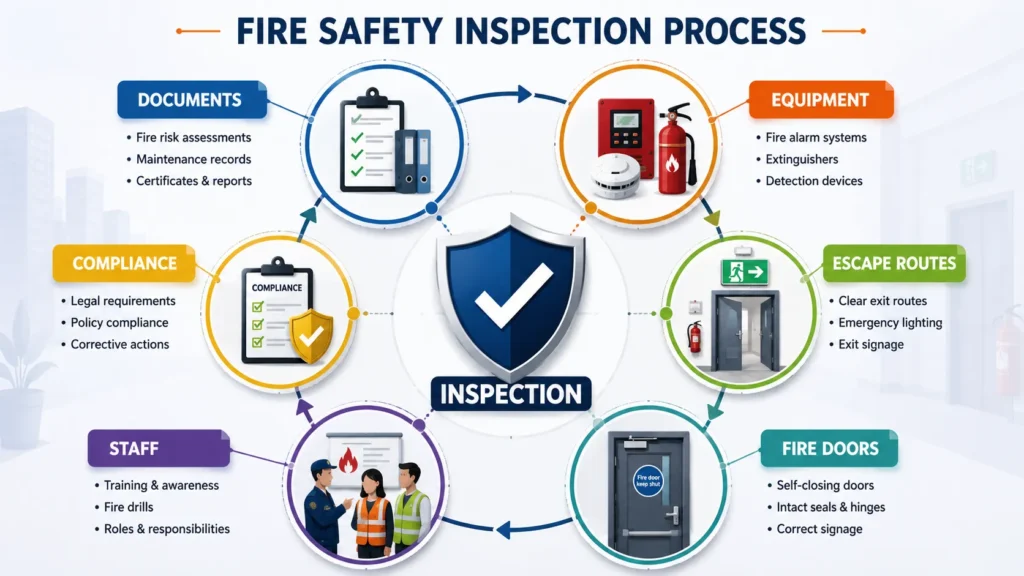
One of the most effective ways to prepare for a fire safety inspection is to understand the inspection process from the inspector’s perspective. Fire inspectors do not simply walk through a building looking for fire extinguishers or emergency exits. They evaluate whether your organisation has implemented a comprehensive fire safety management system that complies with UK legislation and effectively protects occupants.
A successful inspection demonstrates that fire safety is embedded into everyday operations rather than being addressed only when an inspection is scheduled.
The inspection generally consists of four stages:
- Documentation review
- Physical inspection of the premises
- Interviews with responsible personnel and employees
- Identification of deficiencies and recommendations
Documentation Review
Documentation provides evidence that fire safety arrangements are actively managed and regularly reviewed. Missing or outdated records immediately raise concerns about compliance.
Inspectors commonly request:
- Current Fire Risk Assessment
- Emergency Fire Evacuation Plan
- Fire alarm maintenance certificates
- Emergency lighting inspection records
- Fire extinguisher servicing certificates
- Fire door inspection records
- Fire drill reports
- Staff fire safety training records
- Weekly alarm testing logs
- Monthly emergency lighting checks
- Contractor maintenance reports
- Hot work permit records (where applicable)
Tip: Store all records digitally and in a clearly labelled fire safety folder. Quick access to documentation demonstrates effective management.
Fire Detection and Warning Systems
Fire detection systems are among the first physical elements inspectors evaluate because early warning significantly reduces the consequences of a fire.
Inspectors check whether:
- Fire alarm panels are operational.
- Manual call points are unobstructed.
- Smoke detectors are clean and functional.
- Audible alarms can be heard throughout the building.
- Weekly alarm tests are documented.
- Annual servicing has been completed by a competent engineer.
Even a fully functioning alarm system may result in observations if testing records are incomplete.
Emergency Escape Routes
Escape routes must enable occupants to leave the building quickly and safely.
Inspectors assess:
- Clear evacuation routes
- Fire exit signage
- Exit door operation
- Emergency lighting
- Staircase accessibility
- External assembly points
- Storage in escape corridors
- Trip hazards
Blocked exits remain one of the most common reasons organisations fail inspections.
Fire Doors
Fire doors slow the spread of fire and smoke, protecting escape routes during evacuation.
Inspectors examine:
- Self-closing mechanisms
- Door seals
- Intumescent strips
- Door gaps
- Damage to doors
- Fire door signage
- Obstructions preventing closure
Propping open fire doors with wedges or bins is viewed as a serious fire safety breach.
Fire Fighting Equipment
Portable fire extinguishers should be appropriate for the hazards present and properly maintained.
Inspectors verify:
- Correct extinguisher types
- Appropriate locations
- Annual servicing
- Pressure indicators
- Safety pins
- Clear operating instructions
- Accessibility
Additional systems such as sprinkler installations, dry risers and hose reels may also be inspected depending on the building.
Housekeeping Standards
Poor housekeeping significantly increases fire risk.
Inspectors look for:
- Accumulated combustible waste
- Poor storage practices
- Flammable materials near ignition sources
- Overloaded electrical sockets
- Unsafe charging stations
- Excessive paper storage
- Obstructed plant rooms
Good housekeeping demonstrates effective day-to-day fire risk management.
Electrical Safety
Electrical faults remain one of the leading causes of workplace fires.
Inspectors may examine:
- Portable Appliance Testing (PAT)
- Fixed wiring inspection reports
- Damaged electrical equipment
- Extension lead usage
- Electrical distribution boards
- Temporary wiring
- Battery charging areas
Preventive maintenance reduces both fire risk and inspection findings.
Staff Knowledge
Fire safety is not solely about equipment—it is equally about people.
Inspectors may ask employees:
- What should you do if the alarm sounds?
- Where is your assembly point?
- Who is the Fire Marshal?
- How do you report a fire hazard?
- When was your last fire drill?
- Where is the nearest fire extinguisher?
If staff cannot answer basic fire safety questions, inspectors may conclude that training arrangements are inadequate.
Fire Safety Inspection Preparation Timeline
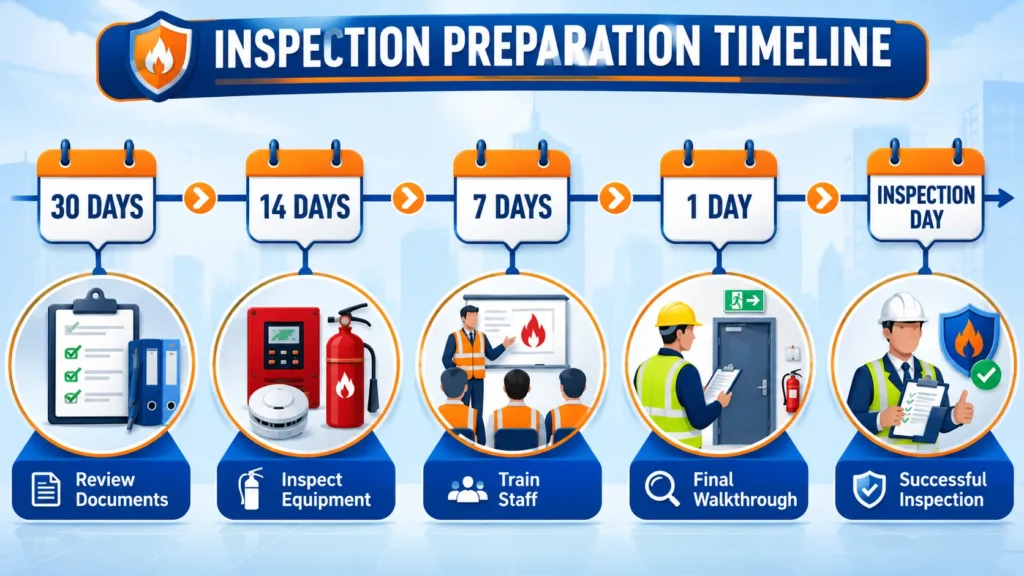
Many businesses only begin preparing a few days before an inspection. In reality, effective preparation starts several weeks in advance. Breaking the process into manageable stages helps identify and resolve issues before they become inspection failures.
30 Days Before the Inspection
This stage focuses on strategic planning and identifying any compliance gaps.
Recommended actions include:
- Review the current Fire Risk Assessment.
- Schedule servicing for fire safety equipment if due.
- Inspect fire doors throughout the premises.
- Review maintenance records.
- Update emergency procedures.
- Check contractor certificates.
- Verify emergency lighting inspections.
- Review previous inspection reports.
- Arrange refresher fire safety training where necessary.
This is also an ideal time to appoint responsibilities to relevant managers and supervisors.
14 Days Before the Inspection
Two weeks before the inspection, attention should shift to operational readiness.
Carry out:
- Full workplace walk-through.
- Fire exit inspections.
- Fire alarm testing.
- Fire extinguisher checks.
- Emergency lighting tests.
- Escape route inspections.
- Removal of unnecessary combustible storage.
- Fire door functionality checks.
- Documentation review.
Correct any identified issues immediately rather than waiting until inspection day.
7 Days Before the Inspection
The final week should focus on verification rather than major corrective work.
Activities include:
- Conduct a mock inspection.
- Review staff knowledge.
- Hold a fire drill if appropriate.
- Organise documentation folders.
- Inspect external assembly points.
- Confirm contractor reports have been received.
- Ensure safety signage remains visible.
- Check housekeeping standards.
- Inspect plant rooms and electrical cupboards.
A mock inspection helps identify small issues that are often overlooked.
The Day Before the Inspection
Avoid rushing. Instead, verify that all previous preparations remain effective.
Complete the following:
- Walk every escape route.
- Remove temporary storage.
- Confirm all exits operate correctly.
- Test communication systems.
- Ensure reception staff understand inspection procedures.
- Prepare meeting room documentation.
- Inform department managers.
- Confirm Responsible Person availability.
The aim is to ensure the workplace reflects normal safe operations rather than appearing artificially prepared.
Fire Safety Inspection Preparation Timeline
| Time Before Inspection | Priority Activities | Desired Outcome |
|---|---|---|
| 30 Days | Review Fire Risk Assessment, service fire systems, inspect fire doors, update documentation | Identify and resolve major compliance issues |
| 14 Days | Walk-through inspections, equipment checks, documentation review, housekeeping improvements | Address operational deficiencies |
| 7 Days | Mock inspection, fire drill, staff refresher training, organise records | Verify inspection readiness |
| 1 Day | Final workplace inspection, clear exits, confirm documentation, notify management | Ensure everything is inspection-ready |
| Inspection Day | Welcome inspector, provide records, accompany inspection, answer questions honestly | Demonstrate effective fire safety management |
Inspection Day Checklist
Inspection day should not involve last-minute repairs or hurried cleaning. Instead, it should demonstrate that your organisation maintains high fire safety standards every day.
Before the inspector arrives:
- Unlock all relevant areas.
- Prepare all documentation.
- Ensure the Responsible Person is available.
- Confirm access to alarm panels.
- Verify plant rooms are accessible.
- Check emergency exits one final time.
- Brief reception staff.
During the inspection:
- Answer questions honestly.
- Avoid guessing if unsure.
- Provide requested records promptly.
- Take notes of inspector observations.
- Ask for clarification where appropriate.
- Demonstrate willingness to improve.
Remember that inspectors appreciate organisations that are cooperative, transparent and committed to continuous improvement.
Fire Safety Inspection Preparation Flowchart
Review Fire Risk Assessment
│
▼
Update Fire Safety Documentation
│
▼
Inspect Fire Protection Equipment
│
▼
Check Fire Doors & Escape Routes
│
▼
Review Electrical & Housekeeping Standards
│
▼
Train Staff & Conduct Fire Drill
│
▼
Carry Out Internal Mock Inspection
│
▼
Correct Any Deficiencies
│
▼
Organise Inspection Records
│
▼
Final Workplace Walk-Through
│
▼
Pass Fire Safety Inspection with Confidence
Fire Safety Inspection Readiness Checklist
The following checklist can be used as a practical self-audit before any inspection.
| Inspection Area | Questions to Ask | Status |
|---|---|---|
| Fire Risk Assessment | Is it suitable, sufficient and up to date? | ✓ / ✗ |
| Fire Alarm System | Has it been tested weekly and serviced annually? | ✓ / ✗ |
| Emergency Lighting | Are monthly checks and annual inspections completed? | ✓ / ✗ |
| Fire Extinguishers | Are all units correctly located, accessible and in date? | ✓ / ✗ |
| Fire Doors | Do all doors close properly with intact seals? | ✓ / ✗ |
| Escape Routes | Are routes and exits clear and clearly signed? | ✓ / ✗ |
| Staff Training | Have all employees received recent fire safety training? | ✓ / ✗ |
| Fire Drills | Have drills been carried out and recorded? | ✓ / ✗ |
| Documentation | Are certificates, logs and maintenance records organised? | ✓ / ✗ |
| Housekeeping | Are combustible materials stored safely and waste removed? | ✓ / ✗ |
Completing this checklist regularly—not just before an inspection—helps build a culture of continuous compliance. It also enables the Responsible Person to identify and address issues early, reducing the likelihood of enforcement action and improving overall workplace fire safety.
Common Reasons Businesses Fail Fire Safety Inspections
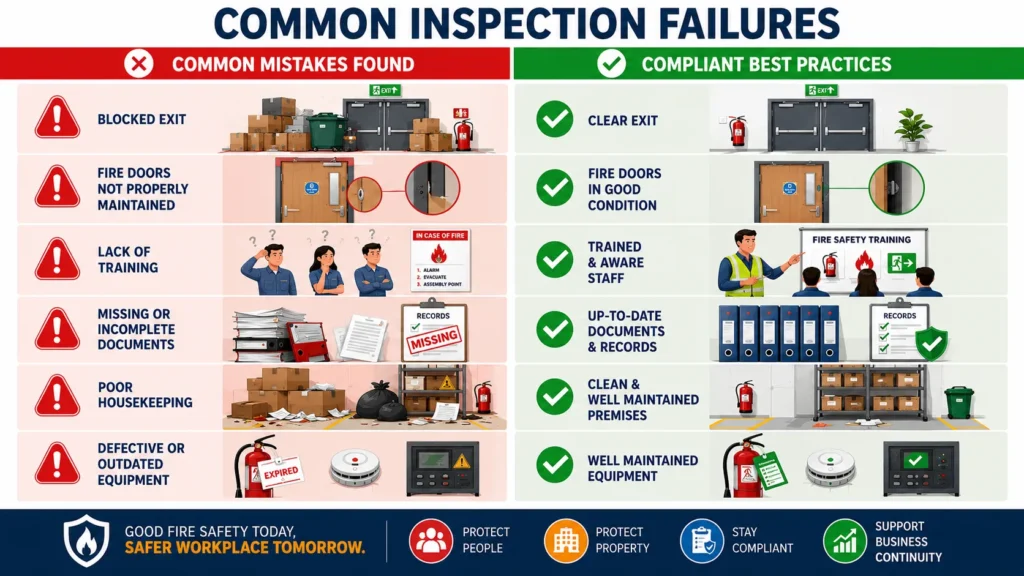
Even organisations that invest in fire safety equipment can fail an inspection if their systems, documentation, or management processes are inadequate. In most cases, inspection failures are not caused by a single major issue but by several smaller compliance gaps that indicate poor fire safety management.
Understanding these common shortcomings allows the Responsible Person to take corrective action before an inspection takes place.
Outdated or Missing Fire Risk Assessments
A fire risk assessment is one of the first documents inspectors review. An assessment that has not been updated following significant changes to the building, occupancy, or work activities may no longer reflect the actual fire risks.
Common issues include:
- Risk assessment completed several years ago without review.
- Building alterations not included.
- New machinery or hazardous materials omitted.
- Lack of documented control measures.
- No evidence of periodic reviews.
A fire risk assessment should be a living document that evolves with the workplace.
Blocked or Inaccessible Fire Exits
Emergency exits must remain available for immediate use at all times.
Inspectors frequently identify:
- Boxes stored in escape routes.
- Locked emergency exit doors.
- Furniture blocking corridors.
- Waste bins restricting exit access.
- External escape routes obstructed by vehicles or equipment.
Even temporary obstructions can result in enforcement action because they directly affect life safety.
Poor Fire Door Management
Fire doors are critical to preventing the spread of fire and smoke.
Common inspection findings include:
- Fire doors wedged open.
- Damaged door frames.
- Missing intumescent strips.
- Faulty self-closing devices.
- Large gaps around doors.
- Fire doors modified without approval.
Routine inspections help ensure fire doors continue to perform as designed.
Inadequate Staff Training
Fire safety equipment alone cannot protect occupants if employees do not understand emergency procedures.
Inspectors may identify:
- Staff unaware of evacuation routes.
- Fire Marshals not appointed.
- New employees lacking induction training.
- No refresher training records.
- Employees unfamiliar with alarm procedures.
Training should be practical, documented, and regularly reviewed.
Incomplete Maintenance Records
Fire safety systems require ongoing inspection and servicing.
Missing records often relate to:
- Fire alarm servicing.
- Emergency lighting tests.
- Fire extinguisher inspections.
- Fire door maintenance.
- Smoke control systems.
- Sprinkler maintenance.
Without documentation, inspectors cannot verify that systems remain operational.
Poor Housekeeping
Good housekeeping reduces ignition sources and limits fire spread.
Common deficiencies include:
- Excess combustible waste.
- Unsafe storage of packaging materials.
- Flammable liquids stored incorrectly.
- Build-up of dust around machinery.
- Electrical cupboards used as storage areas.
Maintaining tidy workplaces significantly improves fire safety.
Industry-Specific Fire Safety Inspection Tips
Although UK fire safety legislation applies across all workplaces, inspection priorities vary depending on the nature of the premises. Understanding these sector-specific considerations helps organisations focus on the areas most relevant to their operations.
Offices
Office environments often contain significant electrical equipment and high occupant densities.
Preparation priorities include:
- Maintaining clear escape routes.
- Managing portable electrical equipment.
- Testing emergency lighting.
- Updating staff training records.
- Securing server rooms and electrical cupboards.
Hotels and Hospitality Businesses
Hotels present additional challenges because occupants may be unfamiliar with evacuation procedures.
Inspectors often focus on:
- Guest evacuation plans.
- Bedroom fire detection.
- Emergency lighting.
- Kitchen fire suppression systems.
- Fire door integrity.
- Staff emergency training.
- Clear escape signage.
Schools and Educational Institutions
Educational premises require particular attention due to large numbers of children and visitors.
Key inspection areas include:
- Classroom evacuation procedures.
- Assembly points.
- Fire drills.
- Science laboratory safety.
- Safe storage of chemicals.
- Maintenance of alarm systems.
Warehouses
Warehouses typically contain high fuel loads and extensive storage systems.
Inspectors examine:
- Racking arrangements.
- Forklift charging areas.
- Combustible material storage.
- High-level sprinkler protection.
- Fire compartmentation.
- Access for emergency services.
Healthcare Facilities
Hospitals and care homes often require progressive horizontal evacuation strategies because some occupants cannot self-evacuate.
Inspection priorities include:
- Personal Emergency Evacuation Plans (PEEPs).
- Staff competency.
- Fire compartmentation.
- Medical gas storage.
- Emergency communication systems.
Retail Premises
Retail environments experience changing customer numbers throughout the day.
Inspectors focus on:
- Customer escape routes.
- Seasonal stock storage.
- Electrical displays.
- Emergency lighting.
- Fire exits.
- Staff emergency awareness.
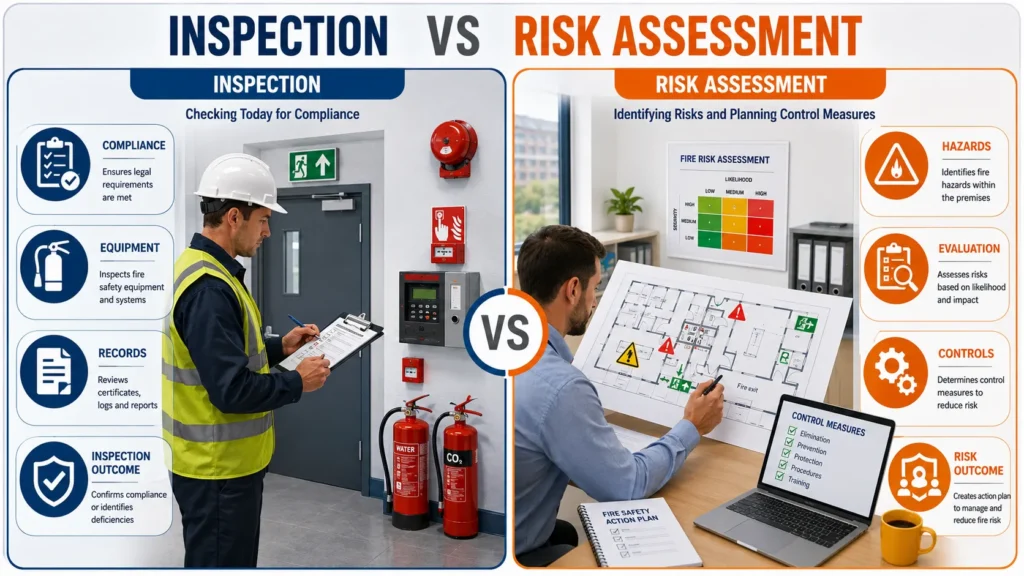
Fire Safety Inspection vs Fire Risk Assessment
Many people mistakenly believe that a fire safety inspection and a fire risk assessment are the same. Although they are closely related, they serve different purposes within an organisation’s fire safety management system.
| Feature | Fire Safety Inspection | Fire Risk Assessment |
|---|---|---|
| Primary Purpose | Verify compliance and inspect existing fire safety measures | Identify fire hazards and evaluate risks |
| Main Focus | Equipment, documentation, management, escape routes and legal compliance | Hazard identification, risk evaluation and control measures |
| Conducted By | Fire and Rescue Authority, fire safety inspector or competent auditor | Competent Fire Risk Assessor or Responsible Person (where competent) |
| Legal Importance | Confirms ongoing compliance with legislation | Required under the Regulatory Reform (Fire Safety) Order 2005 |
| Frequency | Determined by enforcing authorities or organisational needs | Reviewed regularly and whenever significant changes occur |
| Outcome | Inspection findings, recommendations or enforcement action | Written fire risk assessment with action plan |
The fire risk assessment forms the foundation of an organisation’s fire safety strategy, while the fire safety inspection evaluates how effectively that strategy has been implemented and maintained.
Using Digital Technology to Improve Fire Safety Compliance
Modern organisations are increasingly adopting digital tools to simplify compliance and improve inspection readiness. Digital fire safety management enables businesses to maintain accurate records, identify issues quickly, and demonstrate continuous compliance during inspections.
Examples of digital solutions include:
- Cloud-based fire safety management systems.
- Mobile inspection applications.
- QR code asset tracking for fire extinguishers and equipment.
- Digital maintenance schedules.
- Electronic fire drill records.
- Online staff training platforms.
- Automated inspection reminders.
- Digital document storage.
Benefits of Digital Fire Safety Management
| Digital Solution | Compliance Benefit |
|---|---|
| Cloud Document Storage | Provides instant access to inspection records and certificates |
| Mobile Inspection Apps | Standardises workplace inspections and reduces paperwork |
| Automated Maintenance Reminders | Helps prevent overdue servicing and missed inspections |
| QR Code Equipment Tracking | Simplifies asset management and maintenance history |
| Digital Training Records | Demonstrates staff competence during inspections |
| Compliance Dashboards | Provides real-time visibility of outstanding fire safety actions |
Digital systems also support better decision-making by enabling organisations to monitor trends, track corrective actions, and maintain accurate audit trails throughout the year.
Continue Your Fire Safety Career with Inspire College
Preparing for inspections is only one aspect of effective fire safety management. Organisations also benefit from developing competent professionals who understand legislation, fire risk assessment, emergency planning, and workplace compliance.
Inspire College offers a range of industry-focused fire safety qualifications designed to help individuals and organisations strengthen their knowledge, meet legal responsibilities, and progress within the health and safety sector.
Recommended Fire Safety Courses
| Course | How It Supports Inspection Readiness |
|---|---|
| Fire Safety Courses | Builds a strong foundation in workplace fire prevention and emergency procedures |
| Level 4 Certificate in Fire Risk Assessment | Develops practical skills for conducting and reviewing fire risk assessments |
| Fire Marshal Training | Prepares employees to manage evacuations and emergency response effectively |
Key Takeaways
Preparing for a fire safety inspection is not a one-off exercise completed just before an inspector arrives. It is a continuous process of identifying risks, maintaining fire protection systems, training staff, and ensuring compliance with UK legislation.
By understanding the responsibilities of the Responsible Person, keeping fire risk assessments up to date, maintaining accurate records, and conducting regular internal inspections, organisations can significantly improve their chances of passing an inspection while creating a safer environment for employees, visitors, and customers.
The most successful organisations view inspections as opportunities to validate good practice rather than as regulatory obstacles. Consistent attention to housekeeping, equipment maintenance, staff competence, and documentation demonstrates a mature fire safety culture that supports business continuity and legal compliance.
Conclusion
Fire safety inspections play a vital role in protecting lives, property, and business operations. They provide assurance that fire risks are being effectively managed and that organisations are meeting their legal obligations under the Regulatory Reform (Fire Safety) Order 2005 and other relevant UK legislation.
Passing an inspection with confidence requires more than functioning fire alarms and extinguishers. It demands a proactive approach that includes regular fire risk assessments, well-maintained fire protection systems, comprehensive staff training, accurate documentation, and strong leadership from the Responsible Person.
Whether you manage an office, warehouse, school, hotel, healthcare facility, or retail business, adopting a year-round approach to fire safety will not only improve inspection outcomes but also strengthen workplace resilience and protect everyone who enters your premises.
If you are looking to deepen your knowledge of fire safety, compliance, and risk management, explore the range of fire safety and health and safety qualifications available through Inspire College. Developing professional expertise today can help you create safer workplaces, achieve regulatory compliance, and build a rewarding career in the growing field of fire safety management.