
Unlock Your Fire Safety Career: How to Choose the Best Course with Confidence
Choosing the right fire safety course is one of the most important decisions for anyone looking to build a successful Fire Safety Career in fire safety, health and safety, compliance, or risk management. Whether the goal is to become a Fire Safety Officer, Fire Risk Assessor, Fire Safety Advisor, or Compliance Manager, selecting the right qualification provides the knowledge, practical skills, and professional credibility needed to succeed in today’s competitive job market.
With numerous fire safety awareness programmes, fire marshal courses, vocational diplomas, and specialist fire risk assessment qualifications available, it can be difficult to determine which course best matches career goals and industry requirements. Many learners make the mistake of choosing a course based only on price or duration, overlooking important factors such as qualification level, career progression, employer recognition, and practical application. Choosing the right course early can lay the foundation for a rewarding Fire Safety Career with opportunities across construction, healthcare, manufacturing, education, facilities management, and many other industries.
This comprehensive guide explains how to choose the right fire safety course, compares different qualification pathways, highlights common mistakes to avoid, and provides expert guidance for selecting a programme that supports long-term career growth. Whether the learner is starting a new career or progressing into leadership, this guide will help make an informed decision and confidently begin or advance a successful Fire Safety Career.
How do You Choose the Right Fire Safety Course?
The right fire safety course depends on career objectives, current experience, industry requirements, and desired job role. Beginners may benefit from Fire Safety Awareness or Level 3 qualifications, while experienced professionals seeking responsibilities in fire risk assessment or compliance should consider Level 4 or Level 5 qualifications. Always choose a recognised qualification that supports career progression and aligns with employer expectations.
Why choosing the Right Fire Safety Course Matters
Fire safety is no longer limited to emergency response. Modern organisations require competent professionals who understand legislation, conduct fire risk assessments, develop emergency plans, manage compliance, and protect people and property.
Choosing the right qualification can influence:
- Employment opportunities
- Salary potential
- Professional credibility
- Career progression
- Industry recognition
- Leadership opportunities
- Long-term earning potential
A recognised qualification demonstrates competence and commitment while helping employers identify candidates who possess the knowledge required to meet legal and organisational responsibilities.
The Growing Demand for Qualified Fire Safety Professionals
Demand for fire safety professionals continues to increase across the UK due to evolving legislation, stricter compliance requirements, and greater emphasis on workplace safety.
Several industries actively recruit qualified professionals, including:
- Construction
- Manufacturing
- Healthcare
- Education
- Hospitality
- Facilities Management
- Retail
- Warehousing
- Housing Associations
- Local Authorities
- Government Organisations
As organisations invest more heavily in risk management and regulatory compliance, individuals with recognised fire safety qualifications are becoming increasingly valuable.
Fire Safety Training vs Fire Safety Qualifications
Many people assume that fire safety training and fire safety qualifications are the same. Although both improve knowledge, they serve different purposes.
Fire safety training generally focuses on workplace awareness and emergency procedures, whereas professional qualifications prepare individuals for specialist careers with greater responsibilities.
| Feature | Fire Safety Training | Fire Safety Qualification |
|---|---|---|
| Primary Purpose | Workplace awareness | Professional career development |
| Duration | Hours or days | Weeks or months |
| Depth of Learning | Basic | Comprehensive |
| Career Progression | Limited | Excellent |
| Assessment | Practical or short test | Formal assessment and coursework |
| Suitable For | Employees | Fire safety professionals |
| Outcome | Workplace competence | Professional qualification |
Understanding this distinction helps learners avoid enrolling on programmes that do not support their career ambitions.
Why Professional Qualifications Provide Greater Career Value
While workplace training is essential for maintaining safety awareness, professional qualifications provide broader benefits.
Recognised qualifications help learners:
- Develop specialist technical knowledge
- Understand UK fire safety legislation
- Conduct fire risk assessments
- Prepare compliance reports
- Improve decision-making skills
- Progress into supervisory roles
- Build professional confidence
- Increase employability
Employers often prioritise candidates who possess recognised qualifications because they require less foundational training and demonstrate a stronger understanding of compliance requirements.
Who Should Take a Fire Safety Course?
Fire safety education benefits a wide range of professionals. However, different individuals require different qualification levels depending on their responsibilities.
Beginners
Individuals entering the health and safety sector often begin with introductory qualifications that develop a solid understanding of fire prevention, emergency procedures, and workplace safety principles.
Fire Marshals
Employees responsible for emergency evacuation, inspections, and fire prevention benefit from dedicated Fire Marshal training.
Health and Safety Professionals
Professionals already working within occupational health and safety can strengthen their expertise by completing specialist fire safety qualifications.
Facilities Managers
Facilities Managers oversee building safety, fire protection systems, inspections, maintenance, and emergency planning.
Advanced fire safety qualifications enhance their ability to manage compliance effectively.
Construction Professionals
Construction projects require fire safety planning throughout design, construction, and occupation. Site managers and supervisors increasingly complete fire safety qualifications to improve compliance and reduce risk.
Compliance Managers
Professionals responsible for organisational compliance benefit from advanced fire safety qualifications that develop strategic management and auditing capabilities.
Fire Risk Assessors
Those wishing to specialise in fire risk assessment require qualifications that develop inspection techniques, hazard identification, reporting skills, and legal understanding.
How to Identify the Right Course for Your Career
Selecting the right qualification begins with understanding career objectives rather than choosing the most popular course.
Ask the following questions before enrolling:
- What career do I want?
- What responsibilities will I have?
- Which industries interest me?
- What qualification level do employers expect?
- What progression opportunities exist?
- Will this qualification support future promotions?
Answering these questions helps narrow the available options and ensures the chosen course supports long-term professional goals.
Fire Safety Qualification Pathway
The following roadmap demonstrates how learners typically progress from basic awareness training to senior leadership roles.
Fire Safety Awareness
│
▼
Fire Marshal Training
│
▼
Level 3 Fire Safety Qualification
│
▼
Level 4 Fire Risk Assessment
│
▼
Level 5 Fire Safety & Risk Management
│
▼
Senior Fire Safety Professional
│
▼
Fire Safety Consultant
This progression allows learners to develop knowledge gradually while gaining valuable workplace experience.
Understanding Fire Safety Qualification Levels
Each qualification level prepares professionals for different responsibilities.
| Qualification | Best For | Main Focus | Typical Career Outcome |
|---|---|---|---|
| Fire Safety Awareness | Beginners | Fire prevention and emergency procedures | Workplace awareness |
| Fire Marshal Training | Employees with additional responsibilities | Evacuation and inspections | Fire Marshal |
| Level 3 Fire Safety | New professionals | Fire legislation and workplace safety | Fire Safety Officer |
| Level 4 Fire Risk Assessment | Experienced practitioners | Risk assessments and compliance | Fire Risk Assessor |
| Level 5 Fire Safety & Risk Management | Managers and Supervisors | Leadership and organisational compliance | Fire Safety Manager |
Selecting the correct level prevents learners from studying material that is either too basic or too advanced for their current experience.
Key Factors to Consider Before Choosing a Fire Safety Course
Every fire safety qualification should be evaluated against several important criteria.
Career Goals
Choose a course that supports the role you want to achieve rather than simply improving existing knowledge.
Qualification Recognition
Recognised qualifications increase employer confidence and improve career mobility across different industries.
Course Content
A quality programme should cover:
- Fire legislation
- Fire science
- Fire prevention
- Risk assessment
- Emergency planning
- Inspection techniques
- Fire protection systems
- Compliance management
Practical Application
Employers value professionals who can apply theoretical knowledge in real workplace situations.
Courses should include practical scenarios, case studies, inspections, and problem-solving activities where appropriate.
Future Progression
The best qualifications provide a clear pathway into higher-level diplomas, specialist certifications, and management positions.
Benefits of Choosing the Right Fire Safety Course
Selecting an appropriate qualification creates long-term advantages beyond obtaining a certificate.
Benefits include:
- Improved employability
- Greater confidence
- Professional recognition
- Better promotion opportunities
- Increased salary potential
- Stronger technical knowledge
- Enhanced leadership skills
- Greater industry flexibility
Professionals who invest in recognised qualifications often experience faster career progression than those relying solely on workplace experience.
Common Characteristics of High-Quality Fire Safety Courses
Not every training programme delivers the same educational value.
Look for courses that provide:
- Comprehensive curriculum
- Experienced tutors
- Flexible learning options
- Practical examples
- Industry-relevant content
- Professional assessments
- Progression opportunities
- Learner support
- Up-to-date legislation
Choosing a reputable provider significantly improves both the learning experience and career outcomes.
Fire Safety Learning Journey
The following visual illustrates the typical development process for aspiring fire safety professionals.
Learn Fire Safety Fundamentals
│
▼
Choose the Right Qualification
│
▼
Develop Practical Knowledge
│
▼
Gain Workplace Experience
│
▼
Complete Higher-Level Qualifications
│
▼
Progress into Specialist Roles
│
▼
Become a Fire Safety Leader
Step-by-Step Guide to Choosing the Right Fire Safety Course
Selecting the right fire safety course is easier when approached systematically. Rather than choosing the first programme available, evaluate each option based on career goals, current experience, qualification level, and future progression opportunities.
Following a structured decision-making process helps ensure the qualification supports both immediate employment and long-term professional growth.
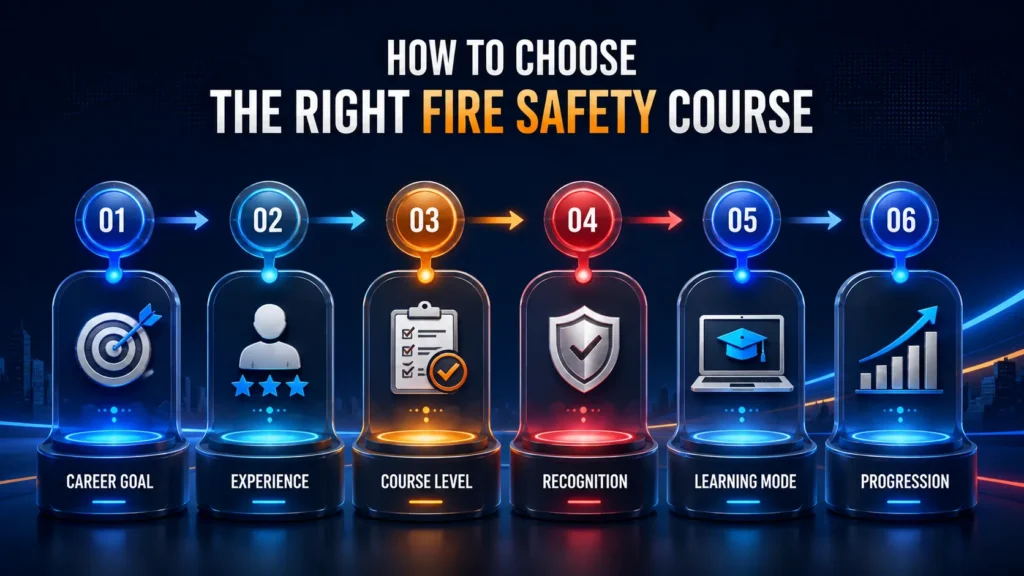
Step 1: Define Your Career Goals
Before comparing qualifications, identify the type of role you want to achieve.
For example:
- Fire Safety Officer
- Fire Marshal
- Fire Risk Assessor
- Fire Safety Advisor
- Compliance Officer
- Fire Safety Manager
- Health and Safety Manager
- Fire Safety Consultant
Every role requires different levels of knowledge, responsibility, and professional competence.
Step 2: Assess Your Current Experience
Your existing knowledge should influence the qualification you choose.
If you are new to fire safety, beginning with a foundation qualification provides a stronger learning experience than enrolling directly on an advanced diploma.
Professionals already working in health and safety may benefit from Level 4 or Level 5 qualifications that build on their existing expertise.
Step 3: Select the Appropriate Qualification Level
Choosing the correct qualification level ensures the course remains challenging without becoming overwhelming.
General guidance includes:
- Beginners → Awareness or Level 3
- Fire Marshals → Fire Marshal Training
- Experienced professionals → Level 4
- Managers and Supervisors → Level 5
- Senior professionals → Advanced Diplomas and Specialist Qualifications
Step 4: Verify Industry Recognition
Employers prefer qualifications that are recognised and respected within the fire safety and health and safety sectors.
Before enrolling, research whether the qualification is widely accepted by employers and supports future progression into higher-level programmes.
Step 5: Compare Course Content
Course titles can be misleading.
Instead of focusing solely on the qualification name, compare the learning outcomes.
Look for programmes covering:
- Fire legislation
- Fire prevention
- Fire behaviour
- Fire protection systems
- Fire risk assessment
- Emergency planning
- Fire inspections
- Compliance management
- Incident investigation
- Report writing
Comprehensive course content provides greater long-term career value.
Step 6: Choose the Right Learning Method
Different learners prefer different study methods.
Some benefit from classroom interaction, while others require flexible online learning that fits around employment and family commitments.
Choose a learning format that supports consistent progress without compromising quality.
Step 7: Consider Future Progression
A qualification should not only help secure the next job but also prepare for future promotions.
Look for courses that support progression into:
- Fire Risk Assessment
- Fire Safety Management
- Occupational Health and Safety
- Building Safety
- Compliance Management
- Consultancy
Step 8: Evaluate Career Value
The best course is not always the cheapest or shortest.
Instead, consider the long-term return on investment.
A recognised qualification can increase employability, improve earning potential, and create opportunities across multiple industries.
Fire Safety Course Selection Process
The following roadmap simplifies the decision-making process.
Identify Career Goal
│
▼
Assess Current Experience
│
▼
Choose Qualification Level
│
▼
Compare Course Content
│
▼
Verify Industry Recognition
│
▼
Select Learning Method
│
▼
Review Career Progression
│
▼
Enroll with Confidence
Fire Safety Course Comparison
Not every qualification is designed for the same learner. The table below compares the most common pathways.
| Qualification | Best For | Learning Focus | Career Outcome | Progression |
|---|---|---|---|---|
| Fire Safety Awareness | Beginners | Workplace fire safety | General awareness | Fire Marshal |
| Fire Marshal Training | Employees | Emergency procedures | Fire Marshal | Level 3 |
| Level 3 Fire Safety | New professionals | Fire legislation and inspections | Fire Safety Officer | Level 4 |
| Level 4 Fire Risk Assessment | Experienced professionals | Fire risk assessments | Fire Risk Assessor | Level 5 |
| Level 5 Fire Safety & Risk Management | Managers | Leadership and compliance | Fire Safety Manager | Consultancy |
| Specialist Professional Qualification | Senior professionals | Strategic fire safety | Consultant | Director |
This comparison helps learners identify the qualification that best matches their current experience and future aspirations.
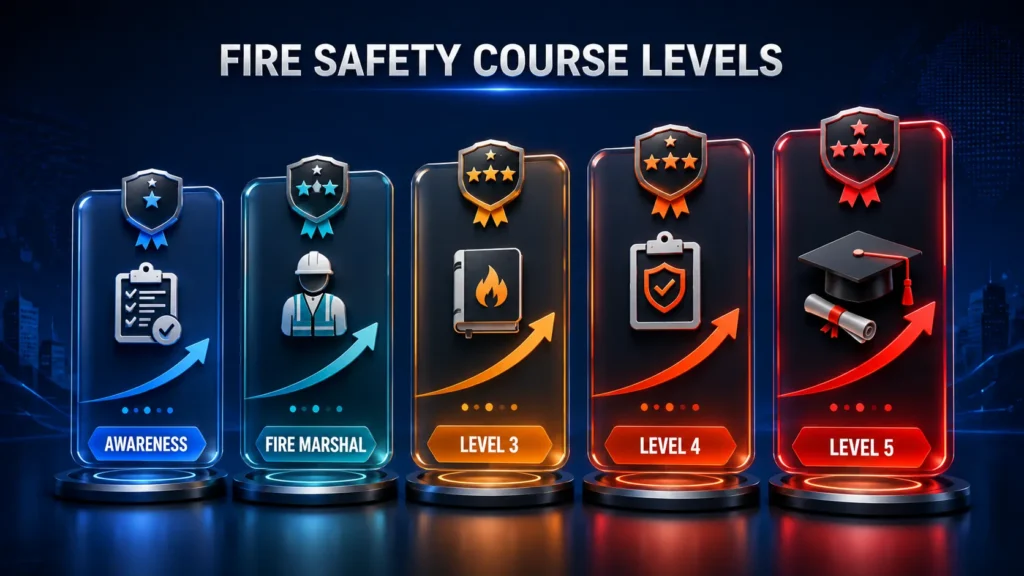
Online vs Classroom Fire Safety Courses
Technology has transformed professional education, giving learners greater flexibility when choosing how they study.
Both online and classroom learning have advantages depending on individual circumstances.
| Feature | Online Learning | Classroom Learning |
|---|---|---|
| Flexibility | Excellent | Fixed schedule |
| Learn at Your Own Pace | Yes | Limited |
| Travel Required | No | Yes |
| Networking Opportunities | Moderate | Excellent |
| Suitable for Working Professionals | Excellent | Good |
| Tutor Interaction | Online support | Face-to-face |
| Accessibility | High | Location dependent |
Neither option is universally better. The ideal choice depends on learning preferences, work commitments, and availability.
How to Evaluate a Fire Safety Training Provider
The quality of the training provider can significantly influence both the learning experience and future career opportunities.
Before enrolling, evaluate the provider carefully.
Industry Reputation
Choose providers with a strong reputation for delivering professional qualifications that meet employer expectations.
Experienced Tutors
Qualified instructors with real industry experience can provide practical insights beyond textbook learning.
Comprehensive Curriculum
Ensure the course covers current legislation, practical applications, and real workplace scenarios.
Learner Support
Good providers offer guidance throughout the learning journey, including tutor support, assessment feedback, and study resources.
Flexible Study Options
Flexible delivery methods allow learners to balance professional development with work and personal commitments.
Career Progression
The provider should offer pathways into higher-level qualifications and specialist training.

Training Provider Evaluation Checklist
Training Provider
│
▼
Industry Reputation ✓
│
▼
Experienced Tutors ✓
│
▼
Recognised Qualification ✓
│
▼
Comprehensive Curriculum ✓
│
▼
Flexible Learning ✓
│
▼
Career Progression ✓
│
▼
Strong Learner Support ✓
Using a checklist helps compare providers objectively instead of making decisions based solely on marketing claims.
Common Mistakes When Choosing a Fire Safety Course
Many learners choose courses without considering their long-term value.
Avoiding these mistakes can improve both learning outcomes and career progression.
Choosing Based Only on Price
A lower course fee does not always represent better value.
Investing in a recognised qualification often produces greater long-term returns through improved employment opportunities and career advancement.
Ignoring Qualification Level
Studying material that is too basic can slow progression, while advanced qualifications may become overwhelming without suitable experience.
Select a level appropriate to your current knowledge and future goals.
Failing to Research the Provider
Not all providers deliver the same quality of education.
Research reviews, course content, tutor expertise, learner support, and progression opportunities before enrolling.
Ignoring Industry Recognition
Employers value qualifications that are recognised and respected within the industry.
Recognition can influence employability and future career mobility.
Overlooking Practical Learning
Fire safety is a practical profession.
Courses that include workplace scenarios, inspections, and problem-solving activities better prepare learners for real-world responsibilities.
Not Thinking About Future Progression
The ideal qualification should support long-term development rather than only helping secure the next job.
Consider where the qualification can lead over the next five to ten years.
Signs You Have Chosen the Right Course
You are likely making the right decision if the course:
- Matches your career goals
- Is recognised by employers
- Covers current fire safety legislation
- Includes practical learning
- Supports career progression
- Fits your preferred learning style
- Provides access to experienced tutors
- Develops both technical and professional skills
Choosing the right course is an investment in your future rather than simply obtaining another certificate.
Why Careful Course Selection Pays Off
Professionals who carefully evaluate qualifications often experience:
- Faster career progression
- Greater confidence
- Higher employability
- Better salary potential
- Increased professional recognition
- Stronger technical competence
- More leadership opportunities
These benefits demonstrate why selecting the right fire safety course is one of the most important career decisions a learner can make.
Career Benefits of Choosing the Right Fire Safety Course
The fire safety industry offers excellent long-term career prospects for professionals who invest in recognised qualifications. Selecting the right course not only helps secure employment but also builds the technical knowledge and professional confidence needed to progress into higher-paying and more specialised roles.
A recognised qualification demonstrates to employers that a candidate understands fire prevention, fire risk assessment, emergency planning, and compliance with current legislation. This makes qualified professionals more competitive in today’s job market.
Some of the biggest career benefits include:
- Greater employability across multiple industries
- Access to higher-level positions
- Improved earning potential
- Increased professional credibility
- Better promotion opportunities
- Stronger understanding of legislation and compliance
- Transferable skills that support career mobility
- Opportunities to specialise in fire risk assessment, consultancy, or management
Choosing the right course is an investment in long-term professional success rather than simply achieving a qualification.
Industries That Value Fire Safety Qualifications
One of the greatest advantages of a fire safety qualification is its relevance across a wide range of industries. Almost every organisation has legal responsibilities relating to fire prevention, emergency preparedness, and workplace safety.
Qualified professionals are in demand in:
Construction
Construction sites present numerous fire hazards due to hot work, temporary electrical installations, combustible materials, and changing site conditions. Fire safety professionals help reduce risks and ensure compliance throughout the project lifecycle.
Healthcare
Hospitals, care homes, and healthcare facilities require specialist fire safety management to protect patients, staff, and visitors, particularly those with limited mobility.
Education
Schools, colleges, and universities rely on qualified professionals to develop emergency procedures, conduct fire risk assessments, and maintain safe learning environments.
Manufacturing
Manufacturing environments often involve machinery, chemicals, electrical equipment, and combustible materials, making effective fire safety management essential.
Hospitality
Hotels, restaurants, and entertainment venues require fire safety professionals to protect guests, employees, and business operations while complying with legal obligations.
Facilities Management
Facilities management companies oversee fire protection systems, maintenance schedules, inspections, and building compliance for commercial and residential properties.
Retail and Commercial Buildings
Shopping centres, office buildings, and retail stores require ongoing fire safety inspections, emergency planning, and compliance management.
Housing Associations
Residential buildings require regular fire risk assessments, maintenance of fire protection systems, and effective evacuation planning.
Logistics and Warehousing
Large warehouses contain significant fire loads due to stored goods, packaging materials, and mechanical handling equipment, creating demand for qualified professionals.
Government and Public Sector
Government departments, local authorities, and public organisations employ fire safety specialists to protect public assets and ensure regulatory compliance.
Industries Hiring Fire Safety Professionals
| Industry | Why Fire Safety Matters | Typical Career Opportunities |
|---|---|---|
| Construction | Site safety and legal compliance | Fire Safety Officer |
| Healthcare | Protection of vulnerable occupants | Fire Safety Advisor |
| Education | Campus safety and emergency planning | Compliance Coordinator |
| Manufacturing | Hazard control and risk reduction | Fire Risk Assessor |
| Hospitality | Guest safety and evacuation planning | Fire Safety Manager |
| Facilities Management | Building compliance | Facilities Compliance Manager |
| Housing Associations | Residential fire safety | Building Safety Officer |
| Logistics | Warehouse risk management | Fire Safety Supervisor |
| Government | Public building compliance | Fire Safety Inspector |
| Commercial Property | Asset protection | Fire Safety Consultant |
This broad industry demand provides excellent career flexibility and long-term employment opportunities.
How the Right Fire Safety Course Improves Career Progression
Professional development in fire safety follows a structured pathway. As qualifications and practical experience increase, professionals become eligible for more senior positions with greater responsibility.
Typical Career Progression
Fire Safety Awareness
│
▼
Fire Marshal
│
▼
Fire Safety Officer
│
▼
Fire Risk Assessor
│
▼
Fire Safety Advisor
│
▼
Fire Safety Manager
│
▼
Fire Safety Consultant
│
▼
Head of Fire Safety
Each stage builds upon previous knowledge while expanding technical expertise, leadership capability, and organisational responsibility.
Future Trends in Fire Safety Training
The fire safety profession continues to evolve in response to technological innovation, regulatory developments, and changing workplace environments. Professionals who keep their knowledge up to date are more likely to remain competitive and valuable to employers.
Digital Learning
Online learning platforms have made fire safety education more accessible than ever. Flexible learning enables professionals to gain recognised qualifications while balancing work and personal commitments.
Smart Building Technologies
Modern buildings increasingly use integrated fire detection systems, intelligent alarms, smoke control systems, and automated monitoring technologies. Fire safety professionals must understand how these systems operate and contribute to overall building safety.
Artificial Intelligence
Artificial intelligence is beginning to support fire risk analysis, predictive maintenance, compliance monitoring, and inspection planning. While AI improves efficiency, qualified professionals remain responsible for interpreting results and making informed decisions.
Digital Fire Risk Assessments
Many organisations now use cloud-based inspection software and digital reporting tools instead of traditional paper records. Professionals with digital reporting skills are becoming increasingly valuable.
Continuous Professional Development
Legislation, standards, and industry best practices continue to evolve. Ongoing learning helps professionals maintain competence and adapt to changing workplace requirements.
Sustainability and Building Safety
Modern construction methods and sustainable building materials present new fire safety challenges. Professionals who understand these developments will be better prepared to manage emerging risks.
Skills That Will Shape Future Fire Safety Careers
Future employers are expected to place even greater emphasis on a combination of technical knowledge and transferable skills.
Key future-focused skills include:
- Digital inspection systems
- Fire risk assessment
- Building safety compliance
- Data interpretation
- Regulatory awareness
- Leadership
- Project management
- Communication
- Report writing
- Problem solving
- Critical thinking
- Continuous learning
Professionals who continuously develop these skills are likely to enjoy stronger career progression and leadership opportunities.
Why Study Fire Safety with Inspire College?
Choosing the right training provider is just as important as selecting the right qualification. Inspire College is committed to supporting learners through flexible, career-focused programmes designed to meet current industry expectations.
Learners benefit from:
- Industry-relevant qualifications
- Flexible study options
- Experienced tutor support
- Practical, career-focused learning
- Progression pathways into advanced qualifications
- Continuous professional development opportunities
- Qualifications aligned with employer needs
Whether the goal is to enter the profession or progress into senior management, Inspire College provides learning pathways that support long-term career development.
Recommended Fire Safety and Health & Safety Courses
Readers interested in advancing their careers can explore these related qualifications and resources available through Inspire College.
- ProQual Level 5 Diploma in Fire Safety and Risk Management
- ProQual Level 5 Diploma in Fire Risk Assessment
- Fire Safety Training Courses
- ProQual Level 6 NVQ Diploma in Occupational Health and Safety Practice
- Health and Safety Management Qualifications
- ProQual Level 6 NVQ Diploma in Construction Site Management
Additional Learning Resources
Fire Safety Career Development Roadmap
The following roadmap demonstrates how continuous learning and recognised qualifications contribute to long-term professional growth.
Choose the Right Fire Safety Course
│
▼
Build Core Knowledge
│
▼
Gain Practical Workplace Experience
│
▼
Complete Higher-Level Qualifications
│
▼
Develop Specialist Expertise
│
▼
Lead Fire Safety Programmes
│
▼
Become a Consultant or Senior Manager
│
▼
Continue Professional Development
Key Takeaways
Choosing the right fire safety course is about far more than obtaining a certificate. The right qualification provides the technical knowledge, practical skills, and professional recognition needed to build a successful and sustainable career.
Before enrolling, learners should evaluate their career goals, current experience, preferred learning method, qualification level, and long-term progression opportunities. Investing time in selecting the right course today can lead to better employment prospects, higher salaries, and greater professional confidence in the future.
As industries continue to strengthen their focus on fire prevention, compliance, and workplace safety, qualified professionals will remain in high demand across construction, healthcare, education, manufacturing, facilities management, hospitality, housing, and many other sectors.

Conclusion
Selecting the right fire safety course is one of the smartest investments anyone can make when planning a career in fire safety or health and safety. A carefully chosen qualification not only builds essential knowledge but also creates opportunities for professional growth, increased earning potential, and long-term career stability.
By understanding qualification levels, evaluating training providers, comparing learning methods, and aligning education with career objectives, learners can confidently choose a course that supports both their current needs and future ambitions.
Whether starting a new career, progressing into management, or specialising in fire risk assessment, the right qualification forms the foundation for lasting success. Inspire College is committed to helping learners achieve these goals through industry-focused qualifications that prepare professionals for the evolving demands of modern fire safety and compliance.