
ProQual Level 7 Diploma in Civil Engineering 10 Sections36 Lessons36 Quizzes10 Weeks
Lesson no: 3 Design and implement high-performance construction systems
The construction industry is increasingly expected to deliver infrastructure that achieves exceptional levels of performance throughout its operational life while addressing growing demands for energy efficiency, durability, sustainability, resilience, and whole-life value. Modern civil engineering projects are no longer assessed solely on their ability to satisfy immediate structural and functional requirements. Instead, infrastructure assets are evaluated according to how effectively they minimise energy consumption, withstand environmental deterioration, optimise maintenance requirements, and contribute to long-term environmental and economic sustainability. Consequently, the design and implementation of high-performance construction systems has become a fundamental responsibility of civil engineers involved in planning, designing, constructing, and managing infrastructure projects.
High-performance construction systems integrate advanced engineering principles, innovative construction methods, high-quality materials, digital technologies, and sustainable design strategies to maximise infrastructure performance throughout its lifecycle. These systems require engineers to consider structural behaviour, thermal performance, moisture control, environmental exposure, material compatibility, maintenance requirements, and operational efficiency during the earliest stages of project development. Rather than treating individual components independently, engineers adopt a systems-based approach in which foundations, structural elements, building envelopes, drainage systems, services, and materials operate together to achieve optimum engineering performance.
This lesson explores the engineering principles involved in producing construction systems that optimise energy efficiency and durability, evaluating how design decisions influence long-term infrastructure performance. Learners will examine methods for reducing operational energy demand, improving structural resilience, minimising deterioration mechanisms, and incorporating sustainable engineering practices into construction system design. Particular emphasis is placed on engineering judgement, lifecycle thinking, risk management, and professional decision-making when selecting appropriate construction solutions.
The knowledge gained throughout this lesson supports professional engineering activities including infrastructure design, project planning, specification development, quality management, sustainability assessment, asset management, and construction supervision. Engineers capable of designing high-performance construction systems contribute directly to safer, more resilient, environmentally responsible, and economically sustainable infrastructure that meets both present and future societal needs.
Learning Objectives
After completing this lesson, learners will be able to:
- Produce construction systems that maximise energy efficiency and long-term durability.
- Evaluate engineering strategies for reducing lifecycle energy demand within civil engineering projects.
- Apply engineering principles that improve structural resilience and service life.
- Assess the influence of environmental conditions on construction system performance.
- Select appropriate construction methods that balance durability, sustainability, quality, and cost.
- Analyse how design decisions influence operational efficiency and maintenance requirements.
- Integrate engineering best practices into the design of high-performance infrastructure.
- Apply professional judgement when developing construction systems for complex civil engineering projects.
1. Produce Construction Systems that Optimise Energy Efficiency and Durability
Modern civil engineering projects are increasingly required to achieve higher levels of performance, sustainability, resilience, and operational efficiency throughout their service life. Traditional construction approaches often focus primarily on satisfying minimum structural requirements and immediate project delivery objectives. However, high-performance construction systems adopt a broader engineering approach by integrating structural performance, energy efficiency, durability, environmental responsibility, and lifecycle value into a coordinated design solution.
Producing high-performance construction systems requires engineers to understand the interaction between multiple components of an infrastructure asset. Structural elements, construction materials, building envelopes, drainage systems, mechanical systems, monitoring technologies, and maintenance strategies must function together to achieve optimum performance. A decision made during the design stage can significantly influence future energy consumption, maintenance requirements, environmental impact, and overall asset reliability.
The development of these systems requires professional engineering judgement because improvements in one area may create challenges in another. For example, increasing insulation levels may improve energy efficiency but requires careful moisture management to prevent condensation and deterioration. Similarly, selecting low-carbon materials may support sustainability objectives but must also demonstrate adequate structural strength and long-term durability.
High-performance construction systems therefore represent an integrated engineering approach where design decisions are based on technical evaluation, whole-life performance, and measurable outcomes rather than short-term construction considerations alone.
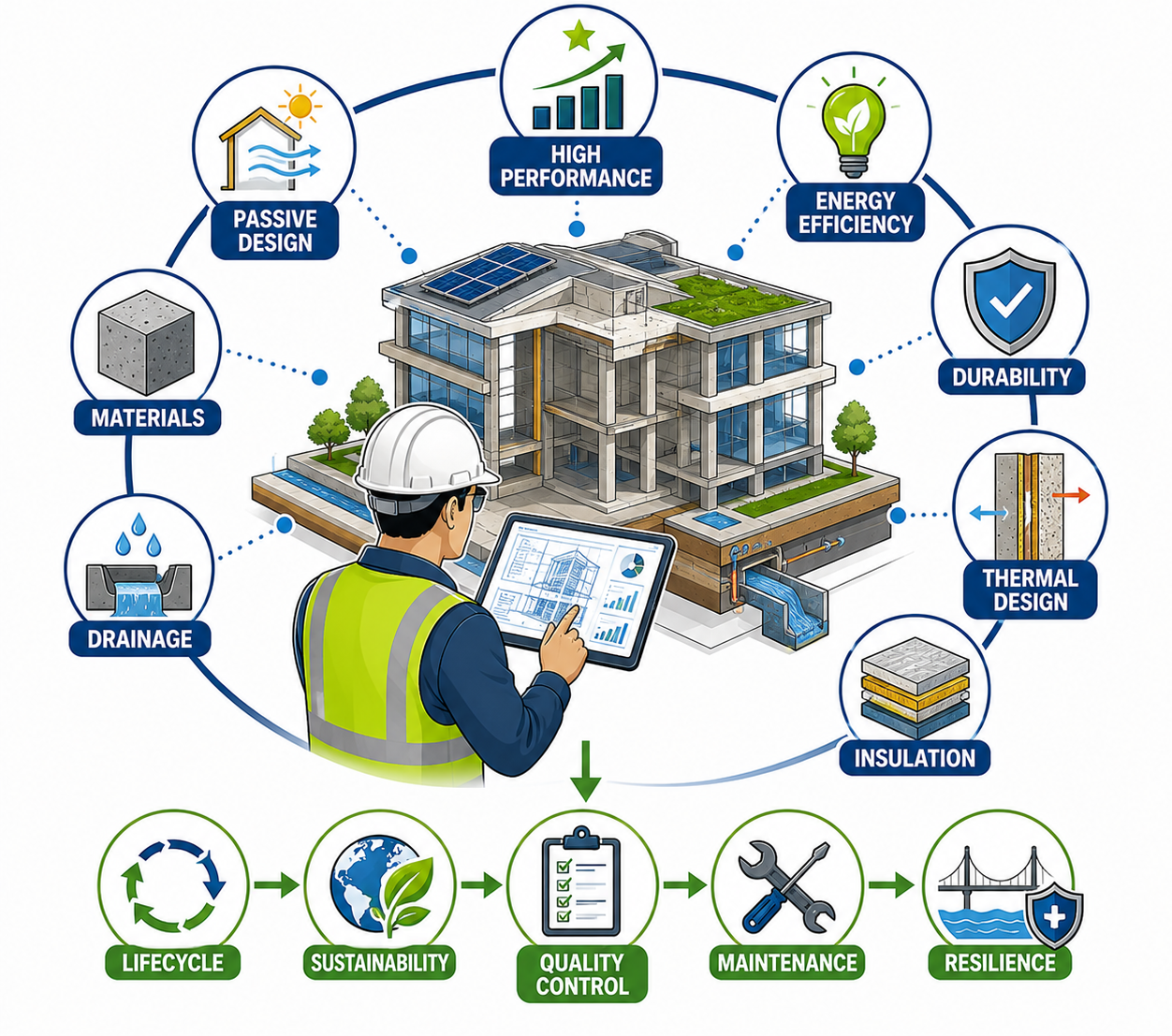
Understanding High-Performance Construction Systems
A high-performance construction system is an integrated engineering solution designed to deliver superior performance across structural, environmental, operational, and economic requirements throughout the complete lifecycle of an infrastructure asset.
Unlike conventional systems that may focus mainly on initial construction requirements, high-performance systems consider:
- Structural reliability.
- Energy efficiency.
- Durability.
- Environmental performance.
- Maintenance requirements.
- User comfort.
- Climate resilience.
- Whole-life cost performance.
The purpose of such systems is not simply to improve one individual characteristic but to optimise the interaction between different engineering components.
For example, an energy-efficient building system requires more than improved insulation. Engineers must consider:
- Structural design.
- Material selection.
- Thermal performance.
- Air leakage control.
- Moisture management.
- Ventilation strategy.
- Maintenance access.
Similarly, a durable bridge system requires consideration of:
- Structural loading.
- Material resistance.
- Environmental exposure.
- Drainage.
- Protective measures.
- Inspection requirements.
High-performance construction systems are therefore based on coordinated engineering decisions that support long-term asset performance.
Key Characteristics of High-Performance Construction Systems
High-performance systems generally aim to achieve several interconnected objectives.
Improved Structural Reliability
Construction systems must maintain adequate strength, stability, and serviceability throughout their design life.
Engineers consider:
- Load-bearing capacity.
- Structural behaviour.
- Material performance.
- Connection integrity.
- Resistance to deterioration.
Improved structural reliability reduces failure risks and increases confidence in long-term asset performance.
Reduced Operational Energy Demand
Energy-efficient systems are designed to minimise the energy required during the operational phase of an asset.
This may be achieved through:
- Improved insulation.
- Efficient building orientation.
- Passive environmental control.
- Reduced heat loss.
- Renewable energy integration.
Reducing operational energy demand contributes to lower running costs and improved sustainability performance.
Enhanced Durability
Durability ensures that construction systems continue performing effectively despite exposure to environmental and operational conditions.
Engineers improve durability through:
- Appropriate material selection.
- Protective detailing.
- Effective drainage.
- Environmental resistance.
- Quality construction practices.
A durable system reduces maintenance requirements and extends asset service life.
Improved Environmental Sustainability
High-performance construction systems contribute to sustainable engineering by reducing:
- Energy consumption.
- Material waste.
- Carbon emissions.
- Resource usage.
Sustainability must be considered alongside structural safety and durability to ensure balanced engineering solutions.
Reduced Lifecycle Costs
A high-performance system may require greater initial investment but provide improved economic value over its operational life.
Lifecycle benefits may include:
- Reduced maintenance frequency.
- Lower energy costs.
- Fewer repairs.
- Extended service life.
- Improved asset reliability.
Engineers should therefore evaluate long-term value rather than focusing only on initial construction costs.
Examples of High-Performance Construction Systems
High-performance systems are applied across a wide range of civil engineering projects.
Examples include:
Energy-Efficient Building Envelopes
Building envelope systems control heat transfer, moisture movement, and environmental exposure.
They may incorporate:
- High-performance insulation.
- Advanced glazing systems.
- Airtight construction.
- Thermal bridge reduction measures.
High-Performance Bridge Systems
Advanced bridge systems may include:
- Durable concrete mixes.
- Corrosion-resistant reinforcement.
- Improved drainage systems.
- Structural monitoring technologies.
These approaches improve resilience and reduce future maintenance requirements.
Sustainable Drainage Infrastructure
Sustainable drainage systems manage water efficiently while reducing environmental impacts.
Examples include:
- Permeable surfaces.
- Attenuation systems.
- Green infrastructure solutions.
Modular Construction Systems
Modular systems improve construction efficiency through controlled manufacturing environments.
Benefits include:
- Improved quality control.
- Reduced site activities.
- Faster installation.
- Reduced material waste.
Low-Carbon Construction Systems
Low-carbon systems aim to reduce environmental impacts through:
- Alternative materials.
- Efficient construction methods.
- Reduced embodied carbon.
- Improved resource efficiency.
Engineering Principles Supporting High-Performance Systems
The production of high-performance construction systems relies on several fundamental engineering principles.
Systems Thinking Approach
Systems thinking requires engineers to evaluate infrastructure as an interconnected system rather than a collection of separate components.
A decision affecting one element may influence overall system performance.
Examples include:
- Structural design affecting thermal performance.
- Drainage design affecting durability.
- Material selection affecting maintenance requirements.
- Building envelope design affecting energy consumption.
By considering these relationships, engineers can optimise overall performance rather than improving isolated components.
Application of Systems Thinking in Practice
A poorly designed drainage system may allow water accumulation around structural elements, increasing deterioration risks. Even if high-quality materials are used, inadequate water management can reduce the expected service life of the structure.
Similarly, improving insulation performance without considering ventilation may result in moisture-related problems that negatively affect indoor environmental quality and material durability.
Systems thinking enables engineers to identify these interactions during the design stage and develop more reliable solutions.
Whole-Life Engineering Approach
Whole-life engineering involves considering the complete lifecycle performance of an asset rather than focusing only on initial construction activities.
The approach evaluates:
- Design requirements.
- Construction quality.
- Operational performance.
- Inspection requirements.
- Maintenance strategies.
- Repair requirements.
- Adaptability.
- End-of-life management.
This approach supports better engineering decisions because the initial construction cost represents only one part of the total asset value.
Benefits of Whole-Life Engineering
Applying whole-life thinking enables engineers to:
- Reduce long-term maintenance costs.
- Improve asset reliability.
- Extend service life.
- Reduce environmental impacts.
- Support sustainable investment decisions.
For example, selecting a more durable concrete specification may increase initial construction costs but significantly reduce future repair requirements over a 60-year service period.
Performance-Based Design Principles
Performance-based design focuses on achieving measurable engineering outcomes rather than relying only on traditional prescriptive requirements.
Instead of specifying only materials or construction methods, engineers define expected performance standards.
Performance objectives may include:
- Structural reliability.
- Thermal efficiency.
- Water resistance.
- Fire performance.
- Durability.
- Acoustic performance.
- Environmental performance.
Advantages of Performance-Based Design
Performance-based design allows engineers to:
- Encourage innovation.
- Compare alternative solutions.
- Optimise project outcomes.
- Select materials based on performance.
- Adapt designs to specific project conditions.
However, engineers must ensure that performance requirements are clearly defined and supported by appropriate verification methods.
Optimising Energy Efficiency Through Construction System Design
Energy efficiency is a major consideration in modern construction system design. Engineers are expected to reduce operational energy demand while maintaining structural safety, functionality, and user requirements.
Energy-efficient construction systems achieve improved performance by controlling:
- Heat transfer.
- Air movement.
- Solar gain.
- Moisture movement.
- Energy consumption.
The objective is to reduce dependence on mechanical systems by improving the inherent efficiency of the construction system.
Factors Influencing Energy-Efficient Design
Engineers consider several factors when developing energy-efficient construction systems.
These include:
- Structural configuration.
- Material thermal properties.
- Insulation performance.
- Airtightness.
- Natural ventilation.
- Daylight utilisation.
- Solar control.
- Renewable energy integration.
Each factor contributes to reducing energy consumption while maintaining effective building performance.
Passive Engineering Strategies
Passive design strategies improve energy efficiency by reducing reliance on active mechanical systems.
Common approaches include:
Optimised Building Orientation
Building orientation influences solar exposure, natural lighting, and heating requirements.
Engineers analyse:
- Sun path.
- Climate conditions.
- Building location.
- Seasonal variations.
Correct orientation can significantly reduce heating and cooling demand.
Improved Thermal Insulation
Thermal insulation reduces unwanted heat transfer between internal and external environments.
Effective insulation:
- Reduces heat loss during colder periods.
- Limits overheating during warmer periods.
- Improves energy efficiency.
Reduction of Thermal Bridging
Thermal bridges occur where heat can transfer more easily through parts of a construction system.
Engineers reduce thermal bridging through:
- Improved detailing.
- Continuous insulation.
- Careful material transitions.
Reducing thermal bridging improves energy performance and helps prevent condensation risks.
Controlled Airtightness
Airtight construction reduces uncontrolled air leakage.
Benefits include:
- Reduced heat loss.
- Improved energy efficiency.
- Better environmental control.
However, airtight systems must be balanced with effective ventilation strategies to maintain healthy internal conditions.
Natural Ventilation Strategies
Natural ventilation reduces dependence on mechanical cooling systems.
Engineers consider:
- Airflow paths.
- Building openings.
- Environmental conditions.
- Occupancy requirements.
Thermal Mass Utilisation
Materials with high thermal mass, such as concrete and masonry, can absorb and release heat gradually.
Benefits include:
- Temperature stability.
- Reduced heating and cooling demand.
- Improved internal comfort.
Energy Efficiency Evaluation Factors
| Engineering Factor | Impact on Performance | Typical Design Approach |
|---|---|---|
| Thermal insulation | Reduces heat transfer | Continuous insulation systems |
| Airtightness | Limits heat loss | Controlled air barriers |
| Thermal mass | Stabilises temperature | Concrete and masonry elements |
| Building orientation | Optimises solar performance | Passive solar design |
| Natural ventilation | Reduces cooling demand | Designed airflow paths |
| Daylighting | Reduces lighting energy | Efficient glazing design |
Selecting an appropriate combination of these strategies allows engineers to improve energy efficiency while maintaining structural performance and durability.
Thermal Performance Evaluation of Construction Systems
Thermal performance is a fundamental consideration when producing high-performance construction systems because it directly influences operational energy consumption, internal environmental conditions, and long-term building efficiency. Engineers must evaluate how effectively a construction system controls heat transfer between internal and external environments while maintaining structural integrity and durability.
The movement of heat through construction systems occurs through three primary mechanisms:
- Conduction through solid materials.
- Convection through air movement.
- Radiation through electromagnetic energy transfer.
A high-performance construction system reduces unwanted heat transfer through appropriate material selection, effective detailing, and integrated design strategies.
Key Thermal Performance Parameters
Engineers evaluate thermal performance using measurable parameters that indicate how efficiently a construction system manages heat flow.
Thermal Conductivity
Thermal conductivity describes the ability of a material to transfer heat.
Materials with low thermal conductivity reduce heat transfer and improve insulation performance.
Examples include:
- Mineral wool insulation.
- Expanded polystyrene.
- Polyurethane insulation.
- Aerogel-based insulation materials.
Material selection should consider both thermal performance and compatibility with structural requirements.
Thermal Resistance
Thermal resistance represents the ability of a construction element to resist heat flow.
Higher thermal resistance generally indicates improved insulation performance.
Engineers increase thermal resistance through:
- Increased insulation thickness.
- Improved insulation materials.
- Reduced thermal bridging.
- Enhanced construction detailing.
U-Value Assessment
The U-value measures the rate of heat transfer through a building element.
A lower U-value indicates improved thermal efficiency.
Engineers assess U-values for:
- External walls.
- Roof systems.
- Floors.
- Windows.
- Doors.
Optimising U-values contributes to reduced operational energy demand.
Moisture Management and Energy Efficiency
Energy-efficient systems must also control moisture movement because poor moisture management can reduce thermal performance and accelerate material deterioration.
Engineers consider:
- Vapour control layers.
- Weather protection.
- Drainage pathways.
- Condensation risk.
- Material permeability.
For example, increasing insulation without appropriate moisture control may result in condensation within wall assemblies, reducing insulation effectiveness and causing long-term damage.
Integrated Energy-Efficient Design Approach
Achieving optimum energy performance requires coordination between multiple construction elements.
An integrated approach considers:
- Structural systems.
- Building envelope design.
- Mechanical systems.
- Material properties.
- Renewable technologies.
- User requirements.
Engineers should avoid treating energy efficiency as an isolated design feature because the overall performance depends on how all components interact.
Designing for Long-Term Durability
Durability is the ability of a construction system to maintain its required performance throughout its intended service life when exposed to environmental, mechanical, and operational conditions.
A durable construction system should:
- Resist deterioration.
- Maintain structural integrity.
- Minimise maintenance requirements.
- Provide predictable long-term performance.
- Support safe operation throughout its design life.
Durability must be considered from the earliest design stages because many deterioration problems originate from initial design decisions rather than construction defects alone.
Factors Influencing Construction System Durability
Durability is affected by several interconnected factors.
Environmental Exposure Conditions
The surrounding environment significantly influences material performance.
Engineers must assess exposure conditions including:
- Marine environments.
- Industrial environments.
- Freeze-thaw conditions.
- Chemical exposure.
- High humidity.
- Temperature variations.
For example, coastal structures require enhanced protection against chloride ingress due to the risk of reinforcement corrosion.
Material Selection
Material selection directly influences durability performance.
Engineers should consider:
- Strength characteristics.
- Permeability.
- Chemical resistance.
- Weather resistance.
- Compatibility with other materials.
Selecting materials unsuitable for environmental conditions can result in premature deterioration.
Structural Detailing
Good detailing reduces vulnerability to deterioration mechanisms.
Important considerations include:
- Water management.
- Joint design.
- Reinforcement protection.
- Surface protection.
- Access for inspection.
Effective detailing ensures that materials can perform as intended throughout their service life.
Construction Quality
Even high-quality materials may fail if construction quality is poor.
Important factors include:
- Correct installation procedures.
- Quality control.
- Workmanship standards.
- Material handling.
- Curing practices.
Quality during construction has a direct influence on long-term performance.
Maintenance Planning
Durable construction systems should include strategies for inspection and maintenance.
Engineers should consider:
- Accessibility.
- Inspection requirements.
- Repair methods.
- Replacement strategies.
Designing for maintenance improves asset reliability and reduces lifecycle costs.
Common Deterioration Mechanisms in Construction Systems
Civil engineers must understand deterioration processes to develop effective durability strategies.
Reinforcement Corrosion
Reinforcement corrosion is one of the most common causes of deterioration in reinforced concrete structures.
Causes include:
- Chloride penetration.
- Carbonation.
- Moisture exposure.
- Inadequate concrete cover.
Consequences include:
- Cracking.
- Concrete spalling.
- Reduced structural capacity.
- Increased maintenance requirements.
Prevention strategies include:
- Low-permeability concrete.
- Increased concrete cover.
- Corrosion-resistant reinforcement.
- Protective coatings.
Freeze-Thaw Damage
Freeze-thaw deterioration occurs when water within materials freezes and expands.
This can cause:
- Cracking.
- Surface deterioration.
- Reduced material strength.
Engineering solutions include:
- Appropriate material selection.
- Air entrainment.
- Moisture control.
- Protective detailing.
Sulphate Attack
Sulphate attack occurs when sulphates react with cement-based materials, causing expansion and deterioration.
Protection measures include:
- Sulphate-resistant materials.
- Appropriate mix design.
- Environmental assessment.
Chloride Ingress
Chloride penetration is particularly significant in marine environments and can accelerate reinforcement corrosion.
Control measures include:
- Reduced permeability materials.
- Protective systems.
- Effective waterproofing.
- Appropriate material specifications.
Carbonation
Carbonation occurs when carbon dioxide reacts with concrete, reducing alkalinity and increasing corrosion risk.
Engineers manage carbonation through:
- Concrete quality improvement.
- Adequate cover depth.
- Protective treatments.
Abrasion and Mechanical Wear
Structures exposed to heavy traffic, water flow, or industrial operations may experience surface wear.
Examples include:
- Hydraulic structures.
- Industrial floors.
- Transport infrastructure.
Protection strategies include:
- Wear-resistant materials.
- Surface treatments.
- Improved material selection.
Engineering Strategies for Improving Durability
Durability is achieved through a combination of design, material, construction, and maintenance strategies.
Appropriate Material Selection
Materials should be selected according to:
- Environmental exposure.
- Structural requirements.
- Expected service life.
- Maintenance strategy.
For example, high-performance concrete may be selected for marine structures because of its reduced permeability and improved resistance to chloride penetration.
Effective Drainage Design
Water is one of the primary causes of construction deterioration.
Effective drainage systems:
- Prevent water accumulation.
- Reduce moisture penetration.
- Protect foundations.
- Minimise freeze-thaw risks.
Drainage should be considered as an essential part of durability design rather than an additional feature.
Protective Systems
Protective measures can extend service life by reducing environmental exposure.
Examples include:
- Protective coatings.
- Waterproof membranes.
- Corrosion protection systems.
- Surface treatments.
Quality Assurance During Construction
Quality assurance ensures that the constructed system achieves the intended design performance.
Quality measures include:
- Material testing.
- Inspection procedures.
- Installation monitoring.
- Compliance verification.
Durability Design Considerations
| Design Consideration | Engineering Objective | Performance Benefit |
|---|---|---|
| Material compatibility | Prevent premature failure | Extended service life |
| Drainage design | Control moisture exposure | Reduced deterioration |
| Corrosion protection | Protect reinforcement | Improved reliability |
| Construction quality | Reduce defects | Improved performance |
| Inspection access | Support maintenance | Lower lifecycle costs |
| Protective detailing | Reduce environmental impact | Increased resilience |
Balancing Energy Efficiency and Durability
Although energy efficiency and durability are closely connected, engineers must carefully evaluate potential conflicts between these objectives.
A high-performance construction system must achieve a balanced solution where improvements in energy performance do not reduce durability.
Managing Moisture Risks
Highly insulated systems improve energy efficiency but may create moisture-related risks if incorrectly designed.
Engineers should consider:
- Vapour movement.
- Condensation control.
- Ventilation requirements.
- Material compatibility.
Balancing Airtightness and Indoor Environmental Quality
Airtight construction reduces energy losses but requires appropriate ventilation strategies.
Poor ventilation may result in:
- Increased humidity.
- Poor air quality.
- Condensation risks.
Engineers must integrate airtightness with effective ventilation design.
Selecting Sustainable Materials
Low-carbon materials can reduce environmental impacts, but engineers must verify:
- Structural performance.
- Durability.
- Availability.
- Long-term behaviour.
Sustainability decisions should always maintain safety and reliability requirements.
Engineering Scenario: High-Performance Municipal Building
A local authority planned a new municipal office facility requiring a service life exceeding 60 years while achieving significantly improved energy performance compared with existing public buildings.
The engineering team developed an integrated construction system incorporating:
- Insulated concrete structural elements.
- High-performance external wall systems.
- Efficient glazing solutions.
- Controlled natural ventilation.
- Improved drainage systems.
- Enhanced reinforcement protection.
During the design process, engineers evaluated:
- Thermal performance.
- Material durability.
- Maintenance requirements.
- Lifecycle costs.
- Environmental impacts.
Thermal modelling demonstrated reduced energy demand, while durability assessments confirmed improved resistance against environmental deterioration.
Although the initial construction investment was higher than a conventional solution, lifecycle analysis demonstrated:
- Lower operational energy consumption.
- Reduced maintenance expenditure.
- Extended service life.
- Improved sustainability performance.
The project demonstrated that high-performance construction systems deliver greater long-term value when energy efficiency and durability are considered together.
Professional Responsibilities in Producing High-Performance Systems
Civil engineers responsible for developing high-performance construction systems must ensure that design decisions are technically justified and aligned with project objectives.
Professional responsibilities include:
- Evaluating performance requirements.
- Selecting appropriate materials.
- Considering lifecycle impacts.
- Assessing environmental exposure.
- Coordinating multidisciplinary design inputs.
- Ensuring constructability.
- Supporting quality assurance.
- Considering future maintenance requirements.
Engineers must apply professional judgement to balance competing requirements such as cost, sustainability, durability, and operational performance.
Standards and Best Practice Considerations
The development of high-performance construction systems should consider recognised engineering standards and best practices, including:
- Structural design principles.
- Material performance requirements.
- Durability assessment methods.
- Energy efficiency guidance.
- Quality management procedures.
- Sustainable construction frameworks.
Applying recognised practices ensures that innovative solutions maintain safety, reliability, and long-term performance.
- High-performance construction systems require integration of structural, environmental, and operational engineering principles.
- Energy efficiency depends on effective thermal management, passive design strategies, and coordinated system design.
- Durability requires appropriate materials, effective detailing, quality construction, and planned maintenance strategies.
- Engineers must balance energy performance, durability, sustainability, and lifecycle cost when developing construction solutions.
- Whole-life engineering provides a framework for delivering infrastructure with improved long-term value and resilience.
- Professional engineering judgement is essential when producing construction systems capable of achieving reliable performance throughout their intended service life.
2. Analyse the Performance of Advanced Construction Technologies
Advanced construction technologies are increasingly influencing how civil engineering projects are designed, constructed, monitored, and maintained. The rapid development of digital engineering systems, automation, prefabrication, robotics, artificial intelligence, smart monitoring systems, and advanced construction equipment has created significant opportunities to improve infrastructure delivery. However, the adoption of advanced technologies alone does not guarantee improved project outcomes. Engineers must systematically analyse whether these technologies achieve measurable improvements in performance, reliability, sustainability, safety, quality, and long-term value.
Performance analysis is therefore an essential engineering activity that enables professionals to evaluate whether a technology delivers the intended benefits under real project conditions. Rather than relying solely on theoretical capabilities, supplier information, or initial expectations, engineers assess actual performance using technical evidence, operational data, testing results, monitoring information, and lifecycle evaluation methods.
The analysis of advanced construction technologies requires a balanced assessment of multiple factors. A technology that improves construction speed may introduce challenges related to cost, training, integration, maintenance, or reliability. Similarly, a system that provides environmental benefits must still demonstrate adequate structural performance and practical suitability. Professional engineers must therefore apply technical judgement to determine whether a technology represents a suitable engineering solution for a specific project environment.
Effective performance analysis supports evidence-based decision-making throughout the construction lifecycle. It allows engineers to identify whether technologies improve productivity, enhance quality, reduce risks, support sustainability objectives, and provide long-term benefits for asset owners and users. This approach ensures that innovation is evaluated according to measurable engineering outcomes rather than technological novelty.
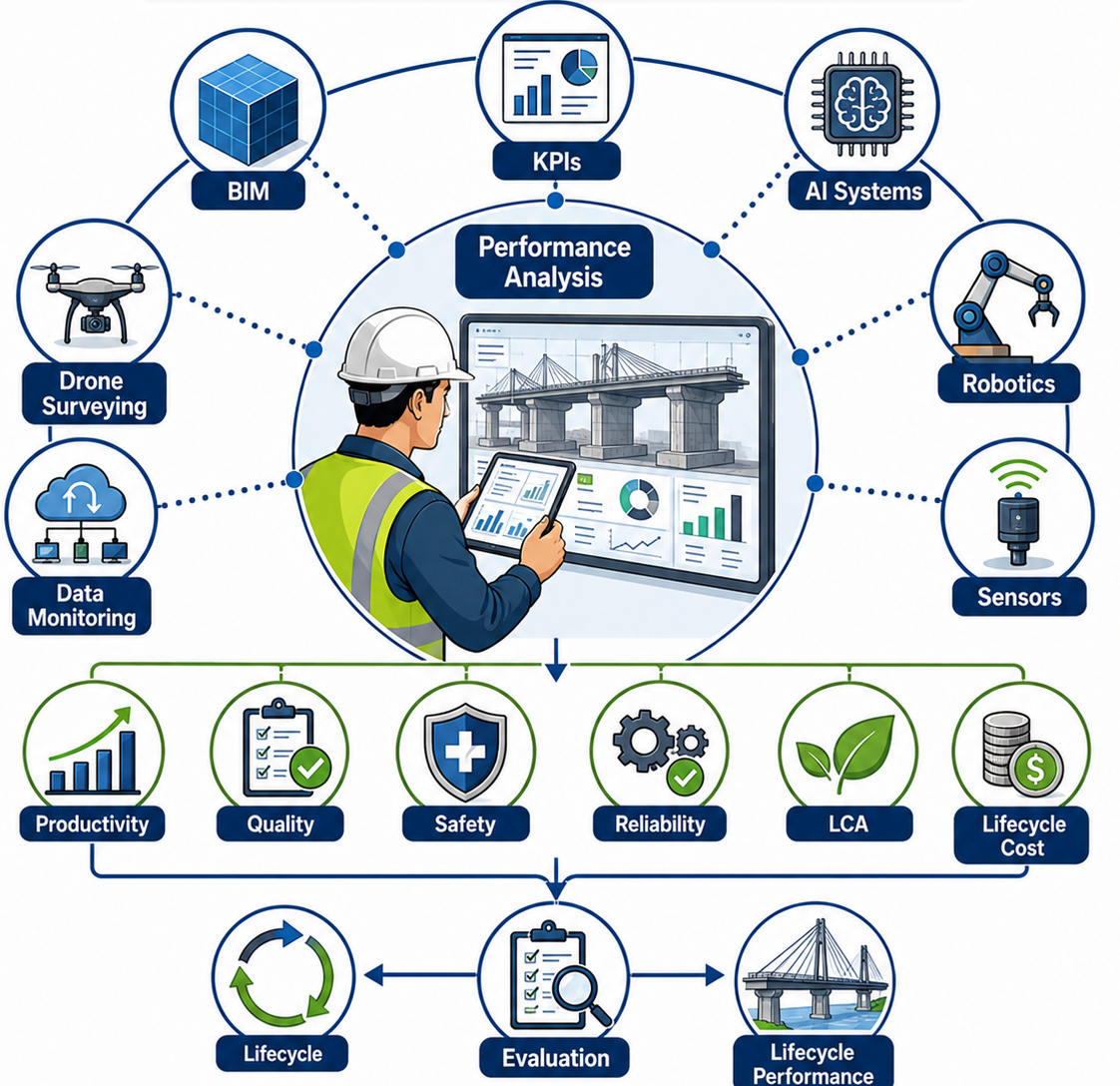
Purpose of Performance Analysis in Civil Engineering
Performance analysis is the structured evaluation of how effectively an advanced construction technology achieves predefined engineering objectives during design, construction, operation, and maintenance stages.
The primary purpose is to determine whether a technology provides measurable improvements compared with existing methods or alternative solutions.
Engineers undertake performance analysis to:
- Verify whether technology objectives have been achieved.
- Compare alternative construction solutions.
- Identify operational improvements.
- Detect performance limitations.
- Support investment decisions.
- Reduce implementation risks.
- Improve future project strategies.
- Optimise construction processes.
A successful analysis provides reliable evidence that supports professional engineering decisions.
Principles of Advanced Technology Performance Evaluation
The evaluation of advanced construction technologies should follow a structured and objective approach. Engineers must ensure that performance assessments are based on measurable evidence rather than assumptions.
Several key principles guide effective evaluation.
Evidence-Based Assessment
Technology performance should be evaluated using reliable engineering evidence collected from:
- Site monitoring.
- Testing results.
- Digital records.
- Inspection data.
- Productivity measurements.
- Quality reports.
- Lifecycle assessments.
Evidence-based assessment enables engineers to determine whether claimed benefits are achieved in practical applications.
For example, a manufacturer may claim that an automated construction system reduces installation time by 30%. Engineers should verify this claim through actual project data rather than accepting the statement without validation.
Performance Against Defined Objectives
Advanced technologies should always be assessed against clearly established project objectives.
These objectives may include:
- Reducing construction duration.
- Improving structural reliability.
- Lowering lifecycle costs.
- Reducing environmental impacts.
- Improving construction quality.
- Increasing workforce safety.
- Enhancing asset management.
Without clearly defined objectives, it becomes difficult to determine whether a technology has delivered meaningful value.
Whole-Life Performance Evaluation
Technology evaluation should consider performance throughout the complete asset lifecycle rather than focusing only on construction activities.
Whole-life assessment considers:
- Initial implementation.
- Construction performance.
- Operational efficiency.
- Maintenance requirements.
- Repair frequency.
- Asset durability.
- End-of-life considerations.
A technology that provides short-term construction benefits but creates higher maintenance requirements may not represent the best engineering solution.
Multi-Criteria Evaluation Approach
Advanced technologies often influence several aspects of project performance simultaneously. Therefore, engineers should avoid evaluating technologies using only one performance measure.
For example, a prefabrication system may:
- Reduce construction duration.
- Improve quality consistency.
- Reduce site labour requirements.
- Lower construction waste.
- Increase transportation challenges.
A complete assessment must consider both advantages and limitations.
Performance Evaluation Framework
A structured performance evaluation framework enables engineers to assess technologies consistently across different projects.
The evaluation process generally includes:
Define Performance Requirements
The first stage involves establishing what the technology is expected to achieve.
Engineers should define:
- Required technical outcomes.
- Project constraints.
- Performance targets.
- Acceptance criteria.
- Monitoring requirements.
For example, when evaluating smart monitoring systems for a bridge, engineers may define requirements related to structural movement detection, data accuracy, reliability, and maintenance planning.
Select Evaluation Criteria
Appropriate evaluation criteria should be selected according to project objectives.
Common criteria include:
- Structural performance.
- Construction productivity.
- Operational reliability.
- Energy efficiency.
- Durability.
- Quality performance.
- Environmental impact.
- Lifecycle cost.
- Safety performance.
- Maintainability.
Collect Performance Data
Accurate data collection is essential for reliable evaluation.
Data sources may include:
- Sensor monitoring systems.
- Construction records.
- Digital models.
- Inspection reports.
- Equipment data.
- Quality management systems.
- Environmental monitoring systems.
Analyse Results
Collected information should be analysed to determine whether the technology has achieved the intended objectives.
Analysis methods may include:
- Performance comparisons.
- Trend analysis.
- Benchmarking.
- Lifecycle assessment.
- Cost-benefit evaluation.
- Risk assessment.
Make Engineering Recommendations
The final stage involves interpreting results and making professional recommendations.
Engineers may recommend:
- Wider technology adoption.
- Additional testing.
- Process modifications.
- Alternative solutions.
- Further monitoring.
Key Performance Indicators (KPIs) for Technology Analysis
Key Performance Indicators (KPIs) are measurable values used to evaluate whether advanced construction technologies are achieving expected outcomes.
KPIs provide objective evidence that allows engineers to compare performance before and after technology implementation.
Effective KPIs should be:
- Relevant to project objectives.
- Measurable.
- Reliable.
- Consistent.
- Easy to interpret.
- Connected to engineering outcomes.
Types of Engineering Performance Indicators
Different technologies require different performance measurements. However, common civil engineering KPIs include:
Construction Productivity Indicators
These measure improvements in project delivery efficiency.
Examples include:
- Output achieved per working day.
- Reduction in construction duration.
- Improved resource utilisation.
- Increased equipment efficiency.
For example, automated earthmoving equipment may be evaluated by comparing excavation output before and after implementation.
Quality Performance Indicators
Quality indicators assess whether technology improves construction accuracy and reduces defects.
Examples include:
- Number of defects.
- Rework requirements.
- Dimensional accuracy.
- Inspection results.
- Compliance with specifications.
Digital inspection technologies, for example, may improve quality control by providing more accurate and consistent inspection records.
Environmental Performance Indicators
Environmental KPIs assess whether technologies contribute to sustainability objectives.
Examples include:
- Carbon emissions.
- Energy consumption.
- Material waste.
- Water usage.
- Resource efficiency.
These indicators are increasingly important as construction projects aim to reduce environmental impacts.
Safety Performance Indicators
Safety indicators evaluate whether technologies reduce risks to workers and improve site safety.
Examples include:
- Incident frequency.
- Hazard exposure.
- Unsafe activity reduction.
- Remote inspection capability.
For example, drone inspection technology may reduce the requirement for engineers to access hazardous locations.
Lifecycle Performance Indicators
Lifecycle indicators assess long-term asset value.
Examples include:
- Maintenance frequency.
- Repair requirements.
- Asset availability.
- Total ownership cost.
These indicators help determine whether a technology provides sustainable long-term benefits.
Performance Indicators Used in Civil Engineering
| Performance Indicator | Engineering Purpose | Typical Measurement |
|---|---|---|
| Construction productivity | Evaluate delivery efficiency | Output per working day |
| Material waste | Assess resource efficiency | Percentage waste reduction |
| Energy consumption | Measure operational efficiency | Energy usage data |
| Construction quality | Evaluate compliance | Defect frequency |
| Safety performance | Assess risk reduction | Incident records |
| Lifecycle cost | Determine long-term value | Total ownership cost |
Using multiple KPIs provides a comprehensive understanding of technology performance and prevents decisions being based on a single measurement.
Analysing Structural Performance of Advanced Technologies
Structural performance remains one of the most critical considerations when analysing advanced construction technologies. Regardless of technological innovation, all construction solutions must maintain structural safety, stability, serviceability, and durability throughout their intended design life.
Engineers must evaluate whether advanced technologies improve structural performance without introducing additional risks or excessive complexity.
Structural Performance Assessment Factors
Key factors include:
Load Resistance
Engineers assess whether the technology can withstand expected structural actions, including:
- Permanent loads.
- Variable loads.
- Environmental forces.
- Dynamic effects.
- Extreme events.
For example, advanced materials or construction methods used in bridge systems must demonstrate adequate resistance to traffic loading and environmental exposure.
Structural Stability
Technology applications must maintain overall structural stability during construction and operation.
Engineers evaluate:
- Structural behaviour.
- Connection performance.
- Deformation control.
- Failure mechanisms.
Serviceability Performance
Serviceability evaluates whether the structure performs effectively under normal operating conditions.
Assessment includes:
- Deflection control.
- Crack development.
- Vibration behaviour.
- Operational requirements.
Durability Performance
Advanced technologies should contribute to improved durability by reducing deterioration mechanisms.
Engineers consider resistance against:
- Corrosion.
- Moisture penetration.
- Chemical attack.
- Fatigue damage.
- Environmental exposure.
Practical Application Example
A contractor introduces automated concrete placement technology for a major infrastructure project. Before approving widespread use, engineers evaluate:
- Placement accuracy.
- Concrete quality.
- Productivity improvement.
- Labour requirements.
- Defect rates.
- Equipment reliability.
The assessment demonstrates improved consistency and reduced rework compared with traditional placement methods. However, engineers also identify the need for specialist operator training and additional maintenance support.
The analysis confirms that the technology provides engineering value when supported by appropriate implementation controls.
Evaluating Construction Productivity Through Advanced Technologies
Construction productivity is one of the most important factors considered when analysing the performance of advanced construction technologies. Infrastructure projects are increasingly required to achieve shorter programmes, improved resource efficiency, and greater certainty in project delivery. Advanced technologies are assessed according to their ability to improve workflow, reduce delays, optimise resources, and increase the efficiency of construction operations.
Engineers must evaluate productivity improvements objectively rather than assuming that technology adoption automatically results in better performance. A technology may increase productivity in one area while creating challenges elsewhere. For example, automated construction equipment may improve production rates but require additional training, maintenance support, and specialist technical knowledge.
Productivity analysis should therefore consider both direct and indirect impacts.
Direct productivity improvements may include:
- Faster task completion.
- Reduced manual operations.
- Improved equipment utilisation.
- Increased production accuracy.
- Reduced downtime.
Indirect productivity improvements may include:
- Improved coordination.
- Reduced rework.
- Better project information management.
- Improved planning accuracy.
- Enhanced decision-making.
Productivity Assessment Methods
Engineers use several methods to evaluate whether advanced technologies improve construction productivity.
Programme Performance Analysis
Programme analysis compares planned and actual project delivery performance.
Engineers assess:
- Activity completion times.
- Critical path improvements.
- Reduction in delays.
- Construction sequencing efficiency.
- Programme certainty.
For example, prefabricated construction systems may be assessed by comparing installation duration against traditional construction methods.
Resource Utilisation Assessment
Advanced technologies should improve the efficiency of labour, materials, and equipment resources.
Engineers evaluate:
- Equipment operating hours.
- Labour productivity.
- Material consumption.
- Site efficiency.
- Resource wastage.
Digital planning systems, for example, may improve resource allocation by providing better visibility of construction activities.
Workflow Improvement Analysis
Technology performance should also be evaluated based on its ability to improve construction workflows.
Engineers consider whether technology:
- Reduces unnecessary processes.
- Improves communication.
- Minimises waiting times.
- Supports better coordination.
- Reduces repetitive activities.
Assessing Environmental Performance of Construction Technologies
Environmental performance has become a critical factor when evaluating advanced construction technologies. Modern infrastructure projects must achieve improved performance while reducing environmental impacts associated with material production, construction activities, operation, and maintenance.
Engineers analyse environmental performance to determine whether technologies contribute towards sustainable construction objectives.
Environmental assessment may include:
- Carbon emissions.
- Energy consumption.
- Material efficiency.
- Waste reduction.
- Water consumption.
- Pollution control.
- Resource conservation.
Carbon Performance Evaluation
Carbon reduction is a major consideration when assessing modern construction technologies.
Engineers evaluate:
- Embodied carbon from materials.
- Energy consumption during construction.
- Transportation impacts.
- Operational emissions.
- Maintenance-related emissions.
For example, a prefabrication system may reduce environmental impacts by reducing material waste and improving manufacturing efficiency. However, transportation requirements must also be considered as part of the overall assessment.
Waste Reduction Analysis
Advanced technologies can significantly influence construction waste generation.
Performance evaluation may examine:
- Material optimisation.
- Cutting accuracy.
- Rework reduction.
- Recycling opportunities.
- Resource efficiency.
Digital design technologies such as BIM can support waste reduction by improving quantity accuracy and reducing design conflicts before construction begins.
Lifecycle Assessment (LCA) in Technology Evaluation
Lifecycle Assessment (LCA) is an important methodology used by engineers to evaluate the environmental performance of construction technologies throughout their complete lifecycle.
Unlike traditional assessments that focus only on construction impacts, LCA considers environmental effects from material production through to end-of-life.
Stages of Lifecycle Assessment
The main lifecycle stages include:
Raw Material Extraction
Engineers assess:
- Resource consumption.
- Environmental impacts.
- Energy requirements.
Material Manufacturing
Evaluation considers:
- Production energy.
- Manufacturing emissions.
- Material efficiency.
Transportation
Engineers analyse:
- Transport distance.
- Fuel consumption.
- Logistics efficiency.
Construction Phase
Assessment includes:
- Site energy use.
- Construction waste.
- Equipment emissions.
- Installation efficiency.
Operation and Maintenance
Engineers evaluate:
- Energy requirements.
- Maintenance frequency.
- Repair requirements.
- Operational efficiency.
End-of-Life Management
Assessment considers:
- Recycling potential.
- Material recovery.
- Disposal impacts.
LCA enables engineers to compare competing technologies based on overall environmental performance rather than initial construction impacts alone.
Operational Reliability of Advanced Construction Technologies
Operational reliability refers to the ability of a construction technology to perform consistently under expected conditions without excessive failures, interruptions, or performance degradation.
Reliability is particularly important for technologies used in critical infrastructure where failures may create significant safety, financial, or operational consequences.
Engineers evaluate reliability through:
- Performance monitoring.
- Failure analysis.
- Maintenance records.
- Equipment availability.
- Operational testing.
Characteristics of Reliable Technologies
A reliable construction technology should demonstrate:
- Consistent operation.
- Predictable performance.
- Low failure rates.
- Effective maintenance support.
- Availability of replacement components.
- Resistance to environmental conditions.
For example, smart monitoring systems installed on bridges must provide accurate and reliable data over extended periods to support maintenance decisions.
Technology Reliability Considerations
| Reliability Factor | Engineering Assessment | Performance Impact |
|---|---|---|
| System availability | Operational uptime | Reduced disruption |
| Data accuracy | Monitoring reliability | Improved decisions |
| Maintenance requirements | Support needs | Reduced downtime |
| Fault tolerance | Failure response | Improved resilience |
| Environmental resistance | Exposure performance | Longer service life |
Comparative Analysis of Advanced Construction Technologies
Different technologies provide different benefits depending on project objectives, constraints, and operational requirements. Engineers must avoid selecting technologies simply because they are innovative and instead evaluate their suitability for specific applications.
| Technology | Performance Benefit | Limitation | Application Area |
|---|---|---|---|
| Prefabrication | Faster construction | Transport restrictions | Bridges and buildings |
| Robotics | Improved precision | High investment | Automated tasks |
| BIM | Better coordination | Training needs | Design management |
| Drone surveying | Rapid data collection | Weather limitations | Inspection and surveys |
| AI systems | Predictive analysis | Data dependency | Planning and maintenance |
| Smart sensors | Real-time monitoring | Installation complexity | Asset management |
This comparison demonstrates that every technology has both strengths and limitations. Engineering decisions should therefore be based on project requirements, risk assessment, and expected performance outcomes.
Digital Performance Monitoring
Digital monitoring systems have significantly improved how engineers analyse construction technology performance. Modern systems can continuously collect, process, and communicate information from construction sites and operational assets.
Examples of digital monitoring technologies include:
- Digital Twins.
- Internet of Things (IoT) sensors.
- Automated inspection systems.
- Laser scanning.
- Drone monitoring.
- Cloud-based platforms.
These systems provide engineers with real-time information about:
- Structural movement.
- Material behaviour.
- Equipment performance.
- Environmental conditions.
- Construction progress.
- Asset condition.
Benefits of Digital Monitoring
Digital performance monitoring enables:
- Early identification of problems.
- Predictive maintenance.
- Improved quality control.
- Faster engineering decisions.
- Reduced operational risks.
- Better lifecycle management.
For example, structural monitoring sensors installed on a bridge can detect unusual movement patterns before they develop into serious structural issues.
Data-Driven Engineering Decision-Making
Modern construction technology evaluation increasingly relies on data-driven approaches. Large volumes of information generated through digital systems allow engineers to identify patterns, predict performance, and optimise project decisions.
Data sources include:
- BIM models.
- Digital Twin platforms.
- IoT sensors.
- Drone surveys.
- Laser scanning.
- Quality management systems.
- Asset monitoring systems.
Importance of Data Quality
Accurate data is essential for reliable engineering analysis.
Poor-quality data can result in:
- Incorrect conclusions.
- Ineffective decisions.
- Unnecessary costs.
- Increased project risks.
Engineers must therefore verify:
- Data accuracy.
- Data completeness.
- Data reliability.
- Data consistency.
Engineering Scenario: Integrated Technology Performance Evaluation
A regional transport authority introduced a combination of prefabricated bridge components, drone inspection systems, BIM coordination, and structural monitoring technology during a highway bridge replacement project.
Before full adoption, engineers established performance criteria covering:
- Construction duration.
- Structural quality.
- Environmental performance.
- Maintenance requirements.
- Safety improvements.
- Operational reliability.
Following implementation, performance analysis showed:
- Reduced construction programme duration.
- Improved component accuracy through controlled manufacturing.
- Lower material waste.
- Reduced disruption to road users.
- Improved communication between design and construction teams.
- Continuous monitoring of structural behaviour.
Although the technology required higher initial investment, lifecycle analysis demonstrated reduced maintenance requirements and improved long-term asset performance.
The project demonstrated that technology value should be measured through overall engineering outcomes rather than initial cost alone.
Challenges in Analysing Technology Performance
Although advanced technologies provide significant benefits, engineers must recognise challenges that may affect performance evaluation.
Limited Performance Data
Emerging technologies may lack sufficient long-term operational data.
Solutions include:
- Pilot projects.
- Extended monitoring periods.
- Independent testing.
- Performance benchmarking.
Integration Challenges
New technologies may not easily integrate with existing systems.
Potential issues include:
- Software compatibility.
- Data exchange limitations.
- Existing workflow conflicts.
Solutions include:
- Early compatibility assessment.
- Digital integration planning.
- Specialist technical support.
Rapid Technological Development
Technology changes quickly, creating challenges when evaluating long-term suitability.
Engineers should consider:
- Upgrade requirements.
- Future compatibility.
- Supplier support.
- Lifecycle implications.
Professional Responsibilities in Technology Performance Analysis
Civil engineers have a professional responsibility to ensure that technology performance evaluations are accurate, objective, and aligned with project objectives.
Responsibilities include:
- Establishing appropriate evaluation criteria.
- Selecting suitable KPIs.
- Reviewing technical evidence.
- Validating performance information.
- Identifying limitations.
- Managing uncertainty.
- Communicating findings clearly.
- Supporting continuous improvement.
Engineers must avoid recommending technologies based solely on innovation trends and should ensure decisions are supported by reliable engineering evidence.
Standards and Best Practice Considerations
Performance analysis should follow recognised engineering principles and industry best practices.
Relevant considerations include:
- Quality management procedures.
- Asset management principles.
- Digital information management practices.
- Environmental assessment methodologies.
- Lifecycle evaluation approaches.
Applying structured evaluation methods improves consistency and reliability in technology assessment.
- Advanced construction technologies must be analysed using objective engineering evidence rather than assumptions.
- Performance evaluation should consider productivity, structural performance, sustainability, reliability, safety, quality, and lifecycle value.
- Lifecycle Assessment provides a comprehensive method for understanding environmental impacts.
- Digital monitoring and data-driven analysis improve engineering decision-making.
- Each technology has advantages and limitations that must be evaluated against project-specific requirements.
- Professional engineers play a critical role in ensuring technology assessments support safe, sustainable, and effective infrastructure delivery.
3. Integrate High-Performance Materials into Construction Designs, Justifying Choices Made
The integration of high-performance materials into construction designs represents a critical aspect of modern civil engineering practice. Infrastructure projects are increasingly required to achieve higher levels of structural performance, durability, sustainability, and resilience while operating under more demanding environmental conditions. Engineers are therefore required to make informed material selection decisions that consider not only immediate construction requirements but also long-term performance, maintenance demands, lifecycle costs, and environmental impacts.
High-performance materials provide enhanced engineering characteristics compared with conventional materials, including improved strength, increased durability, resistance to aggressive environments, reduced maintenance requirements, and improved sustainability performance. However, their successful application depends on appropriate design integration, compatibility with other construction components, effective quality control, and a clear engineering justification for their selection.
Material selection is not simply a process of choosing the strongest or most advanced available option. Professional engineers must evaluate whether a material is suitable for the specific structural, environmental, operational, and economic conditions of a project. A technically superior material may not always provide the best engineering solution if it introduces constructability challenges, excessive costs, limited availability, or maintenance difficulties.
This assessment criterion focuses on the ability to integrate high-performance materials into construction designs through systematic engineering evaluation. It requires consideration of material properties, design requirements, construction processes, environmental conditions, and lifecycle performance to ensure that material choices provide measurable value throughout the service life of infrastructure assets.
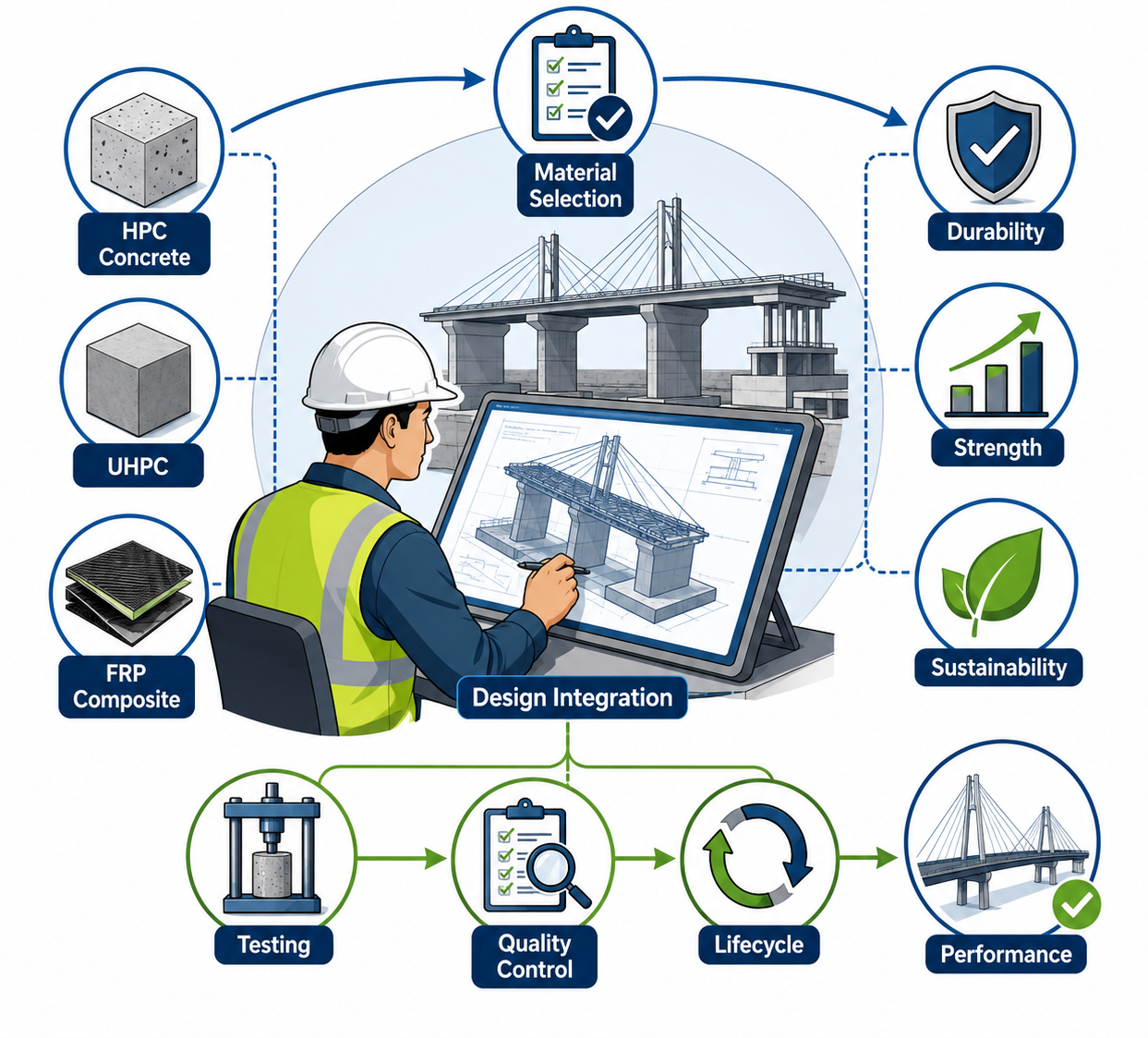
Understanding High-Performance Construction Materials
High-performance materials are advanced engineering materials designed to provide superior performance characteristics compared with conventional alternatives. These materials are developed through improvements in composition, manufacturing processes, reinforcement techniques, or material combinations to achieve enhanced mechanical, durability, environmental, or functional properties.
In civil engineering applications, high-performance materials are commonly used where conventional materials may not provide adequate performance due to demanding conditions such as:
- Heavy structural loading.
- Extreme environmental exposure.
- Long service-life requirements.
- Limited access for maintenance.
- Sustainability targets.
- Reduced construction programmes.
- Complex structural requirements.
Examples of high-performance materials include:
- High-performance concrete (HPC).
- Ultra-high-performance concrete (UHPC).
- Fibre-reinforced concrete.
- Self-healing concrete.
- Geopolymer concrete.
- Fibre-reinforced polymer (FRP) composites.
- High-strength steel.
- Advanced insulation materials.
- Low-carbon construction materials.
- Smart materials with monitoring capabilities.
The successful use of these materials requires engineers to understand both their advantages and limitations within the context of a specific construction system.
Principles of Material Integration in Construction Design
Integrating advanced materials into construction design requires a coordinated approach where material properties support the overall performance requirements of the structure.
The main principles include:
Performance-Based Material Selection
Performance-based selection focuses on defining what the material must achieve rather than selecting materials based only on traditional specifications.
Engineers establish performance requirements such as:
- Required structural strength.
- Durability expectations.
- Environmental resistance.
- Thermal performance.
- Fire resistance.
- Maintenance requirements.
- Sustainability objectives.
- Expected service life.
This approach allows engineers to evaluate innovative materials while ensuring that the selected solution meets project requirements.
Compatibility with Structural Systems
A high-performance material must function effectively within the wider construction system. Engineers must evaluate compatibility between:
- Structural elements.
- Connection systems.
- Existing materials.
- Construction methods.
- Protective systems.
- Maintenance strategies.
For example, introducing a corrosion-resistant reinforcement system into a concrete structure requires consideration of concrete chemistry, bond performance, construction methods, and long-term behaviour.
Lifecycle Performance Consideration
Material decisions should consider the complete lifecycle of an asset rather than only initial construction requirements.
Lifecycle considerations include:
- Material production impacts.
- Construction requirements.
- Operational performance.
- Inspection requirements.
- Maintenance frequency.
- Repair requirements.
- Replacement needs.
- End-of-life considerations.
A material with a higher initial cost may provide greater economic value if it significantly reduces maintenance requirements and extends service life.
Engineering Evaluation of Material Properties
Before integrating high-performance materials into designs, engineers must evaluate their technical properties and suitability for the intended application.
Mechanical Performance
Mechanical properties determine how materials respond to applied structural actions.
Important characteristics include:
- Compressive strength.
- Tensile strength.
- Flexural strength.
- Elastic modulus.
- Fatigue resistance.
- Impact resistance.
- Load-bearing capacity.
For example, ultra-high-performance concrete provides exceptional compressive strength, allowing engineers to design thinner structural elements while maintaining required performance.
Durability Performance
Durability is one of the most important factors when selecting construction materials, particularly for infrastructure exposed to aggressive environments.
Engineers evaluate resistance against:
- Chloride penetration.
- Carbonation.
- Sulphate attack.
- Freeze-thaw cycles.
- Chemical exposure.
- Abrasion.
- Moisture ingress.
- Corrosion mechanisms.
Improved durability reduces maintenance requirements and increases the operational reliability of infrastructure assets.
Environmental Performance
Modern material selection increasingly considers environmental impacts alongside technical performance.
Environmental evaluation may include:
- Embodied carbon.
- Energy consumption during production.
- Recycled content.
- Resource efficiency.
- Waste generation.
- Transportation impacts.
- End-of-life recyclability.
Engineers must balance environmental benefits with structural reliability and long-term performance.
Integrating Advanced Concrete Materials
Concrete technology has advanced significantly through improvements in mix design, additives, reinforcement systems, and manufacturing techniques.
High-Performance Concrete (HPC)
High-performance concrete is designed to achieve enhanced strength, durability, and workability compared with conventional concrete.
Typical improvements are achieved through:
- Reduced water-cement ratio.
- Optimised aggregate grading.
- Supplementary cementitious materials.
- Chemical admixtures.
- Improved curing methods.
Applications include:
- Bridges.
- Tunnels.
- Marine structures.
- High-rise buildings.
- Industrial facilities.
Advantages include:
- Increased durability.
- Reduced permeability.
- Improved structural performance.
- Longer service life.
However, engineers must consider:
- Higher material costs.
- Specialist mixing requirements.
- Quality control demands.
- Skilled workforce requirements.
Ultra-High-Performance Concrete (UHPC)
UHPC represents an advanced development in concrete technology, offering extremely high strength and exceptional durability.
Engineering benefits include:
- Very high compressive strength.
- Excellent crack resistance.
- Reduced permeability.
- Improved resistance to environmental deterioration.
- Reduced maintenance requirements.
Typical applications include:
- Bridge connections.
- Structural rehabilitation.
- Thin structural components.
- Critical infrastructure.
The selection of UHPC must be justified carefully because the higher material cost may not always be economically suitable for conventional applications.
Fibre-Reinforced Materials
Fibre reinforcement improves material behaviour by controlling cracking, increasing toughness, and enhancing durability.
Common fibres include:
- Steel fibres.
- Glass fibres.
- Carbon fibres.
- Synthetic fibres.
Applications include:
- Tunnel linings.
- Industrial floors.
- Bridge repairs.
- Structural strengthening.
Engineers must consider fibre compatibility, distribution, installation methods, and long-term performance.
Advanced Composite Materials
Composite materials combine different materials to achieve improved engineering performance.
Fibre-reinforced polymer (FRP) systems are widely used due to their:
- High strength-to-weight ratio.
- Corrosion resistance.
- Lightweight characteristics.
- Ease of installation.
Applications include:
- Bridge strengthening.
- Structural rehabilitation.
- Marine structures.
- Seismic upgrading.
However, engineers must consider:
- Fire behaviour.
- Long-term durability data.
- Installation expertise.
- Inspection requirements.
Material Selection and Engineering Justification Process
The selection of high-performance materials should follow a structured engineering methodology.
| Evaluation Stage | Engineering Considerations | Purpose |
|---|---|---|
| Requirement assessment | Structural, environmental, operational needs | Define performance objectives |
| Material evaluation | Strength, durability, sustainability | Compare suitable materials |
| Design integration | Compatibility and constructability | Ensure practical application |
| Lifecycle assessment | Maintenance and long-term costs | Evaluate overall value |
| Final justification | Technical and economic evidence | Support professional decision |
This process ensures that material choices are based on engineering evidence rather than preference or short-term considerations.
Practical Application: Coastal Bridge Construction
A civil engineering team was responsible for designing a replacement coastal bridge exposed to marine conditions. The existing structure had experienced premature deterioration caused by chloride ingress and reinforcement corrosion.
The engineering team evaluated several material options, including conventional concrete, high-performance concrete, and composite reinforcement solutions.
The final design incorporated:
- High-performance concrete with reduced permeability.
- Enhanced reinforcement protection.
- Improved drainage detailing.
- Increased durability requirements.
The material selection was justified based on:
- Improved resistance to chloride penetration.
- Extended service life.
- Reduced maintenance requirements.
- Lower lifecycle costs.
- Improved sustainability performance.
Although the initial construction cost increased, lifecycle analysis demonstrated that the selected solution provided greater long-term value by reducing future repair requirements.
Challenges in Integrating High-Performance Materials
Despite their advantages, advanced materials can introduce technical and practical challenges.
Common challenges include:
Higher Initial Costs
Some high-performance materials require greater upfront investment due to:
- Advanced manufacturing processes.
- Specialist ingredients.
- Additional testing requirements.
- Skilled installation.
Engineers must therefore justify decisions using lifecycle cost analysis rather than initial cost alone.
Limited Contractor Experience
Innovative materials may require specialist knowledge and installation techniques.
Solutions include:
- Early contractor involvement.
- Specialist training.
- Supplier technical support.
- Trial installations.
Quality Control Requirements
Advanced materials often have narrower performance requirements and require careful monitoring.
Quality measures include:
- Material certification.
- Laboratory testing.
- Production monitoring.
- Site inspection.
- Performance verification.
Material Availability
Some advanced materials may have limited availability depending on location and supply chain capability.
Engineers should consider:
- Local availability.
- Transportation requirements.
- Supplier reliability.
- Alternative materials.
Professional Responsibilities in Material Selection
Engineers integrating high-performance materials are responsible for ensuring that material choices are technically justified, safe, sustainable, and suitable for the intended application.
Professional responsibilities include:
- Assessing material performance data.
- Reviewing manufacturer information.
- Evaluating environmental conditions.
- Ensuring compliance with relevant standards.
- Considering lifecycle impacts.
- Managing construction risks.
- Communicating design decisions clearly.
- Maintaining accurate technical documentation.
Material selection decisions should always demonstrate professional judgement and evidence-based reasoning.
Standards and Best Practice Considerations
High-performance material selection and application should consider relevant engineering standards and recognised best practices, including:
- Eurocodes for structural design.
- BS EN material standards.
- Concrete durability guidance.
- Quality management requirements.
- Sustainability assessment frameworks.
Compliance with recognised standards ensures that innovative materials are implemented safely and consistently.
- High-performance materials improve construction systems through enhanced strength, durability, sustainability, and resilience.
- Material selection requires evaluation of structural requirements, environmental conditions, lifecycle performance, and economic factors.
- Engineers must justify material choices using technical evidence and professional judgement.
- Advanced materials such as UHPC, high-performance concrete, composites, and sustainable alternatives provide significant benefits when appropriately applied.
- Successful integration depends on effective design coordination, quality assurance, specialist knowledge, and consideration of whole-life performance.
Conclusion
The design and implementation of high-performance construction systems require civil engineers to adopt a comprehensive approach that combines advanced materials, innovative technologies, sustainable practices, and lifecycle engineering principles. Optimising energy efficiency and durability involves understanding how construction components interact, selecting appropriate design strategies, and ensuring that infrastructure performs effectively throughout its intended service life.
The analysis of advanced construction technologies enables engineers to evaluate whether innovative solutions provide measurable improvements in productivity, sustainability, reliability, and long-term value. Through performance monitoring, lifecycle assessment, and evidence-based decision-making, engineers can determine the suitability of technologies and ensure that implementation delivers genuine engineering benefits.
Integrating high-performance materials into construction designs requires careful consideration of structural requirements, environmental conditions, durability expectations, sustainability objectives, and economic factors. By applying professional judgement and justifying material choices through technical evaluation, engineers can deliver safer, more resilient, efficient, and sustainable infrastructure solutions that meet the complex demands of modern construction practice.