
Workplace Fire Safety Responsibilities: What Employees Must Know
Workplace fire safety is an essential part of protecting employees, visitors, contractors and other people who may be present in a business environment. A fire can develop rapidly, damage property, interrupt operations and place lives at risk. Understanding workplace fire safety responsibilities helps employees recognise hazards, follow established procedures and respond appropriately when an emergency occurs.
Fire safety is not solely the responsibility of employers or designated fire wardens. Although the person legally responsible for fire safety must arrange appropriate precautions, employees also have duties to take reasonable care, cooperate with workplace safety arrangements and report dangerous conditions. Effective fire prevention therefore depends on clear management arrangements and the active participation of everyone at work.
In the UK, workplace fire safety requirements depend on the relevant jurisdiction and the type of premises. In England and Wales, the Regulatory Reform (Fire Safety) Order 2005 establishes important duties for the responsible person and employees. Scotland and Northern Ireland operate under separate fire safety legislation and arrangements.
For employees, understanding these responsibilities means knowing how to identify fire hazards, keep escape routes clear, use equipment safely, recognise warning signals and evacuate without putting themselves or others at unnecessary risk.
This guide explains the key workplace fire safety responsibilities employees must know, the legal framework behind those duties, practical prevention measures and the actions to take during a fire emergency.
What Are Workplace Fire Safety Responsibilities?
Workplace fire safety responsibilities are the duties and practical actions required to prevent fires, reduce fire-related risks, maintain safe working conditions and protect people during emergencies.
These responsibilities include following fire safety instructions, reporting hazards, maintaining clear escape routes, handling combustible materials appropriately, participating in training and responding correctly when a fire alarm sounds.
Responsibilities vary according to a person’s role. Employers and other responsible persons arrange risk assessments, appropriate precautions and emergency procedures. Employees must cooperate with those arrangements and report relevant dangers. Fire wardens may have additional responsibilities assigned to them by their organisation.
The purpose is straightforward: prevent avoidable fires, support safe evacuation and reduce the likelihood of injury, loss of life and property damage.
Why Workplace Fire Safety Matters
Workplace fire safety protects more than buildings and equipment. It helps safeguard human life, business continuity and the wellbeing of everyone who enters a workplace.
A fire may start through faulty electrical equipment, unsafe cooking practices, overheating machinery, combustible waste, hot work or the incorrect storage of flammable substances. In some workplaces, several hazards can combine to increase the likelihood or consequences of a fire.
For example, a workshop may contain combustible materials near equipment that generates heat. If poor housekeeping allows waste to accumulate and an ignition source is not controlled, a small incident can develop into a serious emergency.
Effective fire safety arrangements help organisations identify such conditions before an incident occurs.
The main benefits include:
- Protecting employees, contractors and visitors from injury.
- Reducing the likelihood of accidental fires.
- Supporting prompt and orderly evacuation.
- Maintaining access to emergency exits and firefighting equipment.
- Reducing property damage and operational disruption.
- Improving employee awareness and confidence.
- Supporting compliance with applicable fire safety requirements.
- Encouraging a positive workplace safety culture.
Fire safety should therefore be treated as an ongoing management responsibility rather than an activity performed only during inspections or emergency drills.
UK Workplace Fire Safety Legislation
Understanding the legal framework helps employees recognise why workplace procedures must be followed and why fire hazards should be reported promptly.
The Regulatory Reform (Fire Safety) Order 2005
The Regulatory Reform (Fire Safety) Order 2005 is a principal piece of fire safety legislation for England and Wales. It places duties on the responsible person to take appropriate general fire precautions, assess fire risks, maintain suitable arrangements and provide relevant information and training.
Article 23 also establishes general duties for employees. These include taking reasonable care for their own safety and that of other relevant people, cooperating with the employer and reporting certain serious dangers or shortcomings in workplace safety arrangements. <a href=”https://www.legislation.gov.uk/uksi/2005/1541/enacted” target=”_blank” rel=”noopener noreferrer”>Read the legislation on the official UK legislation website.</a>
The Health and Safety at Work etc. Act 1974
The Health and Safety at Work etc. Act 1974 provides a wider framework for workplace health and safety in Great Britain. It addresses employers’ responsibilities to protect employees and others affected by work activities, alongside employees’ duties to take reasonable care and cooperate with relevant safety requirements.
Fire safety must be considered alongside other workplace risks, including electrical safety, machinery, hazardous substances and emergency management.
Other Relevant Requirements
Additional legislation and guidance may apply depending on the workplace, the activities being carried out and the location of the premises.
Examples include:
- The Fire Safety Act 2021, which clarified aspects of the Fire Safety Order relating to certain residential buildings in England and Wales.
- The Fire Safety (England) Regulations 2022, which introduced additional requirements for specified residential buildings in England.
- Applicable building regulations and standards relevant to the design and fire protection of premises.
- Sector-specific requirements for workplaces handling dangerous substances or carrying out higher-risk activities.
Employees do not need to interpret every legal provision independently. However, they should understand the safety instructions relevant to their work, follow established procedures and report conditions that may put people at risk.
Who Is Legally Responsible for Workplace Fire Safety?
The responsible person is generally the employer where the employer controls the workplace, or another person with relevant control over the premises, depending on the circumstances. Owners, occupiers, landlords and facilities managers may also have duties within the scope of their control.
Where several responsible persons share premises, they may need to cooperate and coordinate their fire safety arrangements. The UK government’s workplace fire safety guidance explains these responsibilities.
Employees have their own duties, but these do not remove the responsible person’s legal obligations.
The Main Workplace Fire Safety Responsibilities Employees Must Know
1. Follow Workplace Fire Safety Procedures
Every employee should understand the fire safety arrangements that apply to their workplace. These procedures should explain how to raise the alarm, which escape routes to use, where to assemble and whom to contact if a hazard is discovered.
Employees should familiarise themselves with fire action notices and follow instructions given during inductions, briefings and drills.
Procedures may differ between offices, warehouses, construction sites, factories, healthcare facilities and hospitality businesses. An employee should not assume that the arrangements used in a previous workplace will be appropriate in a new one.
If an instruction is unclear, the employee should seek clarification from a supervisor, fire warden or designated safety representative before an emergency occurs.
2. Identify and Report Fire Hazards
Identifying hazards early is one of the most practical ways employees can contribute to fire prevention.
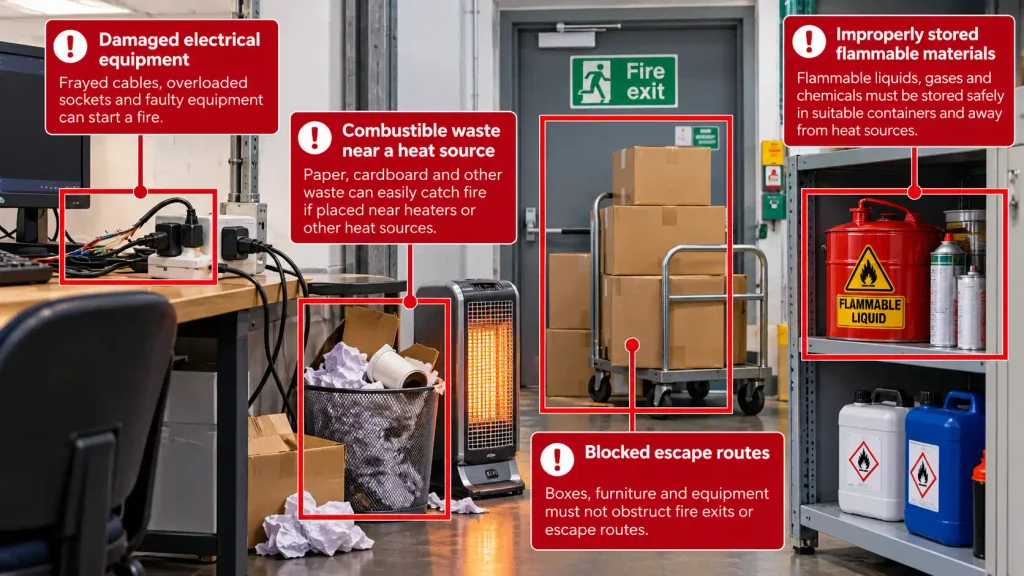
Common warning signs include damaged electrical cables, overheating equipment, combustible waste near heat sources, blocked escape routes, faulty fire doors and incorrectly stored flammable substances.
Employees should report hazards through the workplace’s established reporting process. Serious and immediate dangers should be escalated promptly in accordance with emergency procedures.
Employees should not attempt repairs or interventions beyond their training, competence and authority.
For example, if an employee notices smoke coming from an electrical socket, the correct response is not to dismantle the socket. The employee should raise the alarm or follow the emergency procedure as appropriate, warn others if safe and ensure the danger is reported.
3. Keep Fire Exits and Escape Routes Clear
Escape routes must remain available so that people can leave the building safely during an emergency.
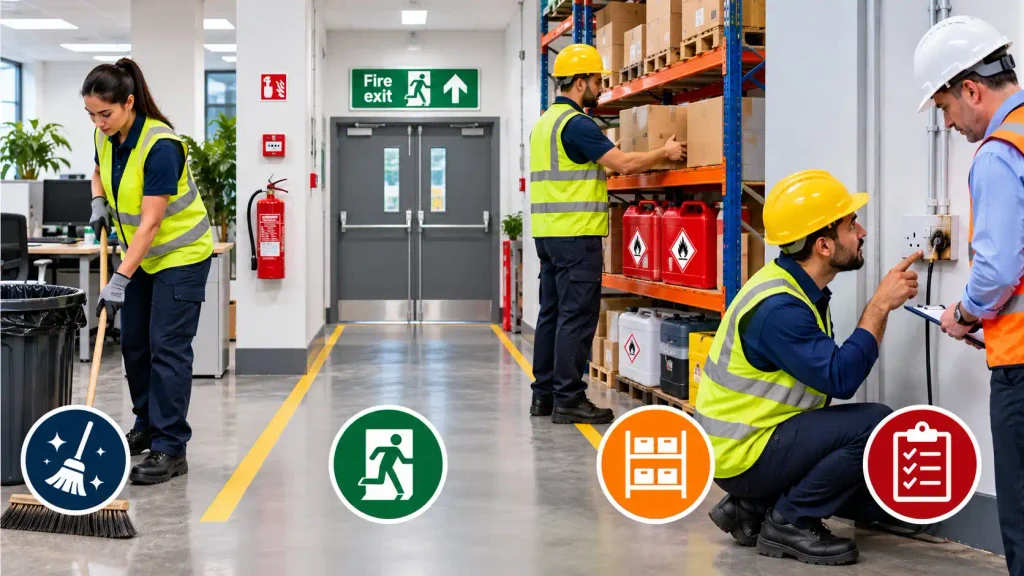
Employees should not store boxes, delivery items, waste or equipment in corridors, stairways or designated escape routes. Fire exits must not be obstructed or secured in a way that prevents emergency escape.
Fire doors must also be used correctly. Wedging a fire door open can undermine its ability to restrict the spread of smoke and fire. If a fire door appears damaged, fails to close correctly or has a defective self-closing device, the problem should be reported.
A clear escape route is particularly important when visibility is reduced or occupants are moving under pressure.
4. Use Electrical Equipment Safely
Electrical faults can create ignition sources, especially when equipment is damaged, poorly maintained or used in unsuitable conditions.
Employees should inspect equipment visually before use where appropriate and follow manufacturer instructions and workplace procedures.
Important precautions include:
- Avoiding damaged plugs, cables and electrical equipment.
- Not overloading sockets or extension leads.
- Keeping electrical equipment away from water unless designed for the environment.
- Reporting burning smells, unusual heat, sparks or repeated electrical faults.
- Switching off equipment when required by workplace procedures.
- Using only authorised charging equipment and designated charging areas where applicable.
Employees should not carry out unauthorised electrical repairs. Equipment suspected of being dangerous should be taken out of use only through a safe and authorised process.
5. Handle and Store Flammable Materials Correctly
Some workplaces use flammable liquids, gases, solvents, cleaning products, aerosols or combustible materials. These substances can increase the likelihood or severity of a fire when handled incorrectly.
Employees must follow relevant risk assessments, safety instructions, storage requirements and product information.
Flammable materials should be kept in designated storage areas, away from ignition sources and incompatible substances where required. Containers should remain properly closed when not in use, and spills should be managed using the prescribed procedure.
Waste materials contaminated with flammable substances may also require special handling and disposal.
Employees should never transfer chemicals into unlabelled containers or improvise storage arrangements. Any uncertainty about safe handling should be raised with a competent supervisor.
6. Maintain Good Housekeeping
Good housekeeping reduces opportunities for fires to start and helps prevent existing fires from spreading.
Work areas should be kept free from unnecessary combustible waste, packaging and clutter. Materials should be stored in designated places, and waste should be removed according to workplace procedures.
In warehouses, this may involve keeping aisles clear and separating stored materials from heat-generating equipment. In offices, it may involve avoiding paper accumulation around electrical equipment and ensuring that portable heaters are used only in accordance with workplace rules.
Housekeeping should be part of everyday work rather than something reserved for inspection days.
7. Understand Fire Alarm Systems and Warning Signals
Employees should know how the workplace communicates a fire emergency. This may include audible alarms, visual warning devices, voice messages or other arrangements suitable for the premises.
Everyone should understand what the alarm sounds or signals mean and what action is required.
If a fire alarm activates, employees should follow the evacuation procedure rather than assuming that the alarm is a test or false activation. Only authorised personnel should investigate or reset alarm systems under the relevant procedures.
Employees should also report alarms that appear faulty, warning devices that cannot be heard or seen in occupied areas, and any uncertainty about the evacuation signal.
8. Participate in Fire Safety Training and Drills
Fire safety training helps employees understand the hazards present in their workplace and the actions required during an emergency.
Training should be appropriate to the risks and the employee’s role. New employees need relevant instruction, while changes in responsibilities, equipment, processes or workplace risks may require additional training.
Employees should participate in drills, learn the evacuation routes and understand the assembly arrangements. Drills can help identify confusion, delays, blocked routes and other weaknesses that require improvement.
Employees should treat drills seriously and provide constructive feedback when asked.
9. Cooperate With Fire Wardens and Supervisors
Fire wardens, fire marshals and supervisors help implement workplace fire safety arrangements. Their assigned duties may include guiding evacuation, communicating hazards and supporting emergency coordination.
Employees should follow lawful and appropriate emergency instructions, cooperate with safety checks and report issues that may affect evacuation.
However, employees should not assume that a fire warden’s presence makes it safe to ignore hazards. Fire safety depends on everyone following the procedures relevant to their role.
10. Respond Safely During a Fire Emergency
When a fire is discovered or an alarm sounds, employees must prioritise life safety.
They should activate the alarm or use the designated reporting method, evacuate using the appropriate route and proceed to the assembly point. Lifts should not be used during a fire evacuation unless a specifically designed and authorised evacuation arrangement instructs otherwise.
Employees should not stop to collect personal belongings, re-enter the building to retrieve equipment or return to their workstation before being authorised to do so.
Firefighting should only be attempted where it is permitted by workplace procedures, the employee has received suitable training, the equipment is appropriate and the action can be taken without exposing anyone to unacceptable risk. Evacuation and personal safety take priority.
11. Report Defects in Fire Safety Equipment
Fire alarms, emergency lighting, fire doors, extinguishers and other protective systems must be suitable for the premises and maintained under the relevant arrangements.
Employees should report visible defects, missing equipment, damaged signs or other concerns immediately through the workplace reporting process.
For example, an employee who notices that a fire exit sign has fallen down should report it rather than assuming someone else will deal with it.
Employees must not interfere with alarm systems, disable safety devices or move firefighting equipment without authorisation.
12. Consider the Needs of Other People
Workplace fire safety must account for the people who may need additional assistance during an emergency.
Visitors, new employees, contractors and people unfamiliar with the premises may not know where to go. People with mobility, sensory or other access requirements may need specific evacuation arrangements.
Employees should follow the workplace’s procedures for assisting others without placing themselves or those individuals in additional danger.
Any assigned assistance role should be supported by suitable instructions, planning and training. Employees should not improvise hazardous rescue attempts or enter smoke-filled areas to search for missing people.
Employer Responsibilities Compared With Employee Responsibilities
Workplace fire safety involves different duties that complement one another. Understanding the distinction helps employees recognise what they should do and what must be arranged by management.
Employer and Responsible Person Duties
Depending on the applicable legislation and the person’s control over the premises, the responsible person must arrange appropriate fire safety measures. These generally include:
- Carrying out and reviewing a suitable fire risk assessment.
- Identifying people who may be at risk.
- Implementing appropriate fire prevention and protection measures.
- Providing suitable emergency procedures and escape arrangements.
- Maintaining relevant fire safety equipment and systems.
- Providing appropriate information, instruction and training.
- Arranging competent assistance where required.
- Coordinating with other responsible persons where premises are shared.
Employee Duties
Employees should:
- Take reasonable care for their own safety and that of others.
- Cooperate with the employer’s fire safety arrangements.
- Follow workplace fire safety instructions.
- Report relevant dangers and shortcomings in safety arrangements.
- Keep work areas and escape routes clear in accordance with procedures.
- Attend relevant training and participate in drills.
- Evacuate promptly when required.
- Avoid interfering with safety equipment or taking unauthorised risks.
Table 1: Employer Responsibilities vs Employee Responsibilities
| Area | Employer or Responsible Person | Employee |
|---|---|---|
| Fire risk assessment | Arrange a suitable assessment and review it | Follow relevant controls and report hazards |
| Fire prevention | Provide appropriate systems and arrangements | Work safely and avoid creating fire hazards |
| Emergency planning | Establish suitable evacuation procedures | Learn and follow the procedures |
| Training | Provide appropriate information and instruction | Participate and apply the training |
| Fire safety equipment | Arrange suitable maintenance and testing | Report visible defects and avoid interference |
| Escape routes | Ensure appropriate escape arrangements are provided | Keep routes clear and report obstructions |
| Emergency response | Establish arrangements and assign competent people where needed | Raise the alarm, evacuate and cooperate |
| Risk reporting | Act on reported hazards and shortcomings | Report dangers promptly |
The exact legal duties depend on the relevant legislation, the premises and the responsibilities assigned to each person. This table is a practical overview rather than a substitute for legal advice.
Common Workplace Fire Hazards Employees Should Recognise
Fire hazards vary between industries, but several risks occur across many workplaces.
Electrical Equipment and Wiring
Damaged cables, defective equipment, unsuitable charging arrangements and overloaded electrical systems may create ignition risks. Employees should follow equipment instructions and report suspected faults.
Heating and Cooking Equipment
Portable heaters, kitchen equipment and other heat-producing devices can ignite nearby combustible materials if used incorrectly. Workplace rules should determine where such equipment may be used and how it must be managed.
Hot Work
Welding, cutting, grinding and other activities that produce heat or sparks can ignite nearby combustible materials. Employees must follow the applicable hot-work authorisation, risk assessment, housekeeping and fire-watch arrangements.
Flammable Liquids and Gases
Solvents, fuels, gases and certain cleaning products can present serious fire risks. Safe storage, handling, ventilation and ignition-source control should follow the relevant risk assessment and product information.
Smoking and Ignition Sources
Smoking outside designated areas, careless disposal of smoking materials and unauthorised naked flames can introduce ignition sources. Employees should follow workplace restrictions and use only designated arrangements.
Waste and Poor Housekeeping
Cardboard, paper, packaging and other combustible waste can contribute to fire growth. Waste must be removed and stored according to the workplace’s arrangements.
Table 2: Workplace Fire Hazards and Preventive Actions
| Fire Hazard | Potential Risk | Employee Preventive Action |
|---|---|---|
| Damaged electrical cables | Electric faults or ignition | Stop unsafe use through the approved procedure and report the defect |
| Blocked escape routes | Delayed evacuation | Keep routes clear and report obstructions |
| Flammable liquids | Rapid ignition or fire spread | Follow storage and handling instructions |
| Combustible waste | Increased fire growth | Remove waste through the correct disposal process |
| Hot work | Sparks igniting nearby materials | Follow authorisation and fire prevention controls |
| Defective fire doors | Increased smoke and fire spread | Report damage or failure to close |
| Faulty alarm devices | Delayed warning | Report faults immediately |
| Unsafe heating equipment | Ignition of nearby materials | Follow workplace rules and maintain safe clearances |
Employees should never attempt to control a serious hazard beyond their training or authority. Where there is immediate danger, they should follow the emergency procedure and protect life first.
What Should Employees Do If a Fire Breaks Out?
A fire emergency can be confusing, particularly when an alarm activates unexpectedly. Employees should learn the workplace’s specific evacuation procedure before an incident occurs.
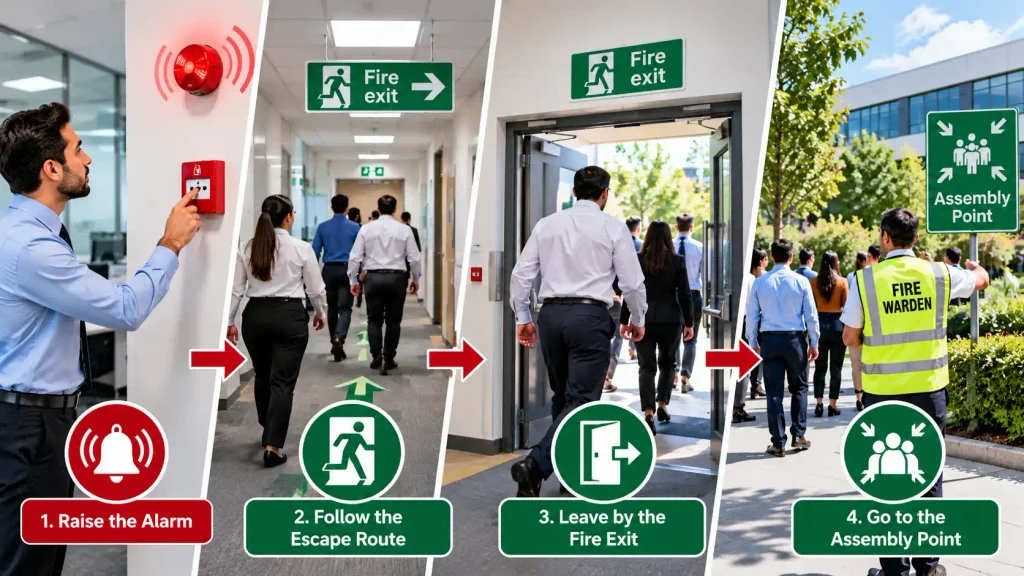
The following sequence provides a general guide. Site-specific instructions and emergency arrangements must take priority.
Step 1: Raise the Alarm
If a fire is discovered, activate the designated alarm or follow the workplace’s emergency reporting procedure. Contact the emergency services using the appropriate local emergency number and arrangements.
Do not delay the alarm while attempting to establish the full extent of the fire.
Step 2: Warn Others if Safe
Warn nearby people when this can be done without delaying evacuation or exposing anyone to danger. Follow the workplace’s arrangements for communicating the emergency.
Step 3: Evacuate Immediately
Use the nearest suitable safe escape route, following the emergency plan. Do not use ordinary lifts during a fire evacuation. Avoid routes affected by smoke, flames or other hazards.
If the usual route is blocked, use an alternative designated route where it is safe to do so.
Step 4: Assist Within the Planned Arrangements
Follow any assigned evacuation responsibilities and established arrangements for people who need assistance. Do not put yourself at risk or attempt an unplanned rescue in dangerous conditions.
Step 5: Go to the Assembly Point
Proceed to the designated assembly point and follow instructions from the fire warden or other authorised personnel.
Step 6: Report Missing People or Relevant Information
Tell the designated person or emergency services if someone may still be inside, if a route is blocked or if there is important information about the fire. Do not re-enter the building to investigate.
Step 7: Wait for Authorisation
Remain at the assembly point until authorised personnel or the emergency services confirm that it is safe to leave or re-enter, in accordance with the workplace procedure.
Flowchart 1: Workplace Fire Emergency Response
[TEXT FLOWCHART — Employee discovers a fire or hears the fire alarm]
Employee discovers fire / alarm sounds
↓
Raise the alarm and alert others if safe
↓
Leave by the nearest suitable safe escape route
↓
Avoid lifts and areas affected by smoke or flames
↓
Proceed to the designated assembly point
↓
Report missing people or relevant hazards
↓
Wait for instructions and authorisation
Important: Never delay evacuation to collect belongings, investigate the fire or attempt firefighting beyond your training and safe operating conditions.
Fire Wardens and Fire Marshals: What Employees Should Understand
Fire wardens and fire marshals are employees or other designated individuals assigned specific responsibilities within workplace fire safety arrangements.
Their duties depend on the organisation’s emergency plan, the risks present and their level of training.
Possible responsibilities include helping communicate evacuation instructions, supporting an orderly evacuation, identifying hazards within their assigned area where safe, reporting relevant information and cooperating with emergency services.
Employees should know how to identify the designated fire wardens and understand the instructions they may provide during an emergency.
However, a fire warden is not expected to undertake unsafe firefighting or rescue work simply because of the role. Their responsibilities must be supported by appropriate arrangements, competence and training.
Ordinary employees should not assume they have the same duties or authority as a designated fire warden. They should follow the established evacuation procedure and avoid actions that could put themselves or others in danger.
What Should Employees Know About Fire Extinguishers?
Fire extinguishers can be useful for controlling certain small fires when the circumstances and workplace procedures permit their use. However, extinguishers are not a substitute for raising the alarm, evacuating or maintaining suitable fire prevention measures.
Employees should only use firefighting equipment if they have received appropriate instruction, the equipment is suitable for the type of fire and they can act without unacceptable risk.
Different extinguishers are designed for different fire risks. Using an unsuitable extinguisher can make a situation more dangerous. For example, applying water to energised electrical equipment or certain burning liquids may create additional hazards.
Employees should therefore understand the limitations of the equipment available in their workplace and follow the training provided.
If a fire is growing, smoke is spreading, the escape route is threatened or there is any uncertainty about safe intervention, employees should evacuate and leave firefighting to appropriately equipped and trained personnel.
Fire Safety Training: What Employees Need to Learn
Fire safety training should be relevant to the risks of the workplace and the duties of each employee.
At induction, employees should receive information about the emergency arrangements, fire alarm signals, escape routes, assembly points and relevant hazards. Additional instruction may be needed when work activities, equipment, responsibilities or risks change.
The training provided should enable employees to understand:
- Common workplace fire hazards and prevention measures.
- How to report fire risks and defective safety equipment.
- The meaning of fire alarms and emergency signals.
- Escape routes and alternative evacuation arrangements.
- Assembly points and emergency communication.
- Procedures for assisting people who may need support.
- The limits of their role during an emergency.
- The safe use of firefighting equipment, where relevant to their role.
Training should be reinforced through suitable briefings, practice and review. Employees should raise questions if instructions are unclear or if workplace changes create new hazards.
The UK government’s guidance on fire safety equipment, drills and training provides further information about these arrangements.
How Employees Can Improve Workplace Fire Safety Every Day
Fire prevention becomes more effective when safe behaviour is incorporated into everyday work.
Employees can make a practical contribution by checking that their work areas are orderly, using equipment correctly, keeping escape routes clear and reporting hazards before they develop into emergencies.
Supervisors can reinforce these practices by encouraging prompt reporting, addressing recurring problems and ensuring that employees understand their responsibilities.
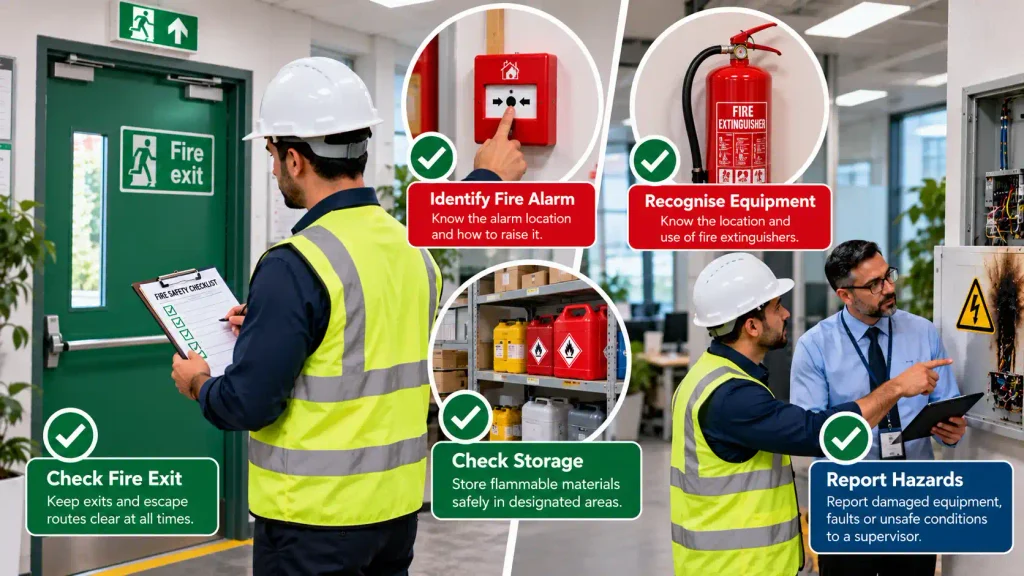
A useful approach is to incorporate simple fire safety checks into normal working routines, where these checks are consistent with workplace procedures and assigned responsibilities.
Daily Fire Safety Awareness Checklist
Employees can use the following checklist as a general awareness guide, alongside the checks formally assigned by the employer.
- Check the work area for visible fire hazards.
- Keep corridors, stairways and fire exits unobstructed.
- Follow safe procedures for electrical equipment.
- Store flammable materials in designated locations.
- Remove waste through the approved disposal process.
- Report damaged fire doors, signs or safety equipment.
- Know the nearest suitable escape route.
- Understand the alarm signal and assembly point.
- Follow instructions from designated safety personnel.
- Participate in relevant training and emergency drills.
This checklist does not replace formal inspections, equipment testing, fire risk assessments or other duties assigned to competent personnel.
Flowchart 2: Everyday Fire Prevention
Observe the work area
↓
Identify a fire hazard or unsafe condition
↓
Is there an immediate danger?
↓
Yes → Follow emergency procedures, warn others if safe and raise the alarm where required
↓
No → Report the hazard through the workplace procedure
↓
Follow instructions and avoid unsafe intervention
↓
Confirm the issue has been escalated or addressed through the appropriate process
Employees should never assume that a reported hazard has been resolved without appropriate confirmation where their role requires follow-up.
Common Fire Safety Mistakes Employees Should Avoid
Even employees who understand the basic rules can unintentionally increase fire risk through unsafe habits or assumptions.
Blocking Fire Exits
Leaving boxes, equipment or deliveries in escape routes may delay evacuation. Temporary obstructions should not be accepted as harmless simply because they are expected to be removed later.
Ignoring Small Hazards
A damaged cable, unusual burning smell or defective fire door may appear minor, but it could indicate a significant problem. Employees should report relevant concerns promptly.
Assuming an Alarm Is False
Employees should treat an activated fire alarm seriously and follow the established emergency procedure unless authorised instructions clearly indicate another action.
Using Fire Extinguishers Without Training
Attempting to fight a fire without suitable instruction or equipment can expose the employee to smoke, heat or rapidly changing conditions. Personal safety and evacuation take priority.
Leaving Fire Doors Open
Fire doors may be designed to restrict the movement of smoke and flames. Propping them open can undermine their function unless a suitable, authorised hold-open system is installed and operates as intended.
Ignoring Changes in Workplace Conditions
New equipment, changed storage arrangements, maintenance work and temporary contractors can introduce unfamiliar risks. Employees should follow updated instructions and report concerns.
Failing to Report Defects
A fire alarm fault or damaged emergency light should not be left unreported because someone else may have noticed it. Prompt reporting supports timely corrective action.
Returning to the Building Too Early
Employees must not re-enter the building to retrieve personal belongings or resume work before the appropriate authorisation has been given.
Workplace Fire Safety in Different Industries
Although the underlying principles are similar, the practical responsibilities of employees vary according to the workplace environment.
Office Environments
Office employees should pay attention to electrical equipment, charging devices, paper storage, kitchen facilities and clear evacuation routes. They should understand alarm signals and the location of assembly points.
Warehouses and Distribution Centres
Warehouse employees may work around combustible packaging, vehicle charging areas, storage racks and equipment that generates heat. They should follow designated storage arrangements, maintain clear access routes and report damaged electrical or mechanical equipment.
Construction Sites
Construction work can involve temporary electrical installations, hot work, fuel storage and changing escape routes. Employees should follow site-specific fire procedures, permit requirements where applicable and instructions relating to temporary works.
Factories and Workshops
Manufacturing environments may involve machinery, combustible dust, flammable substances and high-temperature processes. Employees should follow task-specific risk controls and report unsafe equipment or storage arrangements.
Healthcare and Care Settings
Fire safety planning in healthcare and care environments must consider people who may need assistance to evacuate, including individuals with limited mobility or other support needs. Employees should understand their assigned responsibilities and follow the site’s emergency arrangements.
Hospitality and Catering
Kitchens may involve cooking oils, gas equipment, hot surfaces and combustible packaging. Employees should follow procedures for cooking equipment, extraction systems, cleaning and the safe management of cooking-related fire risks.
Across all these environments, employees should apply the training and instructions relevant to their own workplace rather than relying on general assumptions.
How Organisations Can Build a Strong Workplace Fire Safety Culture
A strong fire safety culture develops when management provides effective arrangements and employees actively support them.
Clear responsibilities are important, but written procedures alone are insufficient. Employees must understand the arrangements, have opportunities to ask questions and know how to report concerns.
Organisations can strengthen fire safety through regular communication, suitable training, appropriate maintenance, review of reported hazards and learning from drills or incidents.
Supervisors should encourage employees to report hazards without unnecessary delay. Repeated issues, such as blocked exits or damaged equipment, should be investigated so that underlying causes can be addressed.
Fire safety arrangements should also be reviewed when workplaces change. Alterations to layouts, equipment, storage, occupancy or work processes may affect the risks and require updates to the fire risk assessment and emergency plan.
The aim is to make fire prevention a routine part of safe working practices rather than an occasional compliance exercise.
Table 3: Workplace Fire Safety Responsibilities Checklist
| Responsibility | What Employees Should Do | When |
|---|---|---|
| Hazard awareness | Identify and report relevant fire hazards | During work activities |
| Escape routes | Keep assigned areas clear and report obstructions | Routinely |
| Electrical safety | Follow equipment instructions and report faults | Before and during use, as appropriate |
| Material storage | Follow designated storage and handling procedures | Whenever handling materials |
| Alarm awareness | Know the warning signal and evacuation procedure | During induction and when arrangements change |
| Training | Attend and apply relevant instruction | As required |
| Fire drills | Participate and follow the evacuation plan | When arranged |
| Emergency response | Raise the alarm and evacuate safely | Whenever required |
| Equipment defects | Report visible damage or faults | As soon as identified |
| Workplace changes | Follow updated safety instructions and report new hazards | When conditions change |
This checklist can support awareness sessions, inductions and workplace discussions. It should be adapted to the premises and the employee’s assigned duties.
Conclusion
Understanding workplace fire safety responsibilities helps employees recognise hazards, prevent avoidable incidents and respond appropriately when emergencies occur. Although employers and responsible persons must arrange suitable fire safety measures, employees play an essential role in making those arrangements effective.
The most important actions include following workplace procedures, reporting hazards, keeping escape routes clear, using equipment safely, participating in training and evacuating promptly when required. Employees should also understand the limits of their responsibilities and avoid unsafe attempts to fight fires or rescue others.
For UK workplaces, fire safety arrangements must reflect the applicable legislation, the nature of the premises and the risks associated with the work being performed. Employers should provide relevant instruction and maintain suitable arrangements, while employees should cooperate with those measures and report concerns promptly.
Developing these habits supports a safer working environment, improves emergency preparedness and helps protect employees, visitors, contractors and other people who may be affected by workplace activities.
Further Learning and Fire Safety Training
Employees, supervisors and aspiring fire safety professionals can benefit from structured learning that develops knowledge of fire prevention, hazard recognition, emergency procedures and workplace risk management.
Inspire College offers an opportunity to explore relevant professional and vocational learning options. Before enrolling, learners should review the specific course syllabus, assessment method, entry requirements, awarding organisation and recognition status to ensure that the programme matches their professional objectives.
For further information, visit Inspire College and explore the relevant fire safety and workplace safety training options.
Suggested External References
- UK Government — Fire safety in the workplace: Who’s responsible
- UK Legislation — The Regulatory Reform (Fire Safety) Order 2005
- UK Government — Fire safety and evacuation plans
- UK Government — Fire safety equipment, drills and training
- Astutis — Who is responsible for fire safety in the workplace?