
Why Construction Site Management Is Essential for Successful Building Projects
Construction site management is one of the most important functions in successful building delivery. It connects project plans with the physical work taking place on site, ensuring that people, materials, plant, subcontractors, information and construction activities are properly coordinated.
A well-managed construction site is more likely to maintain programme requirements, control resources, protect quality standards and manage health and safety risks effectively. Poor site management, on the other hand, can contribute to delays, rework, communication failures, resource waste, safety problems and avoidable costs.
In the UK, effective site management also operates within the wider framework of the Construction (Design and Management) Regulations 2015 (CDM 2015). For projects involving more than one contractor, the principal contractor has specific duties to plan, manage, monitor and coordinate the construction phase and to prepare and maintain a construction phase plan.
This guide explains why construction site management is essential, how it supports successful building projects and what effective site management looks like across different stages of construction.
What Is Construction Site Management?
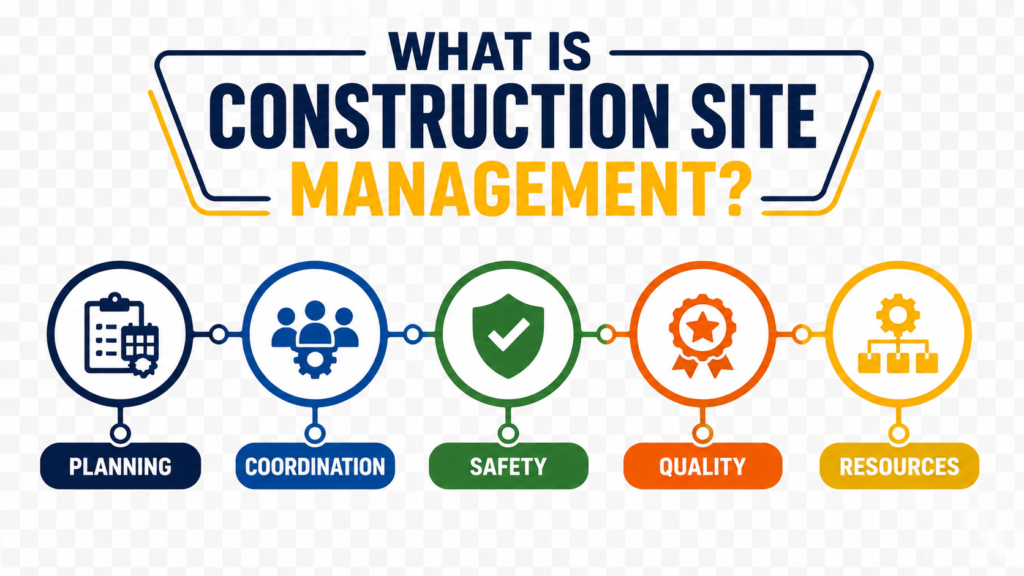
Construction site management is the process of planning, coordinating, supervising and controlling activities taking place on a construction site.
It brings together the operational aspects of a building project, including:
- Workforce coordination
- Subcontractor management
- Site planning
- Materials and deliveries
- Plant and equipment
- Site logistics
- Health and safety
- Quality control
- Progress monitoring
- Construction documentation
- Short-term programming
- Risk management
- Communication between project stakeholders
A construction site manager may be involved in setting up the site, organising work areas, coordinating subcontractors, monitoring progress and ensuring that construction activities follow the agreed programme and required standards.
The Chartered Institute of Building describes the site manager as playing an integral role in project success by coordinating activities so that safety, quality, timeline and budget requirements can be achieved.
Why Is Construction Site Management Important?
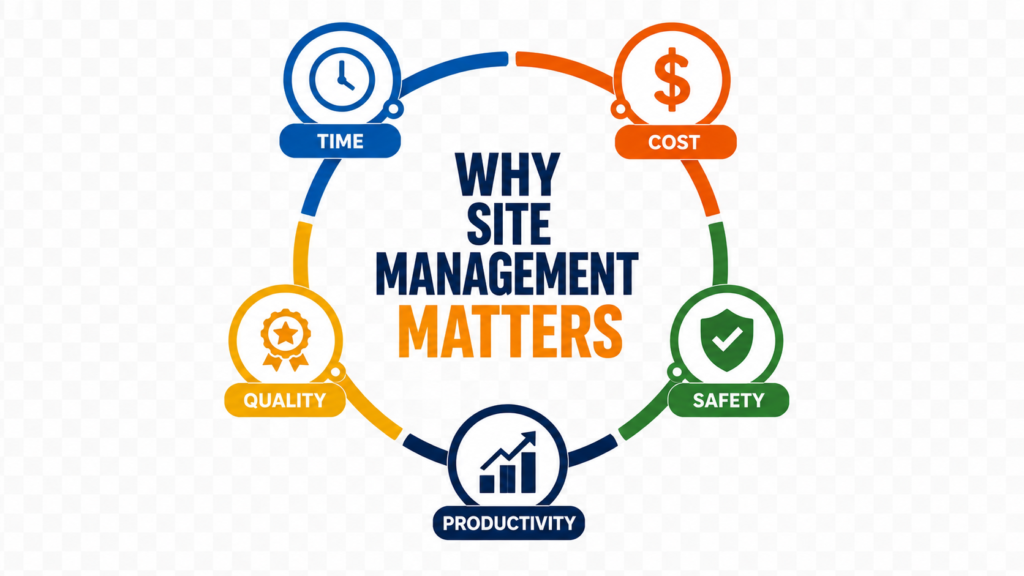
Construction site management is important because it creates the operational control needed to turn construction plans into coordinated physical work.
Effective site management helps:
- Keep construction activities organised
- Coordinate different trades and contractors
- Reduce avoidable delays
- Improve resource utilisation
- Support safe working practices
- Maintain construction quality
- Reduce rework and waste
- Monitor progress
- Identify problems early
- Improve communication
- Support programme and cost performance
- Prepare the project for successful completion and handover
The value of site management is therefore not limited to supervision. It is about creating a controlled environment in which construction activities can progress safely, efficiently and in the correct sequence.
10 Reasons Construction Site Management Is Essential
1. Keeps Construction Work on Schedule
Construction projects involve numerous interconnected activities. Foundations must be completed before certain structural works can progress, structural works may need to reach specific stages before services can be installed, and finishing activities depend on preceding trades.
Effective site management helps coordinate this sequence.
A site manager monitors progress against planned activities, identifies constraints and communicates changes to the relevant teams. When an activity starts to fall behind, corrective action can be considered before the delay affects other work packages.
For example:
Delayed material delivery → workforce cannot start → work package falls behind → following trade is affected → programme pressure increases.
Effective site management aims to identify the delivery problem early and coordinate an appropriate solution.
CIOB identifies progress monitoring against programme milestones as one of the core responsibilities associated with construction site management.
2. Improves Workforce and Subcontractor Coordination
A typical building project can involve numerous trades and specialist contractors.
These may include:
- Groundworkers
- Bricklayers
- Steelworkers
- Electricians
- Plumbers
- Mechanical contractors
- Dryliners
- Roofers
- Flooring contractors
- Painters and decorators
- Specialist installation teams
Each trade has its own requirements, but their work is interconnected.
Site management helps determine who needs to work where, when activities can begin and what information or resources are required.
Good coordination reduces:
- Trade clashes
- Conflicting work areas
- Unnecessary waiting
- Duplication of work
- Disruption between contractors
- Misunderstandings about responsibilities
Contractors working under CDM 2015 also have responsibilities to coordinate their work with other members of the project team where more than one contractor is involved.
3. Controls Materials, Plant and Resources
Construction productivity depends heavily on having the right resources available at the right time.
Site management can coordinate:
- Material deliveries
- Storage areas
- Plant requirements
- Equipment availability
- Labour resources
- Waste removal
- Temporary facilities
- Site access
Poor resource coordination can create significant inefficiencies.
If materials arrive too early, the site may experience storage and access problems. If they arrive too late, workers may be unable to complete planned activities.
The same principle applies to plant and equipment. A crane, excavator, telehandler or specialist machine may need to be available for a particular work package. Effective planning helps avoid unnecessary downtime.
4. Supports Health and Safety
Health and safety is one of the most important reasons effective site management matters.
Construction sites contain changing hazards associated with:
- Work at height
- Excavation
- Plant and vehicles
- Temporary works
- Lifting operations
- Electrical systems
- Construction materials
- Dust and hazardous substances
- Site traffic
- Temporary structures
- Demolition or alteration activities
Site management contributes to controlling these risks through planning, supervision, coordination, communication and monitoring.
Under CDM 2015, the principal contractor on a project involving more than one contractor must plan, manage, monitor and coordinate the construction phase and must consider Health and Safety risk management affecting workers and others who may be affected by the work.
The construction phase plan is also a key part of managing health and safety arrangements. HSE states that it must be prepared before the construction phase begins and should outline health and safety arrangements, site rules and relevant risk-control measures.
Effective site management therefore helps translate safety planning into practical site arrangements.
5. Maintains Construction Quality
Quality problems can become expensive when they are discovered late.
For example, if defective workmanship is identified after another trade has completed its work over the affected area, correcting the defect may require:
- Additional labour
- Material replacement
- Removal of completed work
- Reinstallation
- Additional inspections
- Programme changes
Site management supports quality by coordinating inspections, monitoring workmanship and ensuring that relevant issues are identified and addressed at the appropriate stage.
Quality control may involve:
- Checking completed work
- Coordinating inspections
- Monitoring specifications
- Reviewing installation standards
- Supporting testing
- Recording defects
- Coordinating corrective action
The earlier a problem is identified, the greater the opportunity to correct it before it affects subsequent activities.
6. Reduces Rework and Construction Waste
Rework occurs when completed or partially completed work has to be altered, removed or repeated because it does not meet the required standard or because preceding information or coordination was inadequate.
Common causes can include:
- Poor communication
- Incorrect information
- Defective workmanship
- Inadequate planning
- Trade clashes
- Material errors
- Incorrect sequencing
- Failure to identify design or installation issues
Effective site management helps reduce these problems through coordination, inspections, communication and progress monitoring.
Reducing rework has several benefits:
Less rework → less material waste → less labour disruption → fewer delays → better cost control.
This makes site management an important contributor to construction efficiency.
7. Improves Communication
Construction projects involve many people with different responsibilities.
Information may need to move between:
- Client representatives
- Project managers
- Site managers
- Designers
- Engineers
- Quantity surveyors
- Supervisors
- Subcontractors
- Suppliers
- Workers
- Inspectors
Without effective communication, even a well-designed project can experience operational problems.
Site management provides an important communication link between project-level requirements and site-level activities.
Clear communication helps ensure that:
- Workers understand instructions
- Subcontractors understand sequencing
- Changes are communicated
- Site constraints are reported
- Problems are escalated
- Progress information is available
- Safety information reaches relevant workers
CIOB also identifies communication with clients, architects, local authorities and site teams as an important aspect of site management.
8. Identifies and Controls Site Risks
Construction risks change as the project develops.
A risk that exists during excavation may no longer exist after the structure reaches another stage, while new risks can emerge as different trades and activities are introduced.
Site management helps identify and respond to operational risks such as:
- Unsafe access
- Poor housekeeping
- Conflicting work activities
- Material storage problems
- Plant movement
- Delivery constraints
- Unplanned work
- Changes in site conditions
- Interface risks between contractors
Risk management is most effective when problems are identified early.
For example:
Potential access problem → identified during site planning → delivery route changed → congestion avoided → work continues with less disruption.
This demonstrates why site management is a proactive function rather than simply a response to problems.
9. Improves Productivity and Cost Efficiency
Construction productivity is affected by how effectively labour, materials, plant, information and time are used.
Site management can improve productivity by reducing avoidable downtime and helping workers focus on planned activities.
Examples include:
- Preparing work areas before trades arrive
- Coordinating deliveries
- Ensuring materials are available
- Providing relevant information
- Sequencing trades correctly
- Reducing unnecessary movement
- Resolving site constraints quickly
- Monitoring productivity and progress
Although overall project cost management may sit with project and commercial management teams, effective site management has a direct influence on costs.
Poor site control can lead to:
- Labour downtime
- Material waste
- Plant inefficiency
- Rework
- Overtime
- Programme extensions
- Additional supervision
Effective site management helps reduce these operational inefficiencies.
10. Supports Successful Handover
Site management remains important as a project approaches completion.
The final stages may involve:
- Defect identification
- Snagging
- Testing
- Commissioning
- Final inspections
- Cleaning
- Documentation
- Outstanding works
- Coordination with specialist contractors
- Handover preparation
Poor control at this stage can delay completion even when the main construction work is substantially finished.
Effective site management helps ensure outstanding items are identified, allocated and tracked so that the project can move towards practical completion and handover in an organised way.
Construction Site Management and the UK Regulatory Environment
Construction site management in the UK operates within a regulatory and organisational framework designed to protect workers and others affected by construction activity.
One of the most important frameworks is the Construction (Design and Management) Regulations 2015.
CDM 2015 establishes duties for different project dutyholders, including clients, designers, principal designers, principal contractors, contractors and workers.
For projects involving more than one contractor, the client must appoint a principal contractor to control the construction phase. The principal contractor must have the appropriate skills, knowledge, experience and, where relevant, organisational capability for the work.
The principal contractor’s responsibilities include:
- Planning the construction phase
- Managing health and safety
- Monitoring construction activities
- Coordinating contractors
- Preparing the construction phase plan
- Providing suitable site inductions
- Ensuring welfare arrangements
- Consulting workers
- Preventing unauthorised access
- Coordinating with the principal designer
These responsibilities demonstrate why construction site management is closely connected to planning, communication and operational control.
Why the Construction Phase Plan Matters
A construction phase plan is an important management document for construction health and safety.
HSE states that a construction phase plan must be prepared before the construction phase begins. For projects involving more than one contractor, this is the responsibility of the principal contractor; for single-contractor projects, the contractor is responsible.
The plan should be proportionate to the scale and complexity of the project.
It can cover arrangements relating to:
- Site rules
- Health and safety
- Site access
- Welfare
- Emergency procedures
- Cooperation and coordination
- Specific construction risks
- Worker information and induction
Effective site management helps ensure that planned arrangements are understood and implemented throughout the construction phase.
Why Construction Site Logistics Matter
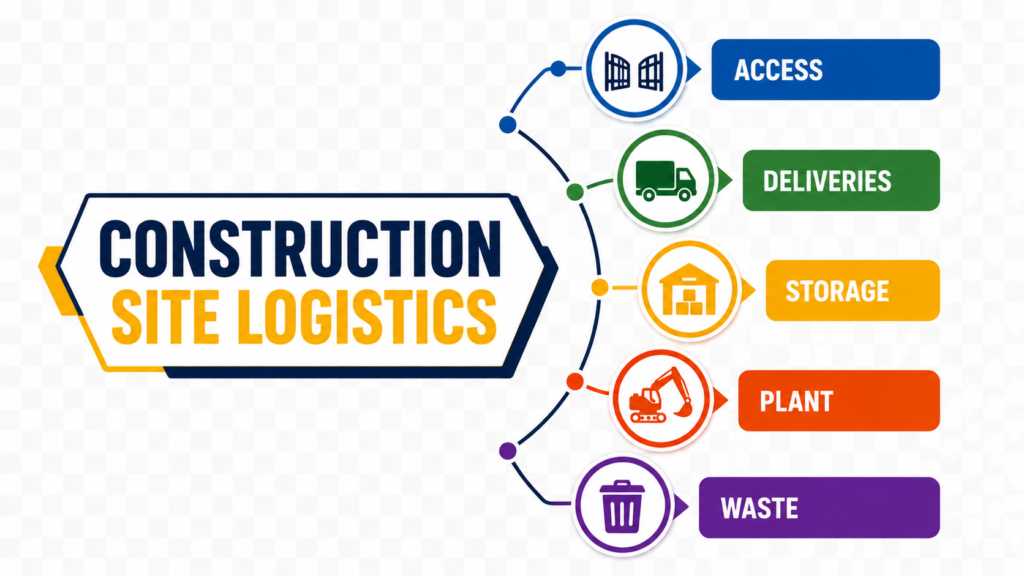
Site logistics is sometimes overlooked, but it can have a major impact on construction productivity.
A site needs carefully managed arrangements for:
- Vehicle access
- Pedestrian routes
- Material deliveries
- Storage
- Plant movement
- Waste
- Loading and unloading
- Temporary facilities
- Emergency access
Consider a project where multiple deliveries arrive at the same entrance during the busiest working period.
Without coordination:
Multiple deliveries → congestion → restricted access → waiting time → reduced productivity.
With effective logistics planning:
Scheduled deliveries → controlled access → predictable movement → less disruption → improved workflow.
Site logistics therefore supports both productivity and safety.
What Happens Without Effective Construction Site Management?
Without effective site management, a building project becomes more exposed to operational problems.
Potential consequences include:
Programme delays
Poor sequencing, missing resources or inadequate coordination can prevent planned activities from starting on time.
Labour downtime
Workers may be available but unable to work because materials, information, access or preceding activities are incomplete.
Quality problems
Inadequate inspections or poor coordination can allow defects to continue into later stages.
Rework
Errors discovered late can require completed work to be removed or repeated.
Safety risks
Poor planning, supervision and coordination can increase exposure to construction hazards.
Resource waste
Poorly managed materials, plant and labour can reduce productivity.
Communication failures
Unclear instructions or late information can create misunderstandings between project teams.
Cost pressure
Delays, rework, waste and inefficiency can increase project costs.
Handover difficulties
Unresolved defects and incomplete documentation can make project completion more difficult.
The key point is that these problems are often interconnected.
Poor site coordination → delay → increased labour cost → programme pressure → rushed work → quality risk.
Effective site management aims to interrupt this chain before small problems become major project issues.
How Site Management Supports the Construction Project Lifecycle
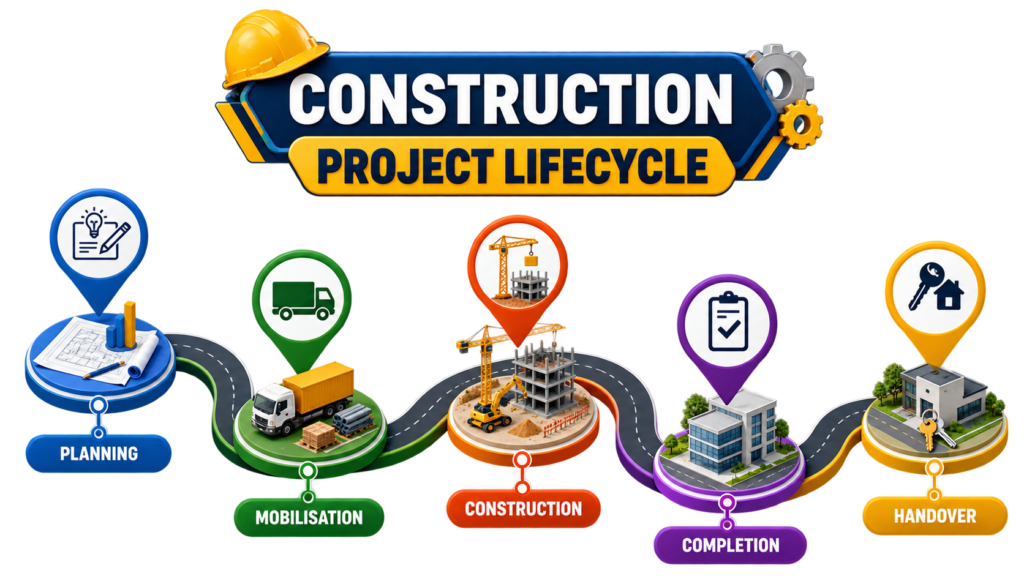
Pre-Construction
Although site management is most visible during physical construction, its contribution can begin before work starts.
Planning may include:
- Site access
- Logistics
- Temporary facilities
- Storage
- Work sequencing
- Construction methods
- Resource requirements
- Site constraints
Early planning helps establish realistic arrangements before workers and materials arrive.
Site Mobilisation
During mobilisation, site management helps establish the operational environment.
This can involve:
- Site offices
- Welfare
- Fencing
- Access
- Signage
- Storage
- Traffic arrangements
- Security
- Temporary services
HSE identifies suitable welfare, site-specific induction and arrangements for preventing unauthorised access among the responsibilities associated with managing the construction phase.
Construction Phase
This is where site management becomes highly visible.
Activities include:
- Daily coordination
- Subcontractor management
- Progress monitoring
- Quality checks
- Safety management
- Material coordination
- Site logistics
- Problem-solving
- Short-term planning
Completion
At completion, site management focuses increasingly on:
- Defects
- Snagging
- Testing
- Commissioning
- Outstanding works
- Documentation
- Final inspections
Handover
The final objective is to help ensure the physical project is ready for handover and that outstanding site matters are properly controlled.
Practical Example: How Site Management Can Prevent a Construction Delay
Consider a commercial building where internal mechanical and electrical installation is scheduled to begin after structural and partition work reaches a specified stage.
A progress inspection identifies that one area is not ready because a preceding activity is behind schedule.
Without effective site management
The mechanical and electrical contractor arrives as planned.
The work area is unavailable.
The specialist workforce cannot proceed.
The team waits or moves to another area.
The original programme is disrupted.
Additional coordination becomes necessary.
With effective site management
The constraint is identified during progress monitoring.
The site team coordinates with the relevant subcontractor.
The preceding activity is prioritised.
The specialist contractor is informed of the revised sequence.
The work area is prepared before the next team arrives.
This simple example demonstrates the practical value of site management:
Monitor → identify → coordinate → correct → continue.
How Site Management Supports Quality, Safety and Productivity Together
One of the most important characteristics of effective site management is that quality, safety, productivity and programme performance should not be treated as completely separate objectives.
For example, poor housekeeping can create a safety risk while also slowing movement around the site.
Poor material storage can cause damage, create trip hazards and increase waste.
Poor sequencing can create productivity problems while increasing the risk of trade clashes.
This means one site-management improvement can create multiple project benefits.
| Site Management Activity | Immediate Effect | Project Benefit |
|---|---|---|
| Trade coordination | Better sequencing | Fewer clashes and delays |
| Material planning | Resources available | Less downtime |
| Quality inspections | Early defect detection | Less rework |
| Safety monitoring | Better risk control | Safer working environment |
| Progress tracking | Early problem identification | Faster corrective action |
| Site logistics | Better movement | Improved productivity |
| Communication | Clearer information | Fewer misunderstandings |
| Resource planning | Better utilisation | Improved efficiency |
Skills Required for Effective Construction Site Management
Effective construction site management requires more than technical construction knowledge.
Important skills include:
Planning
The ability to organise activities, resources and work sequences.
Communication
The ability to provide clear information and coordinate different teams.
Leadership
The ability to guide workers, supervisors and subcontractors towards common project objectives.
Problem-Solving
Construction sites change constantly, so site managers need to identify practical solutions when unexpected issues arise.
Technical Construction Knowledge
Understanding construction methods, materials, sequencing and site operations supports better decision-making.
Health and Safety Awareness
Site management requires an understanding of construction risks and the arrangements needed to control them.
Quality Management
The ability to recognise quality requirements and coordinate inspections and corrective action is essential.
Resource Management
Efficient use of labour, materials, plant and time directly affects construction productivity.
CIOB similarly identifies organisation, planning, problem-solving, communication, leadership and understanding of construction methods, logistics and regulations as important site-management capabilities.
Construction Site Management vs Construction Project Management
Construction site management and construction project management are closely related but have different primary areas of focus.
Construction site management is mainly concerned with the practical execution of construction activities.
Construction project management has a broader project-wide focus that can include scope, programme, cost, procurement, risk, contracts and stakeholders.
The two functions need to work together.
For example:
Project planning → construction programme → site coordination → physical execution → progress reporting → project control.
Site management provides the operational connection between plans and physical construction.
For a detailed comparison, the related guide Construction Site Management vs Construction Project Management: Key Differences Explained can provide further insight into responsibilities, skills, project lifecycle involvement and career pathways.
Career Opportunities in Construction Site Management
Construction site management can provide a practical career pathway for professionals who enjoy construction operations, team leadership, planning and problem-solving.
A potential progression route may include:
Construction Operative → Site Supervisor → Assistant Site Manager → Site Manager → Senior Site Manager → Construction Manager
Career pathways are not fixed. Experience, occupational competence, qualifications, employer requirements and professional development can influence progression.
CIOB identifies several routes into site management, including site-management qualifications, NVQs and apprenticeships, with progression possible from junior roles into site-management positions.
For professionals already working in construction, a recognised qualification can help formalise existing occupational knowledge and support further career development.
How Can Construction Site Management Be Improved?
Construction organisations can strengthen site management by focusing on several practical areas.
Plan work before it starts
Identify resources, access requirements, sequencing and potential constraints before activities begin.
Coordinate contractors regularly
Regular communication helps ensure different trades understand their responsibilities and interfaces.
Monitor progress continuously
Do not wait until the end of a reporting period to identify delays.
Control site logistics
Plan deliveries, storage, access and plant movements around actual site requirements.
Maintain clear records
Accurate records help track decisions, progress, inspections, defects and outstanding actions.
Identify risks early
Address foreseeable problems before they disrupt construction activities.
Communicate changes quickly
Late information can create unnecessary disruption, particularly when several trades are affected.
Review quality progressively
Quality should be controlled throughout the work rather than left until completion.
Support worker involvement
Workers should receive appropriate information and be consulted on matters affecting health, safety and welfare. HSE specifically identifies worker consultation and engagement as part of the principal contractor’s responsibilities under CDM 2015.
Frequently Asked Questions
Conclusion
Construction site management is essential for turning project plans into safe, organised and efficient construction work. Effective site management coordinates people, subcontractors, materials, plant, logistics, quality, safety and daily activities while identifying potential problems before they become costly delays. Strong site management also supports productivity, reduces rework and waste, improves communication and contributes to successful project completion. For building projects of every size, competent site management provides the operational control needed to achieve better construction outcomes, maintain required standards and deliver projects successfully.