
Health and Safety: Complete Guide to Workplace Safety, Risk Management and Best Practices (2026)
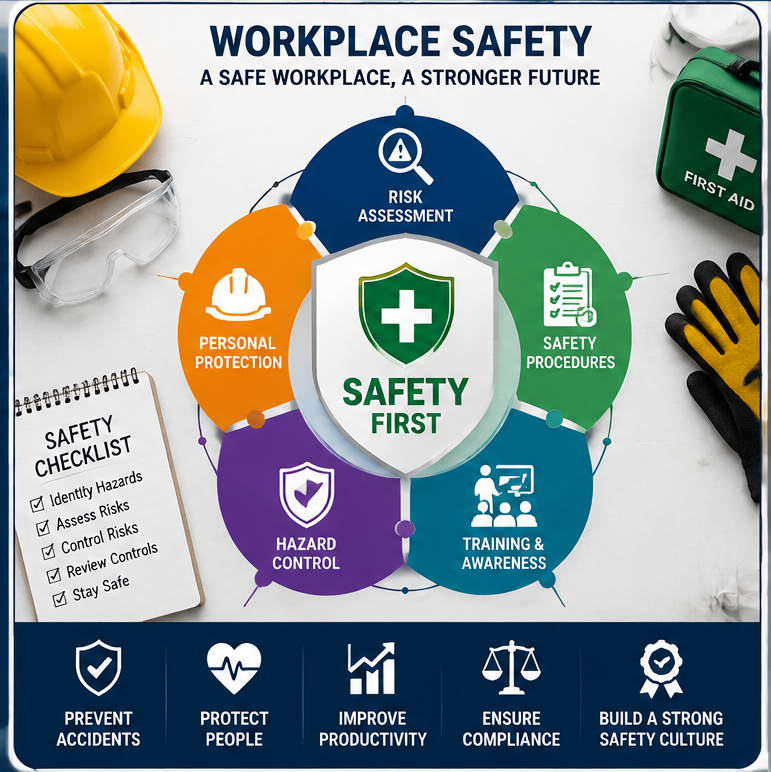
Health and Safety is a fundamental part of every successful organisation. It focuses on protecting employees, visitors, customers, and the public from workplace hazards that may cause injury, illness, or harm.
Modern workplaces are becoming increasingly complex due to changing technologies, new working methods, environmental challenges, and evolving regulations. As a result, organisations must move beyond basic safety rules and develop structured Health and Safety management approaches that identify risks, prevent accidents, and promote employee wellbeing.
A strong Health and Safety system does not only reduce workplace incidents; it also improves productivity, employee confidence, business reputation, and long-term organisational success.
Whether an organisation operates in construction, manufacturing, healthcare, logistics, offices, or industrial environments, effective Health and Safety practices are essential for creating a safe and productive workplace.
This complete guide explains:
- What Health and Safety means
- Why workplace safety is important
- Common workplace hazards
- Risk management processes
- Safety management systems
- Responsibilities of employers and employees
- Safety culture development
- Industry applications
- Future trends in Health and Safety
What is Health and Safety?
Health and Safety refers to the policies, procedures, systems, and practices designed to protect people from workplace injuries, illnesses, accidents, and hazards.
It combines two important areas:
- Health: Protecting people from conditions that may cause physical or psychological harm over time.
- Safety: Preventing accidents, injuries, and immediate workplace dangers.
The main purpose of Health and Safety is to identify potential risks, control hazards, and create working environments where people can perform their duties safely.
A comprehensive Health and Safety approach includes:
- Hazard identification
- Risk assessment
- Safety procedures
- Employee training
- Emergency planning
- Workplace inspections
- Continuous improvement
Importance of Health and Safety in Modern Workplaces
Health and Safety is no longer viewed only as a legal requirement. It has become a strategic priority for organisations that want to protect their workforce and maintain sustainable operations.
Effective Health and Safety management helps organisations:
- Prevent workplace injuries
- Reduce occupational illnesses
- Improve employee wellbeing
- Increase productivity
- Reduce operational costs
- Protect company reputation
- Improve employee confidence
- Create a positive workplace culture
Organisations with strong safety practices are more likely to attract skilled employees because workers prefer environments where their wellbeing is valued.
Difference Between Health and Safety
Although the terms Health and Safety are often used together, they address different areas of workplace protection.
| Health | Safety |
|---|---|
| Focuses on preventing illness and long-term harm | Focuses on preventing accidents and immediate injuries |
| Deals with workplace conditions affecting wellbeing | Deals with workplace hazards causing incidents |
| Includes stress, chemicals, noise, and exposure risks | Includes falls, machinery accidents, and unsafe practices |
| Often involves long-term monitoring | Often focuses on immediate risk prevention |
Both areas work together to create a complete workplace protection system.
For example:
A factory worker exposed to loud machinery may experience hearing problems over time. This is a health risk.
The same worker operating machinery without proper guarding may suffer an immediate injury. This is a safety risk.
Why is Health and Safety Important in the Workplace?
Health and Safety plays a critical role in protecting employees and supporting organisational success.
1. Protecting Employees from Harm
The primary purpose of Health and Safety is protecting people from workplace dangers.
This includes preventing:
- Physical injuries
- Occupational diseases
- Workplace stress
- Unsafe working conditions
- Exposure to harmful substances
A safe workplace allows employees to perform their responsibilities with confidence.
2. Preventing Workplace Accidents
Workplace accidents can result in:
- Employee injuries
- Business disruption
- Financial losses
- Legal consequences
- Reputation damage
Effective safety management identifies risks before they cause harm.
For example:
A construction company that regularly inspects equipment and provides safety training can reduce incidents involving machinery and falls.
3. Improving Productivity
A safe workplace improves employee performance because workers can focus on their tasks without unnecessary risks.
Health and Safety contributes to productivity by:
- Reducing downtime
- Minimising workplace disruptions
- Improving employee morale
- Increasing confidence
4. Supporting Legal and Regulatory Compliance
Organisations have responsibilities to provide safe working environments.
Health and Safety systems help businesses:
- Meet legal obligations
- Maintain proper documentation
- Conduct risk assessments
- Demonstrate responsible management
Failure to manage workplace safety can lead to:
- Fines
- Legal action
- Operational restrictions
- Reputation damage
Common Workplace Hazards
Workplace hazards are situations, substances, or activities that can cause injury, illness, or damage.
Understanding different hazard categories helps organisations develop effective control measures.
Physical Hazards
Physical hazards are environmental factors that can cause injury.
Examples include:
- Slips, trips, and falls
- Noise exposure
- Moving machinery
- Poor lighting
- Temperature extremes
- Electrical hazards
Control measures include:
- Workplace inspections
- Equipment maintenance
- Safety barriers
- Personal Protective Equipment (PPE)
Chemical Hazards
Chemical hazards occur when workers are exposed to harmful substances.
Examples include:
- Toxic chemicals
- Cleaning products
- Industrial gases
- Hazardous materials
Control methods include:
- Safe storage procedures
- Chemical handling training
- Protective equipment
- Exposure monitoring
Biological Hazards
Biological hazards involve exposure to harmful biological agents.
Examples include:
- Viruses
- Bacteria
- Infectious materials
Common industries affected:
- Healthcare
- Laboratories
- Food production
Control measures include:
- Hygiene procedures
- Protective equipment
- Vaccination programmes
- Infection control practices
Ergonomic Hazards
Ergonomic hazards result from poor workplace design or working methods.
Examples include:
- Incorrect lifting techniques
- Poor workstation design
- Repetitive movements
- Poor posture
Control measures include:
- Ergonomic assessments
- Workstation improvements
- Employee training
Psychological Hazards
Modern workplaces increasingly recognise psychological health as part of Health and Safety.
Examples include:
- Workplace stress
- Excessive workload
- Bullying
- Poor work-life balance
Control measures include:
- Employee support programmes
- Clear communication
- Workload management
- Positive workplace culture
Workplace Risk Management and Hazard Control
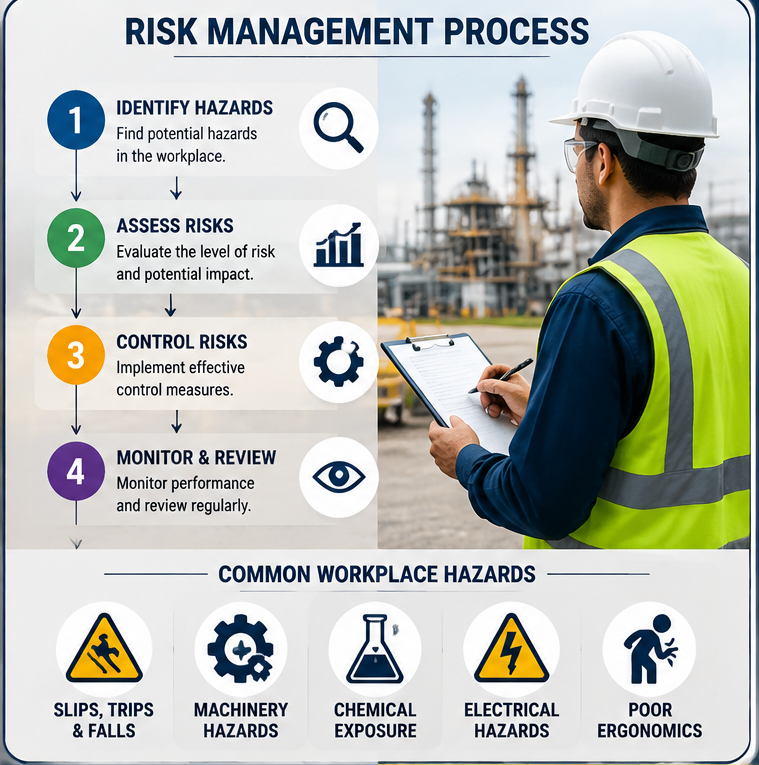
Risk management is one of the most important elements of an effective Health and Safety system. It involves identifying potential hazards, evaluating risks, implementing control measures, and continuously monitoring workplace conditions.
A proactive risk management approach helps organisations prevent accidents instead of only reacting after incidents occur.
A successful risk management process follows a structured approach:
Step 1: Hazard Identification
Hazard identification involves finding anything that could potentially cause harm in the workplace.
Organisations can identify hazards through:
- Workplace inspections
- Employee feedback
- Safety audits
- Incident investigations
- Equipment checks
- Risk assessments
- Previous accident records
Examples:
- A construction site may identify unsafe scaffolding as a fall hazard.
- A manufacturing facility may identify unguarded machinery as an injury risk.
- An office may identify poor workstation design as an ergonomic hazard.
Early identification allows organisations to control risks before they result in harm.
Step 2: Risk Assessment
Risk assessment is the process of analysing identified hazards and determining:
- How likely an incident is to occur
- How severe the consequences could be
- What controls are required
A basic risk assessment evaluates:
| Risk Factor | Explanation |
|---|---|
| Likelihood | The possibility that harm may occur |
| Severity | The potential impact of the incident |
| Exposure | How frequently workers are exposed to the hazard |
| Control Measures | Actions taken to reduce risk |
For example:
A warehouse identifies that workers manually lift heavy materials every day.
Risk assessment may identify:
- High exposure frequency
- Possible back injuries
- Need for mechanical lifting equipment
- Additional manual handling training
Step 3: Implementing Risk Control Measures
After assessing risks, organisations must introduce controls to reduce or eliminate hazards.
The hierarchy of controls is commonly used:
| Control Level | Description | Example |
|---|---|---|
| Elimination | Remove the hazard completely | Removing unsafe equipment |
| Substitution | Replace with safer alternatives | Using safer chemicals |
| Engineering Controls | Isolate people from hazards | Machine guards |
| Administrative Controls | Improve procedures and training | Safety instructions |
| PPE | Provide personal protection | Helmets, gloves, safety footwear |
The most effective controls remove hazards at their source rather than relying only on employee behaviour.
Step 4: Monitoring and Reviewing Risks
Risk management is not a one-time activity.
Organisations should regularly review safety systems because workplaces constantly change.
Reviews may be required after:
- Workplace accidents
- Introduction of new equipment
- Changes in procedures
- New legislation
- Changes in workforce activities
Continuous monitoring ensures that safety measures remain effective.
Health and Safety Management Systems
A Health and Safety Management System (HSMS) is a structured framework that helps organisations manage workplace risks effectively.
It combines policies, procedures, responsibilities, and processes to create a consistent approach to workplace safety.
A strong Health and Safety Management System includes:
Safety Policies and Objectives
A safety policy explains an organisation’s commitment to protecting workers.
It defines:
- Safety goals
- Management responsibilities
- Employee expectations
- Safety standards
An effective safety policy demonstrates leadership commitment and provides direction for safety activities.
Workplace Procedures and Processes
Procedures explain how safety activities should be completed.
Examples include:
- Emergency response procedures
- Equipment operating procedures
- Accident reporting processes
- Inspection procedures
- Safe working methods
Clear procedures reduce confusion and improve workplace consistency.
Safety Training and Competency Development
Training ensures employees understand:
- Workplace hazards
- Safe working practices
- Emergency procedures
- Equipment operation
- Risk control methods
Effective training should be:
- Relevant to job roles
- Regularly updated
- Practical and engaging
- Supported by workplace examples
Safety Monitoring and Performance Measurement
Organisations need to measure whether their safety systems are effective.
Common safety performance indicators include:
- Accident frequency rates
- Incident reports
- Safety inspection results
- Training completion rates
- Near-miss reports
Monitoring allows organisations to identify improvement opportunities.
Building a Positive Health and Safety Culture
Safety culture refers to the shared values, attitudes, beliefs, and behaviours that influence how people approach workplace safety.
A strong safety culture means that everyone within an organisation understands that safety is a shared responsibility.
Leadership Commitment
Leadership plays a major role in creating a positive safety culture.
Effective safety leaders:
- Prioritise safety decisions
- Provide necessary resources
- Encourage reporting
- Lead by example
- Support continuous improvement
When managers demonstrate commitment, employees are more likely to follow safe working practices.
Employee Engagement
Employees should actively participate in safety improvement.
This includes:
- Reporting hazards
- Sharing safety suggestions
- Participating in safety meetings
- Following procedures
- Supporting colleagues
Workers often have practical knowledge about workplace risks because they experience daily operations.
Safety Communication
Clear communication helps prevent misunderstandings and improves awareness.
Effective communication methods include:
- Safety briefings
- Toolbox talks
- Safety newsletters
- Digital reporting systems
- Workplace notices
Good communication ensures everyone understands safety expectations.
Continuous Improvement
A strong safety culture focuses on ongoing improvement rather than maintaining minimum standards.
Continuous improvement involves:
- Reviewing incidents
- Learning from mistakes
- Updating procedures
- Improving training
- Introducing better safety solutions
Health and Safety Responsibilities of Employers and Employees
Health and Safety requires cooperation between employers, managers, supervisors, and employees.
Everyone has a role in maintaining a safe workplace.
Employer Responsibilities
Employers have a duty to provide safe working environments.
Their responsibilities include:
Providing a Safe Workplace
Employers should:
- Identify workplace hazards
- Control risks
- Maintain safe equipment
- Provide suitable facilities
Conducting Risk Assessments
Employers must regularly evaluate workplace risks and implement appropriate controls.
This includes:
- Identifying hazards
- Assessing risks
- Recording findings
- Reviewing controls
Providing Training and Information
Employers should ensure workers receive appropriate safety information and training.
Examples:
- New employee induction
- Equipment training
- Emergency response training
- Safety awareness programmes
Providing Personal Protective Equipment
Where hazards cannot be completely removed, employers should provide suitable PPE.
Examples:
- Safety helmets
- Protective clothing
- Gloves
- Eye protection
- Respiratory protection
Employee Responsibilities
Employees also contribute significantly to workplace safety.
Their responsibilities include:
Following Safety Procedures
Employees should:
- Follow workplace rules
- Use equipment correctly
- Follow instructions
Reporting Hazards
Workers should report:
- Unsafe conditions
- Damaged equipment
- Near misses
- Workplace concerns
Early reporting helps prevent accidents.
Using Safety Equipment Correctly
Employees must use:
- PPE correctly
- Safety devices
- Workplace equipment responsibly
Ignoring safety procedures can increase risks for themselves and others.
Health and Safety Training and Professional Development
Health and Safety training is essential for developing competent employees and safety professionals.
Training helps individuals understand workplace risks and develop the skills required to prevent incidents.
Types of Health and Safety Training
Common training areas include:
Safety Awareness Training
Provides basic knowledge about:
- Workplace hazards
- Safety responsibilities
- Emergency procedures
Risk Assessment Training
Develops skills in:
- Hazard identification
- Risk evaluation
- Control implementation
Leadership Safety Training
Helps managers develop:
- Safety leadership skills
- Decision-making abilities
- Risk management knowledge
Specialist Safety Training
Includes areas such as:
- Fire safety
- Construction safety
- Environmental safety
- Occupational health
Career Opportunities in Health and Safety
Health and Safety has become an important professional field across many industries.
Organisations require skilled professionals who can manage workplace risks and improve safety performance.
Career opportunities include:
Health and Safety Officer
Responsibilities include:
- Conducting inspections
- Supporting risk assessments
- Delivering safety training
- Reporting incidents
Health and Safety Manager
Responsibilities include:
- Developing safety strategies
- Managing safety teams
- Monitoring compliance
- Improving safety performance
HSE Consultant
Health, Safety, and Environment consultants support organisations by:
- Providing expert advice
- Conducting audits
- Improving safety systems
Risk Manager
Risk managers focus on:
- Identifying organisational risks
- Developing control strategies
- Supporting business decisions
Safety Director
Senior safety leaders are responsible for:
- Strategic safety planning
- Governance
- Organisational safety performance
Industry Applications of Health and Safety
Health and Safety principles apply across almost every sector.
Construction Industry
Construction involves high-risk activities such as:
- Working at height
- Heavy machinery operation
- Excavation activities
- Material handling
Key safety practices include:
- Site inspections
- PPE requirements
- Permit systems
- Worker training
Manufacturing Industry
Manufacturing safety focuses on:
- Machinery safety
- Chemical handling
- Production risks
- Workplace ergonomics
Healthcare Industry
Healthcare workers face risks including:
- Biological hazards
- Patient handling injuries
- Chemical exposure
- Workplace stress
Oil and Gas Industry
Safety priorities include:
- Process safety
- Fire prevention
- Hazardous materials management
- Emergency response
Logistics and Transportation
Important safety areas include:
- Vehicle safety
- Manual handling
- Warehouse operations
- Driver safety
Practical workplace examples help organisations understand how Health and Safety principles work in real situations. Effective safety management is not only about creating policies; it is about applying those policies to prevent harm and improve workplace conditions.
Case Study 1: Construction Site Fall Prevention
Situation
A construction company identified that workers were frequently exposed to working-at-height risks during building projects.
The organisation discovered several issues:
- Inconsistent use of fall protection equipment
- Limited supervision
- Lack of regular safety inspections
- Poor awareness of working-at-height procedures
Safety Improvements Implemented
The company introduced:
- Mandatory working-at-height training
- Improved safety supervision
- Regular site inspections
- Better access equipment
- Updated fall protection procedures
Results
The organisation achieved:
- Reduced fall-related incidents
- Improved worker awareness
- Better compliance with safety procedures
- Stronger workplace safety culture
Key Lesson
Workplace hazards can be controlled effectively when organisations combine training, leadership commitment, and practical risk controls.
Case Study 2: Manufacturing Workplace Risk Reduction
Situation
A manufacturing facility experienced repeated minor injuries caused by machinery operation and manual handling activities.
Common problems included:
- Poor machine guarding
- Incorrect lifting methods
- Limited employee safety involvement
Safety Improvements Implemented
The organisation introduced:
- Machinery safety assessments
- Employee training programmes
- Ergonomic improvements
- Improved reporting systems
- Regular safety meetings
Results
The organisation experienced:
- Fewer workplace injuries
- Improved employee participation
- Better operational efficiency
- Reduced downtime
Key Lesson
Employee involvement and continuous improvement are essential components of successful Health and Safety management.
Common Health and Safety Challenges
Although organisations understand the importance of workplace safety, implementing effective Health and Safety systems can create challenges.
Understanding these challenges helps businesses develop stronger strategies.
1. Lack of Safety Awareness
Some employees may not fully understand workplace risks or the importance of following safety procedures.
Common causes include:
- Insufficient training
- Poor communication
- Lack of safety engagement
Solution
Organisations should provide:
- Regular safety training
- Workplace awareness campaigns
- Practical demonstrations
- Safety discussions
2. Poor Safety Culture
A weak safety culture occurs when employees and leaders do not prioritise safety.
Signs of poor safety culture include:
- Ignoring hazards
- Not reporting incidents
- Unsafe working practices
- Limited management involvement
Solution
Businesses should develop a positive safety culture through:
- Leadership commitment
- Employee involvement
- Open communication
- Continuous improvement
3. Resistance to Change
Introducing new safety procedures or technologies may face resistance from employees.
Reasons include:
- Lack of understanding
- Fear of additional responsibilities
- Comfort with existing practices
Solution
Organisations should:
- Explain the benefits of change
- Involve employees in decisions
- Provide proper training
- Demonstrate positive outcomes
4. Inadequate Risk Assessment
Poor risk assessments can result in unidentified hazards.
Common problems include:
- Incomplete hazard identification
- Outdated assessments
- Lack of employee involvement
Solution
Improve risk assessment by:
- Reviewing risks regularly
- Involving workers
- Using systematic approaches
- Monitoring workplace changes
5. Balancing Safety and Productivity
Some organisations mistakenly believe safety reduces productivity.
However, effective Health and Safety management improves efficiency by:
- Reducing accidents
- Minimising downtime
- Improving employee confidence
- Preventing operational disruptions
Best Practices for Successful Health and Safety Implementation
Successful organisations follow structured approaches to improve workplace safety.
1. Establish Strong Safety Leadership
Leadership is one of the most important factors influencing safety performance.
Effective leaders:
- Set clear safety expectations
- Provide resources
- Support safety initiatives
- Encourage reporting
- Lead by example
A workplace where leaders prioritise safety creates stronger employee commitment.
2. Develop Clear Safety Policies and Procedures
Well-defined policies provide guidance for employees.
Effective safety procedures should include:
- Workplace rules
- Emergency procedures
- Reporting processes
- Equipment instructions
- Safety responsibilities
Policies should be reviewed regularly to remain effective.
3. Provide Continuous Training
Safety training should not be a one-time activity.
Continuous training helps employees:
- Understand changing risks
- Improve skills
- Maintain awareness
- Follow updated procedures
Training methods may include:
- Classroom sessions
- Online learning
- Practical demonstrations
- Toolbox talks
4. Encourage Employee Participation
Employees should be actively involved in improving safety.
Organisations can encourage participation through:
- Safety committees
- Suggestion systems
- Workplace discussions
- Hazard reporting programmes
Workers who participate in safety decisions often become stronger safety advocates.
5. Use Data and Performance Monitoring
Safety decisions should be based on accurate information.
Organisations should monitor:
- Accident rates
- Near misses
- Inspection results
- Training records
- Safety observations
Data helps identify trends and improve safety strategies.
6. Regular Audits and Reviews
Safety audits help organisations evaluate whether systems are working effectively.
Audits examine:
- Compliance
- Procedures
- Workplace conditions
- Documentation
- Safety performance
Regular reviews support continuous improvement.
Future Trends in Health and Safety (2026)
Health and Safety continues to evolve due to technology, changing workplace expectations, and increased focus on employee wellbeing.
Future safety management will become more data-driven, predictive, and technology-focused.
1. Digital Transformation in Health and Safety
Digital tools are changing how organisations manage workplace risks.
Examples include:
- Digital safety management platforms
- Mobile safety reporting applications
- Online inspection systems
- Cloud-based safety records
Benefits include:
- Faster reporting
- Better data management
- Improved communication
- Real-time safety monitoring
2. Artificial Intelligence and Safety Analytics
Artificial Intelligence (AI) is becoming increasingly important in workplace safety.
AI technologies can help organisations:
- Predict potential risks
- Analyse incident patterns
- Identify unsafe behaviours
- Improve decision-making
For example:
AI-based systems can analyse workplace data and identify areas where accidents are more likely to occur.
3. Predictive Risk Management
Traditional safety management often focuses on responding after incidents occur.
Predictive risk management focuses on preventing incidents before they happen.
It uses:
- Safety data
- Technology
- Workplace monitoring
- Historical information
to identify future risks.
4. Wearable Safety Technology
Wearable devices are becoming more common in high-risk industries.
Examples include:
- Smart helmets
- Safety sensors
- Location monitoring devices
- Environmental monitoring equipment
These technologies can help monitor:
- Worker exposure
- Fatigue levels
- Environmental conditions
- Unsafe movements
5. ESG and Sustainability Integration
Environmental, Social, and Governance (ESG) principles are influencing workplace safety strategies.
Organisations increasingly focus on:
- Employee wellbeing
- Responsible business practices
- Sustainable operations
- Social responsibility
Health and Safety is becoming a key part of organisational sustainability strategies.
6. Mental Health and Workplace Wellbeing
Modern Health and Safety now includes psychological wellbeing.
Organisations are focusing on:
- Workplace stress management
- Mental health support
- Work-life balance
- Positive workplace relationships
A healthy workforce is essential for long-term organisational success.
Conclusion
Health and Safety is a critical part of every successful organisation. It protects employees, reduces workplace risks, improves productivity, and supports long-term business sustainability.
Effective workplace safety requires more than policies and procedures. It requires strong leadership, employee involvement, continuous improvement, and a proactive approach to risk management.
Organisations that invest in Health and Safety create safer workplaces, stronger safety cultures, and better opportunities for employees and businesses.
As workplaces continue to evolve in 2026 and beyond, Health and Safety will increasingly depend on technology, data-driven decision-making, employee wellbeing, and strategic safety leadership.