
What Is Construction Site Management? Complete Guide to Roles, Skills, Qualifications and Career Path
Construction projects do not succeed through drawings, materials and machinery alone. Behind every well-organised building site is a management process that brings workers, subcontractors, resources, safety requirements, quality standards and project deadlines together.
This process is known as construction site management.
Construction site management focuses on organising and controlling the practical delivery of construction work at site level. It covers everything from coordinating trades and planning daily activities to monitoring workmanship, managing safety risks, arranging resources and keeping work aligned with the project programme.
For anyone planning to build a career in the construction industry, site management offers an opportunity to combine practical construction knowledge with leadership, planning, communication and decision-making.
This guide explores how construction site management works, what a site manager does, the skills and qualifications commonly associated with the profession, possible UK career routes and the changes shaping the future of site management.

What Does Construction Site Management Mean?
Construction site management is the day-to-day organisation and control of construction activities, people and resources required to turn project plans into completed work.
While architects, engineers and other professionals may establish designs and technical requirements, the site management team helps translate those requirements into coordinated activity on the construction site.
This can involve scheduling trades, arranging deliveries, monitoring progress, inspecting work, maintaining site records and resolving operational problems before they cause greater disruption.
Most site-management decisions revolve around four closely connected areas:
Safety: maintaining suitable working arrangements and controlling construction-related risks.
Quality: making sure completed work reflects drawings, specifications, approved materials and required standards.
Programme: coordinating activities so work progresses towards agreed deadlines and project milestones.
Resources and cost: making effective use of labour, materials, plant and equipment while limiting waste, delays and unnecessary rework.
These areas cannot be managed independently.
For example, a delayed material delivery can leave workers unable to continue, disrupt subsequent trades and increase project costs. Similarly, poor-quality work can result in rework that affects both the programme and available resources.
Successful construction site management therefore depends on seeing the project as an interconnected operation.
Why Effective Site Management Matters
A modern construction site can involve dozens of activities taking place at the same time.
Different trades may share access routes, equipment and working areas. Deliveries need to arrive at suitable times. Design information must be available before work starts. Safety controls need to reflect changing site conditions.
Without effective management, these moving parts can quickly become disconnected.
Strong site management helps create structure and accountability across the construction process. It can support:
- safer site operations
- better coordination between trades
- more efficient use of labour
- timely material and equipment availability
- earlier identification of programme delays
- improved workmanship and quality control
- better site logistics
- reduced waste and unnecessary rework
- clearer communication
- accurate construction records
- faster responses to changing conditions
- smoother project completion and handover
In practical terms, site management provides the operational link between what the project intends to achieve and what is actually happening on site.

What Does a Construction Site Manager Actually Do?
A construction site manager is responsible for coordinating the everyday delivery of work on a construction site.
The exact duties can vary significantly.
On a major commercial or infrastructure project, a site manager may oversee several supervisors and specialist subcontractors. On a smaller project, the manager may take direct responsibility for a much wider range of operational activities.
Regardless of project size, the role usually involves balancing people, safety, quality, resources and deadlines.
Preparing and Organising the Site
Good management begins before construction reaches full activity.
Site managers may contribute to planning the physical arrangement and operation of the site, including:
- access and exit points
- welfare facilities
- storage zones
- delivery areas
- temporary works
- emergency arrangements
- security measures
- plant positioning
- pedestrian routes
- workforce movement
A poorly organised site can lead to congestion, wasted time, damaged materials and unnecessary hazards.
Careful planning at the mobilisation stage can therefore have a major influence on later productivity.
Coordinating Trades and Subcontractors
Construction is highly dependent on sequencing.
Groundworkers, electricians, plumbers, steelworkers, bricklayers, carpenters, plant operators and finishing trades may all need access to the project at different stages.
A site manager needs to understand how these activities connect.
For instance, if an earlier work package is incomplete, the next subcontractor may be unable to begin. This can create a chain of delays affecting several later activities.
Site managers therefore coordinate teams, monitor progress and identify clashes between work packages before they become larger programme problems.
Maintaining Health and Safety Arrangements
Health and safety is integrated into everyday construction management.
Depending on the project and level of responsibility, site managers may oversee or contribute to:
- site inductions
- risk assessments
- method statements
- RAMS
- PPE requirements
- working-at-height controls
- plant and machinery arrangements
- access and egress
- housekeeping
- emergency procedures
- welfare provisions
- toolbox talks
- contractor coordination
In Great Britain, construction work operates within an established legal and regulatory framework, including the Health and Safety at Work etc. Act 1974 and the Construction (Design and Management) Regulations 2015.
A competent site manager therefore needs to understand the health and safety responsibilities relevant to the work being managed.
Keeping the Construction Programme Moving
Every construction project works towards deadlines.
Site managers compare what is happening on site with the planned construction programme and identify anything that may affect future activities.
Questions commonly considered include:
- Is current work on schedule?
- Which activities should begin next?
- Are subcontractors meeting agreed dates?
- Are required materials available?
- Is the necessary plant ready?
- Are drawings and design details available?
- Could current delays affect later trades?
When progress begins to slip, managers may need to adjust sequencing, reorganise labour, coordinate alternative resources or raise the problem with the wider project team.
Coordinating Materials, Plant and Equipment
Workers cannot remain productive if essential resources are missing.
Site managers therefore play an important role in ensuring that materials and equipment reach the right location at the appropriate time.
Their responsibilities may include coordinating:
- delivery schedules
- unloading arrangements
- storage areas
- lifting operations
- plant availability
- equipment checks
- material quantities
- waste management
- vehicle access
Efficient logistics can make a substantial difference to productivity.
Poorly timed deliveries, for example, may block access routes or create unnecessary handling. Materials stored incorrectly may become damaged before they are installed.
Monitoring Workmanship and Quality
Finishing work on time has limited value if it does not meet the required standard.
Quality control is therefore another important part of site management.
Site managers may inspect completed or ongoing work against:
- drawings
- specifications
- approved materials
- installation instructions
- applicable standards
- project requirements
- contractual expectations
Early detection is particularly valuable.
A defect identified immediately may be relatively straightforward to correct. The same problem discovered after other trades have completed work around it can become expensive and disruptive.
Supporting Cost and Resource Efficiency
Site managers may not control the entire project budget, but their everyday decisions can have a direct financial impact.
Cost performance can be affected by:
- labour productivity
- material usage
- plant utilisation
- rework
- delays
- poor sequencing
- subcontractor performance
- logistics
Efficient site management therefore supports commercial performance as well as operational delivery.
Managing Site Records and Documentation
Construction management increasingly depends on accurate records.
A site manager may handle or contribute to documents such as:
- daily site diaries
- progress reports
- drawings
- risk assessments
- method statements
- permits
- inspection records
- delivery documentation
- requests for information (RFIs)
- photographic records
- snagging information
- meeting notes
- handover records
Good documentation creates a reliable record of progress, inspections, decisions and site conditions.
Communicating Across the Project Team
Site managers operate at the centre of a broad communication network.
Depending on the project, they may regularly communicate with clients, engineers, architects, quantity surveyors, project managers, safety professionals, subcontractors, suppliers, supervisors and site workers.
This makes communication a core management competency rather than a secondary skill.
Information must be communicated clearly when:
- designs change
- deadlines move
- safety concerns arise
- work areas conflict
- materials are delayed
- defects are identified
- decisions are required
Managing Completion and Handover
The site manager’s role does not end when the main construction work finishes.
As completion approaches, attention typically shifts towards:
- final inspections
- snagging
- defect rectification
- testing
- commissioning
- final cleaning
- completion records
- handover documentation
Effective close-out management helps ensure the completed asset can move smoothly from the construction phase into occupation or operational use.
How the Construction Site Management Process Works
The site-management process can be viewed as a continuous operational sequence:
Plan → Mobilise → Coordinate → Control → Monitor → Communicate → Complete
Plan: determine how work, resources, logistics and people will be organised.
Mobilise: establish the site, facilities, workforce, access arrangements and essential resources.
Coordinate: bring together trades, subcontractors, deliveries and construction activities.
Control: maintain required standards for safety, quality, resources and programme performance.
Monitor: track actual site conditions and progress against expectations.
Communicate: report progress, risks, changes, delays and decisions to relevant stakeholders.
Complete: manage inspections, defects, documentation and final handover.
This process demonstrates why construction site management involves considerably more than supervising workers. It is an ongoing management function that continues throughout project delivery.
A Typical Day in Construction Site Management
No two site-management days are exactly alike.
Construction conditions can change rapidly, meaning managers must balance planned work with unexpected issues.
A typical morning may begin by reviewing the day’s programme, workforce availability, deliveries and priority work areas.
Early activities may involve checking attendance, speaking with supervisors, confirming subcontractor tasks, reviewing planned deliveries and inspecting active areas.
As the day progresses, a site manager might:
- attend coordination meetings
- review drawings
- inspect completed work
- answer subcontractor queries
- coordinate deliveries
- resolve access problems
- discuss technical issues
- monitor programme progress
Unexpected events are common.
A delivery may be late. Weather conditions may stop an activity. Equipment may fail. A design detail may require clarification. A subcontractor may have insufficient labour.
The manager needs to determine how serious the issue is, what other activities it affects and what practical response is required.
Towards the end of the day, attention may shift towards documenting progress and preparing for upcoming activities.
This combination of planning, coordination and rapid decision-making makes site management a demanding but varied profession.
Essential Skills for Construction Site Managers
A successful site manager needs more than technical construction knowledge.
The role combines operational expertise with leadership, communication and management capability.
| Key Skill | How It Supports Site Management |
|---|---|
| Leadership | Provides direction and establishes accountability |
| Communication | Keeps workers and stakeholders properly informed |
| Planning | Helps activities remain aligned with the programme |
| Organisation | Supports management of multiple priorities |
| Problem-solving | Helps resolve unexpected site difficulties |
| Technical knowledge | Supports understanding of construction processes and requirements |
| Safety awareness | Helps identify hazards and maintain controls |
| Quality management | Supports compliant workmanship and early defect identification |
| Commercial awareness | Connects operational decisions with project costs |
| Time management | Helps maintain deadlines and milestones |
| Decision-making | Supports timely responses to changing conditions |
| Digital competence | Enables effective use of modern construction systems |
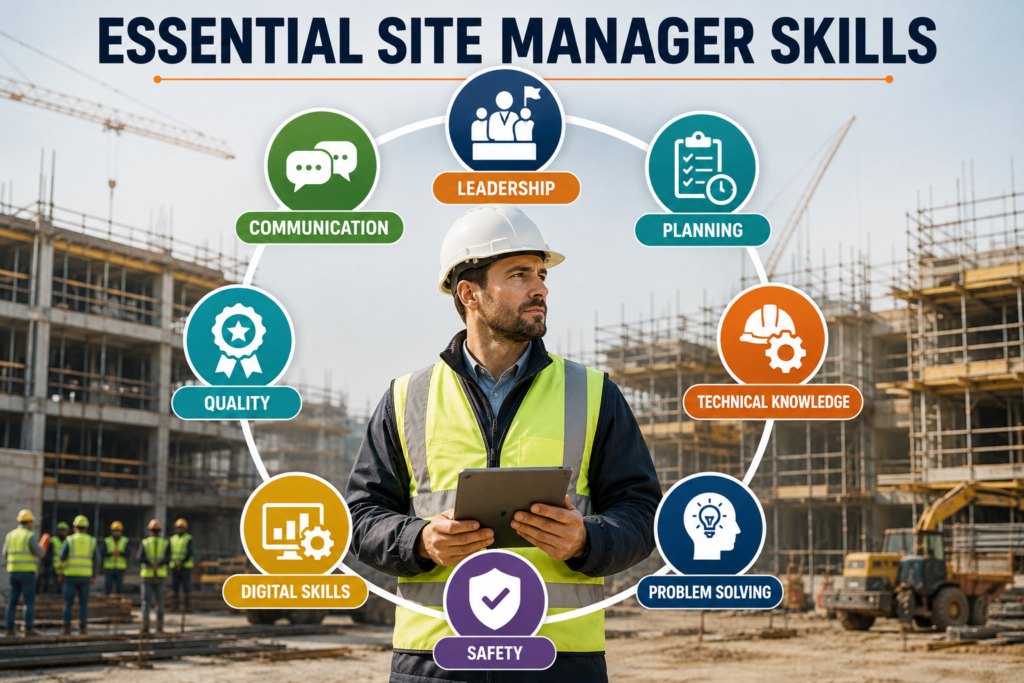
Leadership and Team Coordination
Construction managers need to establish clear priorities and make sure different teams understand what is expected.
Effective leadership is not simply about issuing instructions.
It involves building accountability, resolving conflicts, maintaining standards and helping different trades work towards the same project objectives.
Clear Communication
Site management involves constant communication.
One conversation might involve explaining a safety requirement to workers, while another could involve discussing a technical issue with an engineer or providing programme information to senior management.
Managers therefore need to communicate accurately and adapt their approach to different audiences.
Planning and Organisation
A construction site contains multiple interdependent activities.
Managers need to understand what must happen, when it should happen, what resources are required and which activities depend on earlier work.
Good organisation helps reduce clashes, downtime and avoidable disruption.
Practical Problem-Solving
Problems are inevitable in construction.
The important factor is how quickly and effectively they are managed.
A competent site manager should be able to assess a problem, identify its wider consequences, consider realistic solutions and coordinate appropriate action.
Technical Understanding
Site managers are not expected to personally perform every construction trade, but they require enough technical knowledge to understand how work should be carried out.
Useful knowledge can cover construction methods, drawings, materials, sequencing, temporary works, building services, specifications and quality requirements.
This competence is normally developed through a combination of training and practical experience.
Qualifications for Construction Site Management
There is no universal qualification route that every site manager must follow.
People enter the profession through several pathways depending on their education, existing construction experience and career goals.
University and Higher Education
Construction-related higher education programmes can provide a strong academic foundation.
Relevant subjects may include:
- Construction Management
- Civil Engineering
- Building Studies
- Construction Engineering
- Quantity Surveying
- Project Management
Academic study can develop technical and managerial understanding, although practical site experience remains extremely important.
Construction Apprenticeships
Apprenticeships combine structured learning with workplace experience.
This can be particularly useful for construction management because many of the competencies required for the role are best developed in real project environments.
Vocational and Competence-Based Qualifications
Experienced construction professionals may prefer a workplace-based qualification route.
Construction management NVQs and similar competence-based qualifications are designed to assess whether an individual can demonstrate required occupational skills through evidence from actual work activities.
This route can be particularly relevant for supervisors, assistant site managers and existing managers who already perform management responsibilities.
Site Management Safety Training
The Site Management Safety Training Scheme (SMSTS) is widely recognised within UK construction and focuses specifically on health, safety, welfare and environmental management responsibilities.
However, safety training represents only one part of site-management competence.
A construction site manager also needs technical understanding, management capability and practical experience.
CSCS Requirements
CSCS cards are used within the UK construction sector to demonstrate that workers hold appropriate training and qualifications for their occupational role.
Requirements vary according to the specific occupation and card type. Current CSCS criteria should therefore be checked before deciding which route is appropriate.
Continuing Professional Development
Construction does not remain static.
Regulations, technology, construction methods and industry expectations continue to change.
Ongoing professional development can help site managers strengthen knowledge in areas including:
- construction health and safety
- leadership
- sustainability
- digital construction
- quality assurance
- project planning
- risk management
- building regulations
Continuous development becomes increasingly important as managers take responsibility for larger and more complex projects.
Can a Site Manager Build a Career Without a University Degree?
Yes.
A degree can be valuable, but it is not the only way to progress into construction site management.
Many construction professionals begin in practical roles and gradually take on supervisory and management responsibilities.
A career might progress from hands-on construction experience into team supervision, followed by assistant management and eventually full site-management responsibility.
Workplace-based qualifications can also allow experienced professionals to formally demonstrate competence without leaving employment to undertake a traditional full-time degree.
The most suitable route depends largely on existing experience and career objectives.
How to Become a Construction Site Manager in the UK
Although individual career journeys differ, progression commonly involves several stages.
Step 1: Develop Construction Knowledge
Start by building an understanding of construction methods, materials, safety requirements and general site practices through training, education or employment.
Step 2: Gain Real Site Experience
Practical experience provides insight that cannot be developed entirely in a classroom.
Working on construction projects helps individuals understand sequencing, trade coordination, site pressures and common operational problems.
Step 3: Take on Supervisory Responsibility
Progression into a supervisor, team leader or assistant-management position provides experience in coordinating people and work activities.
Step 4: Complete Relevant Training or Qualifications
The right qualification depends on previous experience and the intended career route.
Options may include apprenticeships, construction-related degrees, vocational qualifications, competence-based NVQs and relevant safety training.
Step 5: Strengthen Management Skills
Construction knowledge alone does not automatically create an effective manager.
Leadership, communication, planning, decision-making, organisation and commercial awareness should develop alongside technical competence.
Step 6: Progress into Site Management
With suitable experience and demonstrated competence, progression can lead to assistant site manager and site manager positions.
Further experience can create opportunities to manage larger projects or progress into senior construction leadership.
Site Supervisor, Site Manager and Project Manager: What Is the Difference?
These roles are related, but their areas of responsibility are generally different.
| Position | Main Focus | Typical Scope |
| Site Supervisor | Workforce and individual activities | Supervises trades, workers and specific daily tasks |
| Site Manager | Construction-site delivery | Coordinates overall site operations, programme, quality, safety and resources |
| Project Manager | Wider project performance | Manages broader objectives, stakeholders, programme and commercial considerations |
A site supervisor normally works closely with individual teams and specific activities.
A site manager takes a broader view of the construction site and coordinates different operational areas.
A project manager usually works across the wider project and may be responsible for major decisions, client relationships, consultants, budgets and overall delivery objectives.
Job titles and responsibilities can vary between employers, so these boundaries are not always identical.
Construction Site Management Career Progression
Site management can lead to a wide range of senior construction roles.
One possible progression pathway is:
Construction Operative / Skilled Trade
↓
Site Supervisor
↓
Assistant Site Manager
↓
Site Manager
↓
Senior Site Manager
↓
Project Manager
↓
Contracts Manager / Construction Manager
↓
Construction Director
This is not a fixed career ladder.
Some professionals enter management through apprenticeships or graduate routes, while others progress after many years in skilled construction roles.
Career opportunities may also develop within specialist sectors such as residential construction, commercial developments, civil engineering, infrastructure, refurbishment, fit-out, health and safety, quality management and project management.
Construction Site Manager Salaries in the UK
Earnings in construction site management depend on several variables rather than one standard salary figure.
Factors that can influence remuneration include:
- experience
- geographical location
- qualification level
- project size and value
- construction sector
- employer
- permanent or contract status
- specialist knowledge
- level of management responsibility
Assistant and entry-level management positions generally earn less than experienced site managers.
Professionals responsible for major developments, specialist projects or multiple teams may command higher remuneration.
Because construction salaries change according to market demand and economic conditions, current recruitment data and recognised UK career sources should be consulted when evaluating salary expectations.
Common Challenges in Construction Site Management
Site management can offer considerable career progression, but it also carries significant responsibility.
Delays and Programme Pressure
Weather, labour availability, design changes, late information and material shortages can all interfere with planned activities.
Managers need to understand not only the immediate delay but also how it could affect later work.
Supply Chain Disruption
Construction programmes often depend on materials arriving at specific times.
A delayed specialist component can prevent an entire work package from progressing.
Changing Safety Risks
Construction sites evolve constantly.
New trades, equipment and work areas can introduce different hazards, meaning safety arrangements require continual monitoring.
Quality and Rework
Defective work can consume labour, materials and programme time.
Strong inspection processes help identify problems before they become more expensive to correct.
Skills and Labour Availability
Shortages of appropriately skilled workers can affect productivity and make programme coordination more difficult.
Design Changes
A design revision can affect completed work, future activities, materials and subcontractor arrangements.
Managers need to understand these implications and communicate changes effectively.
Cost Constraints
Productivity and resource efficiency are important, but they must never come at the expense of required safety or quality standards.
Stakeholder Expectations
Clients, consultants, subcontractors and project teams may have different priorities.
Site managers frequently operate between these groups and must communicate clearly when priorities conflict.
Digital Technology and the Modern Construction Site
Construction site management is becoming increasingly digital.
Technology can help teams access information faster, record evidence more accurately and improve coordination.
Building Information Modelling
Building Information Modelling (BIM) provides structured digital information about buildings and infrastructure.
For site teams, BIM can improve visualisation and coordination while making project information easier to understand.
Common Data Environments
A Common Data Environment (CDE) provides a controlled location for project drawings, specifications and other information.
This can reduce the risk of teams relying on superseded documents.
Mobile Reporting
Mobile construction applications allow site teams to record inspections, defects, progress photographs, safety observations and other information directly from the workplace.
This can make reporting quicker and improve the availability of site evidence.
Drone Technology
When legally and appropriately operated, drones can support progress monitoring, surveying and visual inspections, particularly across large or difficult-to-access areas.
Digital Quality and Safety Inspections
Electronic checklists and inspection platforms can standardise processes and create more traceable records.
Artificial Intelligence
AI-based construction tools are developing rapidly.
Potential applications include programme analysis, document review, planning support and risk identification.
These systems do not remove the need for professional judgement. Instead, they may provide managers with additional information that supports better decisions.
Sustainability and the Site Manager’s Role
Sustainable construction is increasingly connected with everyday site-management decisions.
Site managers can influence environmental performance through:
- waste reduction
- material management
- recycling
- energy use
- water consumption
- delivery planning
- plant efficiency
- pollution prevention
- appropriate material storage
These actions can support environmental objectives while also improving operational efficiency.
For example, reducing damaged materials can lower waste and replacement costs. Better logistics can reduce unnecessary vehicle movements while improving site access.
Sustainability is therefore becoming an integrated part of effective construction management.
Is Construction Site Management a Good Career Choice?
Construction site management can suit individuals who enjoy practical problem-solving but also want responsibility for people, planning and project delivery.
The career may appeal to those interested in:
- construction operations
- leadership
- organising teams
- planning
- technical problem-solving
- decision-making
- varied working environments
- long-term management progression
It is equally important to understand the demands.
Site managers can face tight deadlines, changing priorities, early starts and considerable responsibility for safety, quality and project performance.
For the right individual, however, this combination of responsibility and variety can make site management a rewarding long-term construction career.
What Will the Future Site Manager Need?
The fundamentals of construction management will remain important, but the role is evolving.
Future site managers are likely to need a stronger combination of traditional construction knowledge and modern management capabilities.
Areas becoming increasingly relevant include:
- digital construction systems
- data-informed decision-making
- sustainability
- modern methods of construction
- quality assurance
- collaborative project delivery
- leadership
- risk management
- digital documentation
Practical experience will continue to matter, but professionals who can combine that experience with recognised qualifications and digital competence may be better prepared for more senior responsibilities.

Starting and Progressing a Career in Construction Site Management
Construction site management is ultimately about turning plans into controlled, coordinated and high-quality construction activity.
A site manager must bring together people, materials, plant, safety requirements, quality standards, information and deadlines while responding to a working environment that can change from one hour to the next.
There is also no single career route into the profession.
Some people enter through university study. Others develop through apprenticeships, skilled trades, supervisory experience or vocational qualifications.
For experienced construction professionals who already carry out management duties, competence-based construction management qualifications can provide a way to formally demonstrate existing workplace capability while supporting progression towards more senior roles.
The strongest career route is therefore not necessarily the same for everyone. It should reflect current experience, existing responsibilities and long-term professional goals.
Conclusion
Construction site management is central to delivering projects safely, efficiently and to the required quality standards. From coordinating workers and subcontractors to controlling resources, monitoring progress and solving day-to-day challenges, a skilled site manager helps keep construction activities moving in the right direction. With several routes into the profession, including practical experience, apprenticeships, degrees and vocational qualifications, construction site management offers strong opportunities for long-term career progression. As digital technology, sustainability and modern construction methods continue to reshape the industry, professionals who combine technical knowledge with leadership, problem-solving and digital skills will be well positioned for future construction management roles.