
Fire Safety Regulations in England, Wales, Scotland and Northern Ireland: Key Differences
Fire safety regulations in England, Wales, Scotland and Northern Ireland establish the legal responsibilities that employers, building owners, landlords, property managers and other dutyholders must follow to protect people from fire-related risks. Although all four nations share the objective of preventing fires, protecting occupants and ensuring safe evacuation, they do not operate under one identical fire safety legal framework.
Understanding these differences is essential for organisations operating across the United Kingdom. Legislation that applies to a commercial building in England may not apply in exactly the same way to a similar building in Scotland or Northern Ireland. The terminology used to describe responsible individuals, the supporting regulations, enforcement arrangements and certain record-keeping requirements can also differ.
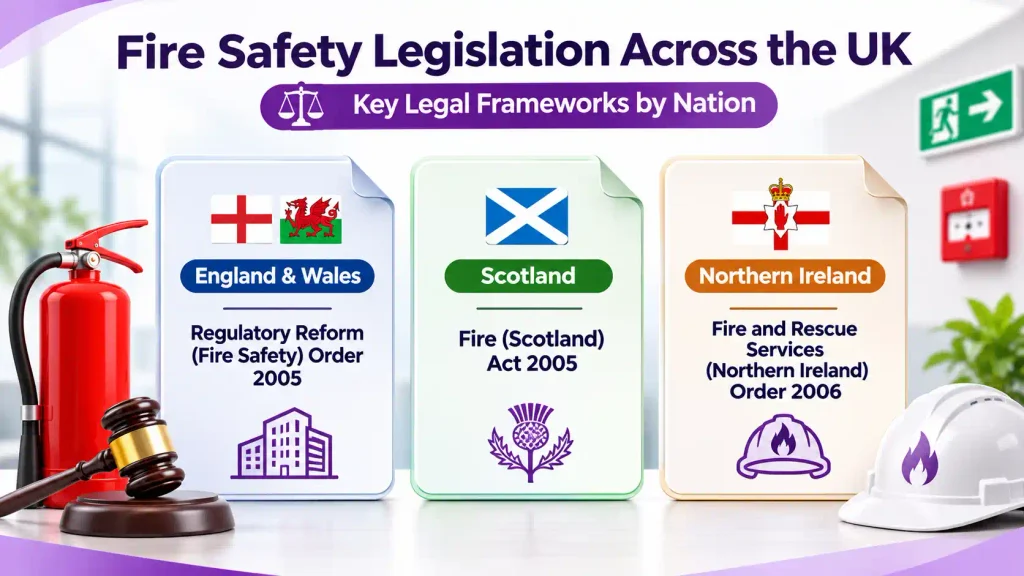
England and Wales primarily operate under the Regulatory Reform (Fire Safety) Order 2005, whereas Scotland uses Part 3 of the Fire (Scotland) Act 2005 and the Fire Safety (Scotland) Regulations 2006. Northern Ireland follows the Fire and Rescue Services (Northern Ireland) Order 2006 and the Fire Safety Regulations (Northern Ireland) 2010.
This guide explains the key differences between these national frameworks, examines their practical implications and provides a comparative overview to help businesses and property professionals understand which fire safety requirements apply to their premises. Whether you manage a workplace, operate a commercial property, oversee residential buildings or work in fire safety management, understanding the correct jurisdiction is an important starting point for effective compliance.
What Are Fire Safety Regulations in the UK?
Fire safety regulations are legal requirements designed to reduce fire risks, protect people from injury or death and ensure that buildings have suitable fire prevention, detection, warning and evacuation arrangements.
They establish responsibilities for people who own, occupy, manage or control relevant premises. Depending on the applicable national legislation, these responsibilities may include conducting fire risk assessments, maintaining fire protection equipment, providing suitable escape routes, training employees and reviewing fire safety arrangements.
The most important point is that UK fire safety law is not one single national regulatory system. England and Wales share a principal fire safety framework, while Scotland and Northern Ireland operate under separate legislation.
Why Are Fire Safety Regulations Important?
Fire safety regulations provide a structured approach to managing fire hazards and protecting building occupants. Without suitable arrangements, a fire can spread rapidly, obstruct escape routes, damage property and expose employees, customers, residents and visitors to serious danger.
Their importance includes:
- Protection of life: Ensuring people can receive warnings and escape safely during emergencies.
- Legal compliance: Helping organisations meet the requirements applicable to their premises.
- Risk reduction: Identifying ignition sources, combustible materials and other potential hazards.
- Business continuity: Reducing the likelihood of operational disruption and significant property damage.
- Accountability: Establishing clear responsibilities for people who control or manage premises.
- Emergency preparedness: Ensuring employees understand evacuation procedures and emergency arrangements.
Fire safety compliance should therefore be treated as an ongoing management responsibility rather than a one-time inspection or administrative exercise.
Understanding the Four Different Fire Safety Legal Frameworks
Before examining the individual nations, it is important to identify the principal legislation governing fire safety in each jurisdiction.
The following comparison provides a starting point for determining which legal framework applies.
Main Fire Safety Legislation Across the UK
| UK jurisdiction | Principal legislation | Supporting regulations | Main enforcing authority |
|---|---|---|---|
| England | Regulatory Reform (Fire Safety) Order 2005 | Fire Safety Act 2021; Fire Safety (England) Regulations 2022; applicable amendments | Local Fire and Rescue Authority |
| Wales | Regulatory Reform (Fire Safety) Order 2005 | Fire Safety Act 2021; applicable amendments, including section 156 of the Building Safety Act 2022 | Local Fire and Rescue Authority |
| Scotland | Fire (Scotland) Act 2005, Part 3 | Fire Safety (Scotland) Regulations 2006 | Scottish Fire and Rescue Service |
| Northern Ireland | Fire and Rescue Services (Northern Ireland) Order 2006 | Fire Safety Regulations (Northern Ireland) 2010 | Northern Ireland Fire and Rescue Service |
This comparison demonstrates why organisations should not automatically apply the same compliance checklist to every UK premises.
For example, the Fire Safety (England) Regulations 2022 introduce specific additional requirements for certain residential buildings in England. They should not be presented as regulations applying throughout England, Wales, Scotland and Northern Ireland.
Fire Safety Regulations in England
England operates under a comprehensive fire safety framework primarily established by the Regulatory Reform (Fire Safety) Order 2005. This legislation provides the foundation for fire safety management in most workplaces and other non-domestic premises. The framework places responsibilities on individuals and organisations that control relevant premises, requiring them to identify fire risks and implement appropriate protective measures.
Regulatory Reform (Fire Safety) Order 2005
The Regulatory Reform (Fire Safety) Order 2005 is the principal legislation governing fire safety in England and Wales.
It applies to most non-domestic premises, including:
- Offices and commercial buildings.
- Retail shops and shopping centres.
- Factories and warehouses.
- Educational institutions.
- Hotels and hospitality establishments.
- Restaurants and entertainment venues.
- Healthcare and care facilities.
- Common areas of relevant multi-occupied residential buildings.
The Order establishes the role of the Responsible Person, who must ensure that appropriate fire safety arrangements are implemented and maintained.
Responsibilities of the Responsible Person
A Responsible Person may be an employer, building owner, landlord, occupier or another individual who has control over relevant premises. Where several people have responsibilities, they must cooperate and coordinate their fire safety arrangements.
The main responsibilities include:
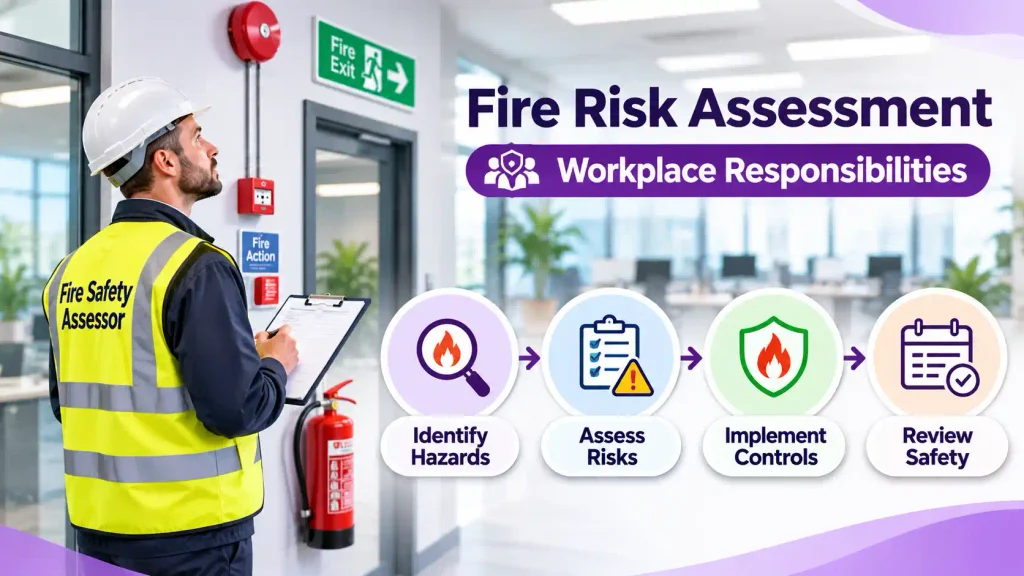
- Fire risk assessment: Identifying fire hazards, evaluating risks and determining suitable preventive and protective measures.
- Fire prevention: Taking reasonable steps to reduce ignition risks and control combustible materials.
- Fire detection and warning: Ensuring appropriate systems are available to alert occupants when a fire occurs.
- Emergency escape arrangements: Providing and maintaining suitable escape routes and exits.
- Firefighting equipment: Ensuring appropriate firefighting equipment is available and maintained.
- Employee training: Providing suitable information, instruction and training about workplace fire safety.
- Ongoing monitoring: Reviewing fire safety arrangements and updating risk assessments when necessary.
These responsibilities form the foundation of workplace fire safety management in England.
Fire Safety Act 2021
The Fire Safety Act 2021 clarified the scope of the Fire Safety Order in relation to certain multi-occupied residential buildings. It confirms that, where a building contains two or more sets of domestic premises, the assessment of fire risks under the Order includes the building’s structure, external walls and attachments, and doors between domestic premises and common parts.
This is particularly important for residential buildings where external wall systems, balconies, cladding and flat entrance doors can influence fire spread and occupant safety. The Act is relevant to England and Wales, rather than being a UK-wide replacement for the separate Scottish and Northern Irish frameworks.
Fire Safety (England) Regulations 2022
The Fire Safety (England) Regulations 2022 introduced additional requirements for certain residential buildings in England. They came into force on 23 January 2023 and include specific duties relating to information sharing, building plans, secure information boxes, signage and checks of firefighting equipment and lifts in qualifying buildings.
A high-rise residential building for the purposes of these regulations is generally a building containing two or more sets of domestic premises that is at least 18 metres high or has at least seven storeys. Other requirements apply to certain residential buildings above 11 metres, including fire door checks. These requirements are particularly relevant to building owners, managing agents and Responsible Persons overseeing multi-occupied residential properties.
New Development: Residential Personal Emergency Evacuation Plans in England
An important legislative development for 2026 is the Fire Safety (Residential Evacuation Plans) (England) Regulations 2025, which came into force on 6 April 2026. These regulations apply in England only and introduce additional arrangements for residents who may have difficulty evacuating specified residential buildings independently.
The requirements include:
- Identifying residents who may need assistance during evacuation.
- Offering person-centred fire risk assessments.
- Identifying appropriate measures to reduce evacuation risks.
- Preparing relevant residential emergency evacuation information.
- Developing building emergency evacuation plans.
- Sharing specified information with fire and rescue authorities, subject to the applicable consent requirements.
The regulations cover qualifying buildings containing two or more domestic premises, including buildings at least 18 metres high or with at least seven storeys, and certain buildings above 11 metres with simultaneous evacuation strategies. This development is particularly important for residential property managers because it adds a more structured approach to supporting residents who may require assistance during emergencies.
Fire Safety Regulations in Wales
Wales shares the principal fire safety legislation used in England, but this does not mean that every additional English fire safety regulation automatically applies in Wales. The distinction is important for organisations managing properties across the English and Welsh borders.
Regulatory Reform (Fire Safety) Order 2005 in Wales
The Regulatory Reform (Fire Safety) Order 2005 also applies in Wales and provides the main legal framework for fire safety in relevant non-domestic premises. It establishes duties for people who control premises and requires appropriate measures to protect employees and other relevant individuals from fire risks.
These responsibilities include:
- Conducting suitable fire risk assessments.
- Identifying and reducing fire hazards.
- Maintaining appropriate fire precautions.
- Providing safe evacuation arrangements.
- Ensuring employees receive relevant fire safety information and training.
- Reviewing and recording fire safety arrangements.
For organisations operating in both England and Wales, this shared legislative foundation can make some aspects of fire safety management more consistent. However, organisations must still consider Welsh-specific guidance and the application of individual supporting regulations.
Fire Safety Act 2021 in Wales
The Fire Safety Act 2021 also affects the application of the Fire Safety Order in Wales. Its clarification of fire risk assessment responsibilities in multi-occupied residential buildings is relevant to building owners and managers operating in Wales. This means that the assessment of fire risks should not be restricted to internal communal areas where the building’s structure, external walls and relevant doors also fall within the applicable scope.
Building Safety Act 2022: Section 156
Section 156 of the Building Safety Act 2022 introduced further changes to the Fire Safety Order. The relevant amendments came into force in England and Wales on 1 October 2023. One important change is that Responsible Persons must record their fire risk assessment in full, including all findings, and record their fire safety arrangements in all circumstances. This removed the previous general recording threshold associated with employing five or more employees, licensing or an alterations notice for the relevant requirements.
The change is particularly important for smaller organisations that previously believed they did not need to maintain a full written record. The legal recording requirements must be understood according to the applicable national legislation rather than assumed to be identical throughout the UK.
How Does Wales Differ from England?
Although England and Wales share the Fire Safety Order, important differences arise from additional regulations.
| Area | England | Wales |
|---|---|---|
| Principal fire safety legislation | Fire Safety Order 2005 | Fire Safety Order 2005 |
| Fire Safety Act 2021 | Applies | Applies |
| Section 156 recording changes | Apply | Apply |
| Fire Safety (England) Regulations 2022 | Apply where relevant | Do not apply |
| Residential Evacuation Plans Regulations 2025 | Apply from 6 April 2026 where relevant | Do not apply |
| Local enforcement | Local Fire and Rescue Authority | Local Fire and Rescue Authority |
Practical example: A property management company operating a qualifying high-rise residential building in England may have additional information-sharing and inspection duties under the Fire Safety (England) Regulations 2022. It should not automatically apply those England-only regulations to a similar property in Wales.
The organisation must instead identify the Welsh requirements relevant to its building and follow the applicable Fire Safety Order and supporting legislation.
Fire Safety Regulations in Scotland
Scotland operates under a separate fire safety legal framework established by the Fire (Scotland) Act 2005. Part 3 of this legislation addresses fire safety duties, including responsibilities for employers and people who control relevant premises. The framework is supported by the Fire Safety (Scotland) Regulations 2006, which provide further requirements for fire safety management.
Fire (Scotland) Act 2005
The Fire (Scotland) Act 2005 establishes the legal foundation for fire safety management in relevant Scottish premises. Unlike the terminology used in the English and Welsh framework, the Scottish legislation uses the term dutyholder. A dutyholder may be an employer or another individual or organisation with control over relevant premises.
Under the Act, employers must ensure, so far as reasonably practicable, the safety of employees in relation to fire risks. People controlling relevant premises must also assess fire risks and implement suitable fire safety measures.
The legislation addresses areas including:
- Fire risk assessment.
- Fire prevention measures.
- Protection of people from fire-related harm.
- Suitable means of escape.
- Fire warning arrangements.
- Firefighting equipment.
- Fire safety management.
- Enforcement and monitoring.
These responsibilities demonstrate that Scottish fire safety legislation is designed to establish practical duties for those who manage and control premises. Legislation.gov.uk+1
Fire Safety (Scotland) Regulations 2006
The Fire Safety (Scotland) Regulations 2006 support the Fire (Scotland) Act 2005 by establishing further requirements relating to fire safety precautions. They address practical matters that dutyholders must consider when managing relevant premises.
These include:
- Fire safety arrangements: Appropriate systems for organising, managing and reviewing fire safety measures.
- Firefighting equipment: Suitable provision and maintenance of equipment according to the nature of the premises and risks.
- Escape routes: Ensuring people can leave premises safely during an emergency.
- Fire detection and warning: Appropriate arrangements for identifying fires and warning occupants.
- Information and training: Ensuring employees understand relevant fire risks and the precautions required.
- Risk assessment reviews: Keeping assessments under review when circumstances change.
The requirements should be considered alongside the Scottish Government’s premises-specific fire safety guidance.
Who Enforces Fire Safety Regulations in Scotland?
The Scottish Fire and Rescue Service (SFRS) is the main enforcing authority for the majority of premises covered by the Scottish fire safety framework. Its enforcement officers may examine premises, review fire safety arrangements and identify areas where additional protective measures are necessary.
Where a dutyholder fails to meet the relevant requirements, enforcement action may be taken under the legislation. This means Scottish businesses should consult the Scottish Fire and Rescue Service and the relevant Scottish Government guidance when establishing their compliance arrangements.
Scottish Fire Safety Guidance
The Scottish Government provides different fire safety guidance documents for different types of premises.
These include guidance for:
- Existing non-residential premises.
- Premises with sleeping accommodation.
- Care homes.
- Specialised housing.
- Existing high-rise domestic buildings.
Using guidance relevant to the building type is important because the risks and practical control measures can vary significantly between workplaces, residential accommodation and specialist care environments. Scottish Government
Explore the official Scottish Government fire safety guidance for further information.
Fire Safety Regulations in Northern Ireland
Northern Ireland has its own fire safety legislation, separate from the legal frameworks used in England, Wales and Scotland. The principal legislation is the Fire and Rescue Services (Northern Ireland) Order 2006, supported by the Fire Safety Regulations (Northern Ireland) 2010. These provisions establish responsibilities for employers and people who control relevant premises.
Fire and Rescue Services (Northern Ireland) Order 2006
The Fire and Rescue Services (Northern Ireland) Order 2006 establishes the legal framework for fire safety responsibilities in relevant premises. It contains provisions addressing the duties of employers, people controlling premises and other individuals with relevant responsibilities.
Articles 25 and 26 are particularly important.
- Article 25: Duties of employers
- Employers must ensure, so far as reasonably practicable, the safety of their employees in respect of harm caused by fire in the workplace. This includes assessing workplace fire risks and taking appropriate fire safety measures.
- Article 26: Duties relating to relevant premises
- People who have control over relevant premises must fulfil the applicable fire safety duties. Depending on the circumstances, responsibilities may also extend to property owners and other individuals with relevant control or obligations. The legislation therefore establishes responsibilities that are not limited to the person who owns a building.
Fire Safety Regulations (Northern Ireland) 2010
The Fire Safety Regulations (Northern Ireland) 2010 provide additional requirements supporting the 2006 Order.
They address important fire safety management matters, including:
- Fire risk assessment arrangements.
- Fire safety precautions.
- Maintenance of fire safety measures.
- Recording relevant assessment information.
- Fire safety management arrangements.
- Information and training for employees.
An important distinction concerns the recording requirements. Under the Northern Ireland regulations, Regulation 8 establishes circumstances in which information relating to fire risk assessments must be recorded. These include situations involving five or more employees, premises requiring a licence or registration, or premises subject to an alterations notice.
This differs from England and Wales, where the changes introduced through section 156 of the Building Safety Act 2022 removed the previous general recording thresholds for the relevant Fire Safety Order duties. Therefore, organisations should not assume that the recording requirements are identical across these jurisdictions.
Role of Northern Ireland Fire and Rescue Service
The Northern Ireland Fire and Rescue Service (NIFRS) is responsible for enforcing relevant fire safety duties under the Northern Ireland framework. It provides business fire safety information and guidance to organisations that need to understand their responsibilities. Its enforcement role includes examining relevant premises and taking appropriate action where fire safety requirements are not met. Businesses should consult NIFRS guidance when assessing their obligations, particularly where premises have complex occupancy arrangements or are used for commercial and residential purposes.
Official resource: Northern Ireland Fire and Rescue Service – Business Fire Safety.
Key Differences Between Fire Safety Regulations in England, Wales, Scotland and Northern Ireland
Understanding the individual legal frameworks is only the first step. Organisations also need to understand how the differences affect practical fire safety management.
The following comparison highlights the main distinctions.
Comparative Fire Safety Legislation Table
| Comparison area | England | Wales | Scotland | Northern Ireland |
|---|---|---|---|---|
| Principal legislation | Fire Safety Order 2005 | Fire Safety Order 2005 | Fire (Scotland) Act 2005 | Fire and Rescue Services Order 2006 |
| Main dutyholder terminology | Responsible Person | Responsible Person | Dutyholder | Employer/person with control |
| Supporting regulations | Fire Safety (England) Regulations 2022 and others | Applicable supporting legislation | Fire Safety (Scotland) Regulations 2006 | Fire Safety Regulations 2010 |
| Main enforcement authority | Local Fire and Rescue Authority | Local Fire and Rescue Authority | Scottish Fire and Rescue Service | Northern Ireland Fire and Rescue Service |
| Fire risk assessment | Required under applicable Fire Safety Order duties | Required under applicable Fire Safety Order duties | Required under Part 3 duties | Required under applicable Order duties |
| Recording arrangements | Full recording under section 156 changes | Full recording under section 156 changes | Scottish legislative requirements | Regulation 8 conditions apply |
| Additional residential requirements | England-specific regulations apply where relevant | Different national arrangements | Separate Scottish framework | Separate Northern Irish framework |
The terminology and recording arrangements are particularly important for organisations that manage premises in more than one jurisdiction.
Difference in Legal Responsibilities
The English and Welsh framework uses the term Responsible Person to describe individuals who have relevant responsibility for fire safety. Scotland uses the term dutyholder, reflecting the responsibilities established under the Fire (Scotland) Act 2005. Northern Ireland establishes duties through its own legislation, including separate provisions for employers and people who control relevant premises. Although these terms are not identical, they all relate to establishing accountability for managing fire safety.
Difference in Residential Building Requirements
Residential buildings require particular attention because their fire safety arrangements can involve communal areas, external walls, doors, evacuation strategies and residents who may need additional assistance. England has introduced additional regulations covering certain residential buildings, including specific requirements for high-rise buildings and residential evacuation planning. Wales shares the main Fire Safety Order but does not automatically follow England-only regulations.
Scotland and Northern Ireland have their own legal approaches to residential premises, including separate arrangements for relevant houses in multiple occupation. Building owners and managers should therefore identify the correct national requirements before preparing a residential fire safety compliance programme.
Difference in Enforcement
The main enforcing authorities differ according to jurisdiction.
| Jurisdiction | Enforcing authority | Practical responsibility |
|---|---|---|
| England | Local Fire and Rescue Authority | Enforces applicable fire safety duties |
| Wales | Local Fire and Rescue Authority | Enforces applicable fire safety duties |
| Scotland | Scottish Fire and Rescue Service | Enforces Scottish fire safety legislation |
| Northern Ireland | Northern Ireland Fire and Rescue Service | Enforces Northern Irish fire safety legislation |
Enforcement can involve inspections, requests for information, identification of deficiencies and formal notices where required. The appropriate authority should always be identified according to the location of the premises.
How to Determine Which Fire Safety Regulations Apply to Your Premises
One of the most common compliance mistakes is selecting fire safety guidance without first identifying the jurisdiction and legal framework. A business may operate several premises across the UK, but the same compliance document should not automatically be used for every location. A systematic approach can help organisations identify the relevant requirements.
Step-by-Step Fire Safety Compliance Process
- Step 1: Identify the location
- Establish whether the premises are situated in England, Wales, Scotland or Northern Ireland. This determines the principal fire safety legislation that must be considered.
- Step 2: Identify the type of premises
- Determine whether the building is a workplace, retail establishment, warehouse, hotel, care facility, educational institution or residential property. The premises’ use can affect which legal requirements apply.
- Step 3: Identify the responsible individuals
- Establish who owns, occupies, manages or controls the premises. Identify the individuals who have legal responsibilities for fire safety and clarify how those responsibilities are shared.
- Step 4: Review the relevant legislation
- Consult the principal legislation and supporting regulations for the applicable jurisdiction. Do not rely solely on general UK fire safety checklists.
- Step 5: Conduct a suitable fire risk assessment
- Identify potential ignition sources, combustible materials, people at risk, fire spread hazards and weaknesses in existing protective measures.
- Step 6: Implement appropriate precautions
- Establish suitable fire detection, warning, escape, emergency lighting, firefighting and management arrangements.
- Step 7: Maintain records and review arrangements
- Maintain the documentation required by the relevant legislation and review fire safety arrangements when significant changes occur.
Fire Safety Compliance Decision Flowchart
The following flowchart illustrates a practical method for identifying the correct starting point for fire safety compliance.
This process should be used as an initial compliance screening method. Complex buildings, mixed-use premises and multi-occupied residential developments may require a more detailed legal and technical review.
Fire Risk Assessments Under the Different UK Frameworks
A fire risk assessment is an essential part of fire safety management. It helps identify potential fire hazards, determine who could be affected and establish suitable measures to reduce risks. Although the precise legal provisions differ between the four nations, assessing fire risks is a fundamental requirement across their respective frameworks.
What Should a Fire Risk Assessment Include?
A suitable assessment should examine the conditions and activities that could contribute to a fire or increase its consequences.
| Assessment area | What should be examined? |
|---|---|
| Fire hazards | Sources of ignition, fuel and oxygen |
| People at risk | Employees, visitors, contractors, residents and people requiring assistance |
| Fire prevention | Measures for controlling ignition and combustible materials |
| Detection and warning | Fire alarms, detectors and warning arrangements |
| Escape routes | Exit availability, travel routes and obstructions |
| Emergency lighting | Lighting arrangements for safe evacuation |
| Firefighting equipment | Suitability, accessibility and maintenance |
| Training | Employee awareness and emergency response competence |
| Documentation | Assessment findings and required fire safety records |
| Review arrangements | Changes in premises, activities, occupancy or identified risks |
When Should a Fire Risk Assessment Be Reviewed?
A fire risk assessment should not be treated as a permanent document that remains valid regardless of changing circumstances.
It should be reviewed when:
- The building layout changes.
- New equipment or processes are introduced.
- Occupancy levels increase.
- New fire hazards are identified.
- Fire protection systems are modified.
- A fire or significant near miss occurs.
- Existing control measures are no longer suitable.
- The assessment is suspected of being invalid.
Regular monitoring helps ensure that fire safety measures remain appropriate for the actual conditions of the premises. For organisations that need professional support, the ProQual Accredited Certified Fire Safety Training Course can be explored as part of a wider approach to developing fire safety knowledge and workplace competence.
Practical Examples: How Different Jurisdictions Affect Fire Safety Compliance
Understanding legislation becomes easier when its application is considered through realistic workplace and property management situations.
Example: A Commercial Warehouse in England
A company operates a large warehouse in Birmingham. The organisation must consider the Regulatory Reform (Fire Safety) Order 2005 and identify the Responsible Person. A suitable fire risk assessment should examine combustible stock, machinery, electrical installations, storage arrangements, escape routes and emergency warning systems. The organisation must also maintain appropriate records and provide suitable fire safety training.
Example: A Retail Property in Wales
A retailer operates several shops in Cardiff. The organisation must follow the applicable Fire Safety Order requirements and ensure that its fire risk assessments reflect the specific risks associated with each property. The organisation should not automatically apply England-only residential regulations simply because its internal compliance policy was originally developed for English premises.
Example: A Care Facility in Scotland
A care facility operates in Glasgow. The organisation must consider Part 3 of the Fire (Scotland) Act 2005 and the Fire Safety (Scotland) Regulations 2006. Its assessment should consider residents who may have mobility difficulties, the availability of assistance, evacuation arrangements and the specific risks associated with sleeping accommodation. Scottish Government guidance for care homes and relevant premises should be considered.
Example: A Business Premises in Northern Ireland
A business operates a manufacturing facility in Belfast. The organisation must consider the Fire and Rescue Services (Northern Ireland) Order 2006 and the Fire Safety Regulations (Northern Ireland) 2010. Its fire safety arrangements should address machinery, electrical equipment, combustible materials, employee training and emergency evacuation. The organisation must also establish the applicable documentation and recording requirements under the Northern Ireland framework. These examples demonstrate why fire safety management should be based on the premises’ location, use and risk profile rather than a generic UK-wide checklist.
Common Fire Safety Compliance Mistakes to Avoid
Even organisations with established safety procedures can make mistakes when interpreting fire safety legislation. Recognising these problems can help prevent legal misunderstandings and improve workplace protection.
Applying English Legislation Throughout the UK
The Fire Safety Order 2005 applies in England and Wales, not Scotland or Northern Ireland. Using it as the principal legal reference for premises in Scotland or Northern Ireland can result in incorrect compliance arrangements.
Recommended approach: Identify the national legislation before preparing the fire safety policy or assessment.
Confusing England-Only Regulations with Welsh Requirements
The Fire Safety (England) Regulations 2022 and the Residential Evacuation Plans Regulations 2025 have England-only application. Their provisions should not automatically be treated as Welsh legal requirements.
Recommended approach: Check the extent and application of each statutory instrument individually.
Failing to Identify All Relevant Dutyholders
Fire safety responsibilities may be shared between employers, property owners, landlords, occupiers and facilities managers. Assuming that only the property owner is responsible can leave important safety duties unmanaged.
Recommended approach: Establish responsibilities clearly and ensure cooperation between all relevant parties.
Treating Fire Risk Assessments as One-Time Documents
Changes in building layout, occupancy, equipment or activities can affect fire risks. An assessment that was appropriate several years ago may no longer reflect current conditions.
Recommended approach: Establish a suitable review process and update assessments when necessary.
Ignoring Employee Training
Even well-maintained fire protection equipment cannot replace effective emergency preparedness. Employees must understand the relevant fire risks, warning arrangements and evacuation procedures.
Recommended approach: Provide suitable induction, refresher and role-specific fire safety training.
Using Outdated Legal Information
Fire safety legislation and supporting guidance can change. Relying on outdated articles or templates can lead to incorrect assumptions about current responsibilities.
Recommended approach: Consult current legislation, government guidance and the relevant fire and rescue authority.
How Organisations Can Improve Fire Safety Compliance Across the UK
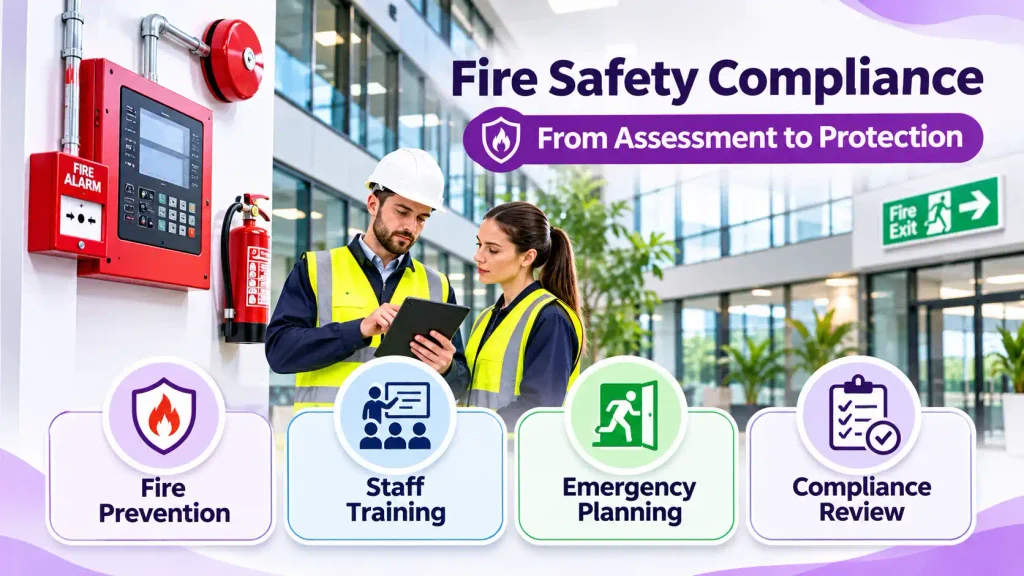
Organisations operating in multiple UK jurisdictions need a structured approach to managing fire safety. A central policy can help establish consistent standards, but it should not replace the legal requirements applicable to individual premises.
The following practices can help improve compliance.
Develop a Jurisdiction-Specific Fire Safety Policy
A fire safety policy should identify the legislation applicable to each premises and establish the responsibilities of relevant individuals. For organisations operating in England, Wales, Scotland and Northern Ireland, it is useful to maintain a separate compliance schedule for each jurisdiction.
This schedule should identify:
- Applicable primary legislation.
- Relevant supporting regulations.
- Responsible individuals and dutyholders.
- Fire risk assessment requirements.
- Inspection and maintenance arrangements.
- Employee training requirements.
- Documentation and review procedures.
- Relevant enforcement authorities.
Establish Effective Fire Safety Management
Fire safety management should be integrated into everyday business operations. Management teams should ensure that fire doors remain functional, escape routes are unobstructed, emergency lighting is maintained and fire detection systems receive appropriate inspections. Organisations should also maintain clear communication between landlords, tenants, contractors and facilities management teams.
Develop Professional Fire Safety Competence
Effective fire safety management requires suitable knowledge and practical understanding.
Professionals involved in fire risk assessments, building management, fire protection systems and workplace safety should develop competence relevant to their responsibilities.
Specialist learning can also support people working in fire engineering and passive fire protection.
For example:
- The ProQual Level 5 Diploma in Fire Engineering Design is relevant to professionals developing knowledge of fire engineering design.
- The ICTQual AB Level 6 International Diploma in Fire Safety & Firefighting Technology provides a specialist learning pathway in fire safety and firefighting technology.
- The ProQual Level 3 Award in the Inspection and Testing of Fire-Rated Intumescent Coatings addresses specialist knowledge associated with inspecting and testing fire-rated coatings.
These learning opportunities can complement organisational fire safety arrangements, although completing a course does not automatically establish legal competence for every specialist activity.
Integrate Fire Safety with Building Safety Management
Fire safety should also be considered alongside wider building safety responsibilities. Building owners and property managers should understand how fire protection, structural safety, evacuation planning and maintenance activities interact. For further information, read InspireCollege’s guide to the Building Safety Act 2022 and Fire Safety: What Property Owners Need to Know. Organisations should also understand the underlying requirements of the Regulatory Reform (Fire Safety) Order 2005 when managing relevant premises in England and Wales.
Official Resources for Understanding UK Fire Safety Legislation
Using reliable sources is essential when interpreting legal requirements. Businesses should prioritise legislation, official government guidance and information published by the relevant fire and rescue services.
The following resources provide useful starting points.
| Organisation | Resource | Purpose |
|---|---|---|
| UK Government | Fire safety guidance for those with legal duties | Guidance on legal responsibilities in England and Wales |
| UK Government | Guide for persons with duties under fire safety legislation | Explains duties under the relevant English framework |
| Scottish Government | Fire safety in Scotland | Scottish fire safety policy and information |
| Scottish Government | Scottish fire safety guidance | Guidance for different types of premises |
| Scottish Fire and Rescue Service | Business advice and guidance | Practical fire safety information for businesses |
| Northern Ireland Fire and Rescue Service | Business fire safety | Guidance for businesses and property managers |
| UK Legislation | Regulatory Reform (Fire Safety) Order 2005 | Primary legislation for England and Wales |
| UK Legislation | Fire (Scotland) Act 2005 | Scottish fire safety legislation |
| UK Legislation | Fire and Rescue Services (Northern Ireland) Order 2006 | Northern Ireland’s principal legislation |
Organisations should check the latest legislation and amendments rather than relying exclusively on explanatory articles.
Conclusion: Understanding Fire Safety Regulations Across the UK
Fire safety regulations in England, Wales, Scotland and Northern Ireland share a common objective: protecting people, buildings and workplaces from the consequences of fire. However, their legal frameworks, terminology, supporting regulations and enforcement arrangements are not identical.
England and Wales operate under the Regulatory Reform (Fire Safety) Order 2005, while Scotland follows the Fire (Scotland) Act 2005 and Northern Ireland operates under the Fire and Rescue Services (Northern Ireland) Order 2006.
Understanding these distinctions helps employers, landlords, building owners, facilities managers and fire safety professionals establish appropriate compliance arrangements for their premises.
The most effective approach is to identify the jurisdiction first, review the applicable legislation, assess the actual fire risks and implement suitable preventive and protective measures.
Organisations should also invest in relevant fire safety knowledge and professional development to strengthen their ability to manage workplace risks and maintain effective safety arrangements.
Develop your professional fire safety knowledge with InspireCollege. Explore our Fire Safety Training Courses to discover learning opportunities that support workplace fire safety awareness, professional development and improved fire safety management.
Recommended keyword placement
| Keyword | Recommended placement |
|---|---|
| Fire Safety Regulations in England, Wales, Scotland and Northern Ireland | H1 and introduction |
| Fire safety regulations UK | Introduction and conclusion |
| Fire Safety Order 2005 | England and Wales sections |
| Fire safety legislation Scotland | Scotland section |
| Fire safety regulations Northern Ireland | Northern Ireland section |
| UK fire safety requirements | Compliance section |
| Fire risk assessment regulations | Fire risk assessment section |
| Fire safety responsibilities | Responsibilities and FAQs |
The most important primary and official sources used for this article are:
- UK Government – Fire Safety Guidance. GOV.UK
- Fire (Scotland) Act 2005. Legislation.gov.uk
- Scottish Government – Fire Safety Guidance. Scottish Government
- Northern Ireland Fire and Rescue Service. Northern Ireland Fire & Rescue Service
- Residential Evacuation Plans Regulations 2025. Legislation.gov.uk
Editorial note: This article is educational information, not legal advice. Organisations should consult current legislation, official guidance and competent fire safety professionals when determining their legal obligations.
Frequently Asked Questions About UK Fire Safety Regulations
Find answers to common questions about fire safety legislation, legal responsibilities and compliance requirements across England, Wales, Scotland and Northern Ireland.
Are fire safety regulations the same throughout the UK?
No. Fire safety regulations are not identical throughout the UK. England and Wales share the Regulatory Reform (Fire Safety) Order 2005, while Scotland follows the Fire (Scotland) Act 2005 and Northern Ireland follows the Fire and Rescue Services (Northern Ireland) Order 2006. Each jurisdiction also has supporting regulations and separate enforcement arrangements.
What is the main fire safety legislation in England?
The main fire safety legislation in England is the Regulatory Reform (Fire Safety) Order 2005. It establishes duties for Responsible Persons to assess fire risks and implement suitable fire precautions in relevant premises. Additional requirements include the Fire Safety Act 2021 and Fire Safety (England) Regulations 2022, where applicable.
Does the Regulatory Reform (Fire Safety) Order 2005 apply in Scotland?
No. The Regulatory Reform (Fire Safety) Order 2005 applies in England and Wales only. Scotland has its own fire safety framework under Part 3 of the Fire (Scotland) Act 2005, supported by the Fire Safety (Scotland) Regulations 2006.
Does the Fire Safety Order apply in Wales?
Yes. The Regulatory Reform (Fire Safety) Order 2005 applies in Wales as well as England. However, certain additional regulations, such as the Fire Safety (England) Regulations 2022, apply in England only. Organisations operating in Wales must follow the relevant Welsh requirements and applicable amendments to the Fire Safety Order.
What fire safety legislation applies in Scotland?
The main legislation is the Fire (Scotland) Act 2005, particularly Part 3, which establishes fire safety duties. It is supported by the Fire Safety (Scotland) Regulations 2006. The Scottish Fire and Rescue Service is the principal enforcing authority for most relevant premises.
What fire safety regulations apply in Northern Ireland?
Northern Ireland primarily follows the Fire and Rescue Services (Northern Ireland) Order 2006 and the Fire Safety Regulations (Northern Ireland) 2010. These establish fire safety responsibilities for employers and individuals who control relevant premises.
Who is responsible for fire safety in the workplace?
Responsibility depends on the applicable legislation and the individual’s role. In England and Wales, the Responsible Person may be an employer, owner, landlord, occupier or another person with control of the premises. In Scotland, the legislation uses the term dutyholder. Northern Ireland establishes duties for employers and people who control relevant premises.
Is a fire risk assessment required in all four UK nations?
Fire risk assessments are an important legal requirement under the applicable fire safety frameworks in all four nations. However, the precise statutory provisions, premises coverage and responsible individuals differ. Businesses should identify the relevant national legislation before preparing their assessments.
Do fire safety regulations apply to residential buildings?
Some fire safety legislation applies to specific parts of residential buildings, including common areas and certain multi-occupied properties. The extent of coverage varies between jurisdictions. England has additional regulations for qualifying residential buildings, while Scotland and Northern Ireland have separate arrangements. Individual domestic dwellings and shared residential areas should not automatically be treated as having identical legal coverage.
What is the difference between a Responsible Person and a Dutyholder?
Responsible Person is the terminology used under the Regulatory Reform (Fire Safety) Order 2005 in England and Wales. Dutyholder is used under the Fire (Scotland) Act 2005. Both terms identify individuals or organisations with relevant legal responsibilities for fire safety, but their precise statutory meanings and associated duties must be understood within their respective legislation.
Do the Fire Safety (England) Regulations 2022 apply in Wales?
No. Despite the Fire Safety Order applying in both England and Wales, the Fire Safety (England) Regulations 2022 apply in England only. Welsh building owners and managers must follow the relevant Welsh legal requirements rather than automatically adopting England-only regulations as statutory duties.
What changed in fire safety recording requirements in 2023?
Section 156 of the Building Safety Act 2022 amended the Fire Safety Order. From 1 October 2023, Responsible Persons in England and Wales must record their fire risk assessments in full, including all findings, and record their fire safety arrangements in all circumstances. This removed the previous general five-employee recording threshold under the Order.
What are the new Residential PEEPs requirements in England?
The Fire Safety (Residential Evacuation Plans) (England) Regulations 2025 came into force on 6 April 2026. They introduce requirements for identifying residents who may need assistance evacuating specified residential buildings, offering person-centred fire risk assessments and establishing relevant emergency evacuation arrangements. They apply in England only.
Who enforces fire safety regulations in the UK?
The enforcing authority depends on the premises’ location. Local Fire and Rescue Authorities enforce relevant legislation in England and Wales. The Scottish Fire and Rescue Service is the principal enforcing authority in Scotland, while the Northern Ireland Fire and Rescue Service enforces the relevant Northern Irish legislation.
How can businesses maintain fire safety compliance across different UK jurisdictions?
Businesses should identify the legislation applicable to each premises, establish clear dutyholder responsibilities, conduct suitable fire risk assessments, maintain protective equipment, provide employee training and keep appropriate records. Organisations operating across multiple nations should maintain jurisdiction-specific compliance arrangements and regularly review changes to legislation.