
Fire Safety Documentation Every Business Should Maintain to Stay Compliant
Fire safety documentation is one of the most overlooked aspects of workplace compliance, yet it is often one of the first things a fire inspector requests during an inspection. While fire extinguishers, alarms, emergency lighting, and escape routes are highly visible, the records that demonstrate how these systems are managed are equally important. Without accurate documentation, a business may struggle to prove that it has fulfilled its legal responsibilities, even if suitable fire safety measures are in place.
Across the UK, every organisation responsible for non-domestic premises has a legal duty to implement and maintain appropriate fire safety arrangements. These responsibilities extend beyond installing fire protection equipment. Businesses must also maintain comprehensive records that show risks have been identified, preventive measures have been implemented, staff have been trained, equipment has been inspected, and emergency procedures are regularly reviewed.
Under the Regulatory Reform (Fire Safety) Order 2005, the Responsible Person must ensure that suitable fire safety arrangements are documented, monitored, and kept up to date. These records provide evidence of compliance, support workplace inspections, strengthen business continuity, and demonstrate due diligence if an incident occurs.
Many organisations only update documentation immediately before a fire safety inspection. However, maintaining accurate and accessible records throughout the year not only helps satisfy legal requirements but also improves operational efficiency, reduces liability, and enhances the overall safety culture of the workplace.
This comprehensive guide explains the essential fire safety documentation every UK business should maintain, why each document matters, who is responsible for keeping it up to date, and how proper documentation supports inspections, insurance claims, and long-term compliance. Whether you manage an office, warehouse, retail premises, hotel, school, healthcare facility, or manufacturing site, this guide will help you build a robust documentation system that protects both people and your organisation.
What is Fire Safety Documentation?
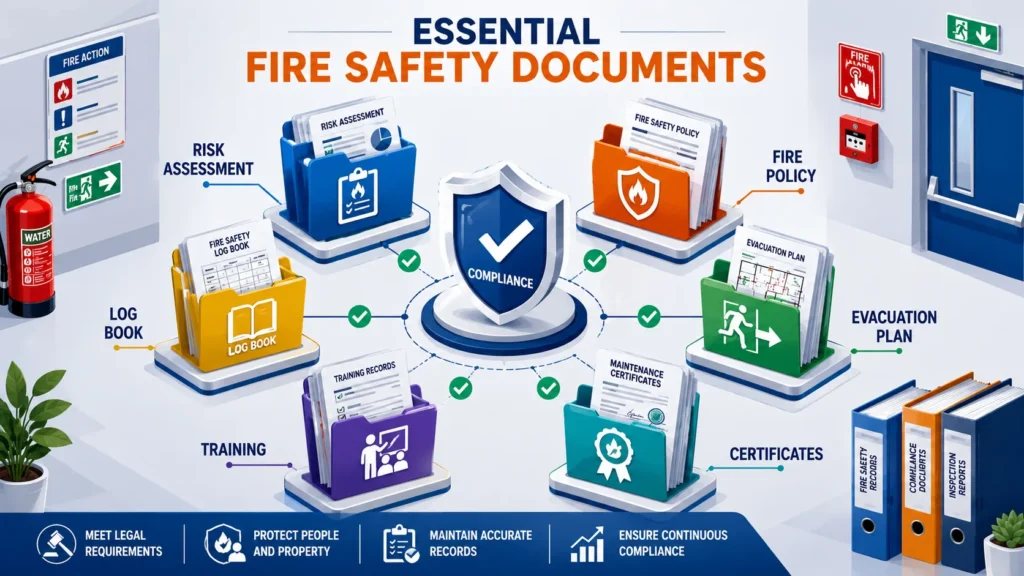
Fire safety documentation refers to the collection of records, policies, certificates, inspection reports, maintenance logs, emergency plans, and training records that demonstrate how an organisation manages fire safety. These documents provide evidence that fire risks have been assessed, preventive measures are in place, and legal duties are being fulfilled.
Rather than serving as paperwork for administrative purposes alone, fire safety documentation forms the foundation of an effective fire safety management system. It enables organisations to monitor compliance, identify areas for improvement, and provide inspectors with clear evidence that fire safety responsibilities are taken seriously.
Depending on the nature of the business and the level of fire risk, documentation may include:
- Fire Risk Assessments
- Fire Safety Policy
- Emergency Fire Evacuation Plan
- Fire Alarm Testing Records
- Emergency Lighting Test Logs
- Fire Extinguisher Maintenance Certificates
- Fire Door Inspection Reports
- Fire Drill Records
- Staff Fire Safety Training Records
- Fire Marshal Appointment Records
- Hot Work Permits
- Personal Emergency Evacuation Plans (PEEPs)
- Contractor Maintenance Certificates
- Fire Safety Audit Reports
- Fire Incident Reports
- Corrective Action Registers
- Building Layout and Escape Plans
- Fire Safety Log Book
Each document plays a specific role in helping organisations reduce fire risks, improve emergency preparedness, and maintain compliance with UK legislation.
Why Fire Safety Documentation Matters
Many businesses focus primarily on physical fire protection systems while giving less attention to the records that support them. However, documentation is often the key factor that demonstrates whether fire safety arrangements are being actively managed or simply assumed to be in place.
Maintaining accurate documentation delivers significant legal, operational, and financial benefits.
Demonstrates Legal Compliance
Fire safety legislation requires businesses to take appropriate measures to protect occupants from fire. Documentation provides objective evidence that these measures have been implemented and maintained.
During a fire safety inspection, records help inspectors verify that:
- Fire risk assessments are current.
- Fire protection systems are regularly maintained.
- Staff receive appropriate training.
- Emergency procedures are tested.
- Corrective actions are completed.
- Fire safety responsibilities are clearly assigned.
Without documentation, organisations may struggle to demonstrate compliance even when suitable fire safety systems exist.
Protects Employees and Visitors
Accurate documentation supports safer workplaces by ensuring important activities are completed on time.
Examples include:
- Routine alarm testing.
- Emergency lighting inspections.
- Fire extinguisher servicing.
- Fire drills.
- Staff refresher training.
- Fire door inspections.
When these activities are properly documented, the likelihood of critical safety measures being overlooked is significantly reduced.
Supports Fire Safety Inspections
One of the first requests during many inspections is access to fire safety records.
Well-organised documentation allows inspectors to quickly verify:
- Maintenance history.
- Equipment servicing.
- Staff competence.
- Emergency planning.
- Fire risk management.
- Compliance reviews.
Businesses with organised documentation often experience smoother inspection processes because information can be produced immediately.
Strengthens Insurance Claims
Following a fire, insurers frequently request evidence that reasonable precautions were taken to reduce fire risks.
Comprehensive documentation may support:
- Insurance investigations.
- Damage assessments.
- Business interruption claims.
- Liability defence.
- Regulatory investigations.
Maintaining detailed records demonstrates that the organisation has exercised appropriate care and fulfilled its legal obligations.
Improves Business Continuity
Unexpected fire incidents can interrupt operations for weeks or months.
Accurate documentation enables organisations to:
- Restore operations more quickly.
- Verify asset maintenance.
- Demonstrate regulatory compliance.
- Reduce downtime.
- Support incident investigations.
- Identify lessons learned for future improvements.
Good record keeping therefore contributes directly to organisational resilience.
UK Fire Safety Legislation Governing Fire Safety Documentation
One of the most important differences between UK businesses and organisations operating elsewhere is the legal framework that governs fire safety management. Understanding this legislation helps businesses maintain the correct documentation and prepare effectively for inspections.
Regulatory Reform (Fire Safety) Order 2005
The Regulatory Reform (Fire Safety) Order 2005 forms the cornerstone of fire safety law for non-domestic premises in England and Wales.
The legislation places responsibility for fire safety on the Responsible Person, who must ensure that appropriate fire prevention measures are implemented, maintained, and reviewed.
Although the legislation focuses on risk management rather than paperwork, effective documentation is essential because it demonstrates that legal duties have been fulfilled.
Examples of documentation required to support compliance include:
- Fire Risk Assessments.
- Maintenance records.
- Fire drill reports.
- Training records.
- Emergency plans.
- Equipment servicing certificates.
Fire Safety Act 2021
The Fire Safety Act 2021 strengthens the existing legislation by clarifying responsibilities relating to the structure and external walls of certain multi-occupied residential buildings.
For organisations responsible for these premises, documentation relating to external wall systems, flat entrance doors, and fire safety management becomes increasingly important.
Building Safety Act 2022
The Building Safety Act introduces enhanced accountability for higher-risk buildings and reinforces the importance of maintaining accurate building safety information throughout the building lifecycle.
Although the Act primarily applies to specific building categories, its emphasis on accurate documentation reflects broader best practice for all organisations.
Health and Safety at Work etc. Act 1974
Fire safety forms part of an employer’s wider duty to protect employees and others affected by workplace activities.
Maintaining fire safety documentation supports compliance with broader health and safety management responsibilities, particularly when demonstrating that foreseeable risks have been identified and controlled.
UK Fire Safety Legislation and Documentation Responsibilities
| Legislation | Primary Purpose | Documentation Businesses Should Maintain |
|---|---|---|
| Regulatory Reform (Fire Safety) Order 2005 | Places legal responsibility for fire safety on the Responsible Person | Fire Risk Assessment, fire safety policy, maintenance records, emergency plans, training records, fire drill reports |
| Fire Safety Act 2021 | Clarifies responsibilities for building structures and external walls | Inspection records, maintenance reports, building safety documentation |
| Building Safety Act 2022 | Strengthens accountability for higher-risk buildings | Building safety records, maintenance history, compliance documentation |
| Health and Safety at Work etc. Act 1974 | Protects employees and others from workplace risks | Risk assessments, training records, safe working procedures |
Understanding how these laws interact helps organisations build documentation systems that support both legal compliance and effective fire safety management.
The Role of the Responsible Person in Managing Fire Safety Documentation
The concept of the Responsible Person sits at the centre of UK fire safety legislation. Every non-domestic premises must have someone legally accountable for ensuring appropriate fire safety measures are implemented and maintained.
Depending on the organisation, the Responsible Person may be:
- The employer.
- The business owner.
- The building owner.
- The landlord.
- The facilities manager.
- The managing agent.
- Anyone with control over part or all of the premises.
Although certain responsibilities may be delegated to competent employees or external contractors, legal accountability remains with the Responsible Person.
Key Documentation Responsibilities
An effective Responsible Person should ensure that fire safety documentation is:
- Accurate and factually correct.
- Reviewed regularly.
- Updated after significant changes.
- Easily accessible during inspections.
- Securely stored.
- Available to relevant personnel.
- Retained for appropriate periods.
- Supported by maintenance evidence.
Rather than treating documentation as an administrative burden, the Responsible Person should view it as evidence that fire safety is actively managed throughout the organisation.
Building a Culture of Continuous Compliance
Maintaining documentation should not be a reactive exercise completed only when an inspection is due. The most successful organisations embed documentation into everyday operations by recording maintenance activities, updating training records, reviewing fire risk assessments after significant changes, and documenting corrective actions as they occur.
This proactive approach improves transparency, strengthens legal compliance, and enables businesses to respond confidently during inspections, insurance reviews, and emergency situations. It also lays the foundation for a strong fire safety culture in which documentation supports informed decision-making rather than simply fulfilling regulatory requirements.
Essential Fire Safety Documents Every Business Should Maintain
Every fire safety document serves a specific purpose within an organisation’s fire safety management system. Together, these records demonstrate that fire risks have been identified, preventive measures have been implemented, employees have been trained, and legal responsibilities are being fulfilled.
Rather than creating documents solely for compliance purposes, businesses should understand how each record contributes to protecting people, property, and business operations.
Fire Risk Assessment
A Fire Risk Assessment is the foundation of every workplace fire safety programme. It identifies potential fire hazards, evaluates the likelihood and consequences of a fire, and recommends suitable control measures to reduce risks.
This document should include:
- Identified fire hazards.
- People at risk.
- Existing fire safety measures.
- Additional control measures required.
- Review dates.
- Significant findings.
The Fire Risk Assessment should be reviewed regularly and updated whenever there are significant changes, such as building alterations, new work processes, increased occupancy, or after a fire incident.
Fire Safety Policy
A Fire Safety Policy outlines the organisation’s commitment to fire prevention and explains how fire safety responsibilities are managed throughout the business.
A well-written policy normally includes:
- Fire safety objectives.
- Roles and responsibilities.
- Emergency arrangements.
- Fire prevention measures.
- Employee responsibilities.
- Monitoring and review procedures.
The policy provides a framework that supports consistent fire safety management across all departments.
Emergency Fire Evacuation Plan
Every workplace should maintain a documented evacuation plan explaining how occupants will safely leave the premises during an emergency.
The plan should identify:
- Escape routes.
- Emergency exits.
- Assembly points.
- Evacuation procedures.
- Fire Marshal responsibilities.
- Arrangements for visitors.
- Procedures for vulnerable occupants.
Employees should receive training on the evacuation plan, and fire drills should confirm that the procedures remain effective.
Fire Safety Log Book
A Fire Safety Log Book acts as the central record for routine fire safety activities. Many inspectors request this document early in the inspection because it provides a snapshot of ongoing compliance.
Typical entries include:
- Weekly fire alarm tests.
- Emergency lighting checks.
- Fire extinguisher inspections.
- Fire door inspections.
- Maintenance visits.
- Fire drills.
- Equipment defects.
- Corrective actions.
Whether maintained electronically or on paper, the log book should be updated promptly and consistently.
Fire Alarm Testing Records
Fire alarm systems require regular testing to ensure early warning during an emergency.
Testing records should include:
- Date of test.
- Device tested.
- Person conducting the test.
- Faults identified.
- Corrective actions.
- Follow-up inspections.
These records demonstrate that the fire detection system remains operational and reliable.
Emergency Lighting Inspection Records
Emergency lighting provides safe evacuation when normal power supplies fail.
Documentation should record:
- Monthly function tests.
- Annual duration tests.
- Defects identified.
- Repairs completed.
- Inspection dates.
- Engineer reports.
Accurate records help demonstrate ongoing compliance with maintenance requirements.
Fire Extinguisher Maintenance Certificates
Portable fire extinguishers require regular inspection and servicing by competent professionals.
Documentation normally includes:
- Equipment identification numbers.
- Service dates.
- Type of extinguisher.
- Maintenance completed.
- Replacement recommendations.
- Engineer certification.
Inspectors frequently compare maintenance certificates with the physical extinguishers located throughout the premises.
Fire Door Inspection Reports
Fire doors are critical life safety features that protect escape routes and limit the spread of fire and smoke.
Inspection reports should document:
- Door condition.
- Self-closing devices.
- Intumescent strips.
- Smoke seals.
- Glazing integrity.
- Door gaps.
- Required repairs.
Routine inspections help ensure fire doors continue performing as intended.
Fire Drill Reports
Fire drills provide evidence that evacuation procedures are practical and understood by employees.
Reports should include:
- Date and time.
- Number of participants.
- Evacuation duration.
- Problems identified.
- Lessons learned.
- Corrective actions.
Regular drills also highlight opportunities to improve emergency response procedures.
Staff Fire Safety Training Records
Training records demonstrate that employees have received appropriate fire safety instruction.
Records should include:
- Employee name.
- Training date.
- Training topics.
- Trainer details.
- Assessment outcomes.
- Refresher training schedule.
These records are particularly valuable during inspections because inspectors may ask employees questions about emergency procedures.
Fire Marshal Appointment Records
Organisations that appoint Fire Marshals should maintain documentation confirming:
- Individual appointments.
- Training completed.
- Responsibilities assigned.
- Areas of responsibility.
- Refresher training.
This demonstrates that competent personnel are available to assist during emergencies.
Personal Emergency Evacuation Plans (PEEPs)
PEEPs are essential where occupants may require additional assistance during evacuation.
A PEEP should identify:
- Individual needs.
- Escape arrangements.
- Assistance required.
- Assigned helpers.
- Specialist equipment.
- Review dates.
These documents help ensure everyone can evacuate safely.
Hot Work Permits
Where activities such as welding, cutting, grinding or soldering take place, Hot Work Permits provide documented control measures.
A permit should record:
- Location.
- Nature of work.
- Fire precautions.
- Responsible supervisor.
- Permit duration.
- Post-work fire watch.
Proper permit management significantly reduces fire risks associated with temporary high-risk activities.
Contractor Maintenance Reports
Many fire protection systems are serviced by specialist contractors.
Businesses should retain reports covering:
- Fire alarm servicing.
- Emergency lighting inspections.
- Fire extinguisher servicing.
- Sprinkler maintenance.
- Smoke control systems.
- Fire door inspections.
These reports demonstrate that competent professionals have maintained critical fire safety equipment.
Fire Incident Reports
If a fire, false alarm or near miss occurs, organisations should document:
- Incident details.
- Cause.
- Damage.
- Injuries.
- Response actions.
- Lessons learned.
- Preventive measures introduced.
Incident reporting supports continual improvement and future risk reduction.
Corrective Action Register
Every inspection, audit or maintenance visit may identify improvement opportunities.
A Corrective Action Register helps organisations track:
- Deficiencies.
- Priority levels.
- Responsible persons.
- Target completion dates.
- Completion status.
- Verification of corrective actions.
Maintaining this register demonstrates a proactive approach to continuous compliance.
Essential Fire Safety Documentation Matrix
| Document | Purpose | Responsible Owner | Recommended Review Frequency |
|---|---|---|---|
| Fire Risk Assessment | Identify hazards and evaluate fire risks | Responsible Person | Annually and after significant changes |
| Fire Safety Policy | Define organisational fire safety responsibilities | Senior Management | Annually |
| Emergency Fire Evacuation Plan | Guide safe evacuation procedures | Responsible Person | Annually and after layout changes |
| Fire Safety Log Book | Record routine fire safety activities | Facilities Manager | Ongoing |
| Fire Alarm Testing Records | Demonstrate alarm testing | Facilities Manager | Weekly and annual servicing |
| Emergency Lighting Records | Confirm lighting reliability | Maintenance Team | Monthly and annually |
| Fire Extinguisher Certificates | Verify equipment servicing | Competent Contractor | Annually |
| Fire Door Inspection Reports | Monitor fire door integrity | Facilities Manager | Every 6–12 months |
| Fire Drill Reports | Evaluate evacuation performance | Fire Marshal | After every drill |
| Staff Training Records | Demonstrate employee competence | HR / Training Manager | After every training session |
| PEEPs | Support vulnerable occupants | Responsible Person | When circumstances change |
| Contractor Maintenance Reports | Verify specialist servicing | Facilities Manager | After every maintenance visit |
| Incident Reports | Record fires and near misses | Line Manager | After every incident |
| Corrective Action Register | Track compliance improvements | Responsible Person | Updated continuously |
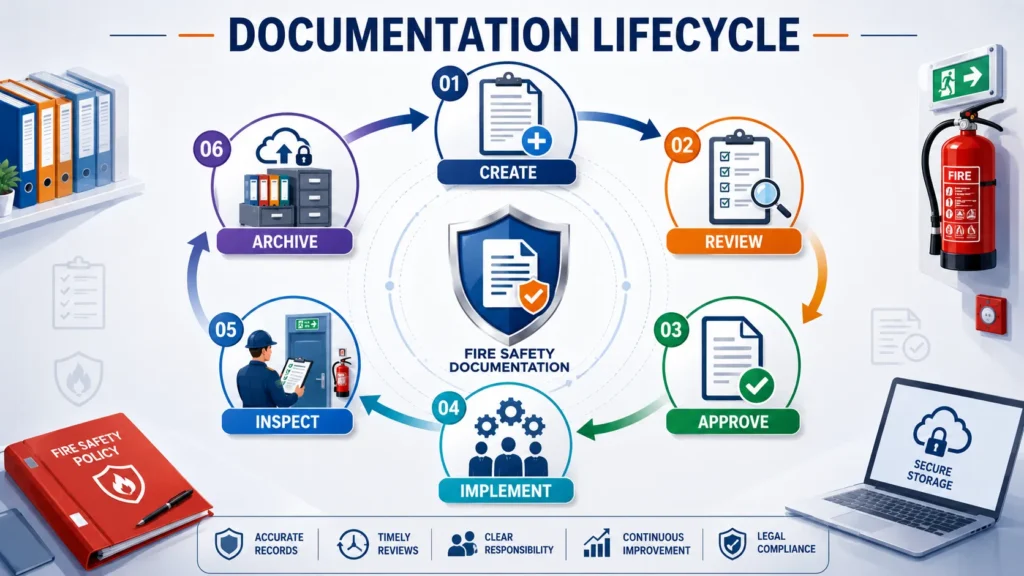
Fire Safety Documentation Lifecycle
Every fire safety document should follow a structured lifecycle to ensure it remains accurate, relevant, and legally defensible.
Identify Requirement
│
▼
Create Document
│
▼
Review for Accuracy
│
▼
Approve Document
│
▼
Implement Procedures
│
▼
Communicate to Staff
│
▼
Monitor Compliance
│
▼
Update After Changes
│
▼
Use During Inspections
│
▼
Archive Securely
│
▼
Retain According to Policy
Following this lifecycle ensures documentation remains current rather than becoming outdated after its initial creation.
Fire Safety Documentation Review Timeline
Maintaining documentation is an ongoing process rather than an annual exercise. Different records require review at different intervals depending on their purpose and the associated legal or operational requirements.
| Review Period | Documentation to Review |
|---|---|
| Daily | Fire safety defect reports, corrective actions, permit records (where applicable) |
| Weekly | Fire alarm testing records, fire log book entries |
| Monthly | Emergency lighting function tests, housekeeping inspections, fire safety log updates |
| Quarterly | Internal fire safety audits, corrective action register, contractor performance reviews |
| Every 6 Months | Fire door inspections, selected equipment inspections, emergency procedure reviews |
| Annually | Fire Risk Assessment review, Fire Safety Policy, emergency evacuation plan, fire extinguisher servicing, staff refresher training |
| After Significant Change | Fire Risk Assessment, evacuation plans, building layouts, PEEPs, training records, fire strategy documentation |
Adopting this structured review schedule helps ensure that documentation remains accurate, supports legal compliance, and is always ready for inspection. It also reduces the risk of overlooked review dates, expired certificates, or outdated emergency procedures that could lead to enforcement action or compromise workplace safety.
Fire Safety Documentation Required During a Fire Safety Inspection
One of the first activities during a fire safety inspection is the review of documentation. Before inspecting fire alarms, emergency exits, or fire extinguishers, inspectors often request evidence that fire safety arrangements are being effectively managed.
Well-organised documentation enables inspectors to verify compliance quickly and demonstrates that the organisation has adopted a proactive approach to fire safety management rather than reacting only when an inspection is scheduled.
The Responsible Person should ensure the following documents are readily available:
- Current Fire Risk Assessment
- Fire Safety Policy
- Emergency Fire Evacuation Plan
- Fire Safety Log Book
- Fire Alarm Test Records
- Emergency Lighting Inspection Reports
- Fire Extinguisher Maintenance Certificates
- Fire Door Inspection Reports
- Fire Drill Reports
- Staff Fire Safety Training Records
- Fire Marshal Appointment Records
- Contractor Maintenance Certificates
- Personal Emergency Evacuation Plans (PEEPs)
- Corrective Action Register
- Fire Incident Reports
- Building Layout and Escape Plans
Producing these records promptly creates a positive first impression and demonstrates effective management of fire safety responsibilities.
What Inspectors Look for in Documentation
Inspectors are not simply checking whether documents exist—they assess their quality, accuracy, and relevance.
Typical questions include:
- Is the Fire Risk Assessment suitable and up to date?
- Have recommendations been implemented?
- Are maintenance records complete?
- Have fire drills been carried out?
- Are employees receiving regular fire safety training?
- Are review dates current?
- Is there evidence of continual improvement?
- Are corrective actions completed and documented?
Documentation that is incomplete, unsigned, or out of date may indicate weaknesses in the organisation’s fire safety management system.
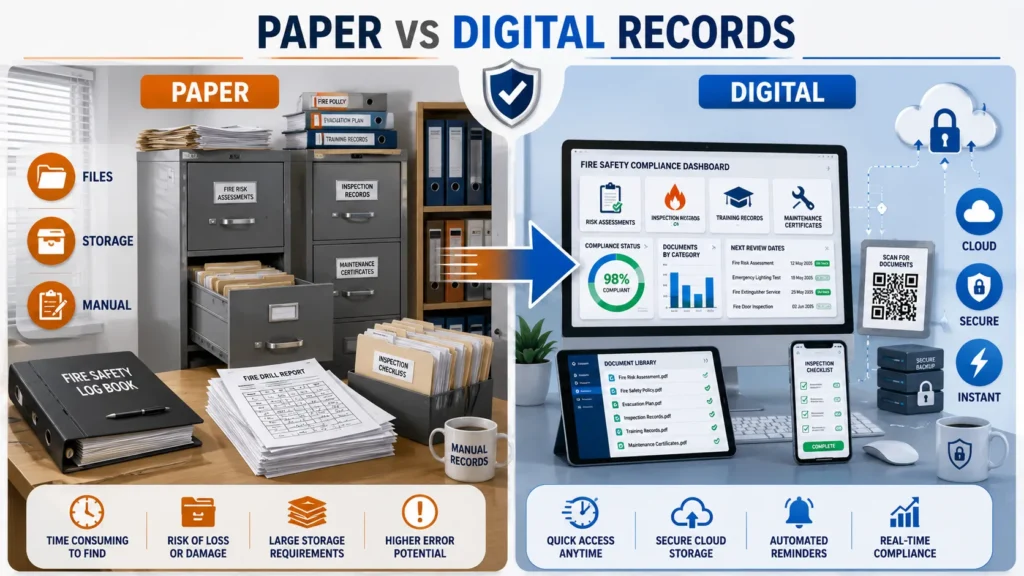
Paper vs Digital Fire Safety Documentation
Businesses increasingly have the option of managing fire safety records using traditional paper systems or modern digital platforms. Both approaches can support compliance if records are accurate, secure, and readily available during inspections.
The choice depends on the size of the organisation, operational complexity, available resources, and long-term compliance objectives.
Paper-Based Documentation
Paper records remain common in smaller organisations because they are simple to introduce and require minimal technology.
Advantages include:
- Low implementation costs.
- Easy to understand.
- Suitable for small businesses.
- No specialist software required.
However, paper systems also present several challenges:
- Documents may be misplaced or damaged.
- Multiple versions may exist.
- Review dates can be overlooked.
- Storage requirements increase over time.
- Sharing information between departments is difficult.
Digital Documentation
Many organisations now manage fire safety records using cloud-based compliance systems or secure electronic document management platforms.
Benefits include:
- Centralised document storage.
- Instant access during inspections.
- Automatic reminders for reviews and servicing.
- Version control.
- Secure backups.
- Mobile access.
- Audit trails.
- Improved collaboration.
Digital systems also make it easier to monitor compliance across multiple buildings or business locations.
Paper vs Digital Fire Safety Documentation
| Feature | Paper Records | Digital Records |
|---|---|---|
| Accessibility | Physical location required | Accessible securely from multiple authorised locations |
| Storage | Filing cabinets and archives | Cloud or secure electronic storage |
| Version Control | Difficult to manage | Automatic version history |
| Inspection Readiness | Manual document retrieval | Immediate access |
| Security | Risk of loss, damage or misfiling | Password protection, encryption and backups |
| Maintenance Reminders | Manual diary systems | Automated notifications |
| Collaboration | Limited | Multiple authorised users |
| Long-Term Record Keeping | Requires physical storage space | Efficient electronic archiving |
For many businesses, a digital system improves efficiency while supporting better compliance management. Regardless of the chosen method, documentation must remain accurate, accessible, and regularly updated.
Common Fire Safety Documentation Mistakes
Many organisations believe they have adequate documentation until an inspection reveals important gaps. Avoiding common documentation errors significantly improves compliance and inspection outcomes.
Outdated Fire Risk Assessments
Fire Risk Assessments should reflect the current workplace.
Common problems include:
- Building alterations not recorded.
- New equipment omitted.
- Staffing changes ignored.
- Control measures no longer relevant.
Regular reviews ensure assessments remain accurate.
Missing Review Dates
Many documents contain no evidence of ongoing review.
Examples include:
- Fire Safety Policies.
- Emergency Plans.
- Fire Risk Assessments.
- Fire Marshal appointments.
Without review dates, inspectors cannot confirm whether documentation remains current.
Incomplete Maintenance Records
Missing servicing certificates create uncertainty regarding equipment reliability.
Frequently missing records include:
- Fire alarm servicing.
- Emergency lighting inspections.
- Fire extinguisher maintenance.
- Fire door inspections.
Maintain certificates in a dedicated compliance folder.
Poor Record Organisation
Documentation stored across multiple departments often results in:
- Duplicate versions.
- Missing records.
- Delayed inspections.
- Confusion over responsibilities.
Centralising documentation improves efficiency.
Lack of Staff Training Evidence
Providing training is important, but organisations must also demonstrate that training occurred.
Training records should include:
- Attendance.
- Course content.
- Trainer details.
- Assessment results.
- Refresher dates.
Corrective Actions Never Closed
Many audits identify improvement opportunities, but businesses fail to record when actions are completed.
Every corrective action should include:
- Description.
- Responsible person.
- Completion deadline.
- Verification.
- Completion date.
Closing actions demonstrates continual improvement.
Industry-Specific Fire Safety Documentation Requirements
Although all businesses must comply with UK fire safety legislation, documentation requirements often vary depending on the workplace environment.
Offices
Typical documentation includes:
- Fire Risk Assessment.
- Fire Alarm Records.
- Emergency Lighting Tests.
- Fire Drill Reports.
- Staff Training Records.
- Contractor Maintenance Reports.
Hotels
Hotels require additional documentation relating to guest safety.
Examples include:
- Guest evacuation procedures.
- Fire compartmentation inspections.
- Kitchen suppression systems.
- Bedroom alarm maintenance.
- Night staff training.
Schools
Educational premises should maintain:
- Evacuation procedures.
- Staff training records.
- Science laboratory fire procedures.
- Fire drills.
- Visitor evacuation arrangements.
Warehouses
Warehouse documentation often includes:
- High-rack storage assessments.
- Forklift charging procedures.
- Dangerous goods storage records.
- Sprinkler maintenance.
- Combustible storage inspections.
Healthcare Facilities
Healthcare organisations require more detailed documentation, including:
- PEEPs.
- Progressive evacuation procedures.
- Medical gas safety records.
- Staff competency assessments.
- Fire compartmentation inspections.
Retail Businesses
Retail premises commonly maintain:
- Seasonal display risk assessments.
- Customer evacuation procedures.
- Fire exit inspections.
- Electrical safety records.
- Staff induction records.
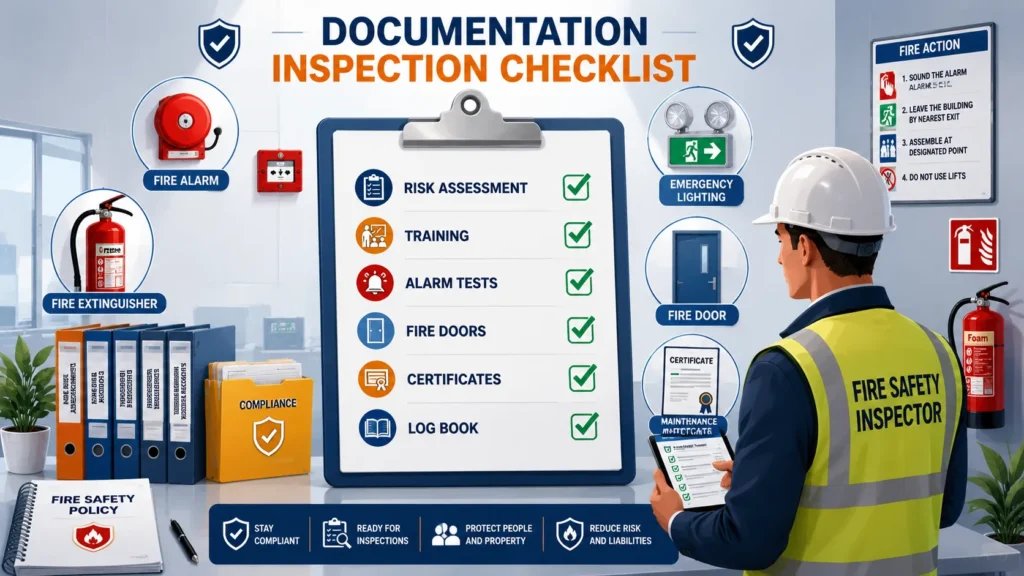
Fire Safety Documentation Checklist
The following checklist can help businesses verify that essential documentation is available before a fire safety inspection.
| Documentation | Available | Review Current |
|---|---|---|
| Fire Risk Assessment | ✓ / ✗ | ✓ / ✗ |
| Fire Safety Policy | ✓ / ✗ | ✓ / ✗ |
| Emergency Fire Evacuation Plan | ✓ / ✗ | ✓ / ✗ |
| Fire Safety Log Book | ✓ / ✗ | ✓ / ✗ |
| Fire Alarm Testing Records | ✓ / ✗ | ✓ / ✗ |
| Emergency Lighting Records | ✓ / ✗ | ✓ / ✗ |
| Fire Extinguisher Certificates | ✓ / ✗ | ✓ / ✗ |
| Fire Door Inspection Reports | ✓ / ✗ | ✓ / ✗ |
| Fire Drill Reports | ✓ / ✗ | ✓ / ✗ |
| Staff Fire Safety Training Records | ✓ / ✗ | ✓ / ✗ |
| Fire Marshal Records | ✓ / ✗ | ✓ / ✗ |
| PEEPs | ✓ / ✗ | ✓ / ✗ |
| Contractor Maintenance Reports | ✓ / ✗ | ✓ / ✗ |
| Fire Incident Reports | ✓ / ✗ | ✓ / ✗ |
| Corrective Action Register | ✓ / ✗ | ✓ / ✗ |
Using this checklist regularly—not just before inspections—helps organisations maintain continuous compliance and quickly identify documentation gaps.
How Good Fire Safety Documentation Supports Business Continuity
Fire safety documentation does more than satisfy legal requirements. It plays an important role in helping organisations recover from emergencies, minimise disruption, and protect long-term business performance.
Well-managed documentation supports:
- Faster regulatory inspections.
- Improved emergency response.
- Better insurance claim outcomes.
- Reduced legal risk.
- Stronger organisational accountability.
- More effective contractor management.
- Continuous improvement in fire safety performance.
Following a fire or significant incident, accurate documentation can demonstrate that the organisation took reasonable steps to protect people and property, which may be valuable during investigations or insurance assessments.
Develop Your Fire Safety Knowledge with Inspire College
Maintaining effective fire safety documentation requires an understanding of legislation, risk assessment, emergency planning, and compliance management. Continuous professional development helps individuals and organisations strengthen these capabilities while improving workplace safety.
Inspire College offers a range of qualifications that support fire safety competence and regulatory compliance.
| Inspire College Course | Why It Is Relevant |
|---|---|
| Fire Safety Courses | Introduces the principles of workplace fire prevention and compliance |
| Level 3 Award in the Inspection and Testing of Fire Stopping Installations | Develop professional fire stopping inspection skills |
| Fire Marshal Training | Prepares Fire Marshals to coordinate evacuations and support emergency response |
Conclusion
Fire safety documentation is far more than an administrative requirement—it is the evidence that demonstrates how an organisation protects people, property, and business operations. Accurate, well-maintained records show that fire risks have been assessed, preventive measures are in place, staff are properly trained, and fire protection systems are routinely inspected and maintained.
Under the Regulatory Reform (Fire Safety) Order 2005, the Fire Safety Act 2021, and related UK legislation, the Responsible Person has a legal duty to ensure that appropriate documentation is created, reviewed, updated, and readily available. Organisations that treat documentation as an ongoing management process rather than a last-minute compliance exercise are better prepared for inspections, more resilient during emergencies, and better positioned to demonstrate due diligence.
Whether your organisation manages an office, school, hotel, warehouse, healthcare facility, retail premises, or manufacturing site, maintaining a structured fire safety documentation system helps reduce legal risk, strengthen business continuity, and create a safer working environment.
By combining comprehensive record keeping with regular reviews, competent training, and continuous improvement, businesses can build a culture of compliance that extends beyond inspections and supports long-term fire safety excellence.