
The Ultimate Fire Risk Assessment Checklist for Commercial Buildings
Every commercial building faces potential fire risks, whether from faulty electrical equipment, blocked escape routes, combustible materials, or poorly maintained fire safety systems. Without regular inspections and effective risk management, these hazards can put people, property, and business operations at serious risk.
The Ultimate Fire Risk Assessment Checklist for Commercial Buildings is designed to help business owners, employers, facilities managers, landlords, and responsible persons identify fire hazards, assess existing safety measures, and maintain compliance with UK fire safety requirements. Using a structured checklist ensures that critical areas such as fire detection systems, emergency exits, fire doors, emergency lighting, and staff preparedness are inspected consistently.
In this guide, you’ll learn the essential steps of a commercial fire risk assessment, discover a practical room-by-room inspection checklist, understand what fire safety inspectors look for, and explore best practices for maintaining long-term compliance. Whether you manage an office, warehouse, retail store, school, hotel, or healthcare facility, this guide provides the practical information needed to create a safer workplace and strengthen your organisation’s fire safety management.
Why a Fire Risk Assessment Checklist Is Essential for Commercial Buildings
Every commercial building has unique fire risks depending on its size, occupancy, business activities, equipment, and building layout. Offices may contain extensive electrical equipment, warehouses often store combustible materials, restaurants operate commercial kitchens, and healthcare facilities accommodate vulnerable occupants who may require assisted evacuation.
A structured fire risk assessment checklist helps organisations:
- Identify fire hazards before they lead to incidents.
- Protect employees, visitors, contractors, and members of the public.
- Meet UK fire safety legal requirements.
- Reduce business interruption caused by fire.
- Improve emergency planning and evacuation procedures.
- Demonstrate compliance during inspections and audits.
- Support insurance requirements and risk management programmes.
- Create a safer working environment for everyone.
Rather than relying on memory or informal inspections, using a detailed checklist ensures that every important aspect of fire safety is assessed consistently and documented properly.
Understanding Fire Risk Assessment
A fire risk assessment is a systematic process used to identify fire hazards, determine who may be at risk, evaluate existing fire safety measures, and recommend improvements where necessary.
Its primary purpose is not simply to satisfy legal requirements but to minimise the likelihood of a fire occurring and reduce its potential consequences should one happen.
A comprehensive assessment typically examines:
| Assessment Area | Purpose |
|---|---|
| Fire hazards | Identify ignition sources, fuel sources, and oxygen supply |
| People at risk | Determine who could be affected, including vulnerable occupants |
| Fire protection measures | Assess alarms, extinguishers, emergency lighting, and fire doors |
| Escape arrangements | Ensure occupants can evacuate safely |
| Management systems | Review maintenance, inspections, staff training, and documentation |
| Risk reduction actions | Recommend improvements based on identified risks |
A professional assessment combines physical inspections, document reviews, interviews with responsible personnel, and evaluation of existing fire safety management systems.
UK Fire Safety Responsibilities for Commercial Buildings
Fire safety responsibilities extend beyond installing alarms and extinguishers. Commercial building owners and managers must actively manage fire risks throughout the life of the premises.
The Regulatory Reform (Fire Safety) Order 2005 places responsibility on the Responsible Person, who is legally accountable for ensuring appropriate fire precautions are in place within non-domestic premises.
Depending on the organisation, the Responsible Person may be:
- Business owner
- Employer
- Building owner
- Landlord
- Facilities manager
- Property manager
- Managing agent
- Occupier of commercial premises
Their responsibilities generally include:
- Conducting a suitable fire risk assessment.
- Identifying and controlling fire hazards.
- Maintaining fire protection systems.
- Providing employee fire safety training.
- Preparing emergency evacuation procedures.
- Keeping appropriate fire safety records.
- Reviewing assessments whenever significant changes occur.
For larger or more complex premises, appointing a competent fire risk assessor is considered best practice.
Which Commercial Buildings Need a Fire Risk Assessment?
Many people assume fire risk assessments only apply to large office buildings. In reality, almost every non-domestic premises requires one.
Common commercial buildings include:
Office Buildings
- Corporate headquarters
- Business centres
- Government offices
- Shared workspaces
Typical risks include:
- Electrical equipment
- Portable heaters
- Paper storage
- Server rooms
- Kitchenettes
Retail Premises
- Shopping centres
- Supermarkets
- Clothing stores
- Electronics retailers
- Convenience stores
Typical risks include:
- High customer occupancy
- Display materials
- Decorative lighting
- Stock storage
- Seasonal displays
Warehouses and Distribution Centres
Warehouses present higher fire risks because of:
- High-rack storage
- Packaging materials
- Forklift charging stations
- Flammable liquids
- Large open spaces
Hospitality Businesses
These include:
- Hotels
- Restaurants
- Cafés
- Bars
- Event venues
Additional fire hazards include:
- Commercial kitchens
- Cooking oils
- Gas appliances
- High occupancy
- Sleeping accommodation
Healthcare Facilities
Examples include:
- Clinics
- Care homes
- Dental practices
- Hospitals
- Medical centres
Special consideration must be given to:
- Assisted evacuation
- Oxygen cylinders
- Medical equipment
- Vulnerable patients
Educational Buildings
Including:
- Schools
- Colleges
- Universities
- Training centres
Risks often involve:
- Laboratories
- Large classrooms
- Assembly halls
- Electrical equipment
- High occupancy during teaching hours
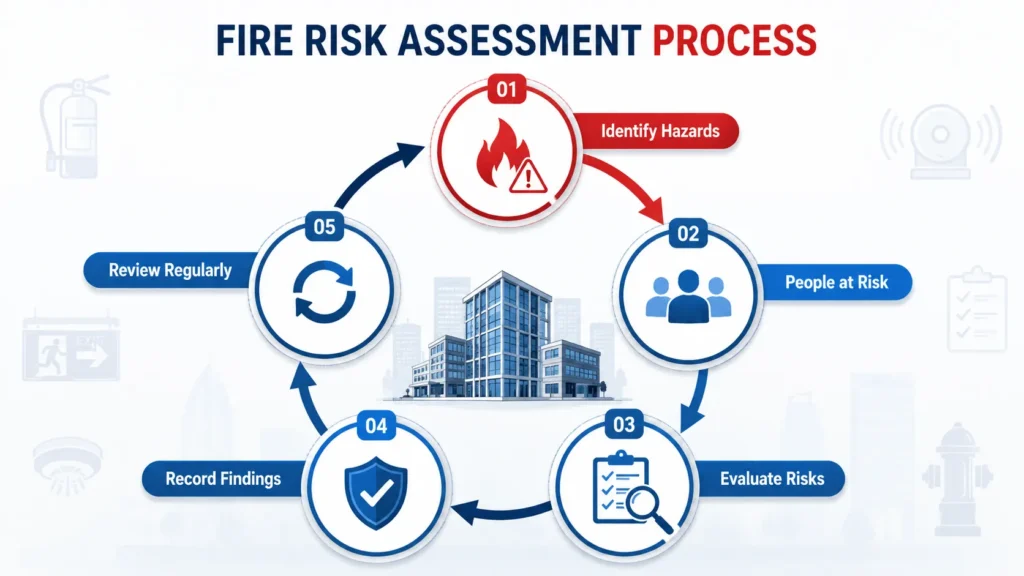
The Official Five-Step Fire Risk Assessment Process
Although every commercial building is different, an effective fire risk assessment generally follows a structured five-step methodology. This approach helps ensure that hazards are identified, evaluated, and managed consistently.
Step 1: Identify Fire Hazards
Begin by identifying anything capable of starting or spreading a fire.
Common ignition sources include:
- Faulty electrical installations
- Portable heaters
- Hot work activities
- Smoking materials
- Commercial cooking equipment
- Machinery
- Overloaded extension leads
- Lighting equipment
Fuel sources may include:
- Cardboard packaging
- Paper records
- Wooden furniture
- Flammable liquids
- Waste materials
- Textiles
- Plastics
- Chemicals
The assessor should also consider how oxygen could support combustion, including natural ventilation, mechanical ventilation systems, and stored oxygen cylinders where applicable.
Step 2: Identify People at Risk
The assessment should identify everyone who may be affected by a fire.
This includes:
- Employees
- Visitors
- Contractors
- Customers
- Temporary workers
- Cleaners
- Security staff
- People working alone
- Disabled persons
- Elderly occupants
- Young persons
- Anyone unfamiliar with the building
Special attention should be given to individuals who may require assistance during evacuation.
Step 3: Evaluate the Risks and Implement Control Measures
After identifying hazards and vulnerable occupants, evaluate whether existing fire precautions are adequate.
Questions to consider include:
- Are escape routes sufficient?
- Are fire alarms working correctly?
- Are emergency exits clearly marked?
- Are fire extinguishers suitable for identified risks?
- Are fire doors functioning properly?
- Are emergency lights tested regularly?
- Are combustible materials controlled?
- Is housekeeping satisfactory?
Where deficiencies are identified, corrective actions should be prioritised according to risk level.
Step 4: Record Findings and Implement Improvements
A well-documented fire risk assessment should clearly record:
- Identified hazards
- People at risk
- Existing controls
- Risk ratings
- Required improvements
- Responsible persons
- Target completion dates
- Review schedule
Maintaining accurate documentation helps demonstrate compliance and provides evidence during inspections.
Step 5: Review and Update Regularly
A fire risk assessment is not a document that should be filed away and forgotten.
It should be reviewed whenever:
- Building layouts change.
- New equipment is installed.
- Occupancy increases.
- Business operations change.
- Fire incidents occur.
- Significant alterations are completed.
- New legislation affects the premises.
- Existing control measures are no longer effective.
Regular reviews help ensure that fire safety arrangements remain suitable as the workplace evolves.
Commercial Building Fire Risk Assessment Process Flowchart
The following workflow summarises how a comprehensive fire risk assessment should be carried out.
Start
↓
Gather building information
↓
Inspect all areas of the premises
↓
Identify ignition sources
↓
Identify combustible materials
↓
Identify people at risk
↓
Inspect fire detection systems
↓
Inspect emergency escape routes
↓
Check fire doors and compartmentation
↓
Inspect emergency lighting
↓
Inspect fire extinguishers
↓
Review staff training and fire drills
↓
Review fire safety documentation
↓
Evaluate overall level of risk
↓
Assign corrective actions
↓
Implement improvements
↓
Record findings
↓
Schedule the next review
↓
Continuous Fire Safety Management
Master Fire Risk Assessment Checklist for Commercial Buildings
The following checklist provides a high-level overview of the areas that should be assessed during every commercial fire risk assessment.
| Inspection Area | Key Checks | Status |
|---|---|---|
| Building information | Occupancy, layout, business activities | □ |
| Fire hazards | Ignition, fuel, oxygen sources | □ |
| Electrical safety | Wiring, sockets, portable equipment | □ |
| Fire detection | Smoke detectors, alarms, call points | □ |
| Emergency lighting | Coverage, testing, maintenance | □ |
| Escape routes | Clear, unobstructed, adequate width | □ |
| Fire exits | Accessible, signed, operational | □ |
| Fire doors | Self-closing, seals, condition | □ |
| Fire extinguishers | Correct type, location, servicing | □ |
| Housekeeping | Waste removal, storage standards | □ |
| Hazardous substances | Storage and segregation | □ |
| Staff training | Induction, refresher training, fire wardens | □ |
| Emergency procedures | Evacuation plans and assembly points | □ |
| Fire drills | Frequency and records | □ |
| Documentation | Risk assessment, maintenance logs, certificates | □ |
| Corrective actions | Outstanding recommendations monitored | □ |
This master checklist serves as the foundation of an effective fire safety programme. In the next section, each inspection area will be explored in greater detail with practical, room-by-room checklists, equipment inspection guidance, and documentation requirements tailored specifically to commercial buildings.
Room-by-Room Fire Risk Assessment Checklist for Commercial Buildings
A comprehensive fire risk assessment should inspect every area of the building rather than focusing only on obvious fire hazards. Different rooms present different levels of risk depending on their purpose, occupancy, equipment, and stored materials. Conducting a room-by-room inspection helps ensure that no critical fire safety issue is overlooked.
Reception and Waiting Areas
Reception areas are often the first point of entry for visitors and should remain safe, accessible, and easy to evacuate.
Inspection Checklist
| Inspection Item | Check |
|---|---|
| Fire exits are clearly visible and unobstructed | □ |
| Emergency exit signs are illuminated and legible | □ |
| Reception desk does not obstruct escape routes | □ |
| Electrical equipment is safely installed | □ |
| Portable heaters are safely positioned | □ |
| Decorative materials comply with fire safety standards | □ |
| Fire alarm call points are accessible | □ |
| Visitors can easily identify evacuation routes | □ |
Office Areas
Modern offices contain numerous electrical devices, making electrical safety one of the primary concerns.
Inspection Checklist
| Inspection Item | Check |
|---|---|
| Extension leads are not overloaded | □ |
| Portable Appliance Testing (PAT) is up to date | □ |
| Damaged electrical cables are replaced | □ |
| Workstations do not block escape routes | □ |
| Paper records are stored safely | □ |
| Fire extinguishers remain accessible | □ |
| Smoke detectors are unobstructed | □ |
| Employees understand evacuation procedures | □ |
Meeting Rooms
Meeting rooms often become overcrowded during events or presentations.
Key inspection points include:
- Emergency exits remain accessible.
- Maximum occupancy is displayed where appropriate.
- Audio-visual equipment is safely connected.
- Extension leads are managed correctly.
- Fire doors close fully.
- Escape signage remains visible even when rooms are occupied.
Kitchens and Staff Break Areas
Commercial kitchens present significantly higher fire risks because they combine heat sources, electrical appliances, cooking oils, and combustible materials.
Inspection Checklist
| Inspection Item | Check |
|---|---|
| Cooking appliances are regularly serviced | □ |
| Grease extraction systems are cleaned | □ |
| Fire blankets are available | □ |
| Wet chemical extinguishers are installed where required | □ |
| Gas shut-off valves are accessible | □ |
| Waste bins are emptied regularly | □ |
| Combustible materials are stored away from heat sources | □ |
Electrical and Server Rooms
Electrical rooms require enhanced fire protection because equipment failures can rapidly develop into serious fires.
Inspectors should verify:
- Electrical panels are clearly labelled.
- Access is restricted to authorised personnel.
- No combustible storage is present.
- Cooling systems operate correctly.
- Cable management is organised.
- Fire detection systems are appropriate for electrical environments.
- Housekeeping standards remain high.
Storage Rooms
Storage areas frequently become one of the highest-risk locations due to accumulated combustible materials.
A suitable inspection should confirm:
- Storage heights remain within safe limits.
- Fire exits are unobstructed.
- Combustible materials are separated from ignition sources.
- Shelving remains stable.
- Flammable products are correctly labelled.
- Waste is removed promptly.
- Aisles remain clear for evacuation.
Warehouses
Warehouses require more detailed assessments because of their size, storage methods, and operational activities.
Inspectors should examine:
- Rack storage arrangements.
- Forklift charging areas.
- Battery charging stations.
- Flammable liquid storage.
- Packaging material accumulation.
- Automatic fire suppression systems.
- High-level smoke detection.
- Emergency access routes.
Plant Rooms and Boiler Rooms
Plant rooms contain equipment capable of generating heat and ignition.
Inspection points include:
- Boilers are serviced regularly.
- Fuel systems are maintained.
- Ventilation remains unobstructed.
- Fire-resistant construction is intact.
- Warning signage is displayed.
- Access remains restricted.
- Emergency shut-off systems function correctly.
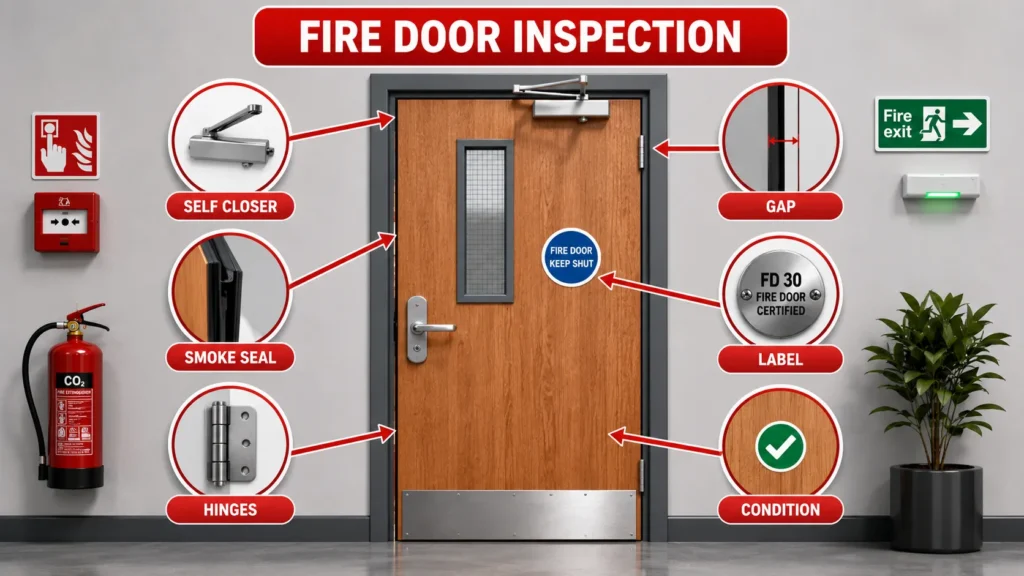
Fire Door Inspection Checklist
Fire doors play a vital role in slowing the spread of fire and smoke, providing occupants with valuable time to evacuate safely. Even minor defects can significantly reduce their effectiveness.
Fire Door Inspection Table
| Inspection Item | Status |
|---|---|
| Door closes completely without assistance | □ |
| Self-closing device operates correctly | □ |
| Smoke seals remain intact | □ |
| Intumescent strips are undamaged | □ |
| Hinges are secure | □ |
| Door leaf has no significant damage | □ |
| Vision panels are intact | □ |
| Fire door signage is present | □ |
| Door is not wedged open | □ |
| Gap around door remains within acceptable limits | □ |
Common Fire Door Defects
Inspectors frequently identify:
- Missing smoke seals
- Damaged intumescent strips
- Broken closers
- Incorrect gaps
- Damaged glazing
- Door wedges preventing closure
- Missing certification labels
- Poor maintenance
Correcting these defects should be treated as a high priority because fire doors are a key component of passive fire protection.
Fire Detection and Alarm System Checklist
Early fire detection significantly reduces the impact of fire incidents by providing occupants with sufficient warning to evacuate.
Fire Alarm Inspection Checklist
| Inspection Item | Status |
|---|---|
| Fire alarm control panel operational | □ |
| Weekly alarm tests completed | □ |
| Manual call points accessible | □ |
| Smoke detectors unobstructed | □ |
| Heat detectors positioned correctly | □ |
| Alarm sounders audible throughout building | □ |
| False alarm records reviewed | □ |
| Annual servicing completed | □ |
Fire Alarm Best Practice
A well-maintained alarm system should:
- Detect fires quickly.
- Alert every occupant.
- Integrate with emergency procedures.
- Receive scheduled maintenance.
- Be tested regularly.
- Maintain accurate service records.
Emergency Lighting Checklist
Emergency lighting ensures safe evacuation during power failures or smoke-filled conditions.
Inspection Checklist
| Inspection Item | Status |
|---|---|
| Escape routes fully illuminated | □ |
| Exit signs illuminated | □ |
| Stairwells adequately lit | □ |
| Emergency lights tested monthly | □ |
| Annual duration tests completed | □ |
| Batteries replaced where required | □ |
| Maintenance records available | □ |
Emergency lighting should provide sufficient illumination to enable occupants to locate exits safely even if normal lighting fails.
Fire Extinguisher Inspection Checklist
Fire extinguishers should only be used where it is safe to do so, but they remain an important first-response fire safety measure.
Inspection Checklist
| Inspection Item | Status |
|---|---|
| Correct extinguisher type installed | □ |
| Easily accessible | □ |
| Clearly signed | □ |
| Pressure gauge within safe range | □ |
| Inspection label current | □ |
| Annual servicing completed | □ |
| No physical damage | □ |
| Staff trained in use | □ |
Common Extinguisher Types
| Fire Risk | Recommended Extinguisher |
|---|---|
| Paper and wood | Water |
| Flammable liquids | Foam |
| Electrical equipment | CO₂ |
| Cooking oils | Wet Chemical |
| Multi-purpose risks | Dry Powder (where appropriate and following risk assessment) |
Choosing the correct extinguisher type is essential because using the wrong extinguisher can worsen certain fire situations.
Electrical Fire Safety Checklist
Electrical faults remain one of the leading causes of workplace fires. A proactive inspection programme helps identify issues before they develop into significant hazards.
Inspection Checklist
| Inspection Item | Status |
|---|---|
| Electrical installations inspected | □ |
| Distribution boards labelled | □ |
| Portable appliances tested | □ |
| Extension leads not overloaded | □ |
| Damaged plugs replaced | □ |
| Temporary wiring removed | □ |
| Server rooms adequately ventilated | □ |
| Battery charging areas monitored | □ |
Common Electrical Fire Hazards
Inspectors should look for:
- Overloaded sockets
- Damaged insulation
- Loose electrical connections
- Improper use of extension leads
- Portable heaters placed near combustible materials
- Poor cable management
- Unauthorised electrical modifications
Housekeeping and Combustible Material Checklist
Good housekeeping is one of the simplest yet most effective fire prevention measures. Poor storage practices can allow a small ignition source to develop into a major fire.
Housekeeping Inspection Checklist
| Inspection Item | Status |
|---|---|
| Waste removed regularly | □ |
| Escape routes clear | □ |
| Storage organised | □ |
| Combustible waste minimised | □ |
| Flammable liquids correctly stored | □ |
| Loading areas kept tidy | □ |
| Plant rooms free of storage | □ |
| Smoking areas managed safely | □ |
Common Housekeeping Problems
Routine inspections often identify:
- Cardboard boxes stored in escape routes.
- Waste accumulating behind buildings.
- Cleaning materials stored near electrical equipment.
- Flammable liquids left outside approved cabinets.
- Packaging materials blocking exits.
- Overstocked storage rooms.
- Poor segregation of hazardous materials.
Addressing these issues promptly helps reduce the available fuel load and supports safer evacuation.
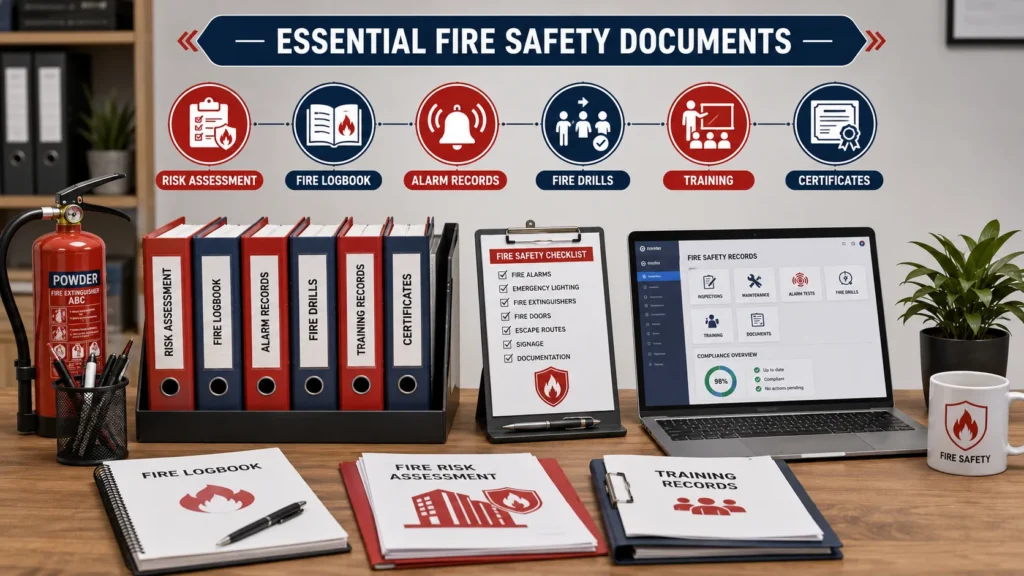
Fire Safety Documentation Checklist
Physical fire protection measures are only part of an effective fire safety strategy. Accurate documentation demonstrates that systems are maintained, inspections are completed, and staff are prepared to respond in an emergency.
Essential Fire Safety Documents
| Document | Available |
|---|---|
| Fire Risk Assessment | □ |
| Emergency Evacuation Plan | □ |
| Fire Logbook | □ |
| Fire Alarm Test Records | □ |
| Emergency Lighting Test Records | □ |
| Fire Extinguisher Service Certificates | □ |
| Fire Door Inspection Records | □ |
| Staff Fire Training Records | □ |
| Fire Drill Reports | □ |
| Maintenance Certificates | □ |
| Corrective Action Register | □ |
| Contractor Hot Work Permits (where applicable) | □ |
Maintaining these records in an organised and accessible format helps demonstrate effective fire safety management and supports inspections by enforcing authorities or insurers.
Staff Training and Emergency Preparedness Checklist
Even the best fire safety systems cannot replace a well-trained workforce. Employees should understand how to prevent fires, recognise hazards, and respond safely during an emergency.
Staff Training Checklist
| Training Requirement | Status |
|---|---|
| Fire safety induction completed | □ |
| Refresher training provided | □ |
| Fire wardens appointed | □ |
| Evacuation procedures understood | □ |
| Assembly points communicated | □ |
| Fire drills conducted regularly | □ |
| New employees trained promptly | □ |
| Contractors informed of emergency procedures | □ |
Training should reflect the specific risks within the commercial building and be reviewed whenever processes, layouts, or occupancy change.
Common Fire Safety Failures Found During Commercial Building Inspections
Many enforcement actions arise not because organisations lack fire safety equipment, but because basic management and maintenance tasks have been overlooked. Identifying these recurring issues during routine assessments can prevent more serious compliance problems.
The most frequently identified deficiencies include:
- Blocked or locked emergency exits.
- Fire doors wedged open or damaged.
- Expired fire extinguisher servicing.
- Emergency lighting that has not been tested.
- Fire alarm systems with overdue maintenance.
- Missing or incomplete fire risk assessment records.
- Excessive combustible storage in plant rooms and escape routes.
- Poor housekeeping leading to unnecessary fire loading.
- Inadequate staff fire safety training.
- Failure to review the fire risk assessment after significant changes to the building or its operations.
Each of these issues increases the likelihood of a fire escalating or delaying safe evacuation. Establishing a routine inspection programme, assigning responsibilities, and tracking corrective actions are essential steps in maintaining a safe and compliant commercial building.
Best Practices for Maintaining Fire Safety Compliance
Completing a fire risk assessment is only the beginning of an effective fire safety management programme. Commercial buildings change over time as layouts are altered, equipment is replaced, occupancy levels fluctuate, and business operations evolve. Without regular monitoring and continuous improvement, even a well-prepared fire risk assessment can quickly become outdated.
Organisations that maintain high standards of fire safety typically adopt a proactive approach rather than waiting for annual inspections or enforcement visits. Fire safety should become part of everyday workplace management, with clear responsibilities assigned to competent individuals and regular checks incorporated into maintenance schedules.
The following best practices can help commercial buildings maintain long-term compliance and reduce fire risks.
Establish a Fire Safety Management Plan
Every commercial building should have a documented fire safety management plan that outlines:
- Fire safety objectives
- Responsibilities of the Responsible Person
- Roles of fire wardens and supervisors
- Inspection schedules
- Maintenance programmes
- Emergency procedures
- Training requirements
- Record-keeping processes
- Contractor management procedures
A structured management plan ensures that fire safety activities are carried out consistently rather than only when inspections are due.
Conduct Routine Workplace Inspections
Regular inspections help identify developing hazards before they become significant risks.
Daily inspections may include:
- Checking escape routes remain clear
- Confirming fire exits are unlocked during occupancy
- Removing combustible waste
- Ensuring electrical equipment is switched off where appropriate
Weekly inspections may include:
- Fire alarm testing
- Emergency exit inspections
- Fire door checks
- Housekeeping inspections
Monthly inspections may include:
- Emergency lighting function tests
- Fire extinguisher visual inspections
- Storage area inspections
- Electrical safety observations
Annual inspections should include:
- Comprehensive fire risk assessment review
- Fire extinguisher servicing
- Emergency lighting duration testing
- Fire alarm servicing
- Fire door inspections by competent personnel
- Staff refresher training
- Emergency evacuation exercises
Encourage Employee Participation
Fire safety is everyone’s responsibility.
Employees should be encouraged to:
- Report blocked escape routes.
- Report damaged fire doors.
- Identify electrical hazards.
- Follow safe housekeeping practices.
- Report faulty emergency lighting.
- Participate in fire drills.
- Follow evacuation procedures immediately.
Creating a positive fire safety culture often leads to hazards being identified much earlier.
Monitor Corrective Actions
Every identified deficiency should be tracked until completion.
A corrective action register should include:
| Item | Example |
|---|---|
| Hazard identified | Fire door not closing properly |
| Risk level | High |
| Corrective action | Replace door closer |
| Responsible person | Facilities Manager |
| Target completion | 7 Days |
| Completion status | Closed |
Monitoring actions demonstrates continual improvement and helps prevent repeated inspection findings.
When Should a Fire Risk Assessment Be Reviewed?
A fire risk assessment should never be viewed as a static document. As workplaces evolve, so do the associated fire risks. Regular reviews ensure that existing control measures remain effective and continue to reflect the actual conditions within the building.
A review should be carried out whenever significant changes occur or when there is reason to believe the existing assessment is no longer suitable.
Typical review triggers include:
- Building extensions or renovations
- Internal layout changes
- Installation of new machinery or equipment
- Introduction of hazardous substances
- Changes in occupancy levels
- Changes to business activities
- Fire incidents or near misses
- New legislation or updated guidance
- Installation of new fire protection systems
- Recommendations arising from audits or inspections
Even where no major changes occur, periodic reviews remain essential to confirm that fire safety arrangements continue to meet operational needs.
Industry-Specific Fire Risk Assessment Considerations
Although the principles of fire risk assessment remain the same, each commercial sector presents unique hazards that require tailored control measures.
Office Buildings
Offices are generally considered lower-risk environments, but they still contain significant ignition sources due to extensive electrical equipment.
Key inspection priorities include:
- Electrical distribution systems
- Portable electrical appliances
- Server rooms
- Paper storage
- Kitchenettes
- Emergency exits
- Meeting room occupancy
- Fire alarm coverage
Warehouses and Distribution Centres
Warehouses often contain large quantities of combustible materials and extensive storage systems.
Inspection priorities include:
- High-rack storage
- Forklift charging stations
- Lithium-ion battery charging
- Packaging materials
- Flammable liquids
- Automatic suppression systems
- Smoke ventilation
- Loading bay operations
Retail Stores and Shopping Centres
Retail environments present additional challenges because of high public occupancy.
Focus areas include:
- Customer escape routes
- Display arrangements
- Seasonal decorations
- Stock storage
- Cash office security
- Emergency announcements
- Fire alarm audibility
- Staff evacuation procedures
Hotels and Hospitality Businesses
Hospitality premises require enhanced fire precautions due to sleeping accommodation and commercial kitchens.
Inspectors should evaluate:
- Guest evacuation procedures
- Kitchen fire suppression
- Emergency lighting
- Bedroom smoke detection
- Fire compartmentation
- Staff training
- Fire door maintenance
- Assembly arrangements
Healthcare Facilities
Hospitals, care homes, and clinics accommodate individuals who may require assistance during evacuation.
Priority inspection areas include:
- Progressive horizontal evacuation arrangements
- Patient evacuation equipment
- Oxygen storage
- Medical gas systems
- Staff competency
- Fire compartmentation
- Emergency communication systems
- Refuge areas
Educational Institutions
Schools, colleges, universities, and training centres must protect large numbers of occupants while maintaining effective evacuation procedures.
Key inspection areas include:
- Classrooms
- Laboratories
- Assembly halls
- Sports facilities
- Libraries
- Electrical equipment
- Science laboratories
- Fire drill programmes
Common Mistakes to Avoid During a Fire Risk Assessment
Many commercial buildings have appropriate fire safety systems installed but fail to maintain them effectively. Avoiding common mistakes can significantly improve compliance and reduce fire risk.
Some of the most frequent errors include:
- Treating the fire risk assessment as a one-time exercise.
- Using generic templates without assessing the specific building.
- Ignoring changes in occupancy or building layout.
- Failing to inspect all rooms and plant areas.
- Overlooking vulnerable occupants.
- Blocking escape routes with storage or equipment.
- Neglecting routine fire door inspections.
- Missing scheduled fire alarm and emergency lighting tests.
- Keeping incomplete maintenance records.
- Delaying corrective actions after inspections.
- Failing to provide refresher fire safety training.
- Not reviewing the assessment after renovations or operational changes.
A systematic approach supported by regular inspections and accurate documentation helps eliminate these common shortcomings.
Fire Risk Assessment Review Cycle
The following workflow demonstrates how continuous improvement should be integrated into every commercial building’s fire safety management system.
Conduct Fire Risk Assessment
↓
Identify Hazards
↓
Evaluate Existing Controls
↓
Assign Risk Rating
↓
Implement Control Measures
↓
Train Employees
↓
Inspect and Maintain Fire Protection Systems
↓
Record Findings
↓
Monitor Corrective Actions
↓
Review Following Changes or Scheduled Review
↓
Update Fire Risk Assessment
↓
Repeat Continuous Improvement Cycle
Fire Safety Courses to Explore on Inspire College
Expanding knowledge and competency is one of the most effective ways to improve workplace fire safety. Organisations should ensure that responsible persons, facilities managers, health and safety professionals, and fire wardens receive appropriate training to understand legal responsibilities, identify hazards, and implement effective control measures.
Conclusion
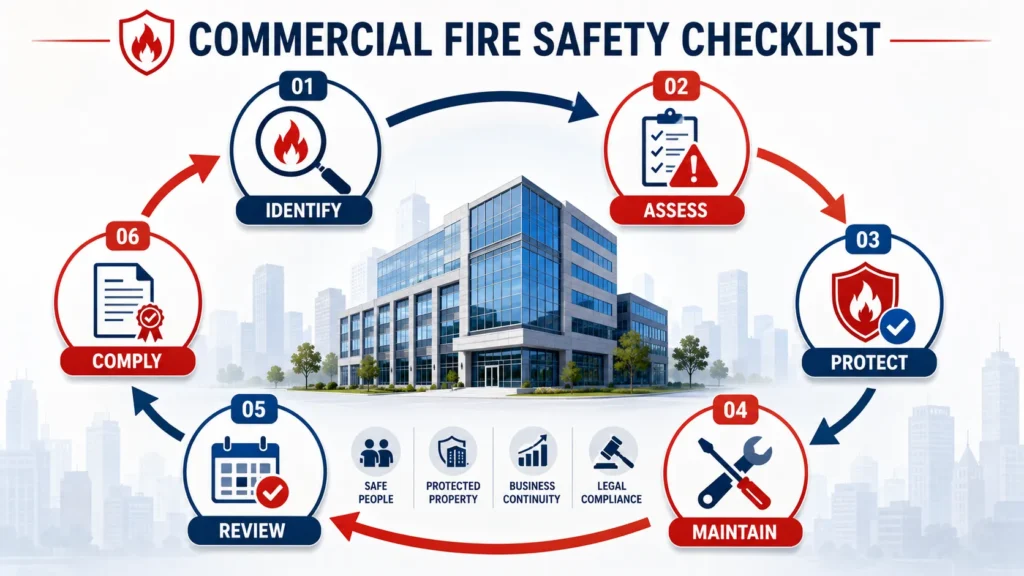
A comprehensive Fire Risk Assessment Checklist for Commercial Buildings is far more than a compliance document—it is a practical framework for protecting people, property, and business operations. By systematically identifying hazards, assessing risks, maintaining fire protection systems, and keeping accurate records, organisations can significantly reduce the likelihood and impact of fire incidents.
The most effective fire risk assessments are those that become part of an organisation’s ongoing safety culture. Regular inspections, proactive maintenance, employee training, and timely reviews ensure that fire safety measures remain effective as buildings, occupancy, and operational activities change over time.
Whether managing an office, warehouse, retail store, healthcare facility, educational institution, hotel, or mixed-use premises, using a structured checklist allows responsible persons to identify weaknesses early, prioritise corrective actions, and demonstrate compliance with UK fire safety requirements.
Investing in competent fire safety training and adopting best-practice fire risk management not only helps organisations meet their legal responsibilities but also creates safer workplaces, protects valuable assets, and strengthens business resilience. A well-managed commercial building is one where fire safety is continuously reviewed, consistently maintained, and embedded into everyday operations.