
Construction Site Management vs Construction Project Management: Key Differences Explained
Construction site management and construction project management are closely connected, but they are not the same function. Both are essential to delivering a construction project safely, on time, within budget and to the required quality standards. The main difference is the level and scope of responsibility.
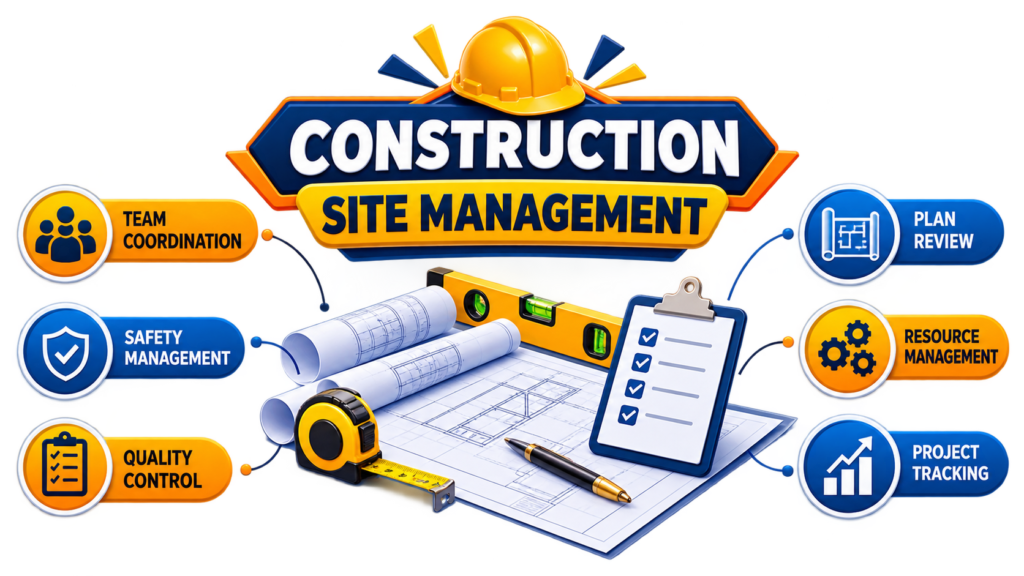
Construction site management focuses primarily on the day-to-day delivery of construction work on site, including workforce coordination, subcontractors, site activities, materials, quality, safety and short-term planning. Construction project management takes a wider view of the project, covering planning, cost, contracts, procurement, risks, stakeholders, programme management and overall project delivery.
The two functions work together rather than operating independently. On larger projects, responsibilities may be divided among several managers, while on smaller projects one professional may perform multiple management functions. UK construction projects are also shaped by requirements such as the Construction (Design and Management) Regulations 2015 (CDM 2015), which establish duties for clients, designers, principal contractors and contractors.
Understanding the difference between construction site management and construction project management is particularly useful for construction professionals considering career progression, employers defining responsibilities and learner researching construction management qualifications.
What Is Construction Site Management?
Construction site management is the practical management and coordination of construction activities taking place on a project site.
The site management function is concerned with turning drawings, specifications, programmes and approved construction methods into physical work. It involves coordinating people, materials, plant, subcontractors and work activities while maintaining appropriate standards of safety, quality and productivity.
A site manager may spend much of the working day on or around the construction site. Typical responsibilities can include:
- Coordinating construction activities
- Supervising site teams and subcontractors
- Allocating work
- Monitoring progress
- Checking construction quality
- Coordinating deliveries and materials
- Supporting health and safety arrangements
- Reviewing risk assessments and method statements
- Managing site logistics
- Monitoring plant and equipment
- Conducting site inspections
- Recording progress and site information
- Identifying problems that could delay the work
- Coordinating different trades
- Supporting testing, commissioning and handover activities
Under CDM 2015, contractors have duties to plan, manage and monitor the construction work under their control and to ensure risks are appropriately controlled. Where multiple contractors are involved, the principal contractor has wider responsibilities for planning, managing, monitoring and coordinating the construction phase.
This means site management is not simply about supervising workers. It is a structured management function involving safety, quality, resources, sequencing, communication and operational control.
What Is Construction Project Management?
Construction project management is the broader management of a construction project from planning through delivery and completion.
A construction project manager is typically concerned with the overall objectives of the project rather than only the physical activities taking place on site. Depending on the organisation and project structure, responsibilities can include:
- Project planning
- Programme management
- Budget management
- Cost forecasting
- Procurement
- Contract administration
- Risk management
- Stakeholder management
- Client communication
- Resource planning
- Quality management
- Change management
- Progress reporting
- Commercial coordination
- Project documentation
- Handover and closeout
Project management therefore connects different parts of a construction project. It may involve the client, designers, consultants, contractors, subcontractors, suppliers, commercial teams and other stakeholders.
The precise responsibilities depend on the employer, contract and project structure. On some projects, the project manager may have substantial commercial and contractual responsibilities, while on others these functions may be shared with commercial managers, quantity surveyors, contract managers or other specialists.
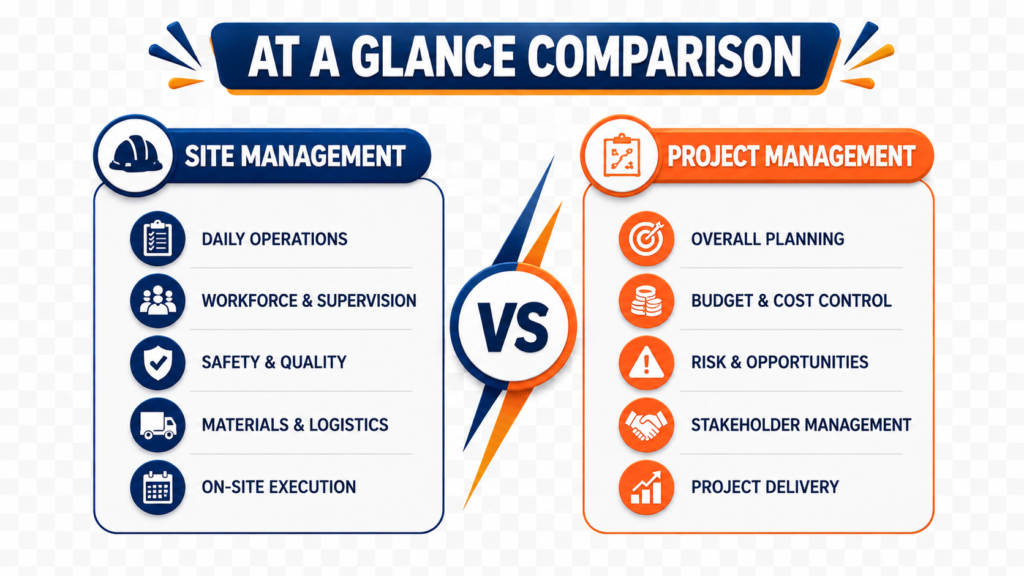
Construction Site Management vs Construction Project Management: At a Glance
| Area | Construction Site Management | Construction Project Management |
|---|---|---|
| Primary focus | Physical construction and site operations | Overall project delivery |
| Main environment | Construction site | Project-wide |
| Workforce | Direct operational coordination | Overall resource and stakeholder coordination |
| Subcontractors | Daily coordination and supervision | Strategic and contractual coordination |
| Programme | Short-term and site-level planning | Overall project programme |
| Budget | Monitors resource use and site costs | Overall budget, forecasting and cost control |
| Safety | Site implementation and monitoring | Project-level management and coordination |
| Quality | Inspections and operational control | Overall quality strategy and project requirements |
| Procurement | Site requirements and coordination | Procurement planning and contractual coordination |
| Risk | Identifies and controls site-level risks | Manages wider project risks |
| Client | Provides site progress information | Often leads wider client communication |
| Documentation | Site records and operational documentation | Project reports, plans and management records |
| Decision-making | Immediate operational decisions | Strategic and project-wide decisions |
| Handover | Supports physical completion and defects | Coordinates overall project completion and closeout |
The table provides a general comparison. Actual responsibilities vary according to the construction company, project size, procurement route, contract and organisational structure.
What Is the Main Difference Between Site Management and Project Management?
The simplest way to understand the difference is to consider scope.
Site management is primarily concerned with delivering construction work effectively on the site.
Construction project management is concerned with managing the wider project so that its objectives are achieved.
For example, imagine a major commercial building project.
A site manager may be responsible for coordinating today’s concrete pour, checking that the correct workforce and equipment are available, ensuring the work follows approved procedures and coordinating other trades that could be affected.
The project manager may be reviewing the overall programme, discussing progress with the client, monitoring the project budget, managing procurement issues, reviewing risks and assessing the effect of a potential delay on the overall completion date.
Both professionals are dealing with the same project, but they are looking at it from different management perspectives.
1. Scope of Responsibility
Site management generally has a strong operational focus.
The site manager needs to understand what is happening on the ground and ensure construction activities are properly coordinated. This can include labour, materials, plant, subcontractors, logistics and work sequencing.
Project management has a wider scope.
The project manager may coordinate multiple workstreams and management functions, including programme, budget, procurement, contracts, stakeholders, risks and project reporting.
This does not mean that project management is always “higher” than site management. Organisational structures differ, and senior site managers can have considerable authority and responsibility.
2. Daily Activities
The daily routine is another useful way to distinguish the two functions.
A site manager may begin the day with a site inspection, workforce coordination meeting or toolbox talk. The day may then involve checking progress, coordinating subcontractors, reviewing deliveries, resolving site problems and monitoring quality and safety.
A project manager may spend the day reviewing programme performance, attending client meetings, assessing risks, reviewing costs, coordinating procurement, managing changes and preparing project reports.
There is significant overlap, particularly on smaller projects.
3. Construction Programme and Scheduling
Both functions contribute to scheduling, but at different levels.
Site management is heavily involved in short-term construction planning.
This can involve:
- Daily work planning
- Weekly programmes
- Trade sequencing
- Labour allocation
- Delivery schedules
- Site logistics
- Identifying immediate constraints
Project management generally focuses more heavily on the overall project programme.
This can involve:
- Key milestones
- Critical activities
- Overall completion dates
- Design dependencies
- Procurement periods
- Contractor programmes
- Project interfaces
- Recovery planning
The two levels must remain aligned. A problem with a site activity can affect the wider programme, while a change to the overall programme can require significant changes to site operations.
4. Budget and Cost Control
Construction project management normally has a broader responsibility for project cost performance.
Project-level cost management may include:
- Budget monitoring
- Forecasting
- Cost reporting
- Procurement costs
- Variations
- Commercial risks
- Cash-flow considerations
- Financial reporting
Site management also has an important role because poor site control can increase costs.
For example, inefficient labour allocation, material waste, equipment downtime, rework or poor sequencing can affect project profitability.
A site manager therefore contributes to cost control even when the overall commercial responsibility sits elsewhere.
5. Workforce and Subcontractor Management
Site management has a strong operational relationship with the workforce and subcontractors.
A site manager may coordinate:
- Trade contractors
- Site operatives
- Supervisors
- Plant operators
- Delivery teams
- Specialist subcontractors
The emphasis is often on ensuring that the right people are in the right place with the right information and resources.
Project management takes a broader view of contractor relationships. This may include procurement, contract strategy, performance monitoring, commercial issues and stakeholder coordination.
6. Health and Safety Responsibilities
Health and safety is not the responsibility of one individual alone.
Under CDM 2015, different dutyholders have defined responsibilities. For projects involving more than one contractor, the principal contractor is responsible for planning, managing, monitoring and coordinating the construction phase, including preparing and maintaining a construction phase plan.
Site management is closely involved with the practical implementation of safety arrangements.
This can include:
- Site inductions
- Site inspections
- Monitoring work activities
- Checking control measures
- Coordinating contractors
- Managing site access
- Monitoring housekeeping
- Supporting consultation with workers
- Escalating unsafe conditions
Project management may have a wider responsibility for ensuring appropriate resources, planning, governance and coordination are available across the project.
It is important not to assume that a job title alone determines a person’s legal CDM duty. Legal responsibilities depend on the person’s appointed role and the circumstances of the project.
7. Quality Management
Site management is closely connected with physical quality control.
Site teams may inspect work, monitor workmanship, coordinate testing and identify defects or non-conformities.
Project management considers quality at a wider project level, including:
- Quality requirements
- Inspection and test arrangements
- Documentation
- Client expectations
- Design compliance
- Quality reporting
- Defect management
- Handover requirements
Effective quality management requires both preventive processes and practical inspections. Learn more about quality assurance and quality control, including their principles, tools, certifications and applications across the construction industry.
A project can have an excellent quality plan, but if site activities are poorly controlled, the intended standards may not be achieved.
8. Risk Management
Site managers frequently deal with immediate operational risks.
Examples include:
- Unsafe access
- Poor sequencing
- Delivery conflicts
- Plant movements
- Interface problems
- Unexpected site conditions
- Subcontractor coordination issues
Project managers generally consider a broader risk register that can include:
- Programme risks
- Commercial risks
- Procurement risks
- Design risks
- Contractual risks
- Stakeholder risks
- Resource risks
- Regulatory risks
The most effective approach connects both levels.
A site-level problem should be escalated when it could become a wider programme, cost, safety or contractual risk.
9. Procurement and Materials
Site management is concerned with ensuring materials and resources arrive when required and are suitable for the planned work.
Poor delivery coordination can cause:
- Labour downtime
- Programme delays
- Storage problems
- Additional costs
- Site congestion
Construction project management may be involved earlier in procurement strategy, supplier selection, contractual arrangements and overall purchasing schedules.
The site team then provides practical information about what is required for construction activities.
10. Client and Stakeholder Communication
Site managers communicate frequently with supervisors, workers, subcontractors, suppliers and other site-based professionals.
They may also provide progress information to senior management or the project manager.
Project managers commonly have broader communication responsibilities involving:
- Clients
- Consultants
- Designers
- Contractors
- Senior management
- Commercial teams
- Regulators and other stakeholders where applicable
This makes communication and reporting important skills for both career paths.
Site Manager vs Construction Manager vs Project Manager
These three terms are often confused.
Site Manager
A site manager generally focuses on the operational management of construction activities at a particular site.
The role is strongly connected to:
- Daily site operations
- Workforce coordination
- Subcontractors
- Safety
- Quality
- Site logistics
- Construction progress
Construction Manager
A construction manager can have a broader construction-delivery role.
Depending on the organisation, a construction manager may oversee one major project, several work packages or multiple sites. The role can include planning, resource coordination, construction methods, quality, safety and delivery strategy.
Project Manager
A project manager normally has responsibility for the wider project objectives.
The role can include:
- Scope
- Programme
- Cost
- Risk
- Procurement
- Stakeholders
- Contracts
- Quality
- Project reporting
However, titles are not completely standardised across the construction industry. The same organisation may assign responsibilities differently from another organisation.
How Site Management and Project Management Work Together
The best construction projects do not treat site management and project management as separate worlds.
They operate as connected levels of management.
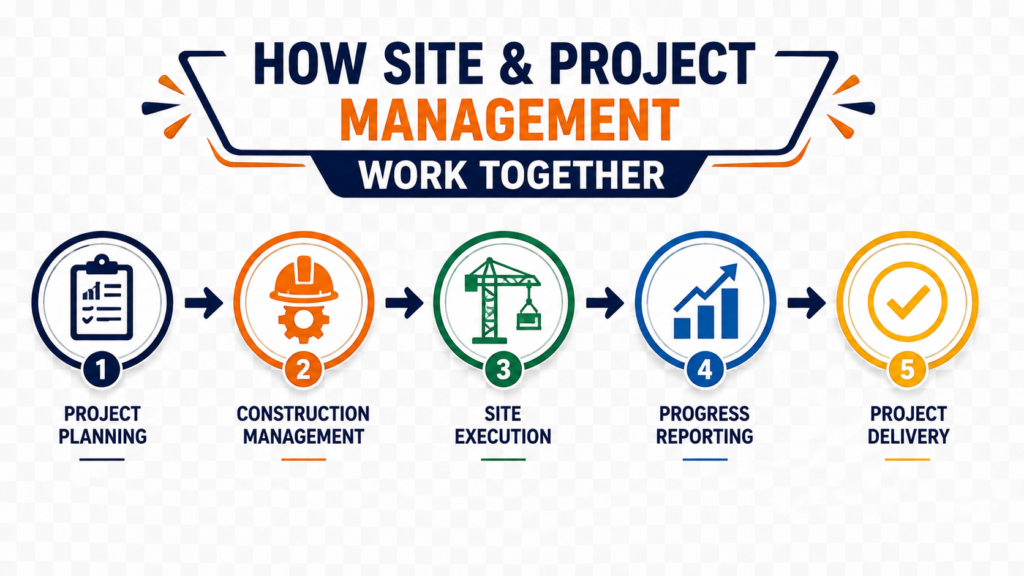
If a site manager identifies a two-week delay caused by a material issue, the project manager needs to understand how that delay affects the overall programme, cost, client commitments and other activities.
Likewise, if the project programme changes because of a client decision, the site manager needs to reorganise site resources and construction activities accordingly.
Construction Management Across the Project Lifecycle
Pre-Construction
Project management may focus on:
- Project objectives
- Planning
- Procurement
- Programme development
- Risk identification
- Stakeholder coordination
- Contractual arrangements
Construction management may contribute to:
- Buildability
- Construction methodology
- Resource planning
- Site logistics
- Programme development
- Construction sequencing
Site Mobilisation
Site management becomes increasingly important during mobilisation.
Activities may include:
- Establishing site facilities
- Access arrangements
- Site security
- Welfare facilities
- Storage
- Traffic management
- Site rules
- Workforce induction arrangements
For projects involving more than one contractor, the principal contractor must prepare the construction phase plan before construction begins and ensure it remains suitable as the project develops.
Construction Phase
During construction, site management becomes heavily involved in:
- Daily operations
- Workforce coordination
- Subcontractor management
- Quality
- Safety
- Materials
- Plant
- Progress
- Short-term planning
Project management continues to focus on:
- Programme
- Cost
- Risks
- Contracts
- Client requirements
- Procurement
- Project reporting
- Change management
Completion and Handover
Site management supports physical completion by coordinating:
- Defect rectification
- Testing
- Final inspections
- Cleaning
- Site completion
- Documentation
- Handover activities
Project management coordinates the wider closeout process, including completion requirements, documentation, contractual matters and stakeholder acceptance.
What Skills Are Needed for Construction Site Management?
A successful site manager generally needs a combination of technical construction knowledge, leadership and practical management skills.
Important skills include:
- Construction planning
- Site supervision
- Leadership
- Communication
- Health and safety awareness
- Risk assessment
- Quality control
- Problem-solving
- Workforce coordination
- Subcontractor management
- Time management
- Construction documentation
- Resource management
- Decision-making
Strong site managers also need to understand how different trades and activities interact. A decision affecting one work package can have consequences for several others.
What Skills Are Needed for Construction Project Management?
Construction project management requires a wider project-management skill set.
Important skills include:
- Project planning
- Programme management
- Budget management
- Risk management
- Contract awareness
- Procurement
- Stakeholder management
- Communication
- Negotiation
- Reporting
- Leadership
- Change management
- Commercial awareness
- Problem-solving
- Decision-making
A construction project manager also benefits from understanding construction processes. Project management is more effective when decisions are grounded in realistic knowledge of how construction work is actually delivered.
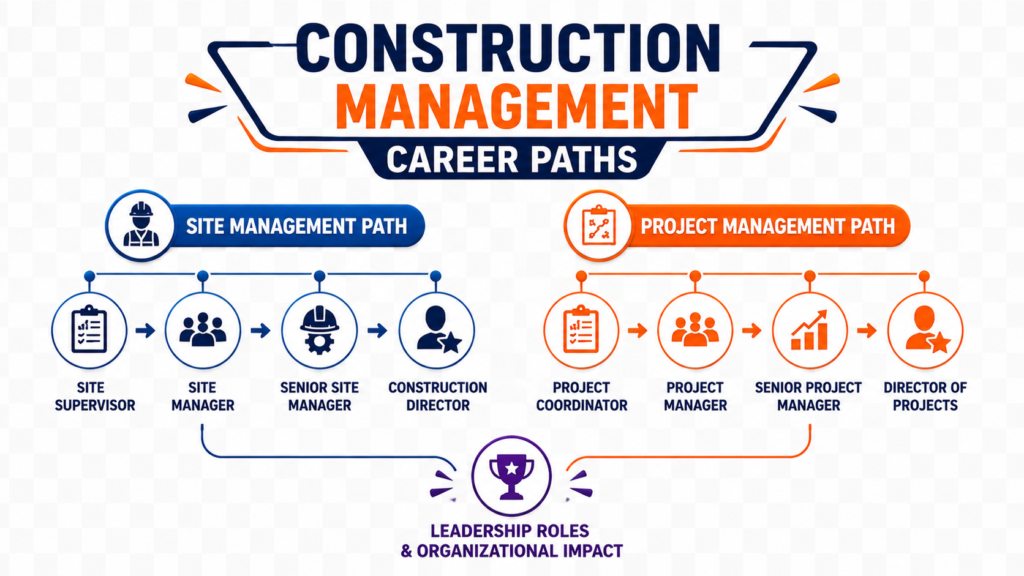
Construction Site Management Career Path
A common progression route may look like:
Construction Operative → Skilled Worker → Supervisor → Assistant Site Manager → Site Manager → Senior Site Manager → Construction Manager
The route is not fixed. Experience, technical qualifications, management competence, project exposure and professional development can all influence career progression.
For construction management occupations, CSCS states that Manager cards are associated with appropriate construction management or technical qualifications, including NVQ/SVQ Levels 4, 5, 6 or 7 depending on the occupation and card route.
For example, CSCS identifies the Level 6 NVQ Diploma in Construction Site Management as a relevant qualification for the Building Site Manager occupation on its Black Manager card qualification information.
Construction Project Management Career Path
A possible progression route is:
Construction Professional → Assistant Project Manager → Project Manager → Senior Project Manager → Project Director → Construction/Project Director
Some professionals move into project management from site management because practical site experience can provide valuable understanding of construction delivery.
Other routes may begin through construction management, engineering, quantity surveying, commercial management, architecture or other built-environment disciplines.
The most appropriate route depends on the intended role, employer requirements, previous experience and qualification pathway.
Qualifications for Construction Site and Project Management Careers
Qualifications can help demonstrate knowledge and competence, but the exact requirements depend on the occupation and employer.
For site management, construction-related vocational qualifications can be particularly relevant. CSCS explains that NVQs measure occupational competence against defined standards and that higher-level NVQs can support eligibility for relevant management cards.
For example, construction professionals may pursue qualifications in:
- Construction site management
- Construction supervision
- Construction management
- Civil engineering
- Building and construction
- Health and safety
- Project management
- Quantity surveying
- Built environment disciplines
Professional development can also include management training, health and safety training and role-specific programmes.
It is important to check the current requirements for the specific occupation and CSCS card rather than assuming that one qualification automatically applies to every construction management role. CSCS states that SMSTS and SSSTS are not themselves accepted as the qualification for a CSCS Manager or Supervisor card, although they can be recorded in the My Skills section of the My CSCS app.
Which Career Is Better: Site Management or Project Management?
There is no universal answer because the better option depends on career interests, experience and preferred responsibilities.
Site management may be suitable for a learner who enjoys:
- Working in a construction environment
- Practical problem-solving
- Managing site teams
- Coordinating trades
- Daily operational decisions
- Construction activities
- Site-based leadership
- Seeing physical progress from plans to completed work
Project management may be suitable for a learner who enjoys:
- Planning
- Organising complex projects
- Budget and cost discussions
- Client communication
- Risk management
- Procurement
- Contracts
- Reporting
- Strategic decision-making
- Coordinating multiple stakeholders
There is also no requirement to view the two careers as completely separate. Construction professionals can develop experience across site and project management and progress into broader management positions.
Can a Site Manager Become a Project Manager?
Yes. Site management experience can provide a strong practical foundation for progression into construction project management.
A site manager already understands many aspects of construction delivery, including:
- Workforce management
- Construction sequencing
- Subcontractors
- Quality
- Safety
- Site logistics
- Programme constraints
- Construction problems
To move towards project management, additional development may be required in areas such as:
- Budget management
- Commercial awareness
- Contract administration
- Procurement
- Client management
- Risk management
- Project reporting
- Strategic planning
The transition is therefore not simply a change of job title. It involves expanding from operational site management into broader project-level management.
Is Construction Site Management Part of Construction Project Management?
Construction site management can be considered an important component of construction project delivery, but the exact organisational relationship varies.
Project management provides wider coordination across the project, while site management concentrates on the practical execution of construction activities.
On a large project, several specialist managers may contribute to project delivery. On a smaller project, one person may perform responsibilities associated with both site management and project management.
Therefore, it is more accurate to view the two functions as overlapping and complementary rather than completely separate disciplines.
Why Both Functions Matter
A construction project cannot succeed through planning alone.
A well-prepared programme, budget and risk strategy still needs effective site execution.
At the same time, excellent site management cannot compensate indefinitely for poor project planning, inadequate procurement, uncontrolled changes or unrealistic budgets.
Successful delivery therefore depends on connecting:
Planning + Resources + People + Safety + Quality + Cost + Programme + Communication + Site Execution
Construction site management provides strong operational control, while construction project management provides broader project coordination.
Together, they help convert project objectives into measurable construction outcomes.
Frequently Asked Questions
Final Thoughts
Construction site management and construction project management have different primary focuses, but both are essential to successful construction delivery.
Construction site management is primarily concerned with what is happening on the ground: people, trades, materials, equipment, safety, quality, logistics and daily construction progress.
Construction project management is concerned with the wider project: scope, programme, cost, procurement, contracts, risks, stakeholders, reporting and overall delivery.
The distinction becomes particularly important when considering a construction career. A learner who enjoys practical site leadership may find site management a natural direction, while someone interested in planning, commercial coordination, stakeholder management and strategic delivery may prefer construction project management.
However, the strongest construction professionals understand how the two functions connect. Practical site experience can strengthen project-management capability, while strong project management provides the structure and resources needed for effective site delivery.
For anyone planning a career in construction management, the most useful approach is to develop both technical construction competence and management capability. Relevant qualifications, practical experience, continuing professional development and an understanding of UK construction responsibilities can all contribute to long-term career progression.
Key Takeaway
Site management manages the construction operation; construction project management manages the wider project. The two functions work together to deliver construction safely, efficiently, on programme and to the required standard.
Sources and further reading:
The UK Health and Safety Executive provides current guidance on CDM 2015 dutyholders, principal contractors, construction-phase planning and construction health and safety.
The Construction Skills Certification Scheme provides current information on construction qualifications and management card requirements.