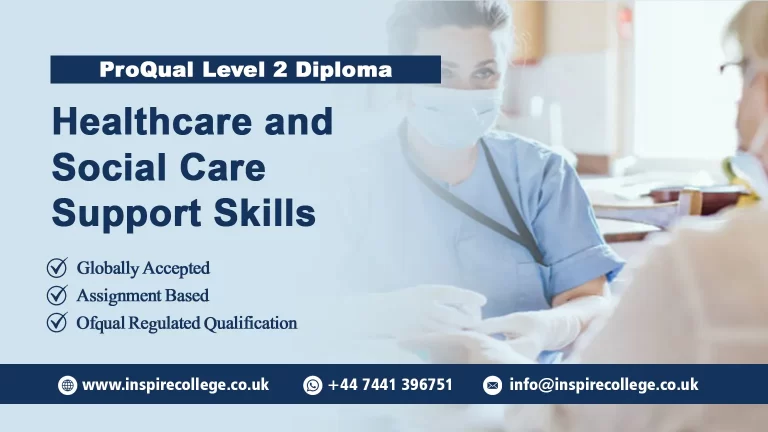
ProQual Level 2 Diploma in Healthcare and Social Care Support Skills
Level 2 Diploma in Health & Social Care – Enhance Skills
Awarding Body : ProQual
Level: 02
Credits: 37
TQT: 350 hours
Build Skills, Deliver Exceptional Care.
The ProQual Level 2 Diploma in Healthcare and Social Care Support Skills is an Ofqual-regulated qualification designed for individuals who wish to gain a more comprehensive understanding of the healthcare and social care sectors. This diploma provides learners with the essential skills, knowledge, and practical experience needed to work effectively in a variety of care settings. It is an ideal qualification for those looking to start or progress their career in healthcare and social care roles, offering a more in-depth curriculum compared to lower-level awards and certificates. The qualification is assignment-based, providing learners with the flexibility to complete their studies at their own pace, without the need for formal exams.
The ProQual Level 2 Diploma in Healthcare and Social Care Support Skills offers a broad overview of healthcare and social care support, with a focus on improving care delivery and ensuring the well-being of individuals in care settings. It covers key areas such as communication, health and safety, safeguarding, person-centred care, and supporting individuals with specific needs.
The qualification is particularly suited to individuals who work, or intend to work, in healthcare roles where they support vulnerable individuals, including those in care homes, hospitals, or home care services. By completing this diploma, learners will be able to demonstrate a thorough understanding of the skills required to provide high-quality care, as well as the ability to apply them in real-life settings.
Upon completion of the ProQual Level 2 Diploma in Healthcare and Social Care Support Skills, learners have several progression opportunities. They may choose to progress to higher-level qualifications, such as the ProQual Level 3 Diploma in Healthcare and Social Care, which opens up opportunities for more senior and specialised roles in healthcare, including managerial positions. Additionally, learners may choose to specialise in certain areas of care, such as dementia care, mental health, or palliative care.
To enrol in the ProQual Level 2 Diploma in Healthcare and Social Care Support Skills, learners are required to meet the following entry requirements:
- Minimum Age:Learners must be at least 16 years old.
- Educational Background: There are no specific educational qualifications required for this course. It is open to learners of all educational backgrounds. Whether you have completed formal education or have relevant work experience, you are eligible to apply.
- Professional Experience: Previous experience in health, social care, or voluntary support roles is advantageous but not mandatory. Exposure to care environments enhances understanding of course concepts.
- Language Proficiency:Learners must have a strong command of English, both written and spoken, to complete assessments successfully and communicate effectively.
Mandatory Units
To achieve the ProQual Level 2 Diploma in Healthcare and Social Care Support Skills; Candidates must achieve a minimum of 37 credits: a minimum of 25credits must be from the Level 2 units and the remaining 12 credits can be from any combination of units from the Level 2 or Level 3 or Level 4 units
Level 2 Units
| Sr# | Unit Title | Credit Value | GLH |
|---|---|---|---|
| 1 | Implement person centred approaches in health and social care | 5 | 33 |
| 2 | Principles of safeguarding and protection in health and social care | 3 | 26 |
| 3 | Assist in the administration of medication | 4 | 25 |
| 4 | Carry out personal hygiene for individuals unable to care for themselves | 3 | 23 |
| 5 | Support individuals with speech and language disorders to develop their communication skills | 4 | 28 |
| 6 | Perform the non-scrubbed circulating role for perioperative procedures | 3 | 23 |
| 7 | Minimise the risk of infection when transporting and storing healthcare waste | 3 | 20 |
| 8 | Assist in the issuing of prescribed items | 3 | 15 |
| 9 | Assist in the manufacture and assembly of medicinal products | 7 | 20 |
| 10 | Assist in the preparation of documentation, materials and other items for manufacture and assembly of medicinal products | 10 | 40 |
| 11 | Support individuals to carry out their own health care procedures | 2 | 15 |
| 12 | Provide support for therapy sessions | 2 | 14 |
| 13 | Contribute to the discharge of individuals to carers | 2 | 14 |
| 14 | Paediatric Emergency First Aid | 1 | 10 |
| 15 | Introduction to communication in health, social care or children’s and young people’s settings | 3 | 23 |
| 16 | Support individuals to meet personal care needs | 2 | 16 |
| 17 | Contribute to the safe use of medical devices in the perioperative environment | 4 | 29 |
| 18 | Causes and Spread of Infection | 2 | 20 |
| 19 | Prepare documentation, materials, components and other items for the preparation of aseptic products | 6 | 10 |
| 20 | Introduction to duty of care in health, social care or children’s and young people’s settings | 1 | 9 |
| 21 | Provide support for mobility | 2 | 14 |
| 22 | Assist others to plan presentations | 2 | 16 |
| 23 | Order Routine Pharmaceutical Stock | 3 | 11 |
| 24 | Dementia Awareness | 2 | 17 |
| 25 | Move and position individuals in accordance with their plan of care | 4 | 26 |
| 26 | Support individuals to manage continence | 3 | 19 |
| 27 | Handle information in health and social care settings | 1 | 10 |
| 28 | The role of the health and social care worker | 2 | 14 |
| 29 | Obtain and test specimens from individuals | 2 | 12 |
| 30 | Prepare individuals for healthcare activities | 3 | 17 |
| 31 | Assist in planning and evaluating learning activities | 3 | 22 |
| 32 | Assist the practitioner to carry out health care activities | 2 | 13 |
| 33 | Minimise the risk of infection during the removal of used linen | 2 | 15 |
| 34 | Inform an individual of discharge arrangements | 2 | 13 |
| 35 | Understand the context of supporting individuals with learning disabilities | 4 | 35 |
| 36 | Select and wear appropriate personal protective equipment for work in health care settings | 2 | 15 |
| 37 | Monitor and maintain the environment and resources during and after clinical / therapeutic activities | 3 | 20 |
| 38 | Prepare and dress for scrubbed clinical roles | 4 | 28 |
| 39 | Care for individuals with naso-gastric tubes | 3 | 20 |
| 40 | The principles of Infection Prevention and Contro | 3 | 30 |
| 41 | Assist with the provision of a pharmacy service to meet individuals’ needs | 3 | 10 |
| 42 | Contribute to the effectiveness of teams | 3 | 5 |
| 43 | Introduction to personal development in health, social care or children’s and young people’s settings | 3 | 23 |
| 44 | Support individuals who are distressed | 3 | 21 |
| 45 | Support individuals undergoing healthcare activities | 3 | 22 |
| 46 | Prepare equipment for intraoperative cell salvage blood processing | 4 | 26 |
| 47 | Assist in receiving, handling and dispatching clinical specimens | 2 | 17 |
| 48 | Assist in the sale of medicines and products | 8 | 50 |
| 49 | Receive Pharmaceutical Stock | 3 | 9 |
| 50 | Prepare aseptic products | 10 | 40 |
| 51 | Prepare and apply dressings and drains to individuals in the perioperative environment | 2 | 18 |
| 52 | Planning and Monitoring Work | 2 | 8 |
| 53 | Cleaning, Decontamination and Waste Management | 2 | 20 |
| 54 | Ensure your own Actions Reduce risks to Health and Safety | 2 | 8 |
| 55 | Introduction to equality and inclusion in health, social care or children’s and young people’s settings | 2 | 20 |
| 56 | Provide agreed support for foot care | 3 | 23 |
| 57 | Contribute to health and safety in health and social care | 4 | 33 |
| 58 | Support independence in the tasks of daily living | 5 | 33 |
| 59 | Prepare equipment for intraoperative cell salvage blood collection | 2 | 17 |
| 60 | Maintaining quality standards in the health sector | 1 | 8 |
| 61 | Emergency First Aid Skills | 1 | 10 |
| 62 | Assemble prescribed items | 3 | 15 |
| 63 | Support participation in learning and development activities | 3 | 23 |
| 64 | Provide support for sleep | 2 | 13 |
| 65 | Remove wound closure materials | 3 | 24 |
| 66 | Support individuals to eat and drink | 2 | 15 |
| 67 | Undertake agreed pressure area care | 4 | 30 |
| 68 | Meet food safety requirements when providing food and drink for individuals | 2 | 15 |
| 69 | Understand loss and grief in end of life care | 3 | 22 |
| 70 | Understand how to work in end of life care | 3 | 28 |
| 71 | Service improvements in the health sector | 2 | 15 |
Level 3 Units
| Sr# | Unit Title | Credit Value | GLH |
|---|---|---|---|
| 1 | Work with babies and young children to promote their development and learning | 6 | 45 |
| 2 | Engage in personal development in health, social care or children’s and young people’s settings | 3 | 10 |
| 3 | Support individuals with multiple conditions and/or disabilities | 4 | 31 |
| 4 | Support individuals who are bereaved | 4 | 30 |
| 5 | Prepare for and carry out extended feeding techniques | 4 | 27 |
| 6 | Provide support to continue recommended therapies | 3 | 20 |
| 7 | Insert and secure nasogastric tubes | 4 | 30 |
| 8 | Develop positive relationships with children and young people | 4 | 30 |
| 9 | Provide advice and information to enable parents to promote the health and well-being of their newborn babies | 3 | 22 |
| 10 | Facilitate and monitor housing and accommodation services to support individuals with mental health needs | 5 | 32 |
| 11 | Collaborate in the assessment of environmental and social support in the community | 4 | 23 |
| 12 | Influencing Others at Work | 1 | 6 |
| 13 | Care for the physical and nutritional needs of babies and young children | 6 | 45 |
| 14 | Support families who have a child with a disability | 3 | 23 |
| 15 | Support individuals to manage their finances | 3 | 20 |
| 16 | Obtain venous blood samples | 3 | 24 |
| 17 | Implement therapeutic group activities | 4 | 25 |
| 18 | Collate and communicate health information to individuals | 3 | 20 |
| 19 | Provide information and advice to individuals on eating to maintain optimum nutritional status | 5 | 38 |
| 20 | Assist in the implementation of programmes to increase mobility, movement and functional independence | 4 | 28 |
| 21 | Receive and handle clinical specimens within the sterile field | 4 | 30 |
| 22 | Prepare anaesthetic environment and provide support for pre and post-operative anaesthesia and recovery | 5 | 38 |
| 23 | Make recommendations for the use of physical resources in a health setting | 5 | 33 |
| 24 | Maintaining quality standards in the health sector | 2 | 13 |
| 25 | Understand Models of Disability | 3 | 26 |
| 26 | Support individuals to access and use services and facilities | 4 | 25 |
| 27 | Promote and implement health and safety in health and social care | 6 | 43 |
| 28 | Support young people with a disability to make the transition into adulthood | 5 | 40 |
| 29 | Understand mental well-being and mental health promotion | 3 | 14 |
| 30 | Carry out vision screening | 4 | 27 |
| 31 | Assist professionals to support individuals from diverse linguistic and cultural backgrounds to access speech and language therapy services | 5 | 35 |
| 32 | Implement hydrotherapy programmes for individuals and groups | 5 | 35 |
| 33 | Deliver exercise sessions to improve individuals’ health and wellbeing | 5 | 32 |
| 34 | Provide support to the surgical team when preparing individuals for operative and invasive procedures | 4 | 32 |
| 35 | Facilitate person centred assessment, planning, implementation and review | 6 | 45 |
| 36 | Work in partnership with families to support individuals | 4 | 27 |
| 37 | Support individuals to develop and run support groups | 3 | 24 |
| 38 | Monitor own work practice in health, social care or children’s and young people’s settings | 3 | 20 |
| 39 | Perform first line calibration on clinical equipment to ensure it is fit for use | 3 | 20 |
| 40 | Monitor and review individuals progress in relation to maintaining optimum nutritional status | 3 | 26 |
| 41 | Give presentations to groups | 4 | 26 |
| 42 | Support individuals in undertaking their chosen activities | 4 | 24 |
| 43 | Control the use of physical resources in a health setting | 3 | 25 |
| 44 | Support children and young people experiencing transitions | 3 | 28 |
| 45 | Promote communication in health, social care or children’s and young people’s settings | 3 | 10 |
| 46 | Contribute to the prevention of aggressive and abusive behaviour of people | 4 | 26 |
| 47 | Service improvement in the health sector | 3 | 20 |
| 48 | Understand the process and experience of dementia | 3 | 22 |
| 49 | Understand Physical Disability | 3 | 22 |
| 50 | Support individuals with a learning disability to access healthcare | 3 | 25 |
| 51 | Undertake urethral catheterisation processes | 4 | 28 |
| 52 | Promote good practice in handling information in health and social care settings | 2 | 16 |
| 53 | Understand mental health problems | 3 | 14 |
| 54 | Perform routine Electrocardiograph ECG Procedures | 4 | 30 |
| 55 | Undertake treatments and dressings of lesions and wounds | 4 | 25 |
| 56 | Adapt and fit healthcare equipment, medical devices, assistive technology, or products, to meet individuals’ needs | 6 | 37 |
| 57 | Administer oral nutritional products to individuals | 5 | 35 |
| 58 | Promote effective communication with individuals with sensory loss | 4 | 30 |
| 59 | Work with other professionals and agencies to support individuals with physical disability | 3 | 23 |
| 60 | Support individuals to access housing and accommodation services | 4 | 24 |
| 61 | Identify information requirements in a health context | 4 | 30 |
| 62 | Prepare and reproduce permanent radiographic images | 4 | 23 |
| 63 | Develop and prepare speech and language therapy resources for alternative and augmentative communication AAC use | 4 | 25 |
| 64 | Carry out wound drainage care | 4 | 32 |
| 65 | Prepare and provide surgical instrumentation and supplementary items for the surgical team | 6 | 43 |
| 66 | Care for a newly born baby when the mother is unable to do so | 4 | 32 |
| 67 | Understand Child and Young Person Development | 4 | 30 |
| 68 | Provide support to maintain and develop skills for everyday life | 4 | 28 |
| 69 | Facilitate learning and development activities to meet individual needs and preferences | 5 | 35 |
| 70 | Enable individuals with behavioural difficulties to develop strategies to change their behaviour | 8 | 41 |
| 71 | Reprocess endoscopy equipment | 4 | 30 |
| 72 | Support individuals with cognition and learning difficulties | 5 | 34 |
| 73 | Assist in testing individuals’ abilities prior to planning physical activities | 5 | 38 |
| 74 | Support individuals to manage dysphagia | 5 | 35 |
| 75 | Provide advice on foot care for individuals with diabetes | 3 | 23 |
| 76 | Transport, transfer and position individuals and equipment within the perioperative environment | 5 | 32 |
| 77 | Understand Sensory Loss | 3 | 21 |
| 78 | Support families who are affected by Acquired Brain Injury | 3 | 30 |
| 79 | Support individuals during a period of change | 4 | 29 |
| 80 | Perform intravenous cannulation | 4 | 34 |
| 81 | Care for individuals with urethral catheters | 4 | 30 |
| 82 | Conduct routine maintenance on clinical equipment | 4 | 30 |
| 83 | Assist and support individuals to use alternative and augmentative communication systems _AAC | 5 | 35 |
| 84 | Measure and record individuals’ body fluid balance in a perioperative environment | 4 | 23 |
| 85 | Support parents/carers to interact with and care for their newborn baby | 4 | 30 |
| 86 | Deliver training through demonstration and instruction | 3 | 21 |
| 87 | Principles for implementing duty of care in health, social care or children’s and young people’s settings | 1 | 5 |
| 88 | Promote Child and Young Person Development | 3 | 25 |
| 89 | Develop and sustain effective working relationships with staff in other agencies | 4 | 24 |
| 90 | Undertake physiological measurements | 3 | 23 |
| 91 | Undertake stoma care | 4 | 30 |
| 92 | Assure the effective functioning of radiographic image processing equipment | 4 | 25 |
| 93 | Operate equipment for intraoperative cell salvage blood collection | 5 | 40 |
| 94 | Advise and inform individuals on managing their condition | 5 | 31 |
| 95 | Assist others to monitor individuals’ progress in managing dysphagia | 5 | 38 |
| 96 | Support carers to meet the care needs of individuals | 5 | 30 |
| 97 | Maintain pharmaceutical stock | 3 | 4 |
| 98 | Anatomy and Physiology for Maternity Support Workers | 2 | 20 |
| 99 | Receive prescriptions from individuals | 3 | 15 |
| 100 | Understand how to support individuals with autistic spectrum conditions | 3 | 28 |
| 101 | Support Individuals with Specific Communication Needs | 5 | 35 |
| 102 | Obtain and test capillary blood samples | 4 | 30 |
| 103 | Support individuals at the end of life | 7 | 53 |
| 104 | Contribute to effective multidisciplinary team working | 3 | 20 |
| 105 | Analyse and present health related data and information | 4 | 30 |
| 106 | Remove wound drains | 4 | 27 |
| 107 | Develop activities and materials to enable individuals to reach specific communication goals | 5 | 38 |
| 108 | Operate equipment for intraoperative cell salvage blood processing and complete intraoperative cell salvage blood process | 5 | 39 |
| 109 | Support parents/carers and those in a parental role to care for babies during their first year | 5 | 36 |
| 110 | Obtain a client history | 3 | 22 |
| 111 | Manage the availability of physical resources to meet service delivery needs in a health setting | 5 | 33 |
| 112 | Administer medication to individuals, and monitor the effects | 5 | 30 |
| 113 | Assist in the Issuing of Pharmaceutical Stock | 4 | 5 |
| 114 | Undertake an in-process accuracy check of assembled prescribed items prior to the final accuracy check | 4 | 11 |
| 115 | Promote equality and inclusion in health, social care or children’s and young people’s settings | 2 | 8 |
| 116 | Understand the impact of Acquired Brain Injury on individuals | 3 | 28 |
| 117 | Support individuals to live at home | 4 | 25 |
| 118 | Promote person centred approaches in health and social care | 6 | 41 |
| 119 | Undertake tissue viability risk assessments | 3 | 26 |
| 120 | Interact with and support individuals using telecommunications | 5 | 36 |
| 121 | Manufacture equipment or medical devices for individuals within healthcare | 4 | 30 |
| 122 | Provide support for individuals with communication and interaction difficulties | 5 | 39 |
| 123 | Monitor individuals’ progress in relation to managing their body weight and nutrition | 3 | 26 |
| 124 | Assist in implementing treatment programmes for individuals with severely reduced movement/mobility | 5 | 29 |
| 125 | Assist in the delivery of perioperative care and support to individuals | 4 | 31 |
| 126 | Examine the feet of individuals with diabetes | 4 | 32 |
Level 4 Units
| Sr# | Unit Title | Credit Value | GLH |
|---|---|---|---|
| 1 | Support disabled children and young people and those with specific requirements | 6 | 45 |
| 2 | Enable children and young people to understand their health and well-being | 5 | 38 |
| 3 | Develop and agree individualised care plans for babies and families | 5 | 38 |
The ProQual Level 2 Diploma in Healthcare and Social Care Support Skills is designed for individuals who want to develop essential care skills and gain a recognized qualification to support their career in the health and social care sector. This course is ideal for learners seeking practical knowledge and professional growth in care environments.
- Aspiring Health and Social Care Workers – Individuals looking to start a career in healthcare or social care support roles.
- Current Care and Support Staff – Professionals working in care homes, hospitals, or community services who wish to formalize and enhance their skills.
- Volunteers in Care Settings – Those involved in voluntary care work who want to gain structured knowledge and professional recognition.
- Learners Seeking Career Progression – Individuals aiming to progress to higher-level qualifications or supervisory roles in health and social care.
- Individuals Returning to Work – Those re-entering the care sector and looking to refresh their skills and confidence.
By completing this course, participants will gain the practical skills, knowledge, and confidence required to provide effective support in healthcare and social care settings. The diploma offers a strong foundation for long-term career development and progression within the care sector.
Choosing the right training provider is essential for building a successful and rewarding career in health and social care. Our ProQual Level 2 Diploma in Healthcare and Social Care Support Skills is designed to provide high-quality learning that combines practical skills, professional knowledge, and career-focused outcomes.
- Industry-Experienced Tutors – Learn from qualified professionals with real-world experience in healthcare and social care environments.
- Comprehensive Course Content – Covers essential areas such as care support, communication, safeguarding, and health and safety practices.
- Practical, Skills-Based Learning – Real-life scenarios and applied learning help learners confidently perform in care settings.
- Recognized Qualification – Gain a ProQual Level 2 Diploma that is respected by employers and supports career progression.
- Career-Focused Pathway – Build a strong foundation to progress into Level 3 qualifications or advanced care roles.
- Flexible Learning Structure – Designed to support learners balancing work, study, and personal commitments.
By choosing our course, learners gain the confidence, competence, and practical skills needed to succeed in healthcare and social care roles. Our commitment to quality education and professional development ensures you are well-prepared to grow and advance in the care sector.
Start Learning Today
Get in Touch
+44 2035 764371
+44 7441 396751
info@inspirecollege.co.uk
www.inspirecollege.co.uk