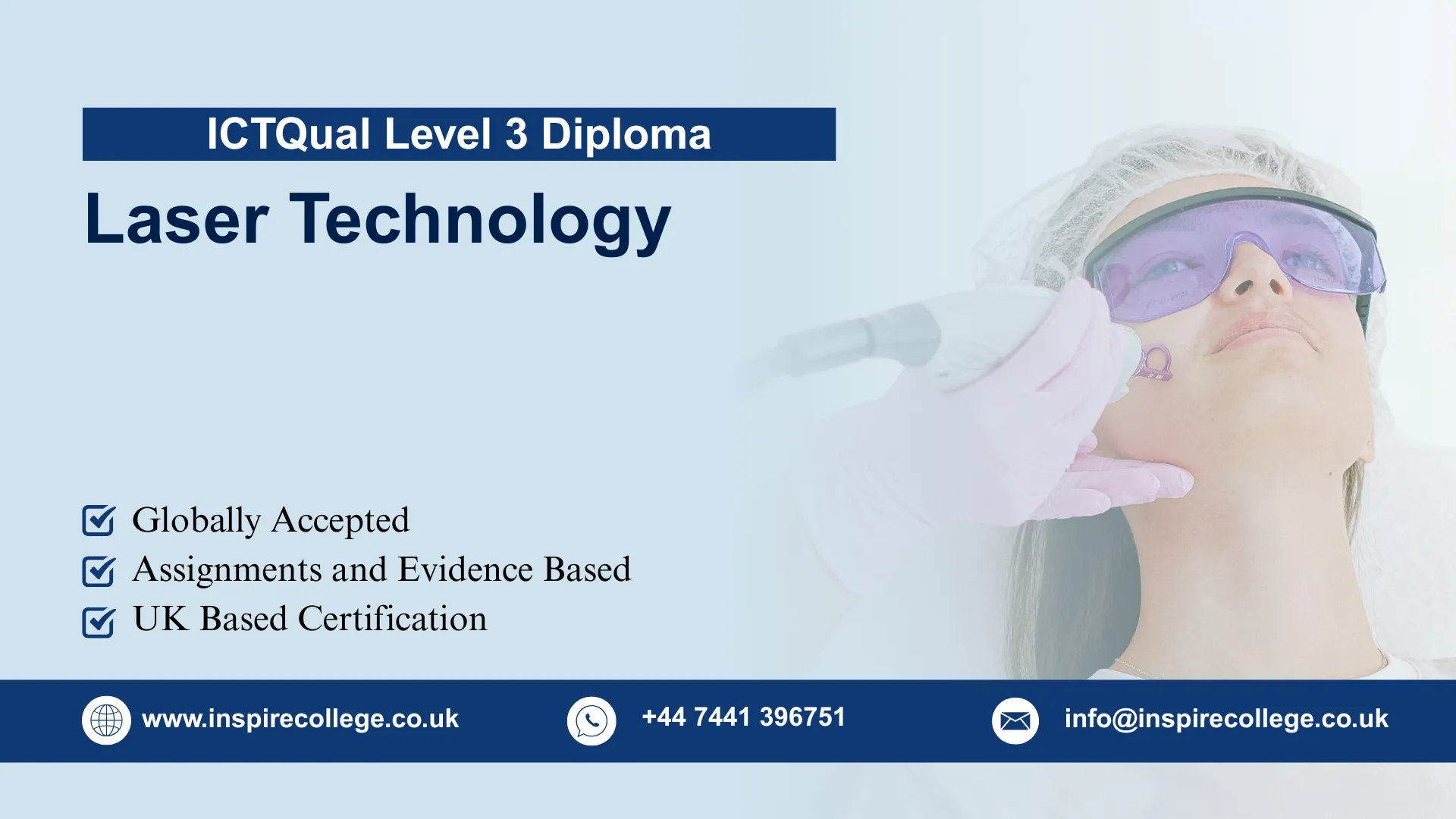
ICTQual Level 3 Diploma in Laser Technology
The ICTQual Level 3 Diploma in Laser Technology is a comprehensive qualification designed to provide learners with advanced knowledge and practical skills in the field of laser systems and applications. As laser technology continues to transform industries such as manufacturing, engineering, health care, telecommunications, and research, this diploma equips learners with the expertise to operate, manage, and innovate safely and effectively. It is an ideal program for individuals seeking to build a career in one of the fastest‑growing areas of modern technology.
Learners will explore the fundamentals of laser physics, system design, and industrial applications, alongside the biological and environmental effects of laser use. The course emphasizes both theoretical understanding and hands‑on practice, covering topics such as laser safety, risk assessment, compliance with international standards, and emerging innovations in laser technology. By integrating case studies and industry best practices, learners gain the confidence to apply their knowledge in real‑world scenarios.
Upon successful completion, graduates of the ICTQual Level 3 Diploma in Laser Technology will be recognized as skilled professionals capable of contributing to diverse sectors where lasers are essential. This qualification opens pathways to roles such as Laser Technician, Safety Specialist, Research Assistant, or Technical Consultant, while also serving as a foundation for higher‑level study and specialization. With its global relevance and industry‑focused curriculum, the diploma positions learners at the forefront of technological advancement and career growth.
To ensure learners are fully prepared for success, the following entry requirements apply to the ICTQual Level 3 Diploma in Laser Technology. These criteria are designed to support effective learning, professional readiness, and alignment with international standards.
- Minimum Age Applicants must be 18 years or older at the time of enrollment. This ensures learners have the maturity to engage with advanced technical and safety‑critical content.
- Educational Background A secondary school qualification (high school diploma or equivalent) is required. Learners with prior studies in science, engineering, or technology subjects gain added relevance.
- Professional Experience Previous exposure to technical environments, laboratory work, or industrial operations is recommended. Direct laser system experience is not mandatory, but it supports faster application of course concepts.
- Additional Experience Candidates with roles in manufacturing, research, or technology development will benefit most from this program. Such experience helps learners connect theoretical knowledge with real‑world laser technology applications.
- Language Proficiency All course materials and assessments are delivered in English. Learners must demonstrate intermediate reading, writing, and communication skills to succeed in technical modules.
Mandatory Units
This qualification, the ICTQual Level 3 Diploma in Laser Technology, consists of 6 mandatory units.
- Principles of Laser Physics and Optical Fundamentals
- Laser System Components, Design, and Integration
- Industrial Applications of Laser Technology
- Medical and Healthcare Applications of Lasers
- International Laser Safety Standards, Risk Assessment, and Compliance
- Research Methods, Innovation, and Professional Practice in Laser Technology
Learning Outcomes for the ICTQual Level 3 Diploma in Laser Technology:
Principles of Laser Physics and Optical Fundamentals
- Demonstrate understanding of the principles of laser generation and optical fundamentals
- Explain the behaviour of light, reflection, refraction, and diffraction in laser systems
- Analyse the properties of coherence, wavelength, and beam quality in laser applications
- Apply theoretical knowledge to practical scenarios involving optical components
- Evaluate the role of optics in enhancing laser performance
Laser System Components, Design, and Integration
- Identify and describe the main components of laser systems (resonators, mirrors, lenses, power supplies)
- Explain the design principles behind different types of laser systems
- Integrate components to achieve functional and efficient laser systems
- Assess the performance and limitations of laser system designs
- Apply engineering principles to optimise system integration for industrial and medical use
Industrial Applications of Laser Technology
- Demonstrate knowledge of laser applications in manufacturing, cutting, welding, and material processing
- Evaluate the advantages and limitations of laser use in industrial environments
- Apply laser technology to improve precision, efficiency, and productivity in industry
- Analyse case studies of industrial laser applications for problem‑solving and innovation
- Assess emerging industrial technologies involving laser systems
Medical and Healthcare Applications of Lasers
- Explain the interaction of lasers with biological tissues in clinical contexts
- Identify medical applications of lasers in surgery, dermatology, ophthalmology, and therapy
- Evaluate risks and benefits of laser use in healthcare procedures
- Apply safety protocols to protect patients and healthcare staff during laser use
- Assess innovations in medical laser technology and their impact on patient care
International Laser Safety Standards, Risk Assessment, and Compliance
- Interpret international laser safety standards (ISO, ANSI, IEC, OSHA)
- Conduct structured risk assessments for laser operations in industrial and healthcare settings
- Identify hazards associated with laser use and develop control measures
- Implement compliance frameworks to meet international safety requirements
- Promote a culture of safety and accountability in professional practice
Research Methods, Innovation, and Professional Practice in Laser Technology
- Apply research methodologies to investigate laser technology applications
- Analyse data to evaluate performance, safety, and innovation in laser systems
- Demonstrate professional practice in managing projects and documentation
- Contribute to innovation in laser technology through applied research and development
- Reflect on ethical, sustainable, and professional responsibilities in advanced laser environments
The ICTQual Level 3 Diploma in Laser Technology is designed for learners who aspire to build strong technical expertise in laser systems, safety, and industrial applications. This program is tailored to individuals seeking career growth in engineering, manufacturing, research, and technology‑driven industries.
- Aspiring Technicians & Engineers Learners aiming to develop practical skills in laser operations, system design, and industrial applications. They benefit from hands‑on training that prepares them for technical roles in modern industries.
- Safety & Compliance Professionals Individuals responsible for workplace safety and regulatory compliance in environments where lasers are used. This diploma strengthens their ability to manage risks and implement international safety standards.
- Research & Academic Learners Students or professionals engaged in scientific research, laboratory work, or technology development. They gain advanced knowledge to apply laser technology safely in experimental and academic settings.
- Career Builders Learners seeking a globally recognized qualification to enhance employability and career progression. This diploma opens pathways to roles such as Laser Technician, Safety Specialist, or Technical Consultant.
- Industry Professionals Those already working in manufacturing, telecommunications, or medical technology who want to upskill. They acquire specialized expertise to integrate laser systems into industrial processes effectively.
The ideal learner for this diploma is someone motivated to combine technical knowledge with practical application in laser technology. By enrolling, learners position themselves as skilled professionals ready to contribute to industrial innovation, workplace safety, and global compliance standards. This qualification not only strengthens career prospects but also places learners at the forefront of technological advancement.esponsibly.
This qualification not only strengthens career prospects but also contributes to safer, more effective clinical practices worldwide.ponsibility for safe and compliant laser operations in industrial environments. By combining technical knowledge with practical safety management skills, this program ensures graduates are equipped to protect personnel, maintain compliance, and support operational excellence.
Register Now
FAQs for ICTQual Level 3 Diploma in Laser Technology