
UK Fire Safety Laws Explained: A Practical Guide for Employers and Businesses
Understanding UK fire safety laws is essential for employers, business owners, landlords, facilities managers and anyone responsible for managing a workplace or commercial building. Fire safety legislation establishes legal duties designed to prevent fires, protect employees and visitors, maintain safe escape routes and ensure that appropriate emergency procedures are in place.
However, compliance involves more than installing fire extinguishers or displaying evacuation signs. Businesses must identify fire hazards, assess risks, maintain suitable fire precautions, provide appropriate staff training and keep records demonstrating how fire safety is managed.
The legal framework also varies across the United Kingdom. England and Wales generally operate under the Regulatory Reform (Fire Safety) Order 2005, while Scotland and Northern Ireland have their own principal legislation and supporting regulations. Additional requirements may apply to residential buildings, premises containing dangerous substances, construction sites and other higher-risk environments.
This practical guide explains the main UK fire safety laws, identifies who is legally responsible, outlines how to conduct and maintain a fire risk assessment, and provides an actionable compliance checklist for businesses.
Whether you manage a small office, retail shop, warehouse, restaurant, factory or multi-occupied building, the objective is the same: establish a documented, risk-based approach that protects people and meets the requirements applicable to your premises.
Quick answer: Businesses must comply with the fire safety legislation applicable to their location and premises. This normally includes identifying the responsible person or dutyholders, completing and reviewing a suitable fire risk assessment, implementing appropriate preventive and protective measures, maintaining fire safety equipment, keeping escape routes usable, preparing emergency procedures and providing staff with suitable information and training.
What Are UK Fire Safety Laws?
UK fire safety laws are the statutes, regulations and associated legal requirements governing the prevention of fire, the protection of people and the management of fire risks in workplaces, commercial premises and other relevant buildings.
These requirements establish responsibilities for employers, building owners, occupiers, landlords and other people who exercise control over premises. They also provide powers for enforcing authorities to inspect premises and take action when fire safety standards are inadequate.
Fire safety legislation does not prescribe an identical set of measures for every building. The precautions needed depend on the nature of the premises, the activities carried out, the people who use the building and the risks identified through assessment.
For example, a small office may require clear escape routes, suitable alarms, emergency lighting where necessary, appropriate extinguishers and staff instruction. A manufacturing facility handling flammable liquids may need additional controls for ignition sources, hazardous substances, ventilation and specialist emergency arrangements.
The governing principle is that fire precautions must be appropriate to the risks and effective in protecting relevant people.
Which Fire Safety Laws Apply in the UK?
Several pieces of legislation contribute to the UK’s fire safety framework. The precise requirements depend on the nation, building type, activities and circumstances.
Regulatory Reform (Fire Safety) Order 2005
The Regulatory Reform (Fire Safety) Order 2005 is the principal fire safety legislation for most non-domestic premises in England and Wales.
It establishes duties for the responsible person, including undertaking a fire risk assessment, implementing general fire precautions, maintaining appropriate fire safety arrangements, providing information and training, and ensuring emergency routes and exits are suitable.
The Order covers a broad range of premises, including workplaces, shops, offices, factories, warehouses, educational establishments and many premises used by the public. It also applies to relevant common parts of buildings containing multiple domestic premises.
The legislation should be read alongside subsequent amendments and applicable regulations.
Fire Safety Act 2021
The Fire Safety Act 2021 clarified how the Fire Safety Order applies to certain multi-occupied residential buildings in England and Wales.
Its scope includes the building’s structure and external walls, including attachments such as balconies, as well as flat entrance doors between domestic premises and common parts.
This matters because fire risk assessments for relevant residential buildings cannot simply ignore these elements. Those responsible must consider the applicable building features and fire risks when determining appropriate precautions.
Building Safety Act 2022
The Building Safety Act 2022 introduced important changes to building safety arrangements, including amendments to the Fire Safety Order through section 156.
For relevant premises in England and Wales, these changes strengthened requirements concerning fire risk assessment records, fire safety arrangements, cooperation between responsible persons, the transfer of fire safety information and information provided to residents where applicable.
Responsible persons should ensure their documentation reflects the requirements currently in force rather than relying on older checklists.
Fire Safety (England) Regulations 2022
The Fire Safety (England) Regulations 2022 introduced additional requirements for responsible persons in certain multi-occupied residential buildings in England.
Depending on the building and applicable provisions, these include resident fire safety information, fire door checks, access to building plans and information for fire and rescue services, and checks of specified firefighting equipment.
These regulations apply in England, not uniformly throughout the UK. Businesses and building managers must identify whether their premises fall within the relevant scope.
Fire safety legislation in Scotland
In Scotland, the main legislation for most non-domestic premises is the Fire (Scotland) Act 2005, supported by the Fire Safety (Scotland) Regulations 2006.
These requirements cover workplaces, commercial premises, premises accessible to the public and certain houses in multiple occupation.
The Scottish framework has its own legal provisions and guidance. Employers and dutyholders operating in Scotland should therefore use the appropriate Scottish guidance rather than automatically applying an England-specific compliance checklist.
Fire safety legislation in Northern Ireland
Northern Ireland has a separate legal framework, principally involving the Fire and Rescue Services (Northern Ireland) Order 2006 and the Fire Safety Regulations (Northern Ireland) 2010.
The Northern Ireland Fire and Rescue Service provides guidance for businesses on their obligations, fire risk assessments and workplace fire safety.
Employers operating in Northern Ireland should check the applicable requirements with the relevant authorities and avoid assuming that all provisions of English legislation apply.
Comparison of the main UK fire safety frameworks
| UK nation | Principal fire safety framework for relevant premises | Practical consideration |
|---|---|---|
| England | Regulatory Reform (Fire Safety) Order 2005, as amended, plus applicable regulations | Check additional requirements for relevant multi-occupied residential buildings. |
| Wales | Regulatory Reform (Fire Safety) Order 2005, as amended, plus applicable Welsh provisions | Use Welsh guidance and monitor changes to the Building Safety (Wales) framework. |
| Scotland | Fire (Scotland) Act 2005 and Fire Safety (Scotland) Regulations 2006 | Follow Scottish legislation and premises-specific guidance. |
| Northern Ireland | Fire and Rescue Services (Northern Ireland) Order 2006 and Fire Safety Regulations (Northern Ireland) 2010 | Follow Northern Ireland requirements and Northern Ireland Fire and Rescue Service guidance. |
Important: This table provides a starting point, not a complete statement of every applicable legal requirement. Check the current legislation and official guidance for your premises, particularly where residential accommodation, specialist industrial processes or higher-risk buildings are involved.
Who Is Responsible for Fire Safety at Work?
One of the most important concepts in workplace fire safety is the responsible person or, in other UK frameworks, the relevant dutyholder.
In England and Wales, the responsible person under the Fire Safety Order is generally the employer where the workplace is under their control. Depending on the circumstances, it may also be the person controlling the premises for business purposes or the owner where the legislation applies.
Relevant examples include:
- Employers responsible for offices, shops and other workplaces.
- Business owners and occupiers with control over premises.
- Landlords responsible for relevant buildings or common parts.
- Facilities managers and managing agents who exercise control over particular fire safety arrangements.
- Other people who have duties under the applicable legislation.
A building may have several responsible persons. For example, an office tenant may control the internal workplace while the landlord or managing agent controls shared corridors, staircases and building systems.
The existence of a maintenance contract or an appointed fire safety consultant does not automatically remove the responsible person’s legal obligations.
Can an employer delegate fire safety responsibilities?
An employer can appoint competent people to assist with fire safety management, inspections, training and risk assessments. However, appointing a contractor does not automatically transfer the employer’s legal responsibilities.
The responsible person must ensure that the required arrangements are appropriate and implemented. They should understand the scope of any contractor’s work, check that identified deficiencies are addressed and maintain oversight of significant risks.
A written allocation of responsibilities is particularly useful where tenants, landlords, contractors and managing agents share a building.
Main responsibilities of the responsible person
The precise duties depend on the applicable law, but typically include:
- Identifying fire hazards and assessing risks to relevant people.
- Implementing appropriate preventive and protective measures.
- Providing suitable means of detecting and warning about fire.
- Keeping emergency routes and exits available and suitable.
- Establishing emergency procedures and evacuation arrangements.
- Maintaining relevant fire safety equipment and systems.
- Providing employees with suitable information, instruction and training.
- Recording required assessments, findings and management arrangements.
- Reviewing arrangements when circumstances change.
- Cooperating with other responsible persons where required.
The official GOV.UK workplace fire safety guidance provides a useful starting point for understanding responsibilities in England and Wales.
What Is a Fire Risk Assessment?
A fire risk assessment is a systematic examination of a premises to identify fire hazards, determine who could be harmed, evaluate the risks and establish the measures needed to prevent fire and protect people.
It is a central element of workplace fire safety compliance. In England and Wales, the Fire Safety Order requires the responsible person to make a suitable and sufficient assessment of the risks to relevant people.
The assessment should reflect the actual building and activities rather than relying on a generic document that has not been checked against the workplace.
For example, a warehouse assessment should consider storage arrangements, combustible materials, charging equipment, vehicle movements and evacuation conditions. A restaurant assessment may need to consider cooking equipment, extraction systems, gas supplies, storage areas and the risks associated with busy service periods.
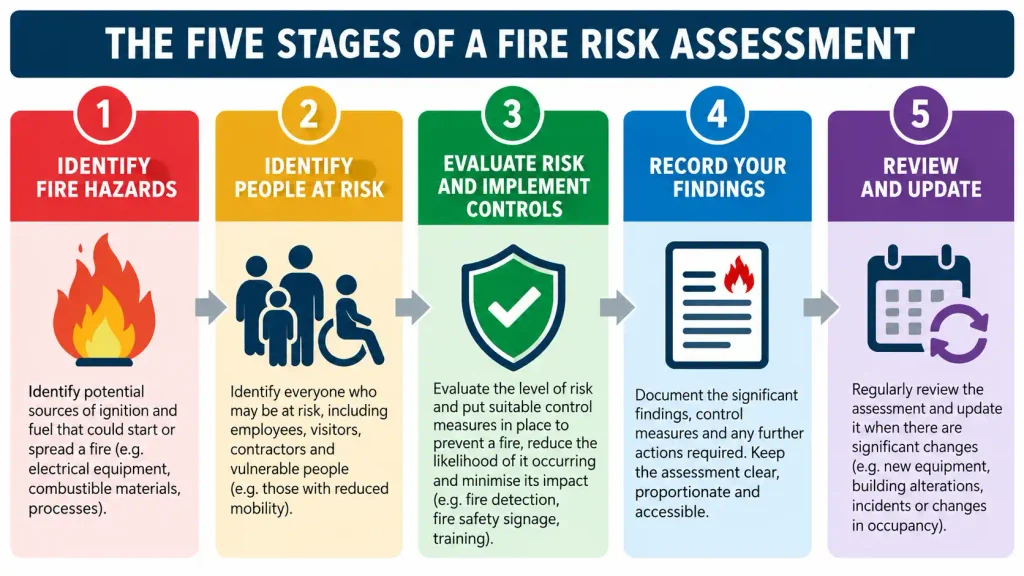
The five stages of a fire risk assessment
The following five-stage process is a practical way to organise the work.
Stage 1: Identify fire hazards
Identify potential sources of ignition, fuel and oxygen. Examples include damaged electrical equipment, hot work, cooking equipment, flammable liquids, packaging, waste and combustible dust.
Stage 2: Identify people at risk
Consider employees, visitors, contractors, customers and other relevant people. Pay particular attention to anyone who may need additional assistance to evacuate, including people with disabilities, temporary injuries or limited familiarity with the building.
Stage 3: Evaluate and reduce the risks
Determine whether the existing controls are adequate. Consider ignition prevention, safe storage, housekeeping, fire separation, alarms, emergency lighting, escape routes and firefighting equipment, as appropriate to the premises.
Stage 4: Record findings and implement arrangements
Record the assessment and its findings as required by applicable legislation. Document the preventive measures, action plan, emergency procedures and staff training arrangements.
Under section 156 of the Building Safety Act 2022, the requirements in England and Wales were strengthened so that responsible persons must record their fire risk assessment in full and document their fire safety arrangements. Confirm the current requirements and any relevant nation-specific provisions.
Stage 5: Review and update the assessment
Review the assessment regularly and whenever significant changes occur. Examples include alterations to the building, changes in occupancy, new equipment, changes in storage arrangements, fire incidents or the discovery of defective safety systems.
An assessment is useful only when it remains relevant and its recommendations are acted upon.
Fire risk assessment flowchart
Use this decision process to determine how to approach an assessment and subsequent action.
START
|
v
Identify the premises and applicable legislation
|
v
Identify the responsible person or dutyholders
|
v
Inspect the premises and identify fire hazards
|
v
Identify people who may be harmed
|
v
Evaluate existing precautions and remaining risks
|
v
Are the risks adequately controlled?
|
+—- NO —-> Set corrective actions and deadlines
| |
| v
| Implement controls
| |
| v
| Verify completion
|
+—- YES —> Record findings and arrangements
|
v
Inform and train staff
|
v
Monitor and review
|
v
END
This flowchart is a practical management aid, not a replacement for the legally required assessment or official guidance.
What Fire Safety Measures Must Businesses Provide?
There is no single equipment list that is suitable for every workplace. The necessary precautions should be determined by the assessment, applicable legislation, the building’s characteristics and the activities being carried out.
Fire detection and warning systems
People must be able to receive an appropriate warning of fire. Depending on the premises, this may require smoke or heat detection, a manual alarm system, audible warnings or other suitable arrangements.
The system should be appropriate for the building’s layout, occupancy, risk profile and evacuation procedures.
A business should not assume that a small premises is automatically safe without an alarm system, or that a large premises can rely on the same arrangements as a small office.
Emergency routes and exits
Escape routes must be suitable for the people expected to use them and must remain available for evacuation.
Businesses should check that:
- Escape routes are not obstructed by stock, furniture, waste or equipment.
- Final exits can be opened as required during an emergency.
- Fire doors are maintained and not improperly wedged open.
- Escape signage is clear where required.
- Emergency lighting is provided and maintained where necessary.
- Evacuation arrangements reflect the building layout and occupancy.
Blocked exits and damaged fire doors can undermine otherwise adequate fire precautions.
Firefighting equipment
Appropriate firefighting equipment should be selected according to the premises and its risks. Equipment may include extinguishers or fixed firefighting systems where necessary.
Staff should understand the location and purpose of the equipment. Only appropriately trained people should attempt to use firefighting equipment, and only where doing so is safe and consistent with the emergency procedure.
Evacuation and personal safety must take priority over attempts to extinguish a fire.
Electrical safety and ignition control
Electrical faults and unsafe working practices can introduce ignition sources. Employers should address damaged cables, overloaded sockets, poorly maintained equipment, unsafe temporary wiring and inappropriate charging arrangements.
Where hot work is undertaken, suitable controls may include authorisation procedures, removal or protection of combustible materials, appropriate fire monitoring and post-work checks.
Businesses handling flammable liquids, gases or combustible dust may require additional measures under the Dangerous Substances and Explosive Atmospheres Regulations 2002 (DSEAR), where applicable. The Health and Safety Executive provides workplace fire and explosion guidance.
Fire safety equipment and management checklist
| Area | What to check | Evidence to retain where applicable |
|---|---|---|
| Fire detection and alarms | Suitability, condition, faults and required testing | Inspection, test and maintenance records |
| Emergency exits | Access, usability and correct operation | Workplace inspection records |
| Fire doors | Condition, closing devices and damage | Inspection and repair records |
| Emergency lighting | Function and suitability | Test and maintenance records |
| Fire extinguishers | Correct selection, accessibility and condition | Servicing and inspection records |
| Electrical equipment | Damage, defects and safe use | Maintenance and defect reports |
| Combustible materials | Storage, housekeeping and waste management | Inspection findings and corrective actions |
| Staff training | Induction, instruction and role-specific competence | Training and attendance records |
| Evacuation arrangements | Procedures, responsibilities and suitability | Emergency plan and drill records, where applicable |
The table is an operational checklist, not a universal statutory testing schedule. Testing frequencies and technical standards should follow applicable requirements, manufacturer instructions, competent advice and the risks identified.
Fire Safety Training Requirements for Employees
Fire safety training helps employees understand the risks in their workplace and respond appropriately if an alarm sounds or a fire occurs.
Under the Fire Safety Order, employers and responsible persons have duties relating to employee information, instruction and training. Equivalent duties must be checked under the legislation applicable in Scotland and Northern Ireland.
Training should be relevant to the workplace, the risks identified and each person’s responsibilities.
What should workplace fire safety training cover?
A suitable programme may include:
- Common fire hazards and the importance of prevention.
- How to raise the alarm and report a fire.
- The location and use of escape routes.
- Assembly points and evacuation procedures.
- Actions to take when an alarm sounds.
- The importance of keeping exits and fire doors clear.
- Procedures for visitors, contractors and people needing evacuation assistance.
- The responsibilities of fire wardens or marshals, where appointed.
- The limitations of firefighting equipment and when not to attempt firefighting.
New employees should receive relevant instruction before they are expected to work independently in the premises. Refresher training should be provided at suitable intervals and whenever changes to the workplace, risks or procedures make additional instruction necessary.
A fire warden or fire marshal may need additional role-specific training. The extent of that training depends on the duties assigned and the workplace’s risk profile.
Employers should retain appropriate training records and check whether employees understand the arrangements, rather than measuring compliance only by the number of training sessions delivered.
How to Create an Effective Workplace Fire Evacuation Plan
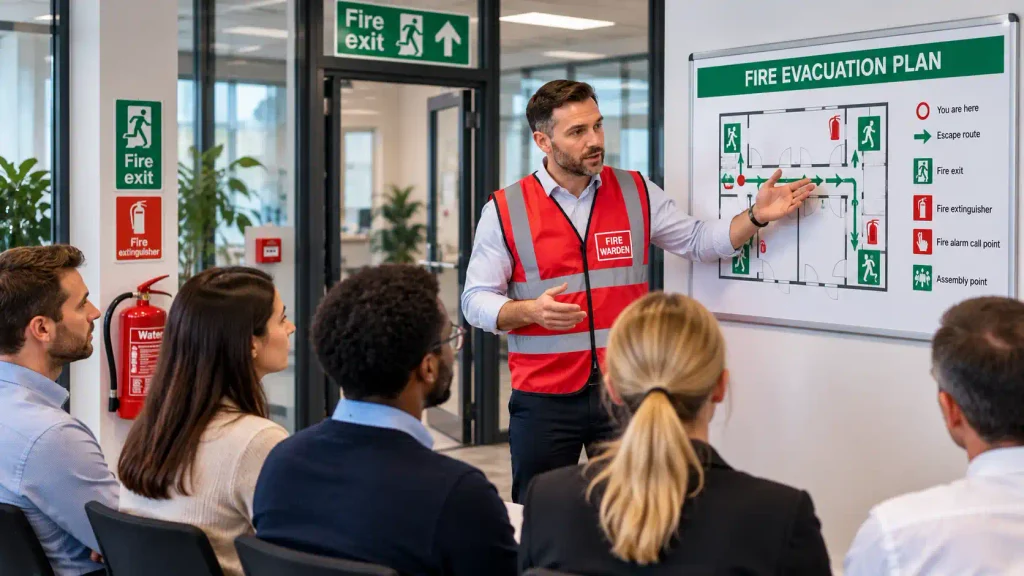
A fire evacuation plan explains how people should respond to a fire, how they will leave the premises and who is responsible for carrying out specific emergency actions.
The plan must reflect the building’s layout, occupancy, fire precautions and identified risks. It should also be consistent with any applicable building-specific evacuation strategy.
Essential elements of an evacuation plan
Alarm and reporting arrangements: Explain how a fire is reported, how the alarm is raised and how emergency services are contacted.
Escape routes: Identify the routes people should use and any relevant restrictions. Keep the routes accessible and communicate alternative arrangements where necessary.
Assembly point: Select a suitable location away from immediate danger that does not obstruct emergency service access.
Staff responsibilities: Identify who will raise the alarm, guide evacuation, contact emergency services where appropriate and provide information about missing people.
Assistance for people who may need it: Consider employees and visitors who may require additional support. Put suitable arrangements in place without relying on assumptions about an individual’s abilities.
Visitors and contractors: Ensure that people unfamiliar with the premises can understand the alarm and evacuation arrangements.
Emergency service access: Make sure responders can be directed to the correct entrance and provided with relevant information.
How to manage a fire emergency
FIRE DISCOVERED
|
v
Raise the alarm
|
v
Follow the site’s emergency procedure
|
v
Evacuate using a safe route
|
v
Call 999 or 112 when safe to do so
|
v
Proceed to the assembly point
|
v
Account for people as far as practicable
|
v
Provide information to emergency services
|
v
Do not re-enter until authorised
This is a general sequence. The site’s approved procedure, including any specialist evacuation strategy, takes precedence where applicable. People should never be instructed to delay evacuation to collect belongings or fight a fire.
Drills, testing and review
Fire drills can help establish whether staff understand the procedure and whether practical difficulties exist. Their frequency should reflect applicable requirements, the risk assessment, building arrangements and relevant guidance.
After a drill or real incident, record relevant findings and identify improvements. For example, an evacuation may reveal that visitors cannot hear the alarm in a particular area or that a designated route becomes congested.
The purpose of a drill is not merely to demonstrate that people can leave the building. It is to test whether the arrangements work and to correct deficiencies.
Fire Safety Laws for Different Types of Businesses
Fire risks vary by sector, so a business should tailor its precautions to its actual operations.
Offices and professional workplaces
Office fire risks may include electrical equipment, kitchens, portable heaters, combustible furniture, paper storage and charging devices.
Managers should maintain clear escape routes, address electrical defects, communicate evacuation arrangements and ensure that staff understand how to respond to an alarm.
Open-plan layouts, meeting rooms and hybrid working arrangements should also be considered when assessing occupancy and emergency procedures.
Retail shops and customer-facing premises
Retail premises must account for employees, customers, contractors and visitors who may not know the building layout.
Stock displays must not obstruct exits, fire doors or firefighting equipment. Back-of-house storage should be managed carefully, and evacuation instructions should be clear to employees responsible for assisting customers.
Seasonal displays, temporary promotions and changes to storage can introduce new hazards that warrant review.
Warehouses and manufacturing facilities
Warehouses and factories may contain substantial quantities of combustible materials, machinery, charging areas, packaging, flammable substances or combustible dust.
Depending on the operations, additional controls may be needed for hot work, ventilation, dangerous substances, machinery maintenance and separation of hazardous processes.
A general workplace checklist may be insufficient for these environments. Specialist assessment and technical advice may be necessary.
Restaurants, hotels and hospitality businesses
Cooking equipment, extraction systems, gas supplies, laundry facilities and waste storage may create specific fire risks.
Hospitality businesses must also consider customers, sleeping occupants where applicable, staff working different shifts and people who may be unfamiliar with the premises.
The correct evacuation strategy and necessary precautions depend on the building type and applicable legal requirements.
Construction and building maintenance
Construction and maintenance activities can change fire risks quickly. Temporary electrical systems, hot work, combustible waste, flammable materials and incomplete fire protection may create hazards.
Employers and contractors should coordinate activities, manage ignition sources, keep escape routes available and review arrangements as the project changes.
The HSE notes that construction and process-related fire risks may involve additional health and safety legislation and enforcement arrangements.
Sector-specific risk overview
| Business type | Typical fire risks | Important management priorities |
|---|---|---|
| Offices | Electrical equipment, kitchens, combustible furnishings | Clear escape routes, alarm arrangements and staff instruction |
| Retail | Stock, packaging, displays and public occupancy | Safe storage, accessible exits and customer evacuation |
| Warehouses | Combustible stock, charging equipment, hazardous materials | Storage controls, ignition prevention and specialist risk assessment |
| Manufacturing | Machinery, hot work, dust and flammable substances | Process controls, maintenance and applicable DSEAR duties |
| Hospitality | Cooking equipment, gas, extraction and sleeping occupants | Suitable evacuation arrangements and equipment maintenance |
| Construction | Hot work, temporary electrics and changing site conditions | Contractor coordination, housekeeping and repeated risk reviews |
These are examples, not exhaustive hazard lists. Each assessment must reflect the actual workplace.
What Happens If a Business Fails to Comply With Fire Safety Laws?
Failure to meet applicable fire safety duties can result in enforcement action and, in serious cases, criminal proceedings.
The consequences depend on the nature of the breach, the legislation involved, the level of risk and the decisions of the relevant enforcing authority or court.
Possible outcomes include:
- Requirements to correct identified deficiencies.
- Formal enforcement notices.
- Prohibition notices restricting the use of unsafe premises or activities.
- Prosecution and financial penalties where the legal conditions are met.
- Business disruption and additional costs arising from remedial work.
- Increased risks to employees, customers, visitors and emergency responders.
Under the Fire Safety Order in England and Wales, enforcing authorities have powers to investigate compliance and issue notices in appropriate circumstances. The relevant enforcement arrangements differ across the UK and for certain specialist premises.
A business should not wait for an inspection before addressing known hazards. If a fire door is defective, an escape route is blocked or a required alarm system is not functioning, the organisation should take appropriate action promptly and introduce interim measures where necessary.
Documentation is important, but paperwork alone does not make a workplace safe. The controls described in the assessment must be implemented, maintained and reviewed.
Common Fire Safety Compliance Mistakes to Avoid
Even businesses that have completed a fire risk assessment can develop weaknesses when arrangements are not maintained.
Treating the assessment as a one-off task
A risk assessment can become outdated after building alterations, changes in occupancy, new equipment or changes to work processes. Review it when necessary and ensure that findings are reflected in everyday practice.
Using a generic assessment without inspecting the premises
Templates can help structure an assessment, but they cannot identify every site-specific hazard. Inspect the workplace and record the actual risks and controls.
Assuming the landlord is responsible for everything
Responsibility may be shared between landlords, tenants, employers and managing agents. Clarify who controls each area and how shared arrangements are coordinated.
Ignoring contractors and temporary activities
Maintenance, hot work and temporary installations can introduce new hazards. Include contractors in relevant site procedures and review risks before significant work begins.
Neglecting staff instruction
Employees may not know which exit to use, how to report a fire or where to assemble. Provide suitable instruction and check understanding.
Failing to close corrective actions
Identifying a hazard does not eliminate it. Assign an owner, set a proportionate deadline, record completion and verify that the corrective measure works.
Applying the wrong nation’s guidance
A business with operations in several UK nations should check the relevant local legislation and guidance for each site. Similar safety objectives do not mean identical legal provisions.
A Practical Fire Safety Compliance Checklist for Employers
Use the following checklist to structure an internal review. It is a practical starting point rather than a substitute for checking the applicable law.
| Check | Key question | Suggested action |
|---|---|---|
| Legal scope | Have we identified the legislation applicable to this site? | Confirm the nation, premises type and any specialist requirements. |
| Responsibility | Is responsibility clearly allocated? | Record responsible persons, dutyholders and shared areas. |
| Risk assessment | Is the assessment suitable, current and recorded as required? | Review hazards, people at risk, findings and controls. |
| Action plan | Have identified deficiencies been addressed? | Assign owners, deadlines and completion evidence. |
| Fire precautions | Are alarms, exits, signs and equipment suitable? | Inspect and maintain controls according to requirements. |
| Evacuation | Is there a suitable emergency plan? | Check routes, assembly arrangements and assistance needs. |
| Training | Do staff understand the procedures? | Provide induction, suitable refresher training and role-specific instruction. |
| Contractors | Are maintenance and temporary activities controlled? | Coordinate work and manage additional risks. |
| Records | Can we demonstrate how fire safety is managed? | Maintain assessment, training, maintenance and review records. |
| Review | Are changes and new hazards identified promptly? | Review after significant changes, incidents or deficiencies. |
A simple fire safety management flowchart
IDENTIFY LEGAL DUTIES
|
v
ASSESS THE FIRE RISKS
|
v
SELECT APPROPRIATE CONTROLS
|
v
IMPLEMENT AND RECORD ACTIONS
|
v
TRAIN AND INFORM STAFF
|
v
INSPECT, TEST AND MAINTAIN
|
v
REVIEW CHANGES AND DEFICIENCIES
|
v
UPDATE THE ASSESSMENT AND PLAN
|
+———-> Repeat the cycle
This continuous cycle is more effective than treating compliance as a document that is completed and then forgotten.
How Fire Safety Training Supports Legal Compliance
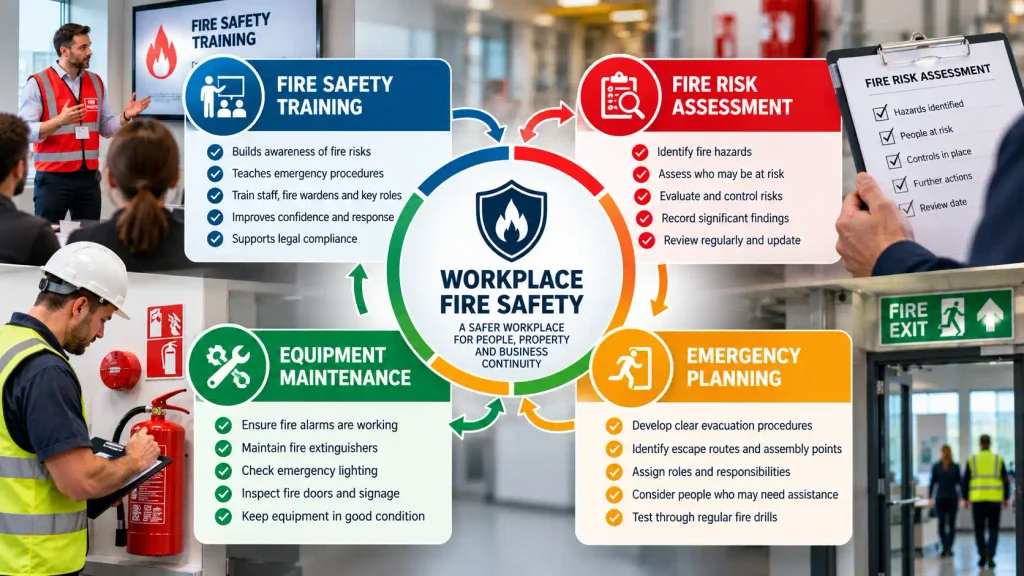
Appropriate training helps staff understand their role in preventing fires, recognising hazards and responding to emergencies. It also supports the practical implementation of the fire safety arrangements established through the risk assessment.
Employers should select training based on the duties and risks involved. General awareness may be appropriate for many employees, while managers, fire marshals, facilities personnel and people involved in risk assessment may need more specialised instruction.
For organisations seeking to strengthen their internal arrangements, relevant fire safety training can help build awareness of hazard identification, emergency procedures, workplace responsibilities and safe working practices.
Training should form part of a wider management system that includes suitable risk assessments, effective equipment, maintenance, communication and review.
Conclusion
UK fire safety laws establish essential responsibilities for protecting employees, customers, visitors and other people who may be affected by fire in workplaces and relevant buildings. Meeting these duties requires more than having an assessment on file: businesses must put suitable controls into practice, maintain equipment, provide appropriate instruction and respond to changing risks.
The most effective starting point is to identify the legislation applicable to the premises, establish who is responsible, review the fire risk assessment and create a clear action plan for any deficiencies. Staff should understand the emergency arrangements, contractors should be managed appropriately, and records should demonstrate how fire safety is maintained.
For businesses operating across England, Wales, Scotland and Northern Ireland, checking the relevant national framework is particularly important. Official guidance should be consulted whenever the legal position or requirements for a specialist building are uncertain.
Official References and Further Reading
- GOV.UK: Fire safety in the workplace — responsibilities
- GOV.UK: Fire safety legislation and guidance for those with legal duties
- Legislation.gov.uk: Regulatory Reform (Fire Safety) Order 2005
- Legislation.gov.uk: Fire Safety Act 2021
- GOV.UK: Fire safety responsibilities under section 156 of the Building Safety Act 2022
- Legislation.gov.uk: Fire Safety (England) Regulations 2022
- GOV.SCOT: Non-domestic fire safety
- Northern Ireland Fire & Rescue Service: Business fire safety
- Health and Safety Executive: Work process fire safety
UK Workplace Compliance Guide
Frequently Asked Questions About UK Fire Safety Laws
Find clear answers about fire safety legislation, risk assessments, employer responsibilities, workplace training and compliance.
What is the main fire safety law in the UK?
The principal legislation differs across the UK. In England and Wales, the Regulatory Reform (Fire Safety) Order 2005 is the main framework for most relevant non-domestic premises. Scotland and Northern Ireland have separate principal legislation and supporting regulations.
Is a fire risk assessment a legal requirement for businesses?
Yes. Applicable fire safety legislation generally requires the relevant dutyholder to assess fire risks in covered premises. The exact requirements and recording obligations depend on the jurisdiction and premises. In England and Wales, the Fire Safety Order establishes the central risk assessment duty.
Who is responsible for fire safety in a workplace?
Responsibility depends on legal status and control of the premises. In England and Wales, an employer may be the responsible person for a workplace under their control. Owners, occupiers, landlords and managing agents may also have duties depending on the circumstances.
How often should a fire risk assessment be reviewed?
There is no single review interval suitable for every workplace. Assessments should be reviewed regularly and whenever there is reason to believe they are no longer valid or significant changes occur. The review schedule should reflect the risks and applicable guidance.
Is fire safety training mandatory for employees?
Applicable legislation imposes duties relating to employee information, instruction and training. Training should be suitable for the workplace and relevant to the risks and responsibilities of the employees concerned.
Do small businesses need to comply with fire safety laws?
Small businesses are not automatically exempt because of their size. If the premises and activities fall within applicable legislation, the business must meet the relevant duties. The precautions required should be proportionate to the risks.
Does a landlord or tenant have responsibility for fire safety?
Responsibility can be shared. A landlord may control common areas or building systems, while a tenant may control the interior of a workplace. The parties should clarify their respective duties, cooperate where required and ensure the overall arrangements work together.
What should be included in a workplace fire risk assessment?
A workplace fire risk assessment should identify fire hazards, people at risk, existing safety measures and additional controls required. It should consider escape routes, fire detection, emergency procedures, staff training and review arrangements. The assessment must reflect the premises and applicable legal requirements.
Are fire doors a legal requirement in commercial buildings?
Fire doors are required where necessary under the applicable building safety arrangements and fire safety requirements. Their location, specification and maintenance depend on the building layout, fire strategy and identified risks. Relevant fire doors should remain in good condition and must not be improperly wedged open.
Who can carry out a fire risk assessment?
The responsible person can carry out the assessment if they have sufficient competence to assess the risks properly. Where specialist knowledge is needed, a competent fire safety professional should be appointed. The responsible person must ensure the assessment is suitable and sufficient.
What records should a business keep for fire safety compliance?
Businesses should maintain relevant records of fire risk assessments, significant findings, fire safety arrangements, staff training, equipment inspections, maintenance and corrective actions, as applicable. In England and Wales, section 156 of the Building Safety Act 2022 strengthened documentation duties for responsible persons.
Do businesses need a written fire evacuation plan?
Businesses should establish emergency procedures appropriate to their premises and risks. A written plan helps communicate evacuation arrangements, staff responsibilities, escape routes and assembly points. Specific legal requirements depend on the applicable legislation and circumstances.
Are fire drills compulsory in UK workplaces?
Fire drills help test evacuation procedures and identify weaknesses. Legal requirements and recommended frequency depend on applicable rules, premises and the risk assessment. Employers should establish appropriate arrangements, record relevant findings and address problems identified during drills.
What is the difference between a fire risk assessment and a fire safety audit?
A fire risk assessment identifies fire hazards, evaluates risks to people and determines necessary precautions. A fire safety audit generally reviews how effectively fire safety arrangements are implemented and maintained. An audit can identify compliance gaps but does not automatically replace a legally required fire risk assessment.
What should employers do if a fire alarm or extinguisher is defective?
Employers and responsible persons should arrange prompt investigation and repair, taking account of the severity of the defect and risks to occupants. Appropriate interim precautions may be necessary until the equipment is restored. Any applicable enforcement notice must also be followed.
Do businesses need fire safety training for temporary workers and contractors?
Temporary workers should receive appropriate fire safety information and instruction for the risks and procedures relevant to their work. Contractors should be informed of site emergency arrangements and relevant hazards. Instruction should reflect their activities and responsibilities.
What is the role of a fire warden or fire marshal?
A fire warden or fire marshal helps implement workplace fire safety procedures. Depending on assigned duties, they may communicate evacuation instructions, direct people towards safe exits, report hazards and support emergency arrangements. Role-specific training should reflect the premises and responsibilities.
Can a business operate if its fire safety arrangements are inadequate?
Whether a business can continue operating depends on the nature and severity of the risks, applicable legal requirements and any action taken by the enforcing authority. Serious deficiencies may lead to restrictions or prohibition notices. Businesses should address significant hazards promptly and obtain competent advice where necessary.
Where can employers find official UK fire safety guidance?
Employers should consult official guidance relevant to their location and premises. Useful resources include:
GOV.UK workplace fire safety guidance
Fire safety legislation and guidance collection