
Suitable and Sufficient Fire Risk Assessment: The Essential Guide
A suitable and sufficient fire risk assessment is the foundation of effective fire safety management in any non-domestic premises. Whether you manage an office, warehouse, retail store, hotel, educational institution, healthcare facility, or industrial workplace, your fire risk assessment should do more than meet legal requirements—it should identify real fire hazards, protect building occupants, and provide practical actions to reduce risk.
Many organisations mistakenly believe that completing a generic fire risk assessment template is enough to demonstrate compliance. In reality, a fire risk assessment must be specific to the building, reflect its current use, identify significant findings, and provide a clear action plan for managing fire risks. An inadequate assessment can leave people vulnerable, expose businesses to enforcement action, and increase the likelihood of fire-related incidents.
This essential guide explains what makes a fire risk assessment suitable and sufficient, why it matters under UK fire safety legislation, who is responsible for ensuring compliance, and how businesses can evaluate the quality of their existing assessments. Whether you are a Responsible Person, employer, landlord, facilities manager, health and safety professional, or aspiring fire risk assessor, this guide will help you understand the principles of a high-quality fire risk assessment and how to maintain long-term fire safety compliance.
What Is a Suitable and Sufficient Fire Risk Assessment?
A suitable and sufficient fire risk assessment is one that accurately identifies fire hazards, evaluates the level of risk, considers everyone who may be affected, and recommends practical control measures based on the specific characteristics of the premises. It should provide enough detail to enable the Responsible Person to make informed decisions and continuously improve fire safety.
Unlike generic or template-based assessments, a suitable and sufficient assessment reflects the actual conditions within the building. It considers factors such as occupancy, building layout, work activities, fire protection systems, vulnerable persons, emergency arrangements, and changes that may affect fire safety.
An effective fire risk assessment should answer key questions, including:
- What fire hazards exist within the premises?
- Who could be affected if a fire occurs?
- Are existing fire safety measures adequate?
- What additional controls are required?
- Which improvements should be prioritised?
- How and when should the assessment be reviewed?
By addressing these questions, organisations can move beyond basic compliance and establish a proactive approach to fire risk management.
Why Does “Suitable and Sufficient” Matter?
The phrase “suitable and sufficient” is more than a legal requirement—it represents the quality standard expected of every fire risk assessment. A poorly prepared assessment may overlook significant hazards, fail to identify people at risk, or recommend inappropriate control measures, leaving an organisation exposed to unnecessary risk.
A suitable and sufficient fire risk assessment helps organisations:
- Identify hazards before they lead to fire incidents.
- Protect employees, visitors, contractors, and members of the public.
- Support compliance with UK fire safety legislation.
- Improve emergency preparedness and evacuation planning.
- Prioritise corrective actions based on risk.
- Reduce operational disruption and financial losses.
- Demonstrate due diligence during inspections or audits.
- Support insurance and business continuity planning.
Ultimately, the quality of a fire risk assessment directly influences the effectiveness of an organisation’s fire safety strategy.
Why Generic Fire Risk Assessments Are Not Enough
Many businesses rely on downloaded templates or copy existing assessments from similar organisations. While templates can provide a useful starting point, they should never replace a site-specific assessment.
Every commercial building presents unique fire risks influenced by factors such as:
- Building age and construction.
- Occupancy levels.
- Internal layout.
- Work activities.
- Storage arrangements.
- Fire protection systems.
- Electrical installations.
- Hazardous materials.
- Vulnerable occupants.
For example, a warehouse storing combustible packaging materials requires different control measures than a healthcare facility caring for patients with limited mobility. Similarly, a hotel with sleeping accommodation has different evacuation challenges compared to a small office building.
A suitable and sufficient assessment recognises these differences and provides recommendations tailored to the specific premises.
UK Fire Safety Responsibilities
Fire safety responsibilities in the UK are primarily based on the principle that those who control premises are responsible for protecting people from fire risks. This includes identifying hazards, implementing suitable fire precautions, and ensuring that fire safety arrangements remain effective over time.
The Responsible Person should ensure that:
- A suitable and sufficient fire risk assessment is completed.
- Fire hazards are identified and managed.
- Appropriate fire protection measures are maintained.
- Emergency procedures are established and communicated.
- Employees receive suitable fire safety training.
- Significant findings are recorded where required.
- The assessment is reviewed whenever necessary.
These responsibilities apply throughout the life of the building and should form part of an organisation’s overall health and safety management system.
Fire Safety Responsibility Matrix
| Responsibility | Purpose |
|---|---|
| Identify fire hazards | Recognise potential sources of ignition and fuel |
| Assess fire risks | Evaluate likelihood and consequences |
| Protect occupants | Implement suitable fire safety measures |
| Maintain fire protection systems | Ensure equipment remains operational |
| Train employees | Improve awareness and emergency response |
| Review assessments | Keep fire risk assessments current and effective |
Who Is the Responsible Person?
The Responsible Person is the individual or organisation with legal responsibility for fire safety within non-domestic premises. Depending on the type of building and business, this may include:
- Business owners
- Employers
- Building owners
- Landlords
- Property managers
- Facilities managers
- Managing agents
- Occupiers of commercial premises
Although specialist fire risk assessors may be appointed to carry out assessments, the overall responsibility for ensuring that a suitable and sufficient fire risk assessment exists remains with the Responsible Person.
This means they should understand:
- The purpose of the assessment.
- The competence of the assessor.
- The findings and recommendations.
- Outstanding corrective actions.
- Review requirements.
Delegating the assessment does not transfer legal responsibility.
Who Can Carry Out a Fire Risk Assessment?
A fire risk assessment should be completed by a competent person with appropriate knowledge, skills, training, and practical experience. Competence is determined by an individual’s ability to identify hazards, evaluate risks, understand fire safety principles, and recommend suitable control measures.
The level of competence required depends on the complexity of the premises.
For smaller, straightforward buildings with simple fire risks, the Responsible Person may be able to carry out the assessment if they have sufficient knowledge and understanding of fire safety requirements.
For larger or more complex premises—such as hospitals, high-rise buildings, hotels, industrial sites, or buildings with vulnerable occupants—it is generally advisable to appoint a qualified and experienced fire risk assessor.
A competent assessor should be able to:
- Understand UK fire safety legislation.
- Identify fire hazards and vulnerable occupants.
- Evaluate active and passive fire protection measures.
- Assess means of escape and emergency arrangements.
- Recommend practical, proportionate improvements.
- Produce clear, evidence-based reports.
- Explain findings to the Responsible Person.
Choosing an experienced assessor helps ensure that recommendations are realistic, prioritised, and tailored to the specific building rather than relying on generic guidance.
What should a Suitable and Sufficient Fire Risk Assessment Cover?
Although every building is different, a comprehensive fire risk assessment should address all significant factors that could influence fire safety.
Key assessment areas include:
- Building construction and layout.
- Occupancy and building use.
- Fire hazards and ignition sources.
- Combustible materials and fuel sources.
- People at risk, including vulnerable occupants.
- Means of escape.
- Fire detection and alarm systems.
- Emergency lighting.
- Fire doors and compartmentation.
- Firefighting equipment.
- Staff training and fire drills.
- Fire safety management procedures.
- Maintenance records and documentation.
- Recommendations for improvement.
- Review arrangements.
Together, these elements provide a complete picture of the building’s fire safety performance and help the Responsible Person make informed decisions.
Fire Risk Assessment Decision Flowchart
The following workflow illustrates the logical process used to determine whether a fire risk assessment is suitable and sufficient.
Start
↓
Identify the type and use of the building
↓
Identify fire hazards
↓
Identify people at risk
↓
Assess existing fire safety measures
↓
Are the control measures adequate?
↓
Yes
↓
Record findings
↓
Develop action plan
↓
Schedule review
↓
Suitable and Sufficient Fire Risk Assessment
OR
↓
No
↓
Identify deficiencies
↓
Implement improvements
↓
Review assessment
↓
Update documentation
↓
Reassess until suitable and sufficient
Key Indicators of a High-Quality Fire Risk Assessment
A well-prepared fire risk assessment should demonstrate that it has been carefully considered, based on evidence, and tailored to the building rather than copied from a generic template.
Some early indicators of quality include:
- Accurate description of the premises.
- Building-specific observations.
- Clear identification of significant fire hazards.
- Consideration of all occupants, including vulnerable persons.
- Practical and prioritised recommendations.
- Realistic timescales for improvements.
- Supporting photographs or evidence where appropriate.
- A clear review schedule.
- Logical structure and easy-to-understand language.
These characteristics help ensure that the assessment becomes a practical management tool rather than simply a document produced to satisfy compliance requirements.
Characteristics of a Suitable and Sufficient Fire Risk Assessment
A suitable and sufficient fire risk assessment is more than a completed document—it is a practical risk management tool that accurately reflects the fire safety conditions within a building and provides a clear roadmap for improvement. It should be tailored to the premises, supported by evidence, and capable of helping the Responsible Person make informed decisions about protecting people and property.
A high-quality assessment should demonstrate the following characteristics:
Building-Specific Assessment
Every building has unique fire risks based on its construction, occupancy, activities, and fire protection systems. A suitable assessment should be prepared specifically for the premises rather than copied from another building or generated using a generic template.
The assessment should include:
- Building description
- Occupancy profile
- Business activities
- Floor layouts
- Fire safety systems
- Significant hazards
- Existing control measures
- Building-specific recommendations
Comprehensive Hazard Identification
The assessment should identify all significant fire hazards rather than focusing only on obvious risks.
Common hazards include:
- Faulty electrical installations
- Portable heaters
- Hot work activities
- Commercial cooking equipment
- Smoking materials
- Flammable liquids
- Lithium-ion battery charging
- Combustible waste
- Poor housekeeping
Each hazard should be evaluated according to its likelihood of causing a fire and its potential consequences.
Consideration of Everyone at Risk
A suitable assessment identifies every group of people who could be affected during a fire.
This includes:
- Employees
- Visitors
- Customers
- Contractors
- Agency workers
- Lone workers
- Disabled persons
- Elderly occupants
- Young persons
- People unfamiliar with the premises
Buildings containing vulnerable occupants require additional evacuation planning and fire safety measures.
Practical and Prioritised Recommendations
Recommendations should be realistic, proportionate, and prioritised according to risk.
Instead of writing:
“Improve fire safety.”
A suitable assessment should specify:
- Install emergency lighting in the rear escape corridor.
- Replace damaged fire door seals within 14 days.
- Conduct fire warden refresher training this month.
- Remove combustible storage from the electrical room immediately.
Clear actions enable organisations to allocate responsibilities and monitor progress effectively.
Evidence-Based Findings
Recommendations should be based on actual inspection findings rather than assumptions.
Supporting evidence may include:
- Inspection photographs
- Maintenance records
- Fire alarm test results
- Fire door inspection reports
- Emergency lighting records
- Fire drill observations
- Occupancy information
Evidence improves the credibility of the assessment and helps justify corrective actions.
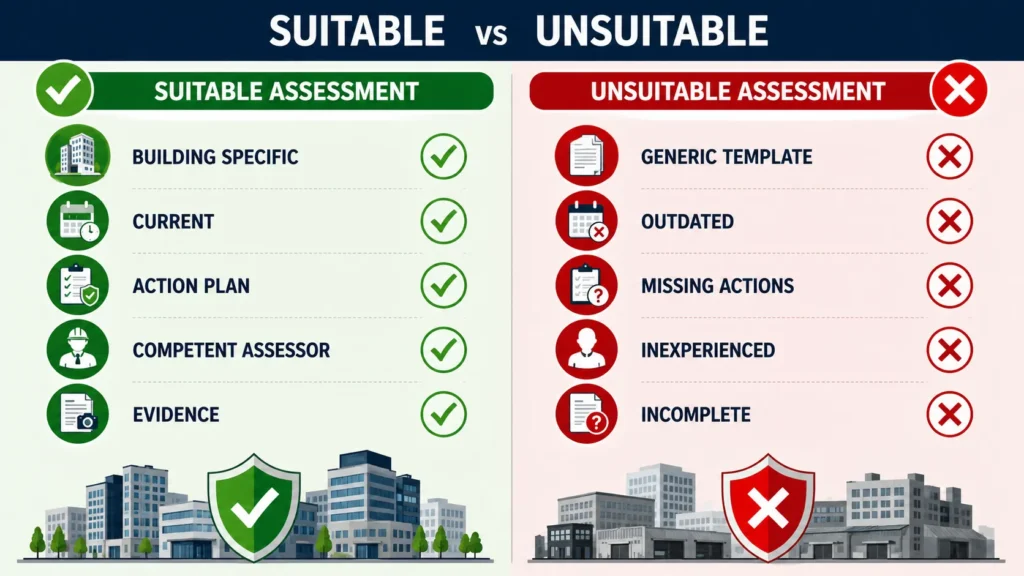
Suitable vs Unsuitable Fire Risk Assessment
One of the easiest ways to understand assessment quality is by comparing the characteristics of suitable and unsuitable fire risk assessments.
| Suitable and Sufficient | Unsuitable or Inadequate |
|---|---|
| Tailored to the building | Generic template copied from another premises |
| Current information | Outdated information |
| Building-specific hazards identified | Important hazards overlooked |
| People at risk clearly identified | Vulnerable occupants ignored |
| Practical action plan included | Vague recommendations |
| Risks prioritised | No prioritisation |
| Supported by evidence | Based on assumptions |
| Review date included | No review schedule |
| Competent assessor | Insufficient knowledge or experience |
| Easy to understand | Confusing or incomplete report |
This comparison highlights why simply completing a fire risk assessment is not enough. The quality of the assessment determines whether it provides meaningful protection and supports compliance.
The Five-Step Process for a Suitable and Sufficient Fire Risk Assessment
Although every building is different, competent assessors generally follow a structured methodology to ensure consistency and completeness.
Step 1: Identify Fire Hazards
Inspect the premises to identify anything capable of starting or spreading a fire.
Examples include:
- Electrical equipment
- Heating appliances
- Cooking equipment
- Flammable liquids
- Waste accumulation
- Gas installations
- Combustible storage
- Hot work activities
Step 2: Identify People at Risk
Determine who may be affected if a fire occurs.
Consider:
- Employees
- Visitors
- Contractors
- Customers
- Disabled occupants
- Lone workers
- Occupants sleeping on site
- Persons unfamiliar with escape routes
Step 3: Evaluate Risks and Existing Controls
Assess whether current fire safety measures adequately control identified risks.
Evaluate:
- Fire alarms
- Smoke detection
- Emergency lighting
- Escape routes
- Fire doors
- Fire extinguishers
- Staff training
- Fire safety management procedures
Where deficiencies exist, determine additional controls required.
Step 4: Record Significant Findings
A professional assessment should document:
- Identified hazards
- People at risk
- Existing precautions
- Risk evaluation
- Recommended improvements
- Priority level
- Responsible persons
- Target completion dates
Clear documentation supports accountability and future reviews.
Step 5: Review and Update
Fire risk assessments should evolve as the building changes.
Reviews should occur after:
- Renovations
- Building extensions
- Operational changes
- Increased occupancy
- Fire incidents
- Installation of new equipment
- Significant legislative updates
- Completion of major corrective actions
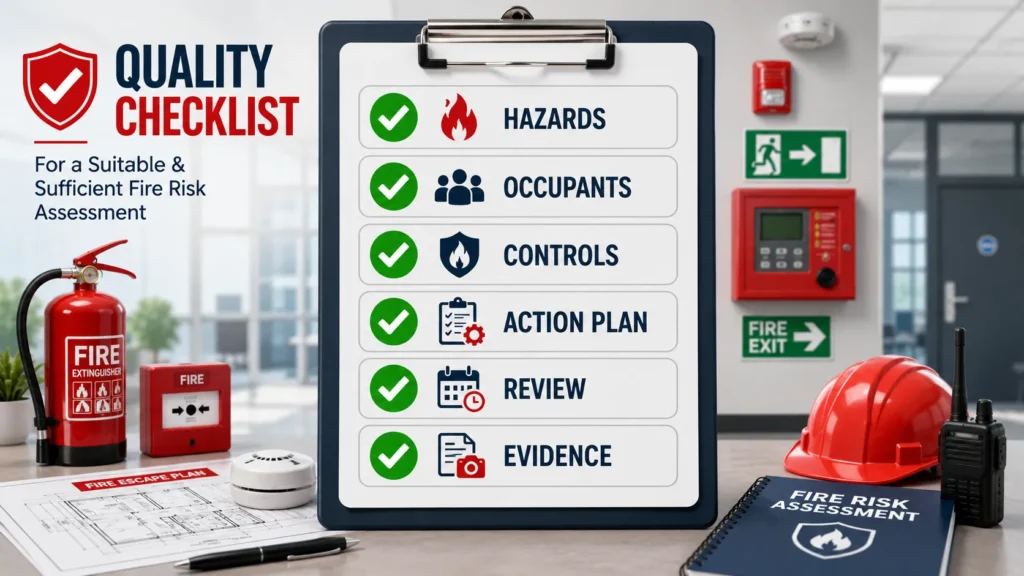
Fire Risk Assessment Quality Checklist
The following checklist can be used to evaluate whether an existing assessment is suitable and sufficient.
| Quality Indicator | Yes | No |
|---|---|---|
| Building details are accurate | □ | □ |
| Building use clearly described | □ | □ |
| Fire hazards identified | □ | □ |
| People at risk identified | □ | □ |
| Vulnerable occupants considered | □ | □ |
| Fire protection systems assessed | □ | □ |
| Means of escape evaluated | □ | □ |
| Risk levels prioritised | □ | □ |
| Action plan included | □ | □ |
| Responsible persons assigned | □ | □ |
| Completion dates included | □ | □ |
| Review date specified | □ | □ |
If multiple items cannot be answered “Yes,” the assessment may require updating to ensure it remains suitable and sufficient.
Common Mistakes That Make a Fire Risk Assessment Unsuitable
Many organisations believe they have an adequate fire risk assessment when, in reality, it contains significant weaknesses. These shortcomings often become apparent during audits, inspections, or following a fire incident.
Some of the most common mistakes include:
Using Generic Templates
Copying an assessment from another building without evaluating the specific premises is one of the most frequent causes of inadequate assessments.
Every building has unique:
- Occupancy
- Activities
- Fire hazards
- Escape arrangements
- Fire protection systems
Generic templates should only be used as a starting point.
Ignoring Building Changes
Buildings constantly evolve.
Common changes include:
- Office refurbishments
- Additional storage
- New machinery
- Increased staffing
- Layout alterations
- Tenant changes
Failure to review the assessment after these changes can leave significant risks unmanaged.
Failing to Identify Vulnerable Occupants
An assessment should consider anyone who may require additional assistance during evacuation.
Examples include:
- Wheelchair users
- Elderly persons
- Patients
- Children
- Pregnant workers
- Individuals with sensory impairments
Ignoring these groups may result in ineffective emergency arrangements.
Poor Risk Prioritisation
Listing hazards without identifying which require immediate attention reduces the value of the assessment.
A suitable assessment prioritises corrective actions according to:
- Likelihood
- Consequence
- Number of people affected
- Existing control measures
This enables organisations to allocate resources effectively.
Incomplete Documentation
Some assessments identify hazards but fail to include:
- Action plans
- Responsible persons
- Completion dates
- Review schedules
Without these elements, recommendations are less likely to be implemented.
Overlooking Passive Fire Protection
Many assessments focus heavily on alarms and extinguishers while paying insufficient attention to passive fire protection.
Inspectors should also evaluate:
- Fire doors
- Fire compartmentation
- Fire stopping
- Structural fire resistance
- Smoke seals
- Service penetrations
Passive fire protection plays a critical role in limiting fire spread.
Fire Risk Assessment Quality Review Flowchart
The following process can help determine whether an existing fire risk assessment remains suitable and sufficient.
Existing Fire Risk Assessment
↓
Review building information
↓
Have building layouts or activities changed?
↓
Yes
↓
Carry out a new inspection
↓
Update hazards and people at risk
↓
Review fire safety measures
↓
Revise action plan
↓
Issue updated assessment
↓
Schedule next review
OR
↓
No
↓
Review maintenance records
↓
Review fire incidents and near misses
↓
Confirm existing controls remain effective
↓
Continue monitoring
↓
Schedule routine review
Signs Your Fire Risk Assessment Needs Updating
Even if an assessment was completed recently, it may no longer be suitable if warning signs begin to appear.
Consider reviewing your assessment if:
- Employees report new fire hazards.
- Fire doors become damaged.
- Escape routes are altered.
- Fire alarm systems are upgraded.
- Emergency lighting is modified.
- New equipment is installed.
- Storage arrangements change.
- Occupancy increases significantly.
- Enforcement recommendations are received.
- Maintenance records reveal recurring defects.
Regular reviews help ensure that the assessment continues to reflect the actual conditions within the building rather than historical information.
How to Review an Existing Fire Risk Assessment
A fire risk assessment should be treated as a living document rather than a one-time compliance exercise. As buildings, work activities, and occupancy change, new fire hazards can emerge while existing control measures may become less effective. Regular reviews help ensure that the assessment continues to provide an accurate reflection of the premises and supports ongoing fire safety management.
Reviewing an existing assessment involves more than checking the review date. The Responsible Person should confirm that all findings remain relevant, recommended actions have been completed, and fire safety arrangements continue to protect occupants effectively.
When reviewing an assessment, consider the following questions:
- Has the building layout changed?
- Have new work processes or equipment been introduced?
- Has the number of occupants increased?
- Are vulnerable persons adequately considered?
- Have fire protection systems been upgraded or modified?
- Have there been any fire incidents or near misses?
- Have outstanding corrective actions been completed?
- Do current evacuation procedures remain effective?
- Is staff fire safety training up to date?
- Does the assessment still reflect current legislation and best practice?
If the answer to any of these questions is No, the assessment should be updated without unnecessary delay.
When Should a Fire Risk Assessment Be Updated?
Although periodic reviews are essential, certain events require an immediate reassessment because they can significantly alter the fire risk profile of a building.
Common review triggers include:
- Building extensions or renovations
- Changes to internal layouts
- Installation of new machinery or equipment
- Introduction of hazardous substances
- Significant changes in occupancy levels
- New business activities or work processes
- Fire incidents or dangerous occurrences
- Installation of new fire protection systems
- Changes to emergency evacuation procedures
- Recommendations from audits or Fire and Rescue Service inspections
Updating the assessment after these changes helps ensure that control measures remain appropriate and proportionate.
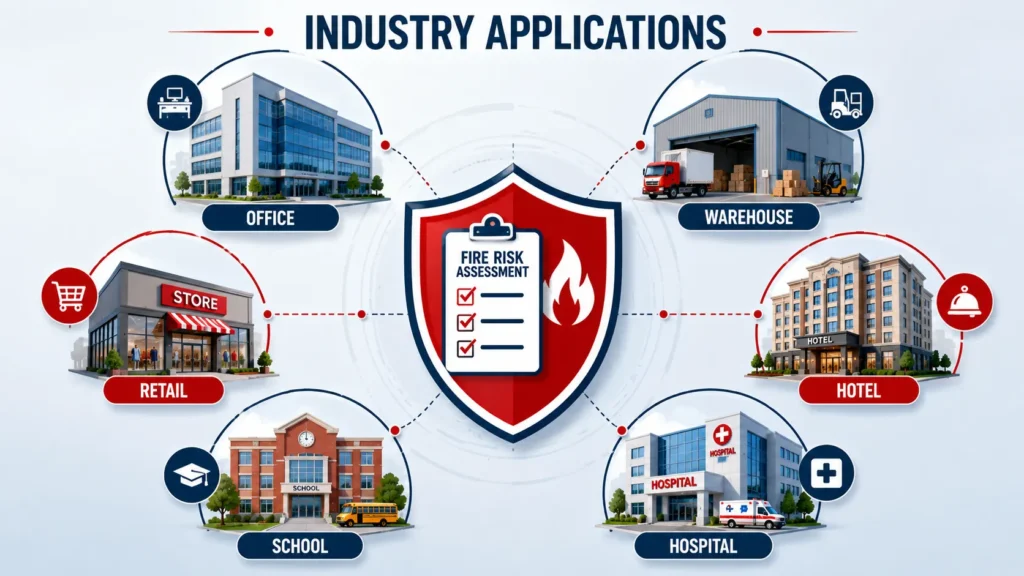
Industry-Specific Examples of Suitable and Sufficient Fire Risk Assessments
Although the principles of fire risk assessment remain consistent, the level of detail and recommended control measures vary depending on the type of premises.
Office Buildings
A suitable assessment for an office should focus on:
- Electrical installations and office equipment
- Escape routes and emergency exits
- Server and IT rooms
- Kitchenettes and staff welfare areas
- Fire alarm coverage
- Fire doors
- Employee evacuation procedures
- Visitor management
Warehouses
Warehouse assessments require greater emphasis on:
- High-rack storage systems
- Combustible packaging materials
- Forklift operations
- Battery charging stations
- Flammable liquid storage
- Smoke ventilation systems
- Access for emergency services
- Automatic fire suppression systems
Retail Premises
Retail environments should include consideration of:
- Customer occupancy
- Display arrangements
- Seasonal decorations
- Stock storage
- Cash office security
- Fire detection systems
- Public evacuation procedures
- Staff fire safety training
Hotels and Hospitality Businesses
A suitable assessment for hospitality premises should evaluate:
- Sleeping accommodation
- Commercial kitchens
- Guest evacuation arrangements
- Fire compartmentation
- Emergency lighting
- Fire alarm zoning
- Fire safety signage
- Staff emergency response procedures
Healthcare Facilities
Healthcare buildings require additional consideration because many occupants may require assistance during evacuation.
Key areas include:
- Progressive horizontal evacuation
- Refuge areas
- Medical gas storage
- Oxygen cylinders
- Patient dependency levels
- Staff competency
- Fire compartmentation
- Emergency communication systems
Educational Institutions
Schools, colleges, universities, and training centres should consider:
- Classroom occupancy
- Laboratories
- Libraries
- Assembly halls
- Science equipment
- Electrical safety
- Student evacuation procedures
- Fire drill programmes
Best Practices for Maintaining a Suitable and Sufficient Fire Risk Assessment
Maintaining assessment quality requires continuous attention rather than waiting until the next formal review.
Organisations that consistently achieve high standards of fire safety usually adopt the following best practices.
Develop a Fire Safety Culture
Fire safety should be integrated into everyday operations rather than treated solely as a legal obligation.
Encourage employees to:
- Report hazards immediately.
- Keep escape routes clear.
- Follow safe housekeeping practices.
- Participate in fire drills.
- Report damaged fire protection equipment.
- Follow emergency procedures without delay.
Assign Clear Responsibilities
Every recommendation within the fire risk assessment should have an assigned owner.
This may include:
- Responsible Person
- Facilities Manager
- Health and Safety Manager
- Fire Warden
- Maintenance Team
- External Contractors
Assigning responsibility improves accountability and helps ensure corrective actions are completed on time.
Monitor Corrective Actions
Recommendations should not remain unresolved for long periods.
A simple action tracker can include:
| Action Required | Priority | Responsible Person | Status |
|---|---|---|---|
| Replace damaged fire door seals | High | Facilities Manager | In Progress |
| Update evacuation plan | Medium | Health & Safety Manager | Completed |
| Service emergency lighting | High | Approved Contractor | Scheduled |
| Conduct fire warden training | Medium | Training Coordinator | Completed |
Tracking actions demonstrates continual improvement and provides evidence during inspections or audits.
Maintain Accurate Fire Safety Records
Good documentation supports both compliance and effective fire safety management.
Records should include:
- Fire risk assessments
- Fire alarm test records
- Emergency lighting tests
- Fire extinguisher servicing
- Fire door inspections
- Fire drills
- Staff training records
- Maintenance certificates
- Corrective action logs
- Contractor permits (where applicable)
Maintaining organised records enables organisations to demonstrate due diligence and monitor long-term performance.
Continuous Improvement Flowchart
A suitable and sufficient fire risk assessment should form part of a continuous improvement cycle rather than a one-off project.
Conduct Fire Risk Assessment
↓
Identify Hazards
↓
Evaluate Existing Controls
↓
Prioritise Risks
↓
Implement Corrective Actions
↓
Train Employees
↓
Inspect and Maintain Fire Safety Systems
↓
Review Documentation
↓
Monitor Performance
↓
Update Fire Risk Assessment
↓
Repeat Continuous Improvement Cycle
Explore Courses on Inspire College
Enhance your Fire Safety knowledge and Risk Assessment skills by exploring Inspire College’s accredited fire safety and risk assessment courses, designed to help learners build competence, achieve compliance, and advance their careers.
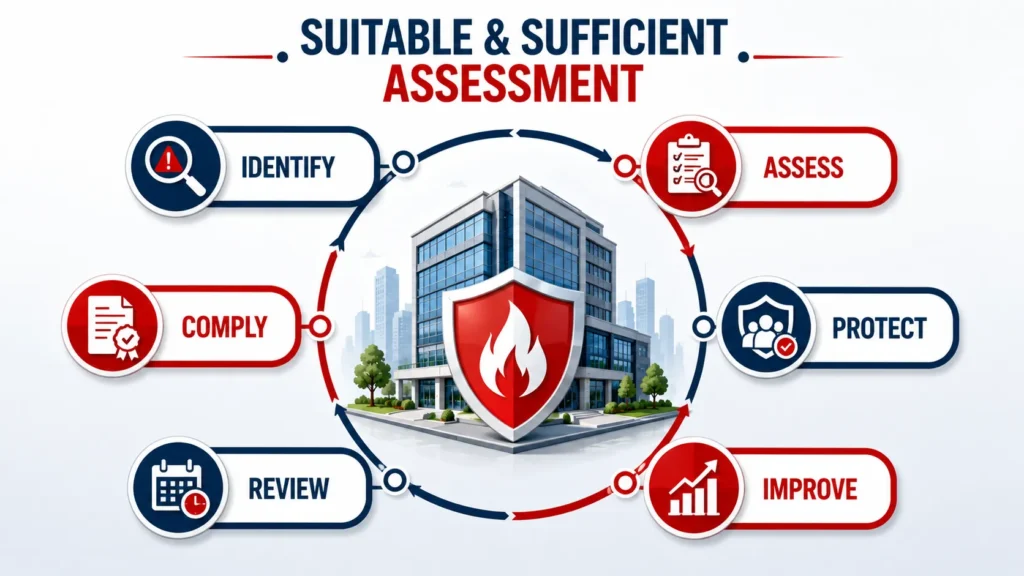
Conclusion
A suitable and sufficient fire risk assessment is much more than a legal requirement—it is the foundation of an effective fire safety management system. By identifying building-specific hazards, evaluating risks, protecting occupants, and implementing practical control measures, organisations can significantly reduce the likelihood and impact of fire incidents.
The most effective assessments are tailored to the premises, completed by competent individuals, supported by evidence, and reviewed regularly to reflect changes in the building or its operations. Generic templates, outdated information, and incomplete action plans can undermine compliance and leave businesses exposed to unnecessary risks.
Whether you manage an office, warehouse, retail store, hotel, healthcare facility, educational institution, or industrial premises, investing in a high-quality fire risk assessment helps protect lives, maintain business continuity, and demonstrate a proactive commitment to fire safety.
For organisations seeking to strengthen their expertise, professional fire safety training and recognised qualifications can provide the knowledge and practical skills needed to carry out, review, and manage fire risk assessments with confidence.