
How to Report a Fire Hazard at Work: A Step-by-Step Procedure
Workplace fire hazards can arise in offices, warehouses, factories, commercial kitchens, construction sites and educational facilities. Common examples include blocked fire exits, damaged electrical cables, faulty fire alarms and the unsafe storage of combustible materials. If these hazards are not addressed promptly, they can increase fire risks, compromise emergency evacuation and endanger employees, visitors and property.
Knowing how to report a fire hazard at work is an essential part of workplace fire safety and fire prevention. A clear reporting procedure helps employees identify unsafe conditions, notify the appropriate person, document potential risks and ensure corrective action is taken. Reporting a hazard is not simply about completing a form; it is about communicating a safety concern before it develops into a more serious incident.
In the UK, the responsible person must ensure that appropriate fire safety precautions, emergency arrangements and relevant staff information are in place. Employees also contribute to effective fire prevention by recognising hazards, following workplace reporting procedures and raising concerns promptly.
This guide explains how to report a fire hazard at work, including the essential reporting steps, the information to include in a hazard report, who to notify, how to follow up on corrective actions and how to confirm that a reported hazard has been addressed. Whether you are an employee, supervisor or aspiring fire safety professional, understanding this procedure can help you support a safer workplace and strengthen your organisation’s fire safety practices.
What Is a Fire Hazard in the Workplace?
A workplace fire hazard is a condition, substance, activity or piece of equipment that could contribute to a fire starting or spreading, or make it more difficult for people to escape safely.
Fire generally requires three elements: a source of ignition, fuel and oxygen. Ignition sources may include electrical equipment, heaters and hot work; fuel may include paper, packaging, combustible liquids and other materials. Oxygen is normally available in the surrounding air.
Common workplace fire hazards include:
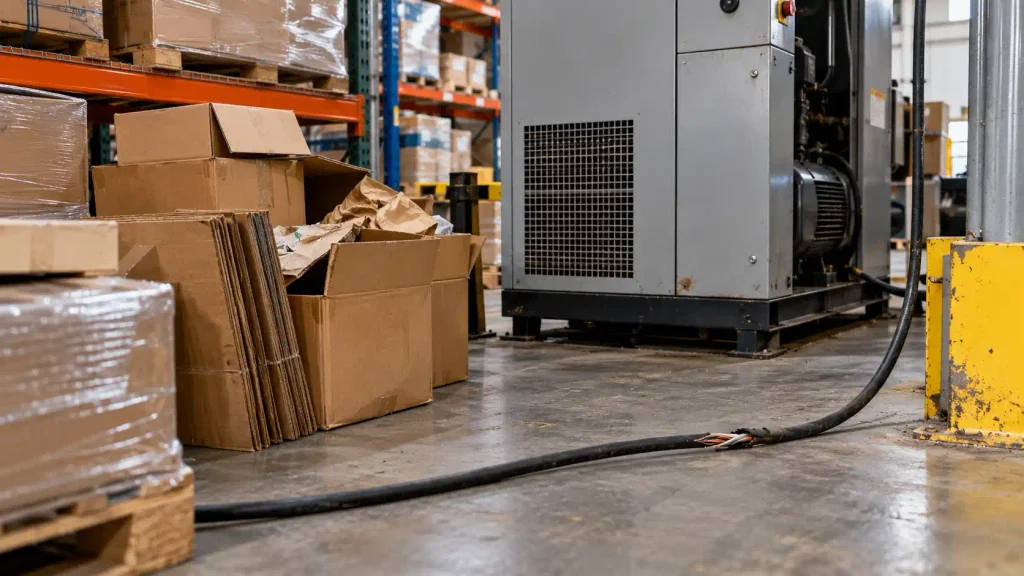
- Damaged plugs, cables or electrical equipment.
- Overloaded electrical sockets or overheating machinery.
- Flammable liquids stored incorrectly.
- Cardboard, packaging or rubbish accumulated near ignition sources.
- Blocked corridors, fire exits or escape routes.
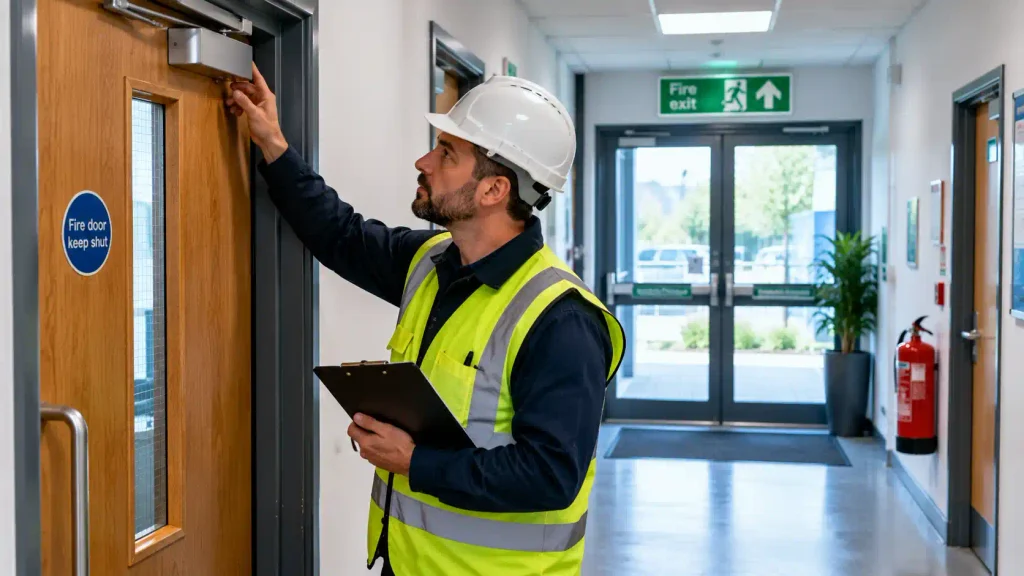
- Fire doors that do not close correctly.
- Damaged fire extinguishers or faults in alarm systems.
- Unsafe smoking practices or poorly controlled hot-work activities.
Recognising these hazards is the first step towards preventing a potentially serious incident.
For a more detailed explanation of common risks, read Inspire College UK’s guide to identifying fire hazards.
Why reporting fire hazards matters
Early reporting allows the appropriate person to assess the risk and arrange suitable controls before an incident occurs. It also helps organisations identify recurring problems, such as inadequate equipment maintenance, poor housekeeping or gaps in employee training.
A report can provide the evidence needed to review existing precautions, update a fire risk assessment and assign responsibility for corrective action.
However, reporting alone does not make a workplace safe. The organisation must also assess the reported concern, take appropriate action and verify that the hazard has been controlled.
How to Report a Fire Hazard at Work? Six Essential Steps
Employees should follow their organisation’s established fire safety and hazard reporting arrangements. The precise process may vary according to workplace size, industry and the seriousness of the hazard.
How to Report a Fire Hazard at Work
Follow these six essential steps to identify a workplace fire hazard, report it correctly and help ensure that appropriate corrective action is completed.
Identify the Fire Hazard
Recognise the unsafe condition without putting yourself or others at risk.
Determine the Urgency
Decide whether immediate action is required, including raising the alarm or evacuating.
Notify the Appropriate Person
Contact your supervisor, designated fire safety contact or another authorised person.
Document the Hazard
Record the location, description, time, potential consequences and immediate actions taken.
Support Corrective Action
Follow authorised instructions and keep clear of unsafe areas or equipment.
Follow Up and Confirm Closure
Check that the issue has been addressed, recorded and escalated if it remains unresolved.
This process creates a clear path from identifying a hazard to confirming that appropriate action has been taken.
Step 1: Identify the Fire Hazard and Its Location
The reporting process begins when an employee notices a condition that could cause a fire, increase its likelihood or prevent safe evacuation.
Employees should remain alert during normal work activities, routine inspections, cleaning, equipment use and deliveries. Fire hazards may develop gradually, so something that was safe during an earlier inspection may no longer be safe.
What should you look for?
Pay attention to electrical equipment, heating appliances, combustible materials, storage areas, fire doors, escape routes and fire protection equipment.
For example, an employee might notice a damaged cable beneath a workstation. A warehouse worker might discover that cardboard packaging has accumulated beside a heater. A cleaner might find that equipment has been left in front of a marked fire exit.
Each situation should be reported through the appropriate procedure.
Describe the hazard clearly
Avoid vague statements such as “the storeroom is unsafe” or “there is an electrical problem”.
Instead, describe what you observed and where it happened.
A useful description might be:
“A damaged electrical cable was observed beside the packing workstation on the ground floor at approximately 10:15 am. The cable’s outer insulation appeared split, and the equipment was still connected to the power supply.”
This description gives the recipient a location, time and observable condition without making unsupported assumptions about the cause.
Do not touch damaged electrical equipment, dismantle it or attempt repairs unless you are authorised and competent to do so. Keep a safe distance and report the condition promptly.
Step 2: Assess the Urgency Without Taking Unnecessary Risks
Not every fire hazard presents the same level of immediate danger. A damaged cable, a blocked escape route and a minor housekeeping concern require appropriate attention, but their circumstances and urgency may differ.
Employees should communicate what they can observe rather than attempting a technical risk assessment beyond their competence.
What if there is an immediate danger?
If you discover flames, smoke, signs of an active fire or another situation requiring an emergency response, follow the workplace emergency procedure immediately.
Raise the alarm, evacuate as instructed, move to a safe location and contact the fire and rescue service using the applicable emergency arrangements. In the UK, call 999 in an emergency. Do not delay evacuation to complete a hazard report or take photographs.
Never put yourself at risk by investigating smoke, approaching burning materials or attempting to extinguish a fire unless you are specifically trained, authorised and the circumstances permit it under the emergency procedure.
How should non-emergency hazards be prioritised?
A hazard that is not currently causing a fire can still require urgent action. For example, a blocked escape route may compromise people’s ability to leave quickly if an alarm sounds.
The following table illustrates a practical approach to urgency. It is guidance for reporting and prioritisation, not a replacement for a competent person’s risk assessment.
| Example | Reporting priority | Appropriate response |
|---|---|---|
| Active fire or dangerous smoke | Emergency | Raise the alarm, evacuate and contact emergency services as required. |
| Suspected live electrical fault or severe overheating | Urgent | Keep clear, warn others where safe and contact the responsible person immediately. |
| Blocked fire exit or defective fire door | Prompt attention | Report immediately and escalate if safe evacuation may be compromised. |
| Faulty alarm or damaged firefighting equipment | Prompt attention | Notify the designated fire safety contact so suitable action and alternative precautions can be assessed. |
| Combustible waste accumulating near equipment | Timely corrective action | Report the condition and arrange safe removal through authorised procedures. |
The urgency of each issue depends on the actual conditions, the people exposed and the effectiveness of existing precautions. Where the risk is uncertain, seek advice from the designated safety contact rather than assuming the problem can wait.
Step 3: Report the Hazard to the Correct Person
Once you have identified the hazard and established that you can communicate safely, notify the appropriate person using the workplace’s reporting arrangements.
Depending on the organisation, this may be your line manager, supervisor, fire warden, health and safety officer, facilities manager or another designated contact.
Choose the appropriate reporting method
Workplaces may use verbal reports, telephone calls, email, digital reporting platforms, hazard report forms or internal safety systems.
For an urgent hazard, use the fastest appropriate communication method. A written form can then provide a record of the concern. For less urgent hazards, follow the established reporting process and make sure the report reaches someone with the authority to act.
If you work for a contractor or in a shared building, you may need to notify both your own supervisor and the person responsible for the relevant premises or equipment.
What if your supervisor is unavailable?
Do not assume that the hazard can wait until the next shift or the next scheduled meeting.
Use the alternative contact identified in the workplace procedure. This may be a duty manager, safety officer, facilities team or designated escalation contact.
If the issue remains unresolved, escalate it through the organisation’s established arrangements. Where there is an immediate danger, follow emergency procedures instead of waiting for the normal reporting chain.
Important: Reporting a fire hazard is a safety action, not an exercise in assigning blame. Focus on the unsafe condition, its potential consequences and the action needed to control it.
Step 4: Record the Hazard Accurately
A verbal warning can help people respond quickly, but written documentation provides a record that the hazard was identified, reported and considered for corrective action.
The exact reporting form will depend on the organisation. However, a useful report should provide enough information for the person receiving it to understand the problem, assess its significance and arrange the next steps.
What information should a fire hazard report include?
| Information | What to record | Example |
|---|---|---|
| Date and time | When the hazard was observed | 27 October, 10:15 am |
| Exact location | Building, floor, room or equipment reference | Ground-floor packing area |
| Hazard description | The observable unsafe condition | Split insulation on an electrical cable |
| Potential consequences | How the condition could cause harm | Electrical fault, overheating or ignition |
| People potentially affected | Employees, visitors, contractors or others | Staff using the packing workstation |
| Immediate actions | Safe actions already taken | Reported to the supervisor; area kept clear |
| Evidence | Relevant photographs or documents, if safe to obtain | Photograph of the cable from a safe distance |
| Person notified | Who received the report and when | Shift supervisor, 10:20 am |
| Required follow-up | Actions requested or agreed | Equipment inspection by an authorised person |
| Status | Whether the issue remains open or has been resolved | Awaiting inspection |
The information should be factual and relevant. Employees should distinguish what they observed from what they believe might have caused it. They should not invent technical conclusions or claim that a hazard has been corrected without confirmation.
Should you take photographs?
Photographs can help explain a hazard, particularly when its location or condition is difficult to describe. However, obtaining evidence must never delay an emergency response or expose anyone to danger.
Follow workplace rules about photography, privacy and recording equipment. Do not enter restricted areas, touch unsafe equipment or approach smoke or flames to obtain a better image.
Example of a completed fire hazard report
Consider an employee who discovers that stock has been placed in front of a fire exit in a warehouse.
Sample Workplace Hazard Report
Workplace Fire Hazard Report
Fire exit obstructed by stored cardboard boxes.
Warehouse, rear loading area, Exit 3.
27 October, 9:40 am.
The obstruction could delay evacuation and restrict access to the emergency exit.
The supervisor was notified promptly. The employee did not attempt to move heavy or unstable boxes without authorisation.
Warehouse supervisor.
Arrange safe removal of the obstruction, check that the exit is accessible and identify why storage was allowed in the escape route.
Confirm that the route is clear and record the corrective action.
Educational example only. The report remains open until the corrective action has been completed and appropriately verified.
This example demonstrates how to write a clear report without exaggerating the risk or assigning blame.

Step 5: Support Corrective Action and Risk Control
After receiving a report, the appropriate person should assess the hazard and arrange suitable corrective action. The response must match the level of risk, the circumstances and the person’s authority.
Employees should follow authorised instructions, but they should not take on repairs or technical work for which they are not trained.
What happens after a hazard is reported?
The responsible manager or competent safety professional may need to:
- Review the report and establish whether additional information is required.
- Assess the seriousness of the hazard and the people who could be affected.
- Introduce suitable interim precautions where necessary.
- Arrange repairs, removal of combustible materials or other corrective measures.
- Record the action taken and assign responsibility for outstanding work.
- Check that the control measures are effective and review whether the fire risk assessment needs updating.
The UK government’s guidance identifies fire risk assessment, suitable fire precautions, emergency planning and staff training as important responsibilities of the responsible person.
Correct the hazard at its source
Where reasonably practicable, eliminating the hazard is generally preferable to relying solely on warnings or individual behaviour.
For example, a defective electrical appliance may need to be taken out of use and repaired or replaced by an authorised person. Recurring combustible waste may require a better collection schedule or a designated storage arrangement.
Similarly, a blocked escape route may require the obstruction to be removed and storage practices to be changed so that the problem does not return.
The following table illustrates how corrective action can address both the immediate problem and its underlying cause.
| Reported hazard | Possible immediate control | Longer-term preventive action |
|---|---|---|
| Defective electrical equipment | Keep people clear and arrange authorised isolation where appropriate | Improve inspection and maintenance arrangements |
| Blocked fire exit | Arrange safe clearance and restore access | Review storage rules and routine escape-route checks |
| Accumulated combustible waste | Arrange safe removal | Improve waste collection frequency and housekeeping |
| Fire door not closing correctly | Report immediately and obtain competent assessment of interim precautions | Arrange repair and include the door in maintenance checks |
| Faulty fire alarm | Notify the designated contact promptly | Arrange competent inspection, repair and appropriate testing |
These are examples rather than universal instructions. The correct action depends on the hazard and the premises. Interim precautions should be determined by an appropriate responsible or competent person.
What if the hazard cannot be fixed immediately?
Some problems require specialist contractors, replacement parts or a more detailed investigation. In such cases, the organisation should not simply mark the report as complete because a repair has been requested.
The risk should be assessed, suitable interim controls established where necessary, and responsibility for the outstanding work assigned. The report should remain open until the required actions have been completed and their effectiveness checked.
Where a serious concern remains unresolved, employees should use the workplace’s escalation process and continue to follow any relevant safety instructions.
Step 6: Follow Up and Confirm That the Hazard Has Been Addressed
Following up is an essential part of the report fire hazard at work procedure. A report may be received and acknowledged without the underlying condition being corrected.
Employees should use the reporting system to check the status of the concern, particularly when the hazard could affect escape routes, fire protection equipment or electrical safety.
What does effective follow-up involve?
First, confirm that the report has reached the appropriate person. Next, check whether corrective action has been assigned and whether any temporary precautions remain necessary.
Once the action is reported as complete, the responsible person should verify that the hazard has been controlled. For example, confirmation that boxes have been moved should be accompanied by a check that the escape route is actually clear and remains accessible.
If the same problem occurs repeatedly, the organisation should consider whether a deeper issue exists, such as inadequate supervision, unclear responsibilities, insufficient maintenance or poor staff awareness.
This approach turns individual reports into opportunities for continuous improvement.
Fire hazard reporting flowchart
The following flowchart illustrates the reporting and escalation process from discovery to closure.
Workplace Fire Hazard Reporting Procedure
Follow these steps to report a fire hazard, arrange corrective action and confirm that the risk has been controlled.
Recognise the unsafe condition without putting yourself at risk.
YES — Emergency Response
NO — Report the Hazard
NO — Escalate
YES — Close the Report
Important: If a fire or immediate danger is present, raise the alarm and evacuate as required. Never delay emergency action to complete a hazard report. Follow your organisation’s approved fire safety procedures.
The key distinction is that an active fire or immediate danger requires an emergency response. Completing a report must never delay raising the alarm or evacuating.
The Report Fire Hazard at Work Procedure Checklist
A checklist makes the process easier to follow, especially for new employees, temporary workers, contractors and staff working across different shifts.
The checklist below can be adapted to a workplace’s approved reporting policy.
Workplace reporting checklist
Workplace Fire Hazard Reporting Checklist
Use this checklist to review the main steps in reporting a workplace fire hazard. Tick each item as you complete it.
Important: Follow your employer’s official fire safety procedure. Emergency actions take priority over routine reporting and documentation.
Use this as a practical guide alongside your employer’s official procedure. Emergency actions take priority over routine documentation.
A workplace may add fields for the report reference, risk rating, responsible person, target completion date and review outcome. The reporting process should remain easy to understand and accessible to all employees.
Who Is Responsible for Reporting and Managing Fire Hazards?
Effective fire safety depends on clear responsibilities. Employees, supervisors, facilities teams and the person responsible for fire safety may all contribute to hazard reporting, but their duties are not identical.
In England and Wales, the Regulatory Reform (Fire Safety) Order 2005 establishes duties for the responsible person and, in relevant circumstances, other people who have control over aspects of the premises. Different legislation applies in Scotland and Northern Ireland.
| Role | Main contribution to hazard reporting |
|---|---|
| Employees | Recognise hazards, follow workplace procedures and report unsafe conditions promptly. |
| Supervisors and line managers | Receive reports, arrange appropriate escalation and monitor assigned corrective actions. |
| Fire wardens or designated safety staff | Support fire safety arrangements within their assigned responsibilities and report concerns. |
| Facilities and maintenance teams | Investigate and address faults within their competence and authorisation. |
| Responsible person or relevant management | Ensure appropriate fire precautions, emergency arrangements and risk assessment processes are in place. |
| Competent fire risk assessor | Assess fire risks and advise on suitable preventive and protective measures within their competence. |
Employees should know who to contact during normal working hours and outside them. The organisation should also explain how hazards can be escalated when the usual contact is unavailable.
Understanding the responsible person’s role
The responsible person is generally the employer, owner, occupier or another person with control of relevant premises, depending on the applicable law and circumstances.
Government guidance explains that the responsible person must ensure appropriate fire risk assessments, fire precautions, emergency planning and staff information or training.
Reporting a hazard helps management meet these responsibilities, but employees should not assume that submitting a form automatically transfers responsibility for managing the risk to them.
Common Mistakes to Avoid When Reporting a Fire Hazard
A reporting process is most effective when employees understand what not to do as well as what actions to take.
1. Waiting until the end of the shift
Delaying a report may leave other employees exposed to an unsafe condition. Report hazards promptly, and use emergency procedures immediately when the situation requires them.
2. Assuming someone else has reported it
A hazard that appears obvious may still be unknown to the responsible person. If you cannot confirm that it has been reported, raise the concern yourself through the approved process.
3. Providing an unclear description
Statements such as “something is wrong with the electrics” do not provide enough information for effective action. Include the location, equipment involved and what you actually observed.
4. Attempting unauthorised repairs
Moving heavy equipment, opening electrical enclosures or repairing fire protection systems without the necessary competence and authorisation can introduce additional risks. Report the issue and follow the instructions of an appropriate person.
5. Treating the report as the solution
A report communicates the problem; it does not eliminate the hazard. Follow up to confirm that corrective action has been completed and the risk is controlled.
6. Failing to report recurring problems
Repeated hazards may indicate a weakness in workplace procedures, maintenance or supervision. Report recurring issues and provide relevant previous report references where available.
7. Ignoring emergency arrangements
A fire hazard report is not a substitute for raising the alarm during an emergency. Protect people first, follow the evacuation procedure and complete routine documentation only when it is safe to do so.
How Organisations Can Improve Fire Hazard Reporting
Employers and safety managers can improve reporting by making the process clear, accessible and consistent across the organisation.
Make the procedure easy to find. Employees should know where to access the reporting form, who receives it and how to escalate an urgent concern.
Provide practical training. Staff should learn how to recognise common fire hazards, distinguish routine reporting from emergency response and understand their limits when dealing with unsafe equipment.
Encourage open communication. Employees should be able to raise genuine safety concerns without unnecessary barriers. Managers should acknowledge reports and communicate progress where appropriate.
Track corrective actions. A hazard register or reporting system can record the issue, assigned responsibility, action taken and closure status. This helps prevent reports from being overlooked.
Review recurring hazards. Repeated reports involving fire exits, electrical equipment or combustible storage may reveal problems requiring changes to working practices.
Include all relevant workers. Induction and refresher arrangements should account for appropriate staff groups, including temporary workers and contractors. Government guidance highlights the importance of fire safety information, training and suitable evacuation arrangements.
These measures help turn hazard reporting into an ongoing prevention process rather than a paperwork exercise.
Developing Your Fire Safety and Risk Assessment Knowledge
Understanding the report fire hazard at work procedure is a valuable foundation for anyone who works in an environment where fire safety matters. However, employees and aspiring safety professionals may also benefit from developing a broader understanding of hazard identification, fire risk assessment and preventive controls.
Inspire College UK offers further learning opportunities relevant to these subjects.
- ProQual Accredited Certified Fire Safety Training Course: Explore fire safety training relevant to workplace awareness and safe working practices.
- ProQual Level 4 Certificate in Fire Risk Assessment: Review this qualification option if you want to develop your knowledge of fire risk assessment.
- ProQual Level 5 Diploma in Fire Risk Assessment: Explore this option for further professional development in fire risk assessment.
Review each course page for its current entry requirements, learning outcomes and qualification details before deciding which programme is suitable for your goals.
For further practical reading, see 5 Essential Steps of Fire Risk Assessment. Understanding how hazards are identified and evaluated helps connect individual reports with the wider process of workplace fire prevention.
Conclusion
Reporting a fire hazard at work is an important part of preventing workplace fires and protecting people. The process begins with recognising an unsafe condition, determining whether emergency action is required, notifying the appropriate person and documenting the relevant facts.
It continues through corrective action, follow-up and verification that the hazard has been controlled. A clear report is useful, but its value depends on an effective response.
Employees should follow their workplace’s established procedures, avoid unauthorised repairs and escalate unresolved concerns appropriately. Employers and responsible persons should maintain suitable fire safety arrangements, provide relevant training and ensure that reported hazards receive appropriate attention.
By combining prompt reporting with effective risk assessment and corrective action, organisations can build a stronger fire safety culture and reduce avoidable risks to employees, visitors and property.
Take the next step: Explore Inspire College UK’s fire safety training and fire risk assessment qualification options to develop your understanding of workplace fire prevention.
Authoritative external references
For accuracy and further reading, link to these relevant UK government resources:
- GOV.UK — Who’s responsible for workplace fire safety
- GOV.UK — Fire safety and evacuation plans
- GOV.UK — Fire risk assessments
- HSE — Introduction to fire safety
These resources support the article’s explanations of fire hazards, emergency planning, fire risk assessment and workplace responsibilities. Note that the applicable legal requirements depend on the UK jurisdiction and premises concerned.