
The Ultimate Guide to Fire Safety Qualifications: Everything You Need to Start a Successful Career
Fire safety has become one of the fastest-growing professional fields in the UK, driven by stricter legislation, increased public awareness, and the rising demand for qualified professionals across construction, healthcare, education, manufacturing, commercial property, and public services. Whether the goal is to become a Fire Safety Officer, Fire Risk Assessor, Fire Safety Advisor, or Compliance Manager, earning the right fire safety qualification is the first step towards building a successful and rewarding career.
Choosing the right qualification can be challenging because there are numerous certificates, diplomas, vocational qualifications, and specialist training programmes available. Each qualification serves a different career stage, industry, and level of responsibility. Understanding which course aligns with career ambitions can save both time and money while improving employment prospects.
This comprehensive guide explains everything about fire safety qualifications in the UK, including qualification pathways, career opportunities, industry requirements, essential skills, and professional progression. Whether the learner is just beginning a career or looking to advance into senior fire safety management, this guide provides the knowledge needed to make informed decisions.
What are Fire Safety Qualifications?
Fire safety qualifications are recognised educational and vocational programmes designed to develop the knowledge, practical skills, and legal understanding required to prevent fires, protect people and property, conduct fire risk assessments, and ensure compliance with UK fire safety legislation.
These qualifications cover areas such as:
- Fire prevention strategies
- Fire risk assessment
- Fire behaviour and fire science
- Fire protection systems
- Emergency planning
- Building fire safety
- Fire legislation and compliance
- Inspection and auditing
- Workplace fire safety management
- Incident investigation
The level of qualification determines the depth of knowledge, leadership responsibilities, and career opportunities available.
What Qualifications do You need to Work in Fire Safety?
The qualifications required depend on the role and level of responsibility. Entry-level positions often require basic fire safety or fire marshal training, while professional roles typically require Level 3, Level 4, or Level 5 qualifications in fire safety or fire risk assessment. Senior management and consultancy positions usually demand advanced diplomas, vocational qualifications, extensive industry experience, and continuous professional development.
Why Fire Safety Qualifications Are More Important Than Ever
The UK’s fire safety landscape has changed significantly in recent years. Businesses are under greater pressure to demonstrate compliance with fire safety regulations, conduct regular risk assessments, maintain safe premises, and protect occupants from fire-related hazards.
As organisations invest more in health, safety, and regulatory compliance, employers increasingly seek professionals who possess recognised qualifications and practical competence.
Qualified fire safety professionals help organisations:
- Identify fire hazards before incidents occur
- Reduce legal and financial risks
- Protect employees, visitors, and residents
- Ensure compliance with UK legislation
- Improve emergency preparedness
- Minimise business disruption
- Enhance organisational reputation
- Support insurance and regulatory requirements
For individuals, recognised qualifications provide a competitive advantage in a rapidly expanding job market.
Why Fire Safety is One of the UK’s Fastest-Growing Careers
Several factors are driving the increasing demand for qualified fire safety professionals across the UK.
Stronger Fire Safety Regulations
Legislation has placed greater responsibility on employers, property owners, housing providers, and responsible persons to demonstrate effective fire safety management. Organisations now require competent professionals capable of interpreting legislation and implementing practical fire safety measures.
Rapid Construction and Infrastructure Development
Large-scale residential, commercial, and infrastructure projects require dedicated fire safety specialists throughout planning, construction, occupation, and ongoing maintenance.
Increased Focus on Building Safety
Modern buildings are becoming increasingly complex, incorporating advanced materials, integrated fire protection systems, smart technologies, and higher occupancy levels. This complexity creates greater demand for qualified specialists who understand both traditional and modern fire safety principles.
Business Risk Management
Fire incidents can cause severe financial losses, reputational damage, legal action, and operational disruption. Employers increasingly recognise that investing in qualified fire safety professionals is more cost-effective than dealing with the consequences of fire-related incidents.
Growing Demand Across Multiple Industries
Unlike many professions limited to one sector, fire safety qualifications open opportunities across numerous industries, providing long-term career stability.
These include:
- Construction
- Manufacturing
- Oil and Gas
- Healthcare
- Education
- Hospitality
- Retail
- Warehousing
- Aviation
- Transport
- Facilities Management
- Housing Associations
- Local Authorities
- Government Organisations
- Commercial Property Management
Benefits of Gaining Fire Safety Qualifications
Professional qualifications deliver far more than technical knowledge. They demonstrate competence, commitment, and professional credibility while supporting long-term career progression.
Increased Employability
Employers prefer candidates who hold recognised qualifications because they reduce training requirements and demonstrate an understanding of legal responsibilities.
Better Career Progression
Qualified professionals can move into supervisory, advisory, managerial, and consultancy roles much faster than those relying solely on experience.
Higher Salary Potential
Advanced qualifications often lead to higher-paying positions involving greater responsibility and leadership.
Professional Recognition
Recognised qualifications enhance professional credibility with employers, clients, regulatory bodies, and awarding organisations.
Broader Career Opportunities
Fire safety professionals are needed across both public and private sectors, creating diverse career pathways.
Continuous Professional Development
Qualifications provide a strong foundation for ongoing learning in specialist areas such as fire engineering, building safety, auditing, and compliance management.
Fire Safety Career Pathway
The journey into fire safety does not follow a single route. Career progression depends on education, practical experience, and continuous professional development.
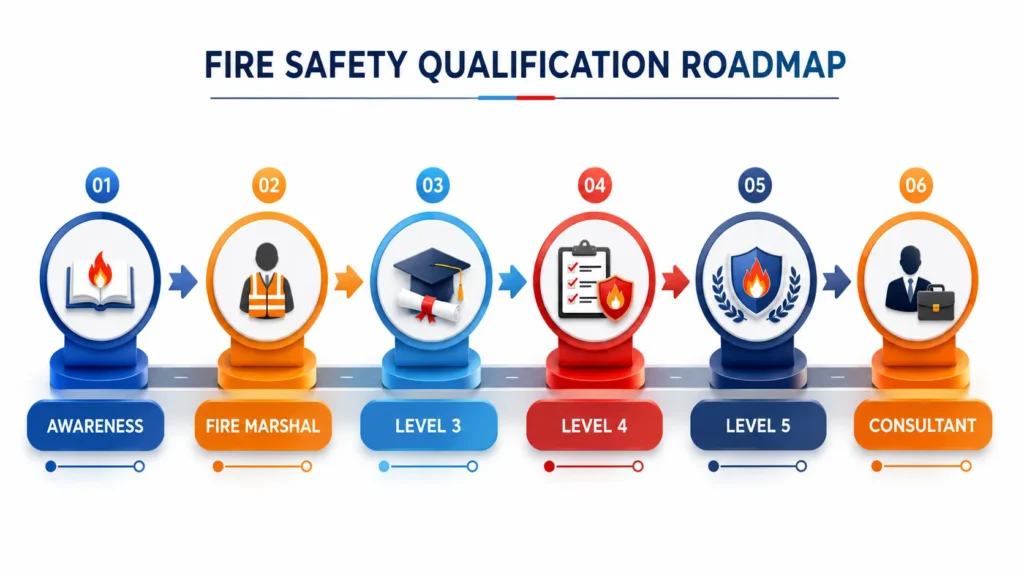
Fire Safety Qualification Roadmap
Career Interest
│
▼
Fire Safety Awareness Training
│
▼
Fire Marshal / Fire Warden Training
│
▼
Level 3 Fire Safety Qualification
│
▼
Level 4 Fire Safety or Fire Risk Assessment Qualification
│
▼
Level 5 Diploma in Fire Safety & Risk Management
│
▼
Senior Fire Safety Advisor
│
▼
Fire Safety Manager
│
▼
Fire Risk Consultant
│
▼
Head of Fire Safety / Compliance Director
This pathway illustrates how qualifications support progression from entry-level awareness to senior leadership roles.
Understanding Fire Safety Qualification Levels
Different qualification levels are designed for different career stages. Choosing the appropriate level helps learners progress efficiently without studying unnecessary content.
| Qualification Level | Typical Learner | Primary Focus | Potential Career Outcome |
|---|---|---|---|
| Fire Safety Awareness | Beginners | Basic fire prevention and emergency procedures | General workplace competence |
| Fire Marshal / Fire Warden | Employees with fire responsibilities | Evacuation, emergency response, extinguisher awareness | Fire Marshal or Fire Warden |
| Level 3 | New professionals | Fire safety principles, legislation, hazard identification | Fire Safety Officer |
| Level 4 | Experienced practitioners | Fire risk assessment, compliance, inspections | Fire Risk Assessor |
| Level 5 | Supervisors and Managers | Fire safety management, leadership, organisational compliance | Fire Safety Manager |
| Advanced Professional Qualifications | Senior professionals | Strategic fire safety management and consultancy | Senior Consultant or Director |
Essential Skills Developed Through Fire Safety Qualifications
Modern employers expect more than theoretical knowledge. High-quality qualifications develop technical expertise alongside workplace competencies that improve professional performance.
Technical Skills
Learners develop knowledge in:
- Fire science and combustion principles
- Fire detection and alarm systems
- Fire suppression systems
- Passive fire protection
- Active fire protection
- Fire legislation
- Building regulations
- Fire risk assessment methodologies
- Emergency evacuation planning
- Incident investigation
- Inspection techniques
- Fire safety auditing
Professional Skills
Successful fire safety professionals also require:
- Critical thinking
- Risk analysis
- Communication
- Leadership
- Report writing
- Problem solving
- Decision making
- Stakeholder management
- Presentation skills
- Time management
- Attention to detail
These transferable skills enable professionals to work effectively with employers, enforcement authorities, contractors, and multidisciplinary teams.
Which Industries Value Fire Safety Qualifications?
One of the greatest advantages of working in fire safety is the diversity of employment opportunities. Almost every industry requires qualified professionals to manage fire risks and maintain legal compliance.
| Industry | Why Fire Safety Professionals Are Needed | Typical Roles |
|---|---|---|
| Construction | Site safety, temporary fire controls, regulatory compliance | Fire Safety Officer, Site Safety Manager |
| Healthcare | Protection of vulnerable occupants and complex buildings | Fire Safety Advisor |
| Education | Emergency planning and compliance for schools and universities | Fire Safety Coordinator |
| Manufacturing | High-risk machinery and hazardous materials | Fire Risk Assessor |
| Hospitality | Guest safety, evacuation planning and inspections | Fire Safety Manager |
| Retail | Public safety and fire prevention | Compliance Officer |
| Warehousing & Logistics | Large storage facilities and high fire loads | Fire Safety Supervisor |
| Housing Associations | Residential fire safety and legal compliance | Building Safety Officer |
| Local Authorities | Public building compliance and enforcement | Fire Safety Inspector |
| Facilities Management | Ongoing maintenance and fire system management | Compliance Manager |
The ability to transfer fire safety knowledge across industries makes this profession resilient, flexible, and attractive for long-term career growth.
How Employers Evaluate Fire Safety Candidates
While qualifications are essential, employers typically assess candidates using a combination of education, practical competence, and professional behaviour.
Recruiters often consider:
- Recognised fire safety qualifications
- Practical workplace experience
- Understanding of UK fire safety legislation
- Ability to conduct fire risk assessments
- Communication and report-writing skills
- Leadership capability
- Continuous professional development
- Commitment to maintaining compliance standards
Candidates who combine recognised qualifications with practical experience are generally more competitive in today’s employment market.
Fire Safety Qualification Journey at a Glance
Learn Fire Safety Fundamentals
│
▼
Gain a Recognised Qualification
│
▼
Develop Practical Workplace Experience
│
▼
Conduct Fire Risk Assessments
│
▼
Progress into Supervisory Roles
│
▼
Lead Fire Safety Programmes
│
▼
Become a Specialist Consultant or Manager
Recommended Fire Safety Courses to Explore at Inspire College
To support career progression, readers can explore relevant qualifications available through Inspire College. These internal resources help learners build knowledge from foundational concepts to advanced professional competence.
Recommended internal links include:
- ProQual Level 5 Diploma in Fire Safety and Risk Management
- ProQual Level 5 Diploma in Fire Risk Assessment
- ProQual Level 6 NVQ Diploma in Occupational Health and Safety Practice
- ProQual Level 6 NVQ Diploma in Construction Site Management
- Fire Risk Assessment Courses
- Occupational Health and Safety Courses
- Construction Safety Qualifications
- Health and Safety Management Courses
- Fire Safety Blog Resources
- Workplace Safety Training Programmes
These courses complement different stages of a fire safety career and allow learners to develop specialist expertise aligned with industry requirements.
Types of Fire Safety Qualifications
Fire safety qualifications are available at different levels to suit beginners, experienced professionals, supervisors, and senior managers. Selecting the right qualification depends on current experience, career objectives, and the type of industry in which the learner intends to work.
Some qualifications focus on workplace awareness, while others prepare professionals to conduct fire risk assessments, manage organisational fire safety programmes, or lead compliance strategies.
Fire Safety Awareness Training
Fire Safety Awareness Training is the starting point for many individuals entering the profession or employees who need a basic understanding of workplace fire safety.
Typical topics include:
- Causes of workplace fires
- Fire prevention measures
- Emergency evacuation procedures
- Fire extinguisher awareness
- Individual responsibilities during emergencies
Although this training provides valuable knowledge, it is generally designed to increase awareness rather than prepare someone for a professional fire safety role.
Fire Marshal and Fire Warden Training
Fire Marshals and Fire Wardens play an important role in supporting workplace safety. They assist with evacuations, identify hazards, carry out routine inspections, and help organisations maintain compliance.
Learners typically study:
- Fire prevention responsibilities
- Emergency evacuation procedures
- Fire extinguisher selection
- Emergency communication
- Workplace inspections
This qualification is ideal for employees assigned additional fire safety responsibilities within their organisation.
Level 3 Fire Safety Qualifications
Level 3 qualifications provide the first significant step into a professional fire safety career.
These qualifications introduce learners to:
- Fire legislation
- Fire science
- Fire behaviour
- Hazard identification
- Fire prevention systems
- Workplace inspections
- Emergency planning
- Basic fire risk assessments
Level 3 qualifications are well suited to individuals seeking employment as:
- Fire Safety Officer
- Health and Safety Assistant
- Safety Coordinator
- Facilities Safety Officer
Level 4 Fire Safety Qualifications
Level 4 qualifications are designed for professionals who wish to undertake more advanced responsibilities, particularly fire risk assessments and compliance management.
Learners develop expertise in:
- Comprehensive fire risk assessments
- Fire safety inspections
- Building fire safety
- Regulatory compliance
- Fire safety auditing
- Report preparation
- Risk evaluation
- Fire safety recommendations
These qualifications are often regarded as the benchmark for professionals responsible for assessing fire risks within commercial and residential properties.
Level 5 Fire Safety Qualifications
Level 5 qualifications prepare professionals for leadership and management positions.
Topics usually include:
- Strategic fire safety management
- Organisational compliance
- Fire safety leadership
- Policy development
- Risk management systems
- Performance monitoring
- Team leadership
- Regulatory responsibilities
These qualifications support progression into management and consultancy roles across numerous industries.
Specialist Fire Risk Assessment Qualifications
Fire Risk Assessment qualifications focus specifically on identifying hazards, evaluating risks, recommending control measures, and producing professional reports.
These qualifications are highly valued because every workplace requires suitable and sufficient fire risk assessments.
Professionals completing these qualifications often work independently or as consultants across multiple sectors.
Choosing the Right Fire Safety Qualification
Not every learner requires the same qualification. Career aspirations, previous experience, and existing responsibilities should influence qualification selection.
Qualification Selection Guide
| Career Goal | Recommended Qualification | Suitable Experience Level | Typical Outcome |
|---|---|---|---|
| Learn workplace fire safety | Fire Safety Awareness | None | General workplace knowledge |
| Become a Fire Marshal | Fire Marshal Training | None | Fire Marshal |
| Start a fire safety career | Level 3 Fire Safety | Beginner | Fire Safety Officer |
| Conduct fire risk assessments | Level 4 Fire Risk Assessment | Some experience | Fire Risk Assessor |
| Lead organisational compliance | Level 5 Diploma | Experienced professional | Fire Safety Manager |
| Become a consultant | Advanced Diploma + Experience | Senior professional | Fire Safety Consultant |
Selecting the correct qualification early creates a smoother career progression pathway and avoids unnecessary duplication of learning.
Fire Safety Qualifications Compared
Each qualification level builds upon previous knowledge while expanding professional responsibilities.
| Qualification | Primary Focus | Typical Responsibility | Career Progression |
|---|---|---|---|
| Awareness Training | Basic knowledge | Fire awareness | Workplace competence |
| Fire Marshal | Emergency response | Evacuation support | Fire Marshal |
| Level 3 | Fire safety principles | Workplace inspections | Fire Safety Officer |
| Level 4 | Fire risk assessment | Risk assessments and reporting | Fire Risk Assessor |
| Level 5 | Strategic management | Compliance leadership | Fire Safety Manager |
| Advanced Professional Qualification | Consultancy | Strategic advice and auditing | Senior Consultant |
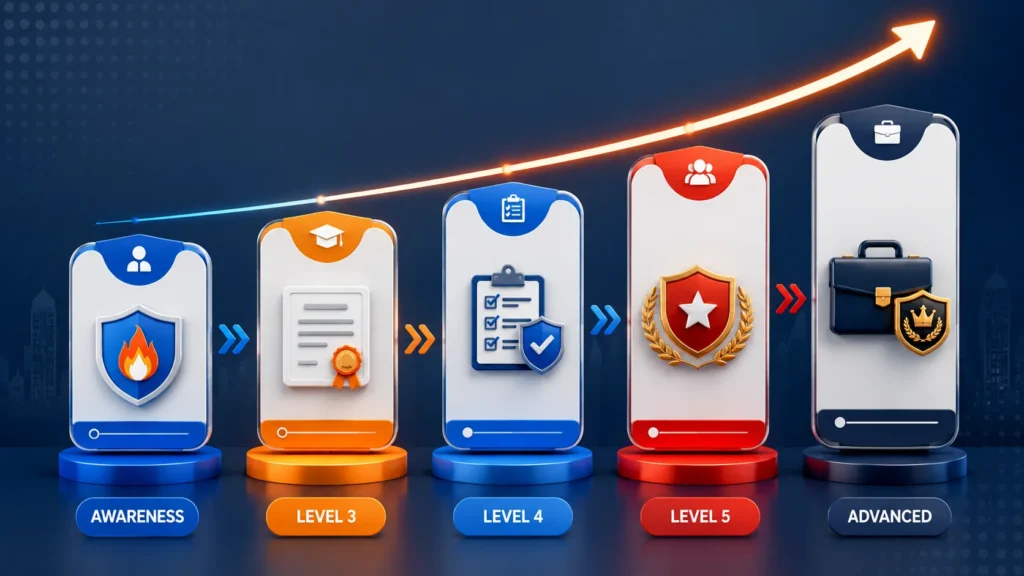
How to Decide Which Qualification Is Right for You
Many learners are unsure where to begin. A simple way to choose the right qualification is to identify the type of work they want to perform in the future.
Qualification Decision Flowchart
Do you want basic workplace knowledge?
│
Yes ────┘
▼
Fire Safety Awareness
│
End
│
No
▼
Want to become a Fire Marshal?
│
Yes ──────┘
▼
Fire Marshal Training
│
End
│
No
▼
Want a professional career?
│
▼
Level 3 Fire Safety
│
▼
Need to carry out Fire Risk Assessments?
│
Yes ──────┘
▼
Level 4 Qualification
│
▼
Want management responsibilities?
│
Yes ──────┘
▼
Level 5 Diploma
Skills Employers Expect from Qualified Fire Safety Professionals
Qualifications provide the technical foundation, but employers also look for professionals who can apply their knowledge effectively in real-world environments.
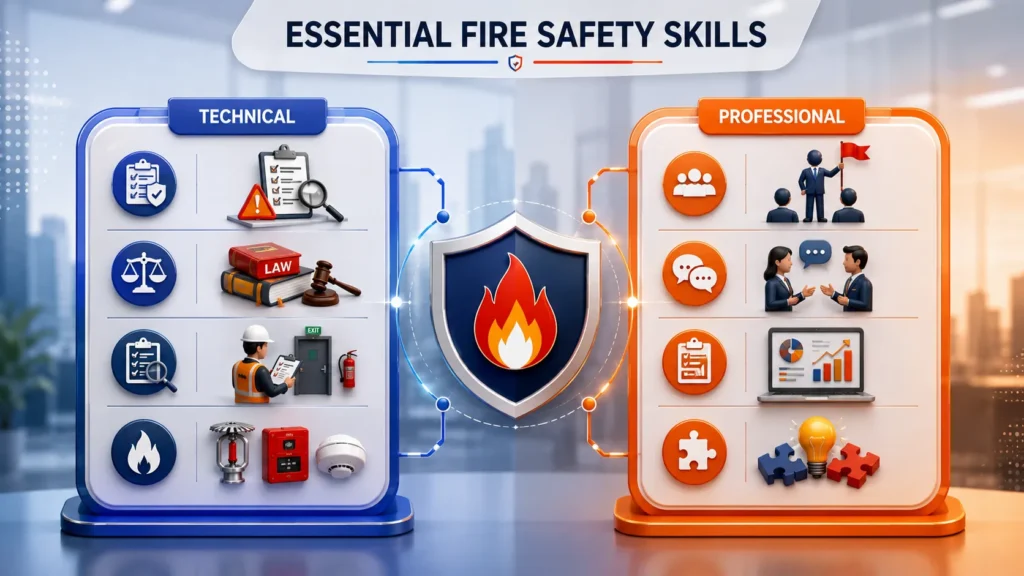
Technical Skills
Successful professionals are expected to understand:
- Fire dynamics
- Fire prevention systems
- Fire detection technology
- Fire alarm systems
- Emergency lighting
- Building regulations
- Passive fire protection
- Active fire protection
- Fire doors
- Compartmentation
- Evacuation planning
- Fire legislation
- Fire risk assessment methodology
Compliance Skills
Modern organisations need professionals capable of ensuring ongoing legal compliance.
Important compliance skills include:
- Understanding UK fire legislation
- Risk evaluation
- Inspection planning
- Compliance auditing
- Documentation
- Corrective action planning
- Incident reporting
- Record management
Professional Skills
The highest-performing fire safety professionals also possess strong interpersonal and leadership capabilities.
These include:
- Communication
- Leadership
- Teamwork
- Analytical thinking
- Decision making
- Problem solving
- Negotiation
- Presentation skills
- Technical report writing
- Time management
Employers increasingly value professionals who combine technical expertise with excellent communication and organisational skills.
Career Opportunities After Completing Fire Safety Qualifications
Qualified professionals have access to diverse career opportunities across public and private sectors.
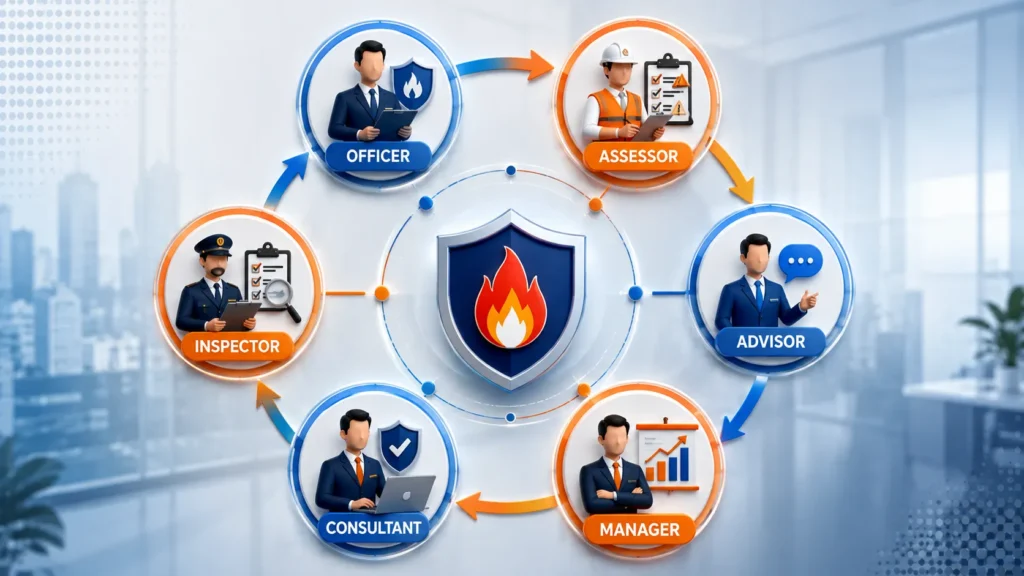
Some of the most common career paths include:
Fire Safety Officer
Fire Safety Officers help organisations implement fire prevention measures, conduct inspections, monitor compliance, and support emergency planning.
Fire Risk Assessor
Fire Risk Assessors inspect buildings, identify hazards, evaluate fire risks, and prepare legally compliant fire risk assessment reports.
Fire Safety Advisor
Fire Safety Advisors provide specialist guidance to employers, contractors, healthcare providers, educational institutions, and commercial organisations.
Compliance Officer
Compliance Officers ensure organisations meet legal obligations relating to fire safety, health and safety, and regulatory standards.
Fire Safety Manager
Managers oversee fire safety programmes, supervise teams, develop policies, manage audits, and coordinate emergency preparedness.
Building Safety Manager
Building Safety Managers oversee fire safety within residential and commercial buildings while ensuring regulatory compliance throughout the building lifecycle.
Facilities Manager
Facilities Managers frequently oversee fire protection systems, maintenance schedules, emergency planning, and contractor management.
Fire Safety Consultant
Consultants advise organisations on improving fire safety strategies, reducing organisational risk, and achieving regulatory compliance.
Career Opportunities by Industry
Fire safety professionals are employed across virtually every major industry.
| Industry | Typical Employer | Common Job Roles |
|---|---|---|
| Construction | Contractors and Developers | Fire Safety Officer |
| Manufacturing | Production Facilities | Compliance Manager |
| Healthcare | NHS and Private Hospitals | Fire Safety Advisor |
| Education | Schools and Universities | Fire Safety Coordinator |
| Hospitality | Hotels and Resorts | Fire Safety Manager |
| Retail | Shopping Centres | Compliance Officer |
| Aviation | Airports | Safety Specialist |
| Logistics | Warehousing | Fire Risk Assessor |
| Government | Local Authorities | Fire Safety Inspector |
| Housing | Housing Associations | Building Safety Officer |
This broad demand makes fire safety one of the most versatile career choices within the health and safety profession.
UK Fire Safety Salary Guide
Salary varies depending on qualifications, experience, industry, and location. Professionals who continue developing their expertise through recognised qualifications generally enjoy stronger earning potential.
| Career Stage | Typical Role | Approximate UK Salary Range |
|---|---|---|
| Entry Level | Fire Safety Assistant | £24,000–£32,000 |
| Early Career | Fire Safety Officer | £30,000–£42,000 |
| Mid-Level | Fire Risk Assessor | £40,000–£55,000 |
| Senior Professional | Fire Safety Advisor | £50,000–£70,000 |
| Management | Fire Safety Manager | £60,000–£85,000+ |
| Consultancy | Senior Fire Safety Consultant | £70,000–£100,000+ |
Actual salaries depend on qualifications, specialist expertise, employer, geographical location, and years of practical experience.
What Employers Look for Beyond Qualifications
Holding a recognised qualification is only one part of becoming a successful fire safety professional. Employers increasingly seek individuals who demonstrate continuous improvement and professional commitment.
Recruiters often prioritise candidates who can demonstrate:
- Practical workplace experience
- High-quality fire risk assessment reports
- Knowledge of current legislation
- Strong communication skills
- Experience working with multidisciplinary teams
- Commitment to continuous professional development (CPD)
- Problem-solving abilities
- Attention to detail
- Leadership potential
- Ethical decision-making
Professionals who regularly update their knowledge and stay informed about changes in fire safety legislation are often better positioned for promotion and long-term career success.
Fire Safety Career Progression Overview
The fire safety profession offers clear opportunities for advancement as qualifications, experience, and specialist knowledge increase.
Fire Safety Awareness
│
▼
Fire Marshal
│
▼
Fire Safety Officer
│
▼
Fire Risk Assessor
│
▼
Senior Fire Safety Advisor
│
▼
Fire Safety Manager
│
▼
Compliance Manager
│
▼
Fire Safety Consultant
│
▼
Head of Fire Safety
This progression demonstrates how continuous learning and recognised qualifications can open doors to leadership, consultancy, and strategic management roles across a wide range of industries.
How to Choose the Best Fire Safety Qualification
Choosing the right fire safety qualification is one of the most important decisions for anyone planning a long-term career in the industry. With numerous training providers and qualifications available, it is essential to evaluate more than just the course title or price.
A well-chosen qualification should align with career goals, employer expectations, and opportunities for future progression.
Before enrolling, consider the following factors.
Career Objectives
The first step is identifying the type of role the learner wants to pursue. Someone aiming to become a Fire Safety Officer may require a different qualification from someone planning to work as a Fire Risk Assessor or Fire Safety Consultant.
Clearly defining career goals makes it easier to select an appropriate qualification level.
Industry Recognition
Employers prefer qualifications that are widely recognised within the fire safety and health and safety sectors. Studying with a reputable training provider helps improve employability and professional credibility.
Course Content
A high-quality fire safety qualification should combine theoretical knowledge with practical application. The curriculum should cover current legislation, fire prevention, fire risk assessment methodologies, emergency planning, compliance, and workplace best practices.
Progression Opportunities
The best qualifications provide clear progression routes into higher-level diplomas, vocational qualifications, and specialist certifications. Building knowledge gradually creates stronger long-term career prospects.
Flexible Learning Options
Many professionals prefer flexible study methods that fit around work commitments. Online learning, blended delivery, and tutor support can make professional development more accessible.
Characteristics of a High-Quality Fire Safety Course
Not all training programmes provide the same value. A comprehensive qualification should develop practical competence alongside technical knowledge.
Look for programmes that include:
- Comprehensive fire safety legislation
- Fire risk assessment methodology
- Practical workplace scenarios
- Fire prevention strategies
- Emergency planning
- Inspection techniques
- Compliance management
- Assessment and feedback
- Tutor support
- Clear progression pathways
Courses that combine academic learning with real-world application often produce more confident and competent professionals.
Common Mistakes When Choosing a Fire Safety Qualification
Many learners invest in qualifications without fully understanding their career value. Avoiding these common mistakes can save time, money, and unnecessary study.
Choosing a Qualification Based Only on Price
Lower-cost courses may not always provide the depth of knowledge or industry recognition needed for career progression.
Ignoring Career Progression
Selecting a qualification without considering future advancement can limit opportunities later. It is important to choose qualifications that support continuous professional development.
Overlooking Practical Skills
Fire safety is a practical profession. Employers value candidates who can apply knowledge confidently in workplace environments rather than relying solely on theoretical understanding.
Not Researching the Training Provider
A reputable training provider should deliver quality learning resources, experienced tutors, and recognised qualifications that meet industry expectations.
Focusing Only on Immediate Employment
While securing a first job is important, qualifications should also support future progression into supervisory, management, and consultancy roles.
The Future of Fire Safety Careers
Fire safety continues to evolve as technology, legislation, and building design become increasingly sophisticated. Professionals who stay informed about industry developments will remain highly competitive.
Several trends are shaping the future of fire safety.
Digital Fire Risk Assessments
Traditional paper-based inspections are rapidly being replaced by digital inspection platforms that improve efficiency, record keeping, and reporting accuracy.
Smart Buildings
Modern buildings increasingly integrate intelligent fire detection, monitoring, and evacuation systems. Fire safety professionals must understand these technologies to manage risks effectively.
Building Safety Reforms
Ongoing regulatory changes continue to strengthen accountability for building owners, managers, and responsible persons. Qualified professionals are essential to implementing and maintaining compliance.
Sustainability and Fire Safety
Sustainable construction materials and energy-efficient buildings introduce new fire safety considerations. Professionals must understand how evolving construction practices affect fire behaviour and risk management.
Data-Driven Compliance
Organisations increasingly use digital dashboards, compliance software, and performance analytics to monitor fire safety programmes. Professionals with digital skills are becoming increasingly valuable.
Artificial Intelligence in Fire Safety
Artificial intelligence is beginning to support predictive maintenance, risk analysis, fire detection, and compliance monitoring. While AI enhances decision-making, qualified professionals remain responsible for interpreting findings and implementing effective control measures.
Why Fire Safety Is an Excellent Long-Term Career Choice
Fire safety offers more than stable employment. It provides opportunities to protect lives, improve workplace safety, and contribute to safer communities while building a rewarding professional career.
Some of the key benefits include:
- Strong demand across multiple industries
- Excellent opportunities for career progression
- Competitive salary potential
- Transferable professional skills
- Opportunities for leadership and consultancy
- Continuous learning and development
- Meaningful contribution to public safety
- Diverse career pathways across the public and private sectors
As legislation and organisational expectations continue to evolve, the need for competent fire safety professionals is expected to remain strong.
How Inspire College Can Support Your Fire Safety Career
Choosing the right training provider is just as important as selecting the right qualification. Inspire College is committed to helping learners gain industry-relevant knowledge and recognised qualifications that support long-term career success.
Whether starting a career or progressing into senior roles, learners can access qualifications designed to develop practical competence, regulatory understanding, and professional confidence.
Key benefits of studying with Inspire College include:
- Industry-focused qualifications
- Flexible learning opportunities
- Experienced tutor support
- Career-focused curriculum
- Practical knowledge aligned with workplace requirements
- Progression pathways into higher-level qualifications
- Support for continuous professional development
Fire Safety Learning Pathway
The following roadmap demonstrates how qualifications and experience work together to build a successful career.
Develop an Interest in Fire Safety
│
▼
Study a Foundation Qualification
│
▼
Gain Workplace Experience
│
▼
Complete a Level 3 Qualification
│
▼
Progress to Level 4 Fire Risk Assessment
│
▼
Develop Inspection and Compliance Skills
│
▼
Complete a Level 5 Diploma
│
▼
Lead Fire Safety Programmes
│
▼
Become a Fire Safety Consultant or Manager
│
▼
Continue Professional Development Throughout Your Career
Recommended Fire Safety and Health & Safety Courses
Readers interested in building a successful career can explore these related qualifications available through Inspire College.
- ProQual Level 5 Diploma in Fire Safety and Risk Management
- ProQual Level 5 Diploma in Fire Risk Assessment
- Fire Safety Training Programmes
- ProQual Level 6 NVQ Diploma in Occupational Health and Safety Practice
Key Takeaways
Choosing the right fire safety qualification is the foundation of a successful career in one of the UK’s most essential and rapidly evolving professions. From entry-level awareness courses to advanced diplomas in fire safety and risk management, each qualification builds the knowledge and practical skills needed to protect people, property, and businesses from fire-related risks.
Professionals with recognised qualifications are increasingly valued by employers across construction, healthcare, education, manufacturing, facilities management, hospitality, housing, and many other sectors. As legislation continues to evolve and organisations place greater emphasis on compliance and risk management, qualified fire safety professionals will remain in high demand.
By selecting a recognised qualification, gaining practical experience, and committing to continuous professional development, learners can progress from foundational roles to senior positions such as Fire Risk Assessor, Fire Safety Manager, Compliance Manager, or Fire Safety Consultant.
Conclusion
Fire safety is more than a profession—it is a responsibility that directly contributes to protecting lives, safeguarding property, and ensuring organisations operate safely and legally. As demand for skilled professionals continues to rise across the UK, investing in recognised fire safety qualifications has never been more valuable.
Whether the goal is to enter the industry, advance into leadership, or specialise in fire risk assessment, choosing the right qualification is the first step towards long-term success. A structured learning pathway, combined with practical experience and continuous professional development, enables professionals to build rewarding careers while making a meaningful impact on workplace and public safety.
For those ready to begin or advance their journey, Inspire College offers career-focused fire safety and health and safety qualifications designed to equip learners with the knowledge, confidence, and practical skills required to succeed in today’s evolving safety landscape.