
Fire Safety Housekeeping: How Workplace Organisation Reduces Risk
Fire safety housekeeping is one of the most practical ways to prevent workplace fires, reduce the spread of flames and smoke, and protect employees, visitors, contractors, and business property. By keeping escape routes clear, removing combustible waste, storing flammable materials correctly, and maintaining organised work areas, organisations can reduce avoidable fire hazards and strengthen their overall fire prevention procedures.
A workplace does not need to be visibly dirty to have a fire safety problem. A cardboard box left beside an electrical heater, packaging stored near machinery, an obstructed fire exit, or a build-up of dust in a workshop can create hazards that are easily overlooked during everyday operations.
For employers, facilities managers, health and safety professionals, fire wardens, and employees, good housekeeping should therefore be treated as an ongoing safety responsibility rather than an occasional cleaning exercise.
This guide explains what fire safety housekeeping means, why workplace organisation reduces risk, which practices are most effective, how to implement a practical inspection system, and how housekeeping supports wider workplace fire safety management.
What Is Fire Safety Housekeeping?
Fire safety housekeeping is the systematic organisation, cleaning, storage, and maintenance of workplace areas to minimise fire hazards, prevent the accumulation of combustible materials, maintain access to safety equipment, and support safe evacuation.
It includes everyday activities such as disposing of rubbish, keeping electrical cupboards free from unauthorised storage, separating combustible materials from ignition sources, managing flammable waste, and ensuring that emergency exits remain unobstructed.
The UK Government’s fire safety guidance identifies housekeeping as an important consideration when assessing workplace fire risks, particularly where combustible materials may accumulate or be stored close to ignition sources.
Effective fire safety housekeeping involves three connected objectives:
- Prevent ignition: Reduce opportunities for heat, sparks, or other ignition sources to come into contact with combustible materials.
- Limit fire development: Control the amount, location, and storage of materials that could contribute to a fire.
- Maintain safe escape and emergency access: Keep evacuation routes, fire doors, alarm call points, and firefighting equipment accessible.
For example, a warehouse that removes packaging waste regularly, maintains clear aisles, and stores chemicals in designated locations is easier to inspect and manage safely than one where materials accumulate unpredictably.
Housekeeping does not replace fire alarms, fire doors, sprinklers, suitable firefighting equipment, or a competent fire risk assessment. It complements these measures by reducing avoidable hazards and helping existing fire precautions remain effective.
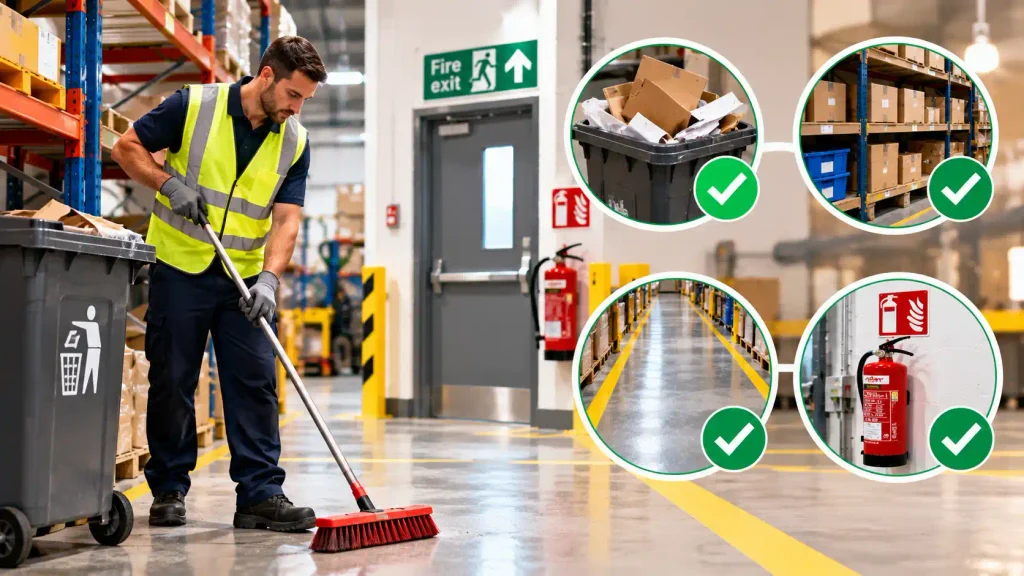
How Workplace Organisation Reduces Fire Risk
Workplace organisation reduces fire risk by controlling fuel sources, separating combustible materials from ignition sources, reducing clutter, and making fire safety hazards easier to identify before they become serious problems.
The fire triangle provides a useful starting point for understanding this relationship.
The fire triangle
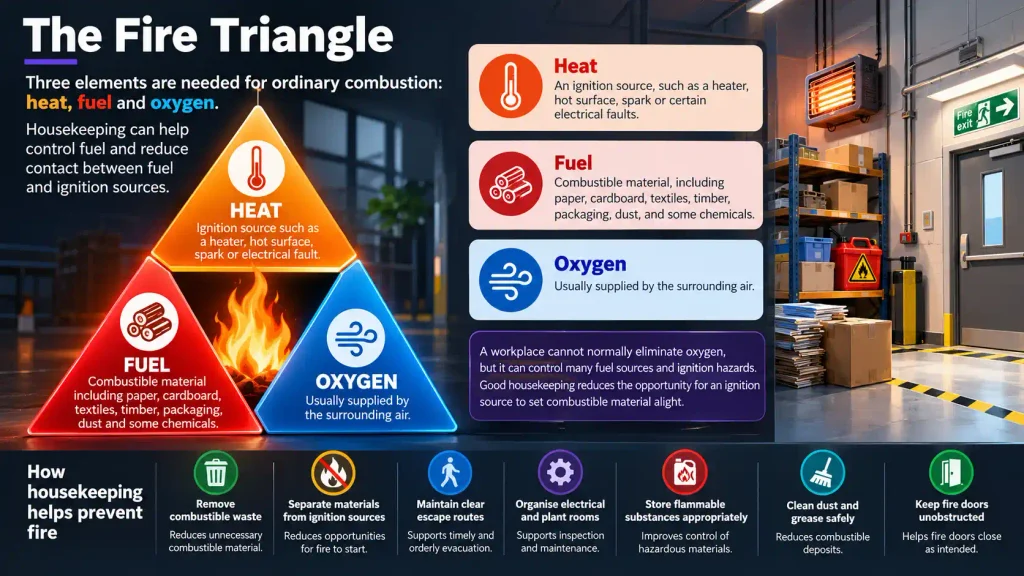
The three elements needed for ordinary combustion are heat, fuel, and oxygen. Housekeeping can help control fuel and reduce contact between fuel and ignition sources.
The three elements are:
- Heat: An ignition source, such as a heater, hot surface, spark, or certain electrical faults.
- Fuel: Combustible material, including paper, cardboard, textiles, timber, packaging, dust, and some chemicals.
- Oxygen: Usually supplied by the surrounding air.
A workplace cannot normally eliminate oxygen, but it can control many fuel sources and ignition hazards. Keeping combustible waste away from heaters, for instance, reduces the opportunity for an ignition source to set that material alight.
Organisation also makes hazards easier to recognise. When storage areas have designated locations, workers can identify materials that have been left in the wrong place. When walkways are consistently marked and kept clear, obstructions become more noticeable during routine inspections.
The following table illustrates the relationship between workplace organisation and fire prevention.
| Housekeeping practice | Risk controlled | Practical benefit |
|---|---|---|
| Removing combustible waste | Accumulation of fuel | Reduces unnecessary combustible material |
| Separating materials from ignition sources | Accidental ignition | Reduces opportunities for fire to start |
| Maintaining clear escape routes | Obstructed evacuation | Supports timely and orderly evacuation |
| Organising electrical and plant rooms | Overheating, obstruction, and unsafe storage | Supports inspection and maintenance |
| Storing flammable substances appropriately | Ignition, leakage, and unsafe handling | Improves control of hazardous materials |
| Cleaning dust and grease safely | Combustible deposits | Reduces avoidable fire hazards |
| Keeping fire doors unobstructed | Impaired fire and smoke separation | Helps fire doors close as intended |
The effectiveness of these measures depends on the workplace, its activities, the materials present, and the findings of its fire risk assessment. Housekeeping controls should always be appropriate to the hazards identified.
Why Is Good Fire Safety Housekeeping Important?
Good housekeeping is important because workplace fires can threaten lives, damage buildings, interrupt operations, and create significant financial and legal consequences. An organised environment helps businesses prevent foreseeable hazards and maintain essential safety arrangements.
It helps prevent fires from starting
Accumulated waste and incorrectly stored combustible materials can increase the amount of fuel available to a potential ignition source.
For example, a maintenance area containing cardboard packaging, oily materials, and cleaning products near equipment that generates heat may present several hazards at once. Removing waste and storing materials correctly helps reduce unnecessary exposure to ignition sources.
It supports safe evacuation
Employees and visitors need to move towards suitable escape routes without encountering avoidable obstructions. Boxes, delivery trolleys, discarded furniture, and waste bags can reduce the usable space in corridors and stairways.
Keeping these routes clear helps people follow evacuation procedures and supports access for those who may require assistance.
It helps maintain fire protection measures
Fire doors, alarm call points, extinguishers, and other safety provisions must remain accessible and usable. Storage placed in front of a fire extinguisher may delay access, while an object preventing a fire door from closing may undermine its intended function.
Routine housekeeping inspections help identify these problems before an emergency occurs.
It improves hazard identification
Organised workplaces make unusual conditions easier to spot. A leaking container, damaged cable, missing safety label, or unexpected accumulation of packaging is more likely to attract attention when the area is normally maintained to a consistent standard.
It supports business continuity
A fire can cause equipment damage, stock losses, operational downtime, investigation costs, and disruption to customers and employees. Although housekeeping cannot eliminate every fire risk, it forms part of a wider strategy to reduce preventable incidents and protect business operations.
Common Workplace Housekeeping Hazards That Increase Fire Risk
Fire hazards can develop in offices, warehouses, factories, commercial kitchens, educational institutions, workshops, construction sites, and other workplaces. The specific hazards vary, but several recurring problems deserve particular attention.
| Workplace hazard | Why it matters | Recommended control |
|---|---|---|
| Cardboard and paper accumulating near equipment | Adds combustible material close to potential ignition sources | Remove waste frequently and use designated collection points |
| Blocked fire exits | Can delay evacuation or prevent access to an exit | Keep escape routes and exits clear at all times |
| Flammable liquids stored incorrectly | May increase the risk of ignition and fire spread | Use suitable storage, containers, and handling procedures |
| Damaged or overheating electrical equipment | May create heat or sparks | Stop using faulty equipment and report it for competent assessment |
| Cluttered plant and electrical rooms | Can introduce combustible material and impede maintenance | Restrict storage and maintain safe access |
| Dust deposits around machinery | Some dusts can ignite or create more severe fire or explosion hazards | Use suitable cleaning and dust-control procedures |
| Grease accumulation in kitchen equipment | Can provide fuel for a fire | Follow appropriate cleaning and maintenance schedules |
| Oily rags or solvent-contaminated waste | May present fire or other chemical hazards | Use appropriate containers and disposal procedures |
| Bins stored against external walls | May provide fuel close to the building and create opportunities for deliberate ignition | Use designated, secure waste storage away from vulnerable areas where practicable |
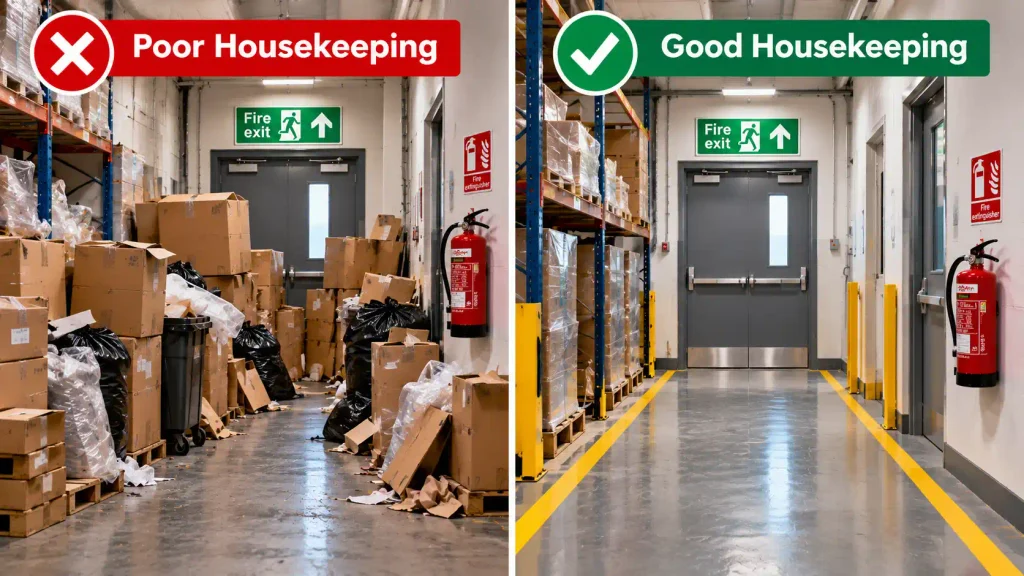
A key principle is that the same housekeeping issue can create several risks simultaneously. A pile of boxes in a corridor, for example, may add combustible fuel, obstruct evacuation, and hide access to firefighting equipment.
Housekeeping inspections should therefore assess the complete situation rather than simply checking whether an area looks tidy.
Best Practices for Fire Safety Housekeeping in the Workplace
An effective workplace fire prevention programme should establish clear standards for storage, waste management, equipment access, cleaning, and reporting. The following practices can be adapted to suit different industries and workplace layouts.
Keep fire exits and escape routes clear
Escape routes should remain clear and usable whenever the premises are occupied. Corridors, stairways, doorways, final exits, and designated evacuation routes must not become temporary storage areas.
Deliveries and maintenance activities require particular attention because materials can be left in passageways while employees complete other tasks.
Practical measures include:
- Establishing designated storage and delivery areas away from escape routes.
- Checking corridors, staircases, and exits during routine workplace inspections.
- Removing obstructions promptly and reporting anything that cannot be corrected safely.
- Ensuring emergency exit doors can be opened as intended.
- Keeping evacuation signage visible and routes suitable for the people using the premises.
Do not assume that a temporary obstruction is acceptable simply because it will be removed later. Escape routes must remain available when needed.
Store combustible materials safely
Paper, cardboard, wood, textiles, packaging, and other combustible materials should be stored in designated areas and managed to prevent unnecessary accumulation.
Keep such materials away from ignition sources, including heaters and equipment that produces heat. Storage should also avoid obstructing electrical installations, fire protection equipment, and escape routes.
In warehouses, consider stock rotation, packaging removal, aisle management, and storage arrangements that reflect the building’s fire risk assessment.
Do not establish arbitrary storage heights or clearances as universal rules. Appropriate distances, ceiling clearances, and storage arrangements depend on the building, installed fire protection systems, materials, and applicable requirements.
Manage flammable substances and hazardous waste
Cleaning products, solvents, paints, fuels, aerosols, and other hazardous substances require controls suited to their properties and intended use.
Good housekeeping includes keeping containers closed when appropriate, retaining labels, preventing leaks, using designated storage arrangements, and avoiding incompatible materials being stored together.
Waste must also be handled correctly. Solvent-contaminated materials and oily rags should not automatically be placed in ordinary rubbish bins. Their risks and disposal requirements depend on the substance and the process involved.
Employees should follow the relevant safety data sheets, workplace procedures, and applicable hazardous-substance and waste requirements.
Maintain safe electrical housekeeping
Electrical hazards should be managed through safe equipment use, inspection, maintenance, and sensible workplace organisation.
Avoid overloading sockets, using damaged leads, or allowing cables to become trapped under furniture. Keep electrical cupboards and distribution boards free from unauthorised storage so that competent personnel can access them safely.
Employees should report unusual heat, burning smells, visible damage, or other signs of electrical malfunction. Suspected faulty equipment should be taken out of use when safe to do so and assessed by a competent person.
Housekeeping inspections do not replace electrical inspection, testing, or maintenance where these are required by the workplace’s risk controls.
Keep fire doors and fire safety equipment accessible
Fire doors form part of the building’s fire and smoke protection arrangements. They should not be wedged open or obstructed by stock, furniture, waste, or equipment.
Fire extinguishers, alarm call points, fire blankets, and other installed safety provisions should be easy to locate and access.
Routine checks should identify:
- Items blocking doors or preventing them from closing.
- Materials obstructing alarm call points or extinguishers.
- Missing, damaged, or obscured safety signs.
- Defects that require maintenance or specialist attention.
Report faults through the workplace’s established procedure rather than assuming that access alone proves the equipment is functional.
Control dust, grease, and production debris
Workshops, manufacturing facilities, woodworking areas, and commercial kitchens may generate deposits that require specialised cleaning arrangements.
Combustible dust can be particularly hazardous in certain industrial processes. Where dust can become airborne and form an ignitable atmosphere, ordinary sweeping or compressed-air cleaning may be unsuitable and could increase the risk.
Use a cleaning method designed for the material and the process, supported by appropriate risk assessment and competent advice.
In kitchens, remove grease and food residues in accordance with cleaning schedules and equipment instructions. Extraction systems, filters, and ductwork may also require planned cleaning and maintenance.
Keep external areas organised
Outdoor housekeeping matters because waste, packaging, vegetation, and stored materials can create additional fire hazards or interfere with emergency access.
Keep external escape routes, fire service access points, and relevant firefighting facilities clear. Store waste in designated areas, manage bins securely, and avoid unnecessary accumulation against the building.
External storage arrangements should also take account of security, deliberate ignition risks, and any local fire safety requirements.
Make housekeeping part of staff routines
Housekeeping works best when it is incorporated into everyday tasks rather than left until a scheduled deep clean.
Employees should understand what belongs in their work area, where waste must go, how to report hazards, and which areas must remain clear.
Supervisors can reinforce these expectations through briefings, induction training, visual reminders, and regular inspections. Where repeated obstructions occur, managers should investigate the underlying cause, such as insufficient storage capacity, inconvenient waste collection, or unclear responsibilities.
Fire Safety Housekeeping Checklist for Workplaces
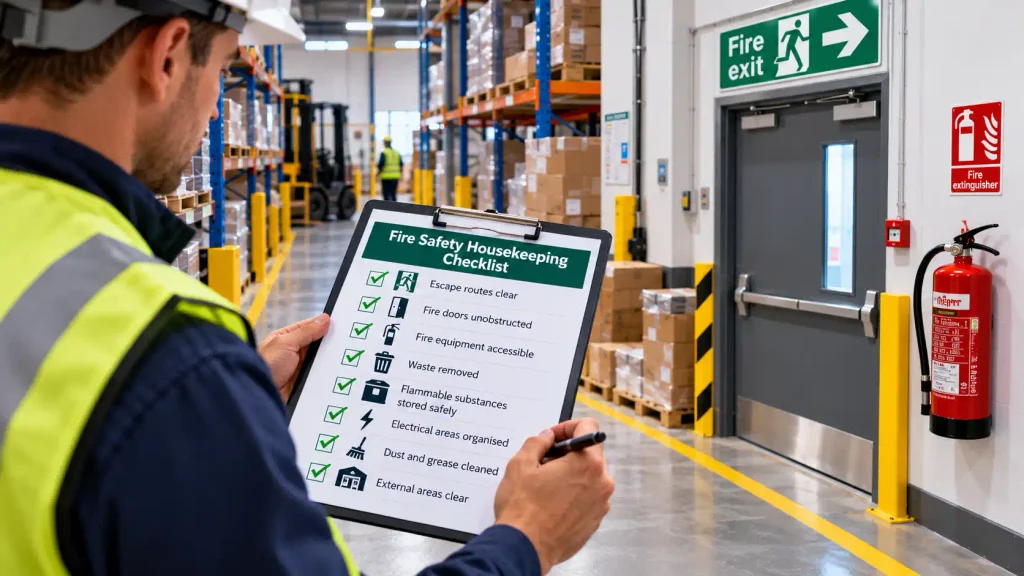
A checklist helps organisations translate general fire prevention principles into observable actions. The following example can be adapted for daily walkthroughs and more detailed inspections.
| Inspection item | What to check | Suggested action if unsatisfactory |
|---|---|---|
| Escape routes | Corridors, stairways, and exits are unobstructed | Remove the obstruction safely or escalate immediately |
| Fire doors | Doors are not wedged open or prevented from closing | Remove obstructions and report defects |
| Fire equipment | Extinguishers and alarm call points are accessible | Restore access and report damage or missing equipment |
| Combustible waste | Waste is removed before unsafe accumulation occurs | Arrange appropriate collection and review frequency |
| Flammable substances | Containers and storage arrangements are suitable | Secure the area and follow substance-specific procedures |
| Electrical areas | No unauthorised storage, visible damage, or obvious overheating signs | Report hazards and seek competent assessment |
| Dust and grease | Cleaning is completed using suitable methods | Arrange appropriate cleaning and maintenance |
| External areas | Waste, exits, and emergency access points are clear | Remove obstructions and improve storage arrangements |
| Records | Findings and outstanding actions are documented | Assign an owner and completion deadline |
A checklist is only effective when deficiencies lead to action. Recording a blocked exit without resolving the obstruction does not make the workplace safer.
How to Implement a Workplace Fire Safety Housekeeping Programme
A structured housekeeping programme gives employees and managers a consistent way to identify hazards, apply controls, and check whether those controls remain effective. It should be linked to the workplace’s fire risk assessment and wider health and safety arrangements.
The UK Government recommends identifying fire hazards, assessing risks to people, implementing preventive and protective measures, recording findings, and reviewing the assessment when necessary. Housekeeping should contribute to each of these activities.
Step 1: Identify hazards in each work area
Inspect offices, storage rooms, workshops, kitchens, plant rooms, corridors, loading bays, and external areas. Look for combustible waste, unsafe storage, possible ignition sources, obstructed exits, and inaccessible fire safety equipment.
Include activities that may create temporary hazards, such as deliveries, maintenance, refurbishment, and equipment cleaning.
Step 2: Assess the level of risk
Consider the likelihood of ignition, the quantity and nature of combustible materials, potential fire spread, and the consequences for people.
Pay particular attention to individuals who may need additional assistance during evacuation. A cluttered corridor can present a greater practical difficulty where occupants have mobility limitations or rely on assistance to reach safety.
Step 3: Introduce suitable controls
Remove unnecessary combustible materials, establish appropriate storage areas, improve waste collection, and keep escape routes clear.
Where a hazard requires technical intervention, such as damaged electrical equipment or unsafe chemical storage, involve a competent person. Do not rely on cleaning alone to resolve a problem that requires maintenance or specialist controls.
Step 4: Assign responsibilities
Identify who is responsible for routine checks, waste collection, storage compliance, defect reporting, and corrective actions.
Employees should understand their own responsibilities, while supervisors and designated fire safety personnel should monitor standards and escalate unresolved hazards.
Step 5: Inspect, record, and improve
Carry out checks at a frequency appropriate to the workplace’s risk profile. Record significant findings, actions, responsible persons, and completion dates.
Review recurring problems and revise procedures when work activities, storage arrangements, building layouts, or risk assessments change.
Workplace fire safety housekeeping flowchart
The following flowchart shows how a housekeeping concern should move from identification to resolution.
Workplace Fire Safety Housekeeping Flowchart
Identify hazards, take corrective action, and review safety standards.
Important: If a fire is discovered, follow the site’s emergency procedures immediately. Raise the alarm, evacuate as required, and contact the emergency services in accordance with the emergency plan. Routine housekeeping checks must never delay emergency action.
Who Is Responsible for Fire Safety Housekeeping?
Fire safety housekeeping is a shared operational responsibility, but duties should be clearly allocated so that important tasks are not overlooked.
In England, the responsible person for non-domestic premises must arrange a suitable fire risk assessment, implement appropriate fire precautions, plan for emergencies, and provide relevant information and training. Depending on the circumstances, the responsible person may be an employer, owner, occupier, landlord, or another person with control of the premises.
| Role | Housekeeping responsibilities |
|---|---|
| Responsible person or employer | Ensure suitable fire safety arrangements and resources are in place |
| Facilities manager | Coordinate building maintenance, waste arrangements, and common-area inspections |
| Supervisors | Monitor housekeeping standards and address reported hazards |
| Fire wardens or designated fire safety personnel | Carry out assigned checks and report deficiencies within their responsibilities |
| Employees | Follow procedures, maintain their work areas, and report hazards |
| Contractors | Follow site rules and control hazards created by maintenance or construction work |
| Competent specialists | Assess and address technical hazards within their expertise |
These responsibilities should be adapted to the organisation’s size, legal duties, and risk profile. Appointing an individual to carry out inspections does not automatically remove the responsible person’s legal obligations.
How Often Should Fire Safety Housekeeping Checks Be Carried Out?
There is no single inspection schedule suitable for every workplace. The appropriate frequency depends on the nature of the hazards, how quickly conditions change, and the findings of the fire risk assessment.
Daily checks may be appropriate for busy storage areas, kitchens, workshops, and escape routes. Less frequently changing areas may need a different inspection arrangement, provided the necessary controls remain effective.
The following is an illustrative schedule, not a universal legal timetable.
| Frequency | Example checks | Typical responsibility |
|---|---|---|
| Throughout the working day | Prevent obstructions, remove immediate hazards, manage waste | All employees |
| Daily or each shift | Check escape routes, exits, work areas, and relevant equipment access | Designated staff or supervisors |
| Weekly | Review storage arrangements, waste collection, and recurring issues | Supervisors or facilities teams |
| Monthly or risk-based intervals | Review housekeeping records, trends, and outstanding actions | Management or fire safety personnel |
| Following significant changes | Reassess hazards after layout changes, new processes, incidents, or increased stock | Responsible person and competent advisers as needed |
These housekeeping intervals should not be confused with the testing and servicing schedules for alarms, emergency lighting, extinguishers, or other fire protection systems. Those require separate arrangements appropriate to the equipment and applicable guidance.
Common Fire Safety Housekeeping Mistakes to Avoid
Even organisations with written procedures can develop unsafe habits. The following mistakes deserve particular attention.
- Using corridors for temporary storage: Deliveries and equipment should not obstruct escape routes while waiting to be moved.
- Assuming a tidy appearance means a safe workplace: A clean area can still contain faulty electrical equipment, unsuitable chemical storage, or ineffective fire doors.
- Leaving waste until the end of the week: Waste collection should reflect how quickly combustible materials accumulate and the risks associated with them.
- Treating fire doors as ordinary doors: They must not be wedged open or obstructed, and defects should be reported.
- Ignoring repeated housekeeping failures: Recurring problems may indicate insufficient storage, inadequate bins, unrealistic workloads, or unclear procedures.
- Using unsuitable cleaning methods: Dust, chemicals, and contaminated materials may require specialist handling rather than routine sweeping or disposal.
- Failing to record unresolved hazards: Without clear ownership and follow-up, problems may remain outstanding or reappear.
- Assuming staff training alone is sufficient: Training must be supported by suitable equipment, practical arrangements, supervision, and management action.
The most effective response is to address both the immediate hazard and the reason it developed. If boxes repeatedly obstruct a corridor because a storeroom is too small, simply instructing employees to remove them is unlikely to provide a lasting solution.
How Fire Safety Housekeeping Supports Risk Assessment and Professional Development
Fire safety housekeeping should be considered alongside the organisation’s wider fire risk assessment, emergency planning, and health and safety management systems.
A risk assessment helps determine which housekeeping arrangements are necessary, where controls should be prioritised, and how often conditions need to be reviewed. It also provides a basis for documenting deficiencies and monitoring corrective actions.
For professionals developing their knowledge of workplace safety, fire prevention, and risk management, structured learning can help build a stronger understanding of hazard identification, preventive controls, inspection procedures, and organisational responsibilities.
Relevant learning opportunities at Inspire College UK include:
- ProQual Level 5 Diploma in Fire Safety and Risk Management — relevant to learners seeking to develop knowledge of fire safety management and risk control.
- ProQual Level 5 Diploma in Fire Risk Assessment — relevant to developing knowledge of fire risk assessment principles and professional risk management.
- Level 3 NVQ in Occupational Health and Safety — relevant to workplace health and safety practices and the management of occupational risks.
Prospective learners should review each course page for its current entry requirements, qualification specification, assessment arrangements, and suitability for their career objectives.
For a practical understanding of fire prevention equipment, see the related guide to fire extinguisher selection. For a broader overview of identifying and controlling workplace hazards, read how fire safety and risk assessment reduce workplace hazards.
Conclusion: Make Workplace Organisation Part of Fire Prevention
Fire safety housekeeping is a practical and essential element of workplace fire prevention. Removing combustible waste, organising storage, controlling ignition hazards, maintaining clear escape routes, and protecting access to fire safety equipment all help reduce avoidable risks.
However, effective housekeeping requires more than occasional cleaning. Organisations need clear responsibilities, suitable procedures, regular inspections, appropriate training, and a reliable system for correcting identified hazards.
The most effective approach is to integrate housekeeping into everyday work, support it through the fire risk assessment, and review arrangements whenever workplace conditions change.
For employers, managers, and health and safety professionals, the next step is straightforward: inspect the workplace, identify the most significant housekeeping-related fire hazards, assign corrective actions, and monitor whether improvements are sustained.
A well-organised workplace is easier to inspect, safer to evacuate, and better equipped to prevent avoidable fire hazards.