
Fire Safety Advisors: Essential Strategies for Professional Growth
Fire safety is no longer limited to checking extinguishers, reviewing evacuation routes, or completing routine inspections. Modern buildings, changing regulations, emerging technologies, complex construction methods, and increasing expectations around competence mean that Fire Safety Advisors need to continuously develop their knowledge and professional capabilities.
For a Fire Safety Advisor, professional growth involves more than collecting qualifications. It means developing technical competence, applying knowledge in real workplaces, keeping up with fire safety legislation and guidance, improving communication and leadership skills, building evidence of experience, and gradually taking responsibility for more complex fire safety challenges.
In the UK, workplace fire safety responsibilities remain closely connected with effective fire risk assessment, appropriate precautions, emergency planning, staff information and training. The UK Government workplace fire safety guidance provides important information on these responsibilities.
For professionals planning long-term careers in fire safety, a structured approach to professional development can support progression into roles such as Senior Fire Safety Advisor, Fire Risk Assessor, Fire Safety Manager, Fire Safety Consultant, or specialist fire safety positions.
This guide explores practical strategies Fire Safety Advisors can use to strengthen competence, demonstrate professional credibility, develop specialist expertise, and prepare for greater responsibility.
What Does Professional Growth Mean for a Fire Safety Advisor?
Professional growth for a Fire Safety Advisor is the continuous development of technical knowledge, practical competence, professional judgement, communication ability, leadership skills, and specialist expertise required to manage increasingly complex fire safety responsibilities.
A simple professional growth pathway can be represented as:
Knowledge → Practical Application → Evidence of Competence → Reflection → Improvement → Greater Responsibility → Career Progression
The important distinction is between knowledge and competence.
A course can provide knowledge of fire behaviour, fire prevention, legislation, risk assessment, emergency planning, and protection systems. Professional competence develops when that knowledge can be applied appropriately in real buildings and workplace situations.
Professional development should therefore combine education with practical experience, feedback, reflection, and measurable evidence of improvement.
Why Continuous Professional Development Matters in Fire Safety
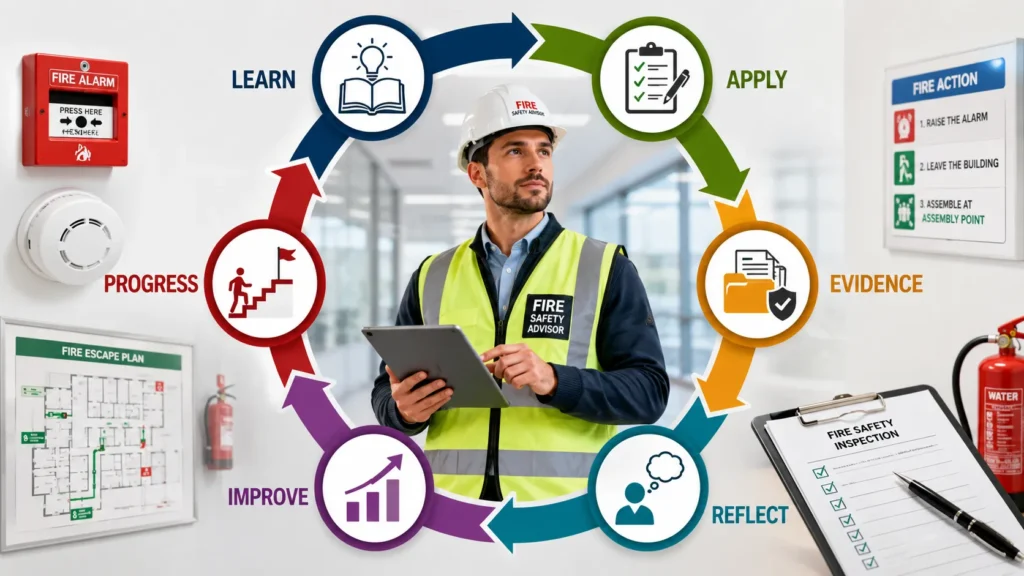
Fire safety is a continually developing professional field. Building design, construction methods, occupancy patterns, fire protection technologies, legislation, guidance, and industry expectations can change throughout a professional’s career.
Continuous Professional Development (CPD) helps Fire Safety Advisors maintain and expand their competence instead of relying only on knowledge acquired earlier in their careers.
Effective CPD may include:
- Formal fire safety qualifications and specialist courses
- Technical workshops and webinars
- Regulatory and standards updates
- Practical workplace projects
- Fire risk assessment experience
- Professional conferences and industry events
- Peer review and mentoring
- Reflective learning
- Technical reading and research
- Emergency exercise evaluation
The strongest CPD activities should have a clear professional outcome. Instead of recording only that a course or seminar was attended, the advisor should consider what was learned, how it applies to current responsibilities, and what improvement resulted.
The cycle becomes:
Learning → Application → Reflection → Evidence → Improvement → Further Learning
This turns CPD from a record-keeping activity into a practical career-development system.
Assess Your Current Fire Safety Competence
Professional development becomes more effective when it begins with an honest assessment of current competence.
A Fire Safety Advisor can create a competency matrix covering the technical, regulatory, communication, leadership, and digital capabilities required for the current role and desired future position.
| Competency Area | Current Position | Evidence | Development Action |
|---|---|---|---|
| Fire risk assessment | Intermediate | Completed assessments | Gain experience with complex premises |
| Fire safety legislation | Intermediate | Training and workplace application | Schedule regulatory reviews |
| Technical reporting | Developing | Inspection reports | Obtain peer review |
| Emergency planning | Intermediate | Drill involvement | Lead exercises |
| Leadership | Developing | Small-team coordination | Lead a fire safety project |
| Digital fire safety | Basic | Inspection software | Develop digital-system knowledge |
| Stakeholder communication | Intermediate | Meetings and briefings | Present findings to senior management |
This exercise helps answer three questions:
Where am I now? → What evidence proves it? → What competence do I need next?
Development can then be targeted toward genuine gaps rather than completing unrelated training.
1. Strengthen Fire Risk Assessment Competence
Fire risk assessment is one of the most important areas of competence for many fire safety professionals.
In England and Wales, the Responsible Person must ensure that an appropriate fire risk assessment is carried out and reviewed, alongside other fire safety responsibilities. The UK Government guidance on fire risk assessments explains the core requirements.
Professional development should move beyond understanding the basic assessment process. Experience should gradually expose the advisor to different occupancies, building layouts, fire hazards, vulnerable occupants, control measures, emergency arrangements, and fire protection systems.
A useful development pathway is:
Basic Assessment Knowledge → Supervised Assessments → Independent Assessments → Complex Premises → Specialist Competence
Fire Safety Advisors should work within the limits of their competence and seek additional expertise when a building or risk falls outside their experience.
2. Keep Up with Fire Safety Legislation and Standards
Fire safety professionals cannot rely indefinitely on knowledge acquired during their initial training.
Professional growth requires a systematic method for monitoring regulatory developments, government guidance, technical standards, industry publications, and lessons emerging from fire safety incidents.
A practical regulatory-development routine might include:
Monitor → Read → Interpret → Compare with Current Practice → Implement Changes → Record Learning
Fire Safety Advisors should understand not only what has changed, but also how the change affects existing assessments, policies, procedures, buildings, or clients.
Keeping a regulatory learning log can provide evidence of CPD while improving professional judgement.
3. Turn Qualifications into Practical Workplace Competence
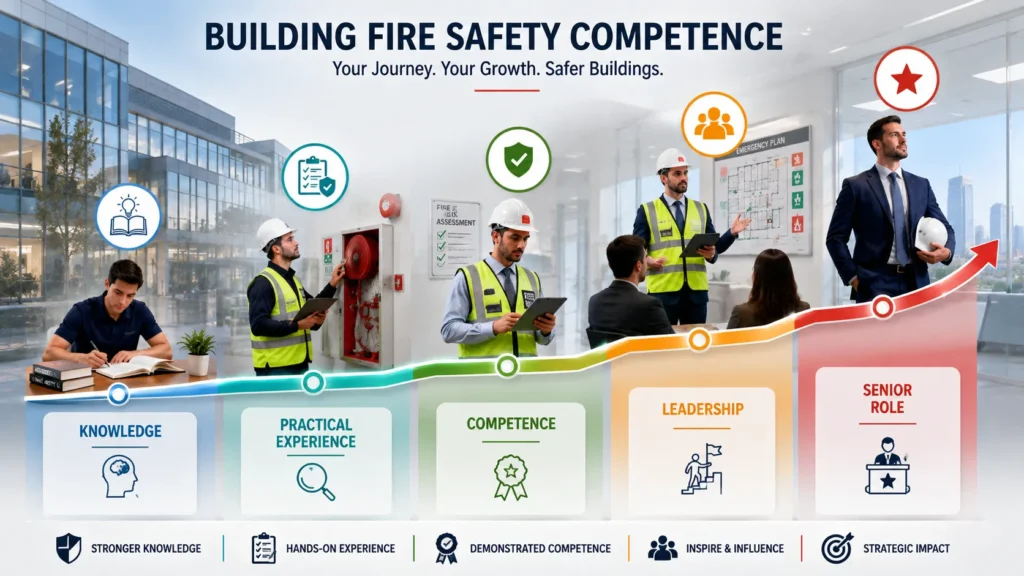
Professional qualifications can provide structured knowledge and demonstrate educational achievement, but professional growth depends on applying that learning.
For example, knowledge about means of escape becomes more valuable when used to evaluate an actual workplace. Knowledge about emergency planning becomes competence when an advisor helps develop, test, review, and improve emergency arrangements.
The development process should therefore follow:
Qualification → Workplace Application → Feedback → Reflection → Improved Practice → Demonstrable Competence
Fire Safety Advisors should actively seek opportunities to apply new learning through inspections, assessments, audits, emergency exercises, training sessions, improvement projects, and technical reports.
This approach helps prevent a common career-development problem: accumulating certificates without developing corresponding practical capability.
4. Gain Experience Across Different Buildings and Risk Environments
Fire safety challenges vary significantly between buildings.
An office, warehouse, hospital, hotel, educational facility, residential building, construction project, and industrial workplace may present very different hazards, occupants, evacuation challenges, and fire protection arrangements.
Exposure to different environments can strengthen professional judgement because it requires an advisor to adapt principles rather than repeatedly apply the same solution.
| Environment | Valuable Development Areas |
|---|---|
| Offices | Evacuation, electrical hazards, staff awareness |
| Hotels | Sleeping risk, evacuation strategy, guest safety |
| Healthcare | Vulnerable occupants, assisted evacuation |
| Construction | Temporary conditions, hot work, changing escape routes |
| Industrial sites | Process hazards, ignition sources, hazardous materials |
| Education | High occupancy, safeguarding, evacuation management |
| Warehousing | Storage arrangements, fire loading, detection and suppression |
Professionals should not assume that experience in one sector automatically demonstrates competence in another. Complex or specialist environments may require additional training, supervision, or technical expertise.
5. Develop Leadership and Stakeholder Management Skills
Technical knowledge alone may not prepare a Fire Safety Advisor for senior responsibilities.
Senior professionals often need to explain risks to directors, facilities teams, contractors, employees, building managers, assessors, and other stakeholders who have different levels of technical understanding.
Effective advisors should be capable of converting technical findings into clear decisions.
For example:
Technical Finding → Explain Risk → Identify Priority → Recommend Control → Assign Responsibility → Verify Action
Leadership also involves influencing fire safety culture.
Rather than simply identifying deficiencies, experienced advisors help organisations understand why improvements are required and how those improvements contribute to safer operations.
Developing presentation, negotiation, meeting management, coaching, conflict-resolution, and decision-making skills can therefore support progression toward senior advisory and management roles.
6. Improve Technical Reporting and Communication
A technically accurate assessment can lose much of its value if findings are difficult to understand.
Professional reports should communicate:
- What was examined
- What hazard or deficiency was identified
- Who may be affected
- Why the issue matters
- How significant the risk is
- What corrective action is recommended
- Which actions require priority
- When further specialist advice may be necessary
Fire Safety Advisors should regularly review their reports for clarity, consistency, evidence, and practical usefulness.
Peer review is particularly valuable. An experienced colleague may identify unclear reasoning, unsupported conclusions, missing evidence, or recommendations that are difficult to implement.
Strong technical communication helps transform an advisor from someone who identifies problems into someone who supports effective risk-based decisions.
7. Build Digital and Emerging Fire Safety Technology Skills
Technology is changing how buildings and fire safety systems are monitored, inspected, documented, and managed.
Fire Safety Advisors increasingly benefit from understanding digital inspection platforms, electronic risk assessment systems, smart detection technologies, connected building systems, digital compliance records, data dashboards, and building information systems.
Professional development does not require every advisor to become an engineer or software specialist. However, professionals should understand how relevant technology affects fire safety decision-making.
A useful learning sequence is:
Understand Technology → Understand Fire Safety Application → Interpret Data → Identify Limitations → Apply Professional Judgement
Human judgement remains essential. Technology should support competent fire safety decision-making rather than replace it.
8. Choose a Fire Safety Specialisation
Career progression does not always mean moving into management.
Some Fire Safety Advisors may achieve greater professional growth by developing specialist expertise.
Potential areas include:
- Fire risk assessment
- Fire safety auditing
- Construction fire safety
- Passive fire protection
- Emergency planning
- Healthcare fire safety
- Industrial fire safety
- Residential fire safety
- Fire safety management
- Fire safety consultancy
Specialisation can help a professional handle more complex work and build deeper expertise in a particular environment or discipline.
The ideal pathway can therefore vary:
General Fire Safety Knowledge → Broad Experience → Identify Strength → Specialist Development → Advanced Responsibility
Professionals should select specialisms according to career goals, existing experience, sector demand, and the level of competence required.
9. Use Mentoring, Networking and Peer Review
Professional development does not need to happen independently.
Mentoring provides access to the judgement and experience of professionals who have already handled complex fire safety situations.
A mentor may help an advisor review technical decisions, understand difficult cases, identify knowledge gaps, plan development activities, and evaluate career options.
Peer review provides another important mechanism for improvement.
Reports, assessments, audit findings, and improvement plans can be reviewed by competent colleagues to identify weaknesses before poor habits become established.
Professional networking can also expose Fire Safety Advisors to different sectors, technologies, technical discussions, and approaches to risk management.
The development cycle becomes:
Experience → Discussion → Feedback → Reflection → Better Judgement
10. Maintain Evidence of CPD and Professional Competence
One of the most overlooked professional-growth strategies is maintaining evidence.
A professional portfolio can demonstrate how knowledge and competence have developed over time.
Evidence may include:
- CPD records
- Qualifications and certificates
- Anonymised assessment examples
- Inspection and audit records
- Technical reports
- Emergency exercise evaluations
- Training delivered
- Project involvement
- Corrective-action records
- Reflective learning notes
- Mentoring records
- Peer-review feedback
The Institution of Fire Engineers’ information on Fire Risk Registration illustrates the importance of demonstrating education, training and experience within professional competence assessment.
The goal should be to show not merely what training was completed, but what the professional can competently do as a result.
Build a Professional Fire Safety Portfolio
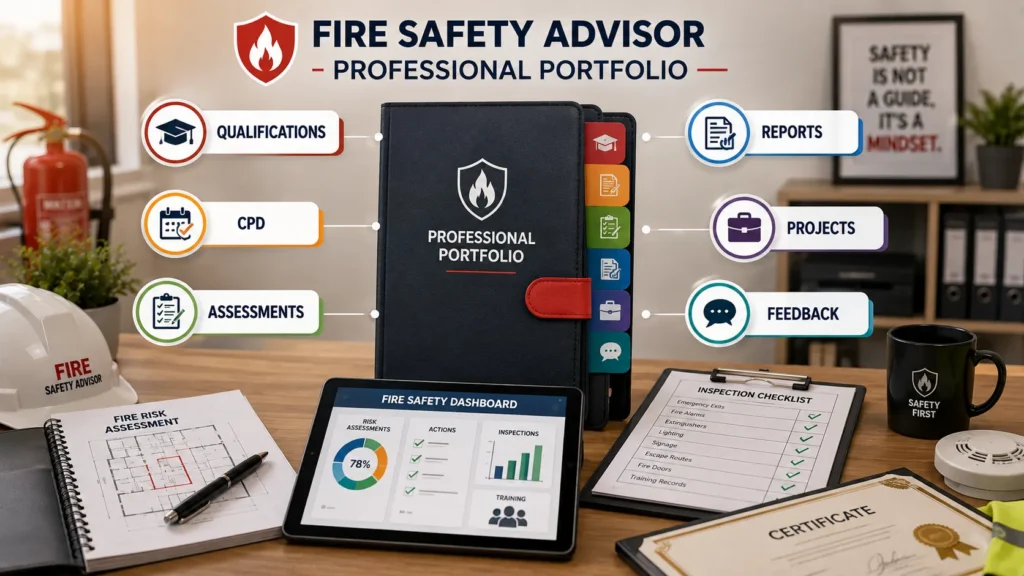
A professional portfolio can become a practical record of career development.
A useful structure is:
Learning Activity → Workplace Application → Evidence → Outcome → Reflection → Development Need
For example, after completing advanced fire risk assessment training, an advisor could record how the knowledge was applied during an assessment, what decisions were made, what feedback was received, and what additional development became necessary.
Over time, the portfolio creates evidence of progression from knowledge acquisition to practical professional competence.
Technical Expertise vs Leadership: What Should You Develop Next?
Not every Fire Safety Advisor needs the same development pathway.
| Technical Development | Leadership Development |
|---|---|
| Advanced fire risk assessment | Team leadership |
| Fire protection knowledge | Stakeholder engagement |
| Regulatory interpretation | Strategic communication |
| Specialist building knowledge | Decision-making |
| Technical auditing | Coaching and mentoring |
| Emergency planning | Project leadership |
Early-career professionals may need greater technical depth, while experienced advisors moving toward management may need stronger leadership and strategic capabilities.
Senior roles often require both.
Common Mistakes That Slow Professional Growth
Professional development can stall when activity is mistaken for progress.
One common mistake is completing multiple courses without creating opportunities to apply the learning.
Another is remaining within one familiar environment for too long. While sector specialisation can be valuable, limited exposure may restrict broader professional judgement.
Other barriers include poor CPD documentation, weak technical writing, avoiding peer feedback, neglecting communication skills, failing to monitor regulatory developments, and pursuing job titles before developing the competence required to perform them.
A better principle is:
Do not measure professional growth only by certificates or years of experience. Measure it by increasing competence, evidence, complexity of work, quality of judgement, and responsibility.
A 12-Month Professional Development Plan for Fire Safety Advisors
Professional development becomes easier to manage when converted into measurable objectives.
| Period | Main Priority | Suggested Action |
|---|---|---|
| Months 1–3 | Competency assessment | Identify strengths, gaps and career objectives |
| Months 4–6 | Technical development | Complete targeted learning and practical projects |
| Months 7–9 | Applied competence | Lead assessments, audits, drills or improvement activities |
| Months 10–12 | Review and progression | Review portfolio and define the next development target |
The cycle can then restart:
Assess → Plan → Learn → Apply → Record → Review → Progress
This creates continuous improvement rather than occasional professional development.
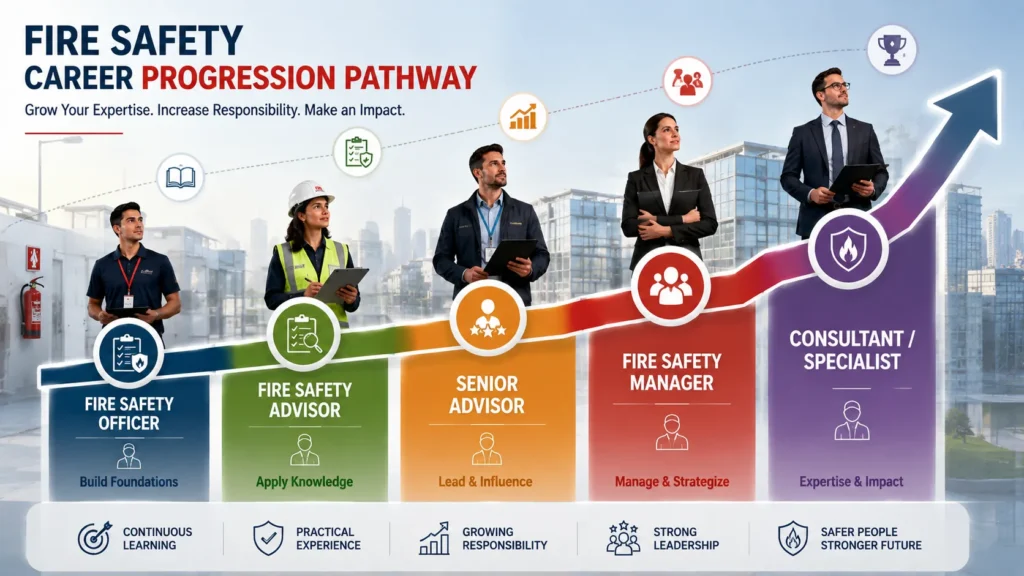
Career Progression for Fire Safety Advisors
There is no single career route within fire safety. Progression depends on qualifications, practical experience, competence, sector, employer requirements, specialist knowledge, and professional goals.
A possible pathway is:
Fire Safety Support Role → Fire Safety Officer → Fire Risk Assessor / Fire Safety Advisor → Senior Fire Safety Advisor → Fire Safety Manager → Fire Safety Consultant or Specialist
Some professionals may move into management, while others may specialise in risk assessment, construction, auditing, passive fire protection, emergency planning, or consultancy.
The most sustainable progression normally occurs when responsibility increases alongside demonstrated competence.
How Professional Qualifications Can Support Career Development
Structured education can help Fire Safety Advisors develop theoretical knowledge, strengthen existing skills, address competency gaps, and prepare for more advanced responsibilities.
- Level 3 Diploma in Fire Watcher
- Level 4 Diploma for Senior Fire Safety Advisor
- Level 5 Diploma in Fire Safety and Risk Management
- Occupational Health and Safety qualifications
Professional qualifications are most valuable when the knowledge gained is subsequently applied, reviewed, documented, and developed through workplace experience.
Future Skills Fire Safety Advisors Should Start Developing
The future Fire Safety Advisor is likely to operate in an increasingly digital, evidence-driven, and multidisciplinary environment.
Useful future-focused development areas include digital inspection systems, smart building technologies, building information management, data interpretation, connected detection systems, remote monitoring, complex-building risk management, multidisciplinary collaboration, and technology-supported compliance management.
Fire safety professionals should also continue developing capabilities that technology cannot easily replace: professional judgement, communication, leadership, ethical decision-making, contextual risk assessment, and the ability to explain complex risk to non-specialists.
The strongest future professional profile is therefore likely to combine:
Technical Competence + Digital Awareness + Regulatory Knowledge + Communication + Leadership + Evidence-Based Professional Judgement
Final Thoughts
Professional growth for Fire Safety Advisors is a continuous process rather than a single qualification or promotion.
Strong career development combines structured education with practical experience, fire risk assessment competence, regulatory awareness, technical communication, leadership, specialist knowledge, mentoring, CPD, and evidence of professional achievement.
The most effective development strategy is simple:
Assess Current Competence → Identify Gaps → Learn → Apply Knowledge → Gather Evidence → Seek Feedback → Reflect → Take Greater Responsibility → Repeat
For Fire Safety Advisors aiming to progress into senior advisory, management, specialist, risk assessment, or consultancy positions, the priority should not simply be accumulating more certificates. The goal should be building demonstrable competence that can be applied confidently and responsibly to increasingly complex fire safety challenges.
By treating professional development as a structured and measurable process, Fire Safety Advisors can strengthen their credibility, adapt to changing industry expectations, and build a sustainable long-term career within the fire safety profession.