
Why Regular Fire Drills Are Essential for Workplace Safety
Fire safety is a fundamental responsibility for every organisation, regardless of its size or industry. While installing fire alarms, extinguishers, emergency lighting, and fire-resistant building materials are all critical elements of workplace protection, these measures alone cannot guarantee a safe evacuation during an emergency. Employees must also know how to respond quickly, calmly, and safely when a fire alarm sounds. This is where regular fire drills play a vital role.
A fire drill is more than a routine exercise or a legal requirement. It is a practical simulation designed to prepare employees, visitors, contractors, and emergency response teams for a real-life fire emergency. By practising evacuation procedures in a controlled environment, organisations can identify weaknesses in their emergency plans, improve communication, reduce panic, and ensure everyone understands their responsibilities.
In the UK, employers have legal obligations under fire safety legislation to provide appropriate emergency procedures and ensure employees receive adequate fire safety information and training. Regular fire drills support these obligations while helping businesses build a stronger safety culture, protect lives, reduce property damage, and maintain business continuity.
Despite their importance, many organisations treat fire drills as a simple compliance exercise. Drills are often predictable, poorly documented, or carried out without meaningful evaluation. This approach limits their effectiveness and can leave workplaces unprepared for real emergencies.
This comprehensive guide explains why regular fire drills are essential for workplace safety, how they improve emergency preparedness, what employers should include in an effective fire drill programme, and how modern technologies such as AI, IoT, and digital evacuation systems are transforming emergency response.
Whether you are an employer, facilities manager, health and safety professional, fire marshal, or someone pursuing a career in fire safety, understanding the value of regular fire drills will help you create a safer and more resilient workplace.
What You’ll Learn in This Guide
| Section | What You’ll Learn |
|---|---|
| Fire Drill Basics | Why fire drills are essential for every workplace |
| Workplace Benefits | How drills improve employee safety and emergency preparedness |
| Fire Drill Process | Step-by-step workplace evacuation workflow |
| UK Legal Responsibilities | Employer duties and compliance considerations |
| Planning Fire Drills | How to organise effective evacuation exercises |
| Performance Evaluation | Measuring the success of a fire drill |
| Modern Technology | AI, IoT, and digital evacuation systems |
| Business Continuity | How drills minimise operational disruption |
| Career Development | Fire safety qualifications and workplace training |
What Is a Fire Drill?
A fire drill is a planned emergency evacuation exercise that allows building occupants to practise leaving the premises safely in response to a simulated fire emergency.
Rather than waiting for a real incident to reveal weaknesses in emergency procedures, organisations use fire drills to test their evacuation plans, communication systems, emergency equipment, and staff readiness under realistic conditions.
During a fire drill, employees follow the same procedures they would during an actual emergency, including:
- Responding immediately to the fire alarm
- Stopping work safely
- Using designated escape routes
- Avoiding lifts
- Proceeding to the assembly point
- Participating in a roll call
- Waiting for further instructions
Although no real fire exists, the objective is to create realistic conditions that allow organisations to evaluate how effectively people and systems perform together.
Why Are Regular Fire Drills Important?
A fire can spread rapidly, leaving occupants with only minutes—or even seconds—to evacuate safely. In these situations, confusion and hesitation can significantly increase the risk of injuries and fatalities.
Regular fire drills help eliminate uncertainty by ensuring employees know exactly what actions to take when every second matters.
Instead of relying on memory during a stressful emergency, employees develop confidence through repeated practice. Familiarity with evacuation routes, alarm signals, assembly points, and emergency procedures enables quicker and safer responses.
Fire drills also provide employers with valuable opportunities to identify issues that might otherwise remain unnoticed until a real emergency occurs.
Examples include:
- Blocked escape routes
- Poor alarm audibility
- Congested stairwells
- Confusing evacuation procedures
- Communication breakdowns
- Accessibility challenges for disabled occupants
Identifying and correcting these issues during practice exercises significantly improves workplace safety.
Fire Drills Save Lives
The primary purpose of every fire drill is to protect human life.
During emergencies, people often experience:
- Stress
- Confusion
- Panic
- Poor decision-making
- Delayed reactions
Regular practice helps replace uncertainty with familiarity.
When employees have rehearsed evacuation procedures multiple times, they are more likely to:
- Recognise alarm signals immediately
- Follow designated escape routes
- Assist colleagues appropriately
- Avoid dangerous behaviours
- Reach assembly points quickly
- Remain calm under pressure
This improvement in behaviour can make a critical difference during a genuine fire emergency.
The Psychology Behind Fire Drills
One topic rarely discussed is how people behave during emergencies.
Human behaviour changes dramatically under stress. Instead of acting logically, many individuals experience:
Decision Paralysis
Some people hesitate because they are unsure whether the alarm is genuine.
Normalcy Bias
Occupants may assume the situation is not serious and continue working rather than evacuating immediately.
Panic
Without prior training, people may rush towards familiar exits instead of using the safest evacuation routes.
Social Influence
Many employees wait to see what colleagues do before taking action themselves.
Regular fire drills reduce these behaviours by creating familiarity and reinforcing correct responses. Repetition develops what is often called muscle memory, enabling people to act more confidently during real emergencies.
Benefits of Regular Fire Drills
Fire drills provide far more than regulatory compliance. They strengthen every aspect of workplace emergency preparedness.
| Benefit | Why It Matters |
|---|---|
| Faster Evacuation | Employees leave the building more quickly and safely. |
| Improved Confidence | Staff understand exactly what to do during emergencies. |
| Reduced Panic | Familiar procedures help occupants remain calm. |
| Better Communication | Fire wardens and managers coordinate more effectively. |
| Safer Workplace | Hazards are identified before real emergencies occur. |
| Legal Compliance | Supports workplace fire safety responsibilities. |
| Business Continuity | Reduces disruption caused by emergency incidents. |
| Continuous Improvement | Each drill identifies opportunities to strengthen procedures. |
Fire Drills vs Real Fire Emergencies
Although fire drills simulate emergency conditions, they also prepare employees for the unexpected.
| Fire Drill | Real Fire Emergency |
|---|---|
| Planned exercise | Unplanned incident |
| Controlled environment | Dynamic and unpredictable |
| No actual fire | Immediate danger |
| Opportunity to learn | Immediate action required |
| Mistakes become lessons | Mistakes can have serious consequences |
| Performance reviewed afterwards | Focus is on life safety |
Practising under controlled conditions allows organisations to improve emergency procedures before lives are placed at risk.
How a Workplace Fire Drill Works
Every successful fire drill follows a structured sequence designed to test emergency procedures from beginning to end.
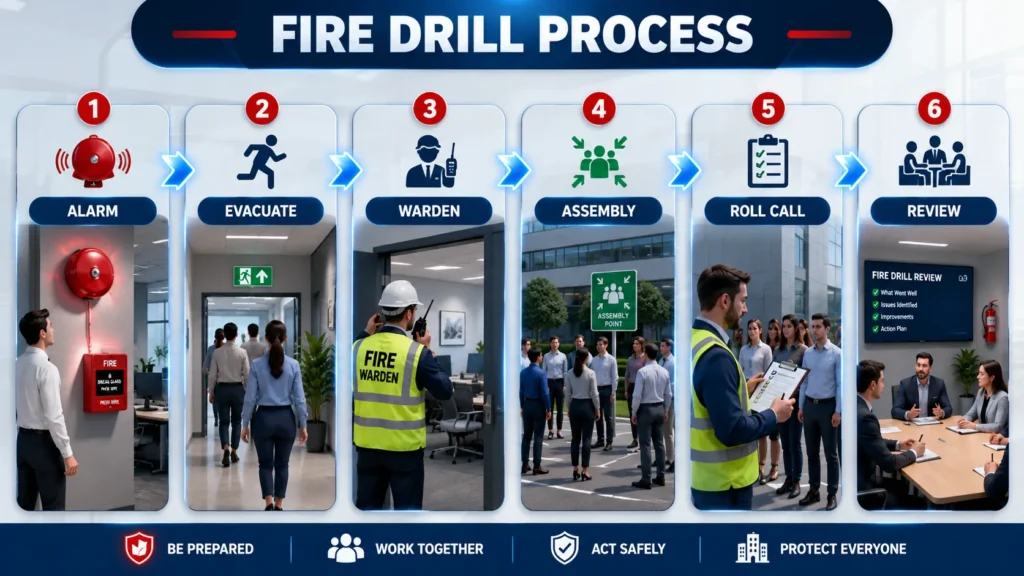
Workplace Fire Drill Workflow
Fire Alarm Sounds
│
▼
Employees Stop Work
│
▼
Evacuate Using Escape Routes
│
▼
Fire Wardens Check Assigned Areas
│
▼
Proceed to Assembly Point
│
▼
Roll Call Conducted
│
▼
Report Missing Persons
│
▼
Debrief and Review
│
▼
Improve Emergency Procedures
Each stage provides valuable information about how effectively the organisation responds under simulated emergency conditions.
What Makes a Fire Drill Effective?
Simply sounding the alarm and asking everyone to leave the building is not enough.
An effective fire drill should evaluate:
- Alarm response times
- Employee behaviour
- Escape route efficiency
- Fire warden performance
- Assembly point organisation
- Communication effectiveness
- Accessibility arrangements
- Emergency documentation
The goal is not merely to complete the drill but to learn from it.
Who Should Participate in Fire Drills?
Every person inside the building should understand how to respond during a fire emergency.
Participants typically include:
- Employees
- Managers
- Fire wardens
- Contractors
- Temporary workers
- Visitors (where practical)
- Security personnel
- Facilities management teams
Including everyone helps ensure no one is overlooked during a real evacuation.
Fire Drills Build a Strong Safety Culture
Organisations with effective fire drill programmes often develop stronger workplace safety cultures.
Employees begin to understand that safety is not simply a legal requirement but a shared responsibility.
Over time, regular drills encourage:
- Greater awareness of fire hazards
- Improved reporting of safety concerns
- Better teamwork during emergencies
- Increased confidence in evacuation procedures
- Stronger leadership from fire wardens and supervisors
This proactive mindset benefits not only fire safety but also broader health and safety performance.
Common Objectives of a Fire Drill
Each fire drill should have clear objectives that can be measured and reviewed afterwards.
Typical objectives include:
- Confirm the fire alarm system functions correctly.
- Test employee response times.
- Verify that escape routes remain unobstructed.
- Assess the effectiveness of emergency communication.
- Ensure assembly points are suitable.
- Evaluate fire warden performance.
- Identify opportunities for improvement.
- Reinforce employee confidence.
- Improve emergency preparedness.
Clearly defined objectives help organisations turn every fire drill into a valuable learning experience rather than simply a routine exercise.
Why Fire Drills Matter More Than Ever
Modern workplaces have become increasingly complex. Open-plan offices, hybrid working arrangements, high-rise buildings, advanced technology, and changing occupancy patterns all create new challenges for emergency evacuation.
Regular fire drills allow organisations to adapt to these changing environments by continuously reviewing and improving emergency procedures.
Rather than treating fire drills as an annual compliance task, forward-thinking organisations view them as an essential investment in employee safety, operational resilience, and long-term business continuity.
UK Legal Responsibilities for Workplace Fire Drills
Fire drills are not simply considered good practice—they form an important part of an organisation’s overall fire safety management system.
In the UK, employers and those responsible for non-domestic premises are expected to establish suitable emergency procedures that enable occupants to evacuate safely if a fire occurs. Regular fire drills help demonstrate that these procedures are practical, effective, and understood by everyone in the workplace.
A comprehensive fire safety programme should include:
- A documented emergency evacuation plan
- Suitable fire detection and warning systems
- Clearly marked escape routes
- Designated assembly points
- Fire safety information for employees
- Fire warden appointments where appropriate
- Regular fire drills
- Routine review and improvement of procedures
Rather than viewing fire drills as a one-time exercise, organisations should treat them as part of a continuous improvement process that evolves alongside workplace changes.
How Often Should Workplaces Conduct Fire Drills?
There is no single frequency suitable for every organisation. The appropriate schedule depends on several factors, including:
- Building size
- Occupancy levels
- Nature of the work
- Fire risks present
- Staff turnover
- Previous drill performance
- Changes to building layout
- Results of the Fire Risk Assessment
Higher-risk workplaces or organisations with frequent staff changes may benefit from more regular evacuation exercises than low-risk office environments.
The most effective organisations review their fire drill programme annually and whenever significant operational changes occur.
Planning an Effective Fire Drill
Successful fire drills begin long before the alarm sounds.
Careful planning ensures that the exercise produces meaningful results rather than becoming a routine event that employees simply expect.
Step 1: Review the Fire Risk Assessment
The Fire Risk Assessment identifies:
- High-risk areas
- Vulnerable occupants
- Escape routes
- Potential evacuation challenges
- Assembly locations
The fire drill should reflect these findings.
Step 2: Define Objectives
Every drill should answer specific questions such as:
- Can everyone hear the alarm?
- Do occupants use the correct exits?
- How long does evacuation take?
- Are fire wardens performing effectively?
- Are disabled persons adequately supported?
- Are visitors accounted for?
Clear objectives make post-drill evaluation much more valuable.
Step 3: Assign Responsibilities
Everyone involved should understand their role before the exercise begins.
Typical responsibilities include:
- Fire Safety Manager
- Fire Wardens
- Supervisors
- Reception Staff
- Security Personnel
- First Aiders
- Facilities Management
Step 4: Prepare Observation Points
Observers should monitor:
- Exit congestion
- Employee behaviour
- Stairwell usage
- Communication
- Assembly point organisation
- Timing
Objective observations provide valuable data for future improvements.
Roles and Responsibilities During a Fire Drill
Fire safety is a shared responsibility, but different individuals have different duties during an evacuation.
| Role | Responsibilities |
|---|---|
| Employer | Provide emergency procedures, training, and fire drills |
| Fire Safety Manager | Plan, coordinate, and evaluate drills |
| Fire Warden | Check assigned areas, assist evacuation, report issues |
| Supervisors | Ensure team members evacuate promptly |
| Reception Staff | Account for visitors and contractors |
| Employees | Follow evacuation procedures immediately |
| Visitors | Follow staff instructions to the assembly point |
| Facilities Team | Monitor systems and support emergency procedures |
Clearly defined responsibilities reduce confusion and improve evacuation efficiency.
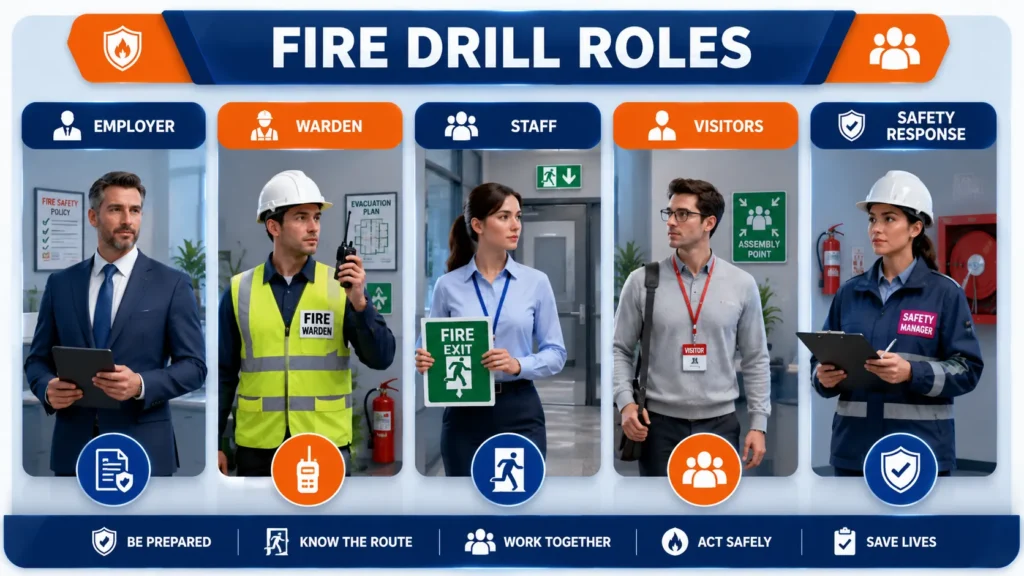
Fire Warden Responsibilities
Fire wardens play a critical role during workplace evacuations.
Typical responsibilities include:
- Sweeping assigned areas
- Checking toilets and meeting rooms
- Assisting vulnerable occupants
- Closing doors where appropriate
- Reporting hazards
- Confirming evacuation completion
- Communicating with emergency services if required
Fire wardens should receive appropriate training and participate in every fire drill.
Industry-Specific Fire Drill Strategies
Not every workplace presents the same fire risks.
Effective fire drills should reflect the environment in which they take place.
Office Buildings
Office environments often contain:
- Open-plan workspaces
- Meeting rooms
- Kitchens
- IT equipment
Fire drills should focus on:
- Stairwell management
- Visitor evacuation
- Hybrid workers
- High occupancy areas
Manufacturing Facilities
Manufacturing sites may contain:
- Machinery
- Flammable materials
- Chemical storage
- Multiple production zones
Drills should evaluate:
- Equipment shutdown procedures
- High-risk process areas
- Contractor evacuation
- Hazard isolation
Construction Sites
Construction environments change frequently.
Fire drills should account for:
- Temporary escape routes
- Changing work areas
- Mobile workforce
- Plant and machinery
- Hot works
Hospitals
Healthcare facilities require more complex evacuation planning.
Drills should include:
- Progressive horizontal evacuation
- Patient prioritisation
- Clinical equipment
- Staff coordination
Hotels
Hotels present unique challenges because occupants may be unfamiliar with the building.
Fire drills should evaluate:
- Guest communication
- Staff coordination
- Multiple exits
- Night-time procedures
Warehouses
Warehouse drills should focus on:
- Large travel distances
- Forklift traffic
- Storage layouts
- High shelving
- Loading bays
Schools and Universities
Educational facilities should assess:
- Classroom evacuation
- Student accountability
- Assembly supervision
- Visitor management
- Special educational needs
Retail Stores
Retail businesses should consider:
- Customer behaviour
- Cash handling
- Stockrooms
- Peak shopping periods
- Multiple exits
Measuring Fire Drill Success
One of the biggest weaknesses in competitor articles is the absence of measurable performance indicators.
Every fire drill should produce data that helps organisations improve future performance.
Fire Drill Performance Metrics
| Performance Indicator | Why It Matters |
|---|---|
| Alarm Response Time | Measures how quickly occupants react |
| Total Evacuation Time | Indicates overall evacuation efficiency |
| Assembly Time | Evaluates organisation at the assembly point |
| Roll Call Accuracy | Confirms accountability for occupants |
| Exit Congestion | Identifies bottlenecks |
| Communication Effectiveness | Assesses information sharing |
| Fire Warden Performance | Reviews leadership during evacuation |
| Visitor Accountability | Ensures non-employees are included |
| Accessibility Support | Evaluates assistance for disabled occupants |
| Improvement Actions | Measures continuous learning |
Recording these metrics over time allows organisations to identify trends and demonstrate continual improvement.
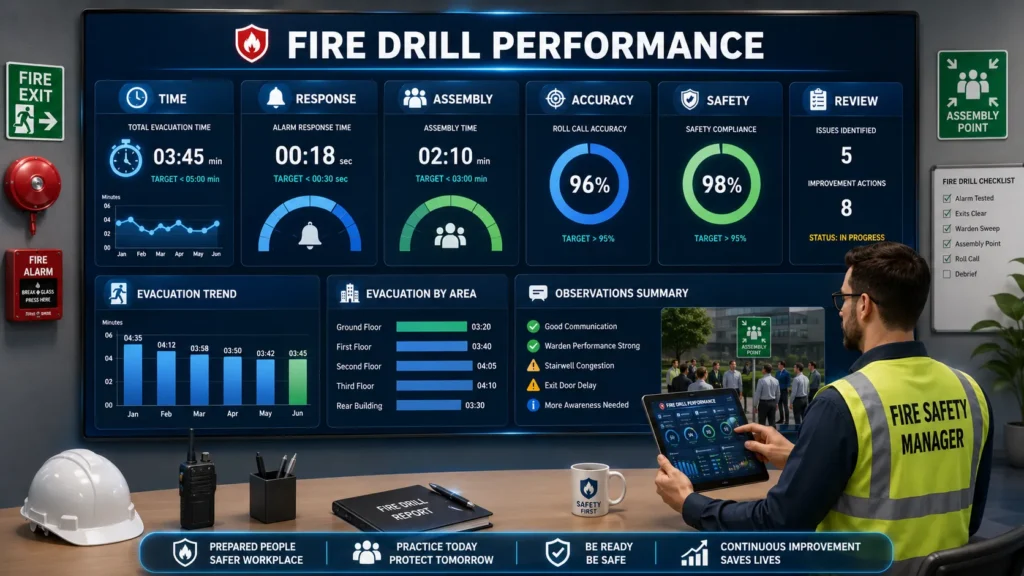
Fire Drill Observation Checklist
Observers should evaluate multiple aspects of the evacuation.
| Observation Area | Review Points |
|---|---|
| Alarm System | Audible throughout building |
| Escape Routes | Clear and unobstructed |
| Exit Doors | Open correctly |
| Employee Behaviour | Calm and organised |
| Fire Wardens | Active and visible |
| Visitors | Escorted appropriately |
| Assembly Point | Well organised |
| Roll Call | Accurate and timely |
| Emergency Communication | Clear and effective |
| Documentation | Completed after drill |
Using a structured checklist ensures no important observations are overlooked.
Common Fire Drill Mistakes
Many organisations conduct fire drills regularly but still make avoidable mistakes that reduce their effectiveness.
Predictable Drill Times
Employees quickly recognise routine schedules.
Occasionally varying the timing creates more realistic conditions.
Ignoring Visitors
Visitors and contractors should always be included in evacuation procedures.
Reception staff should maintain accurate visitor records.
No Roll Call
Without accountability, organisations cannot confirm whether everyone has reached safety.
Blocked Escape Routes
Fire drills often reveal temporary obstructions that may otherwise go unnoticed.
Poor Communication
Unclear instructions create confusion and delays.
Fire wardens should communicate confidently throughout the exercise.
Failure to Review Results
Completing the drill is only the beginning.
Without evaluation, valuable lessons are lost.
Not Supporting Vulnerable Occupants
Emergency plans should include appropriate arrangements for individuals with mobility, sensory, or other accessibility needs.
Continuous Improvement After Every Fire Drill
The most successful organisations treat each fire drill as an opportunity to improve.
After every exercise, conduct a structured debrief.
Review Questions
- What worked well?
- What delayed evacuation?
- Were all alarms audible?
- Were escape routes effective?
- Did everyone reach the assembly point?
- Were visitors accounted for?
- Were communication procedures effective?
- What improvements should be implemented?
Documenting these findings supports continuous improvement and strengthens future emergency preparedness.
Fire Drill Continuous Improvement Cycle
Plan Fire Drill
│
▼
Train Employees
│
▼
Conduct Fire Drill
│
▼
Observe Performance
│
▼
Review Results
│
▼
Improve Procedures
│
▼
Repeat Regularly
This cycle helps organisations build increasingly effective emergency response capabilities over time.
Why Continuous Practice Builds Safer Workplaces
One successful fire drill does not guarantee long-term preparedness. Workplaces change constantly—new employees join, office layouts are modified, equipment is relocated, and occupancy levels fluctuate. Each of these changes can affect evacuation procedures.
Regular planning, realistic exercises, measurable performance reviews, and continuous improvement help ensure emergency plans remain effective as organisations evolve.
How Technology Is Transforming Workplace Fire Drills
Workplace fire drills are evolving beyond traditional alarm tests and manual headcounts. Advances in digital technology are enabling organisations to plan, monitor, and evaluate evacuation exercises with greater accuracy and efficiency.
Modern fire safety systems now combine intelligent detection, real-time communication, and data analysis to improve emergency preparedness and support continuous improvement.
Rather than replacing human decision-making, these technologies help fire wardens, facilities managers, and emergency coordinators make faster and more informed decisions during both drills and real emergencies.
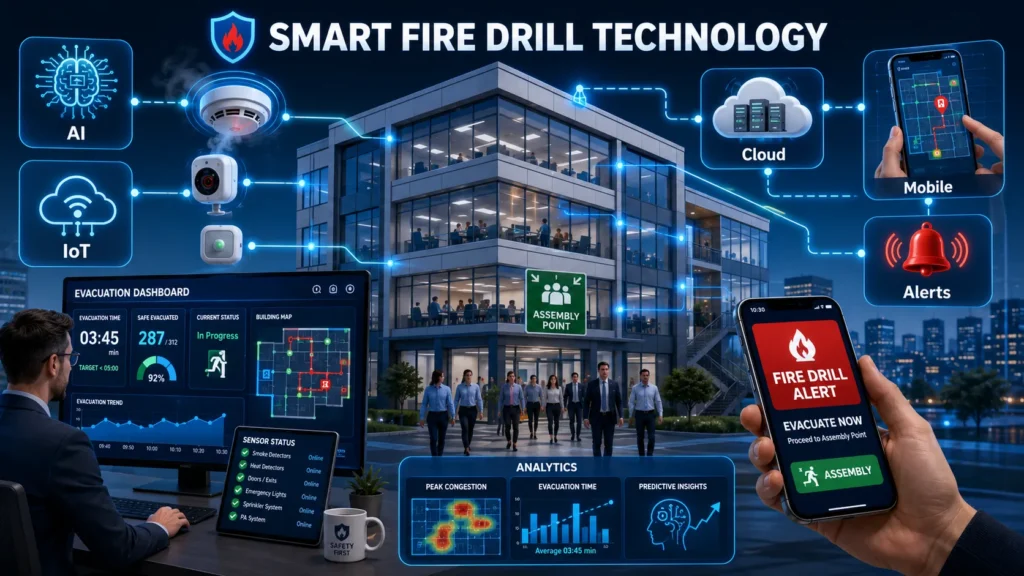
Artificial Intelligence (AI)
Artificial Intelligence is beginning to play an important role in workplace fire safety.
AI-powered systems can:
- Analyse evacuation behaviour
- Detect evacuation bottlenecks
- Predict high-risk areas
- Reduce false alarms
- Generate performance reports
- Recommend improvements after each drill
Over time, AI learns from previous exercises, allowing organisations to continuously refine their emergency procedures.
Internet of Things (IoT)
IoT-enabled fire safety devices communicate with one another in real time.
Connected devices include:
- Smoke detectors
- Heat detectors
- Fire alarm control panels
- Emergency lighting
- Door release systems
- Occupancy sensors
This connectivity provides a live overview of building status during evacuation exercises.
Mobile Emergency Notifications
Many organisations now use mobile applications that instantly notify employees when emergency procedures begin.
Benefits include:
- Faster communication
- Guidance to assembly points
- Real-time status updates
- Visitor notifications
- Emergency instructions
- Drill completion alerts
This is particularly valuable for large campuses and multi-building workplaces.
Cloud-Based Fire Safety Platforms
Cloud technology allows organisations to:
- Store fire drill records
- Schedule future drills
- Generate compliance reports
- Track corrective actions
- Monitor multiple locations
- Share information across departments
Digital record-keeping also simplifies audits and demonstrates ongoing commitment to workplace safety.
Smart Buildings and Fire Drill Integration
Modern commercial buildings increasingly integrate fire safety systems with other building technologies.
Examples include:
- Building Management Systems (BMS)
- CCTV monitoring
- Access control systems
- Smoke extraction
- HVAC shutdown
- Digital signage
- Lift control
- Emergency lighting
During a fire drill, these integrated systems automatically coordinate actions to simulate a realistic emergency response.
This provides a more accurate assessment of organisational readiness.
Fire Drills vs Fire Safety Training
Many people assume fire drills and fire safety training are the same. In reality, they serve different but complementary purposes.
Fire safety training provides the knowledge employees need, while fire drills allow them to apply that knowledge in a practical situation.
Fire Drills vs Fire Safety Training
| Fire Drills | Fire Safety Training |
|---|---|
| Practical exercise | Classroom or online learning |
| Simulates an emergency | Explains fire safety principles |
| Tests evacuation procedures | Teaches emergency procedures |
| Measures organisational readiness | Develops employee knowledge |
| Evaluates behaviour | Builds awareness |
| Identifies weaknesses | Explains legal responsibilities |
| Improves teamwork | Improves understanding |
| Supports continuous improvement | Supports long-term competence |
The most effective organisations combine both approaches to create a comprehensive fire safety programme.
Fire Drills Strengthen Business Continuity
Fire drills do more than protect lives—they also support business resilience.
A well-prepared workforce can significantly reduce operational disruption during an emergency.
Business Benefits Include
- Faster recovery after incidents
- Reduced downtime
- Better protection of assets
- Improved customer confidence
- Lower financial losses
- Stronger regulatory compliance
- Enhanced organisational reputation
Businesses that regularly review and improve emergency procedures are often better equipped to recover quickly following unexpected events.
Building a Strong Fire Safety Culture
Fire safety should never be viewed solely as the responsibility of the health and safety department.
Every employee contributes to creating a safer workplace.
A strong fire safety culture encourages people to:
- Report hazards immediately
- Keep escape routes clear
- Participate actively in drills
- Follow emergency procedures
- Support colleagues during evacuations
- Take personal responsibility for workplace safety
When safety becomes part of everyday behaviour rather than an occasional activity, organisations become significantly more resilient.
Practical Tips for Improving Future Fire Drills
Organisations looking to improve their fire drill programme should consider the following best practices:
- Conduct realistic evacuation scenarios.
- Vary drill times to avoid predictability.
- Include visitors and contractors.
- Test different escape routes.
- Practise alternative evacuation procedures.
- Record evacuation times.
- Review communication effectiveness.
- Debrief employees after every drill.
- Update emergency plans regularly.
- Repeat exercises throughout the year.
Small improvements after each drill create significant long-term improvements in emergency preparedness.
Fire Drill Readiness Checklist
Before conducting a fire drill, ensure the following items have been reviewed.
| Checklist Item | Status |
|---|---|
| Fire Risk Assessment reviewed | ✓ |
| Emergency procedures updated | ✓ |
| Fire wardens available | ✓ |
| Alarm system operational | ✓ |
| Escape routes unobstructed | ✓ |
| Assembly point identified | ✓ |
| Visitors recorded | ✓ |
| Vulnerable persons supported | ✓ |
| Observation team assigned | ✓ |
| Post-drill review scheduled | ✓ |
Using a structured checklist helps ensure every exercise delivers meaningful results.
Career Opportunities in Fire Safety
Understanding fire drills, emergency planning, and workplace fire safety can support a wide range of professional careers.
Growing demand for fire safety professionals has created opportunities across construction, facilities management, education, healthcare, manufacturing, and public services.
Career options include:
| Career | Primary Responsibilities |
|---|---|
| Fire Risk Assessor | Conducts fire risk assessments and recommends improvements |
| Fire Safety Advisor | Develops workplace fire safety strategies |
| Fire Marshal | Coordinates evacuation and emergency response |
| Health and Safety Officer | Oversees workplace safety compliance |
| Facilities Manager | Manages building safety systems |
| Building Safety Manager | Coordinates compliance across occupied buildings |
| Construction Site Manager | Implements fire safety controls on site |
| Fire Safety Trainer | Delivers workplace fire safety training |
| Compliance Officer | Ensures legal and regulatory compliance |
| Emergency Planning Officer | Develops organisational emergency response plans |
Fire safety knowledge is also valuable for professionals working in property management, education, engineering, healthcare, hospitality, logistics, and local government.
Recommended Fire Safety Courses at Inspire College
Readers who want to develop professional knowledge or advance their careers can explore relevant programmes available through Inspire College.
| Course Category | Purpose |
|---|---|
| Fire Safety Courses | Build a strong foundation in workplace fire safety principles |
| Fire Risk Assessment Courses | Learn to identify, assess, and manage fire hazards |
| Fire Marshal Training | Develop emergency leadership and evacuation skills |
| Fire Safety Advisor Qualification | Gain advanced knowledge of fire safety management |
These programmes support both individual career development and organisational competence by providing practical, industry-relevant fire safety education.
Fire Drills and Continuous Workplace Improvement
Organisations should view every fire drill as an opportunity to improve rather than simply demonstrate compliance.
A successful fire drill should generate actionable insights that strengthen:
- Emergency procedures
- Employee awareness
- Fire warden performance
- Communication systems
- Evacuation efficiency
- Business resilience
By reviewing lessons learned after each exercise and implementing improvements, businesses can continually enhance their emergency preparedness and create safer workplaces.
Conclusion
Regular fire drills are one of the most effective ways to protect employees, visitors, and business operations from the devastating consequences of fire. While fire alarms, extinguishers, emergency lighting, and evacuation plans are essential components of workplace fire safety, they are only truly effective when people know how to respond confidently and correctly during an emergency.
Throughout this guide, we’ve explored how regular fire drills improve evacuation speed, reduce panic, strengthen communication, support legal compliance, and reinforce a positive safety culture. We’ve also examined the importance of careful planning, measurable performance indicators, industry-specific evacuation strategies, and continuous improvement through structured reviews. As workplaces become more connected, technologies such as AI, IoT, cloud-based monitoring, and smart building integration are further enhancing the effectiveness of fire drills by providing valuable insights and supporting faster, more informed decision-making.
Ultimately, fire drills should never be viewed as a routine box-ticking exercise. They are practical learning opportunities that help organisations identify weaknesses before a real emergency occurs. Businesses that invest in regular fire drills, ongoing fire safety training, and continual review of emergency procedures are better prepared to protect lives, minimise disruption, and maintain operational resilience.
For individuals looking to build expertise in workplace fire safety, developing knowledge through recognised fire safety qualifications can open the door to rewarding careers in fire risk assessment, fire safety management, health and safety, facilities management, and emergency planning. By combining professional training with regular practical exercises, organisations and individuals can create safer workplaces and contribute to a stronger culture of prevention, preparedness, and continuous improvement.