
Fire Alarm Systems Explained for Beginners: The Ultimate Guide
Fire safety is one of the most important aspects of protecting lives, property, and business continuity. Whether in homes, offices, schools, hospitals, hotels, or industrial facilities, a reliable fire alarm system serves as the first line of defence against fire emergencies. By detecting smoke, heat, or flames at an early stage, a fire alarm system provides occupants with valuable time to evacuate safely and enables emergency responders to act before a small incident escalates into a major disaster.
For beginners, however, understanding how fire alarm systems work can feel overwhelming. Terms such as fire alarm control panel, manual call point, addressable system, and BS 5839 are often used without clear explanations, leaving many property owners, facility managers, and aspiring fire safety professionals confused about what they actually mean.
This comprehensive beginner’s guide explains everything in simple language. You’ll learn what a fire alarm system is, how its components work together, the different types of systems available, and why choosing the right solution is essential for safety and legal compliance in the UK. Whether you’re looking to improve your knowledge, prepare for a fire safety qualification, or make informed decisions for your workplace, this guide provides practical insights based on current industry best practices.
Unlike many online resources that focus only on equipment or installation, this guide also explains the role of fire alarm systems in modern fire risk management, introduces UK standards such as BS 5839, and highlights how technological innovations such as smart monitoring, IoT, and AI are transforming fire detection.
By the end of this guide, you’ll have a clear understanding of fire alarm systems and how they contribute to safer buildings, better emergency preparedness, and regulatory compliance.
What You’ll Learn in This Guide
| Section | What You’ll Learn |
|---|---|
| Fire Alarm Basics | What a fire alarm system is and why it matters |
| System Operation | How a fire alarm detects and responds to fire |
| Main Components | The purpose of every major device |
| System Types | Conventional, Addressable, Wireless and Hybrid |
| Fire Alarm Categories | Understanding L1–L5 and P1–P2 |
| UK Standards | BS 5839 and legal responsibilities |
| Installation & Maintenance | Best practices for long-term reliability |
| Smart Technology | AI, IoT and cloud-connected fire alarms |
| Career Opportunities | Fire safety careers and professional training |
What Is a Fire Alarm System?
A fire alarm system is an integrated network of electronic devices designed to detect the early signs of fire and warn building occupants before the situation becomes life-threatening. These systems continuously monitor the environment for smoke, heat, flames, or manual activation and trigger audible and visual alarms when a potential fire is detected.
The primary objective of a fire alarm system is simple:
- Protect human life
- Reduce property damage
- Support rapid emergency response
- Improve evacuation efficiency
- Minimise business disruption
Modern fire alarm systems do far more than sound an alarm. Depending on the building and system design, they can automatically:
- Notify emergency services
- Unlock emergency exits
- Shut down ventilation systems
- Activate smoke control systems
- Release fire doors
- Control lifts during emergencies
- Integrate with sprinkler systems
- Send real-time alerts to facility managers through mobile applications
This integration makes fire alarm systems a critical part of an overall fire safety strategy rather than just a standalone warning device.
Why Are Fire Alarm Systems So Important?
Many fires start unnoticed. Electrical faults, unattended cooking, overheating equipment, flammable materials, or human error can all lead to rapidly developing fires. Without early detection, valuable minutes may be lost before anyone becomes aware of the danger.
A properly designed fire alarm system significantly increases the chances of preventing injuries and limiting damage by detecting fire in its earliest stages.
Key Benefits of Fire Alarm Systems
| Benefit | Why It Matters |
|---|---|
| Early Detection | Identifies smoke or heat before fire spreads |
| Faster Evacuation | Gives occupants more time to leave safely |
| Reduced Property Damage | Early response limits fire growth |
| Legal Compliance | Helps organisations meet UK fire safety regulations |
| Business Continuity | Reduces downtime after fire incidents |
| Lower Financial Losses | Minimises repair costs and operational disruption |
| Greater Peace of Mind | Provides continuous monitoring 24/7 |
For businesses, fire alarm systems are not simply recommended—they are often a legal requirement under UK fire safety legislation. Employers and responsible persons have a duty to ensure that suitable fire detection and warning systems are installed, maintained, and regularly tested to protect everyone who uses the building.
Where Are Fire Alarm Systems Used?
Fire alarm systems are installed in almost every type of building because the risk of fire exists in every environment.
Common applications include:
- Residential homes
- Apartment buildings
- Schools and universities
- Hospitals and healthcare facilities
- Hotels and hospitality venues
- Office buildings
- Shopping centres
- Warehouses
- Manufacturing plants
- Construction sites
- Data centres
- Airports
- Museums
- Libraries
- Government buildings
Different buildings require different fire alarm solutions based on their size, occupancy, fire hazards, evacuation strategy, and legal requirements. A small retail shop will have different detection needs compared to a hospital or high-rise office building.
How Does a Fire Alarm System Work?
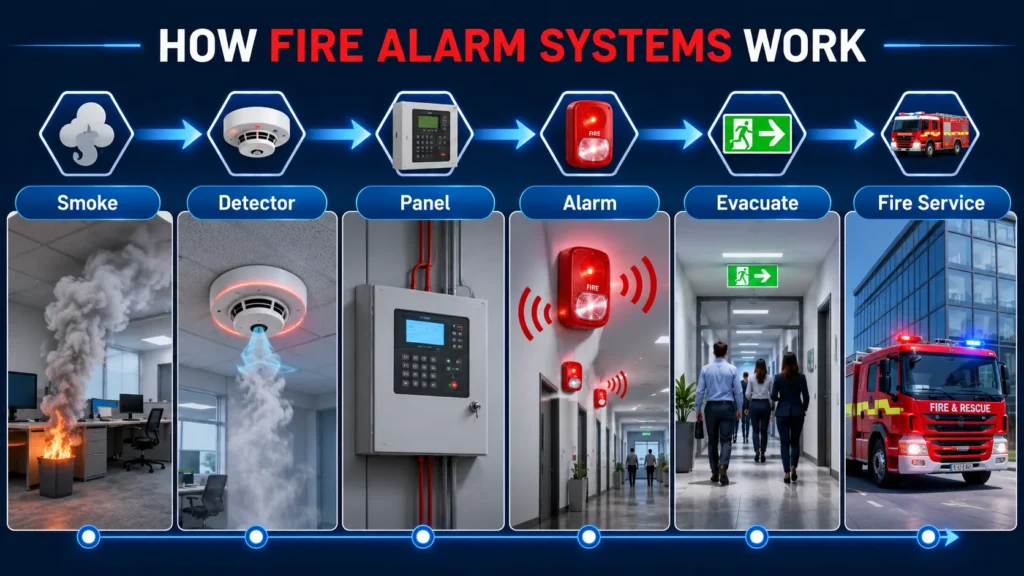
Although fire alarm systems may appear complex, their operation follows a logical sequence. Every component has a specific role, and together they provide continuous protection from the moment a fire begins until occupants have been warned and emergency procedures are activated.
Fire Alarm System Workflow
Fire Starts
│
▼
Smoke / Heat / Flame Detected
│
▼
Detector Sends Signal
│
▼
Fire Alarm Control Panel
│
▼
System Verifies Alarm
│
▼
Sirens + Flashing Beacons Activate
│
▼
Occupants Begin Evacuation
│
▼
Emergency Systems Activate
(Fire Doors • Smoke Control • Lifts)
│
▼
Monitoring Centre / Fire Service Notified
│
▼
Emergency Response Begins
This sequence typically occurs within seconds, demonstrating why reliable detection and routine maintenance are essential.
Understanding the Main Components of a Fire Alarm System
Every fire alarm system consists of several interconnected devices. Each component performs a specific function that contributes to the overall effectiveness of the system.
Fire Alarm Control Panel (FACP)
The Fire Alarm Control Panel is the central brain of the entire system. It receives information from detectors and manual call points, analyses incoming signals, activates alarms, displays the location of the incident, and communicates with other building safety systems.
Modern control panels can monitor hundreds or even thousands of devices across large commercial properties.
Smoke Detectors
Smoke detectors identify airborne smoke particles before flames become fully established.
Common technologies include:
- Optical (photoelectric) detectors
- Ionisation detectors
- Multi-sensor detectors
Optical detectors are widely used because they respond well to slow, smouldering fires commonly found in offices, homes, hotels, and educational buildings.
Heat Detectors
Heat detectors respond when temperatures exceed predetermined limits or rise rapidly.
They are particularly suitable for environments where smoke detectors may produce false alarms, including:
- Kitchens
- Boiler rooms
- Workshops
- Garages
- Industrial production areas
Manual Call Points
Often referred to as break-glass units, manual call points allow occupants to activate the fire alarm immediately if they discover a fire before automatic detectors respond.
These devices are normally positioned near exits and escape routes to enable quick activation during evacuation.
Alarm Sounders and Visual Warning Devices
Once activated, sounders produce loud warning signals while visual beacons provide flashing lights for occupants who may have hearing impairments or where ambient noise levels are high.
Together they ensure everyone receives a clear evacuation warning regardless of their location.
Emergency Power Supply
Fire alarm systems continue operating during power failures through rechargeable backup batteries.
These batteries automatically supply power whenever the main electrical supply is interrupted, ensuring continuous protection during emergencies.
How the Components Work Together
The effectiveness of a fire alarm system depends on seamless communication between all devices.
| Component | Primary Function |
|---|---|
| Smoke Detector | Detects smoke particles |
| Heat Detector | Detects excessive temperature |
| Manual Call Point | Allows manual alarm activation |
| Fire Alarm Control Panel | Processes all incoming signals |
| Alarm Sounders | Warn occupants with audible alarms |
| Visual Beacons | Provide flashing visual alerts |
| Emergency Batteries | Maintain operation during power outages |
| Communication Module | Sends alerts to monitoring centres or emergency contacts |
Instead of working independently, these devices continuously exchange information, creating a coordinated system capable of detecting, confirming, and responding to fire emergencies within seconds.
Why Early Detection Saves Lives
Research consistently shows that the earlier a fire is detected, the greater the likelihood of safe evacuation and reduced damage. Fires can develop rapidly, particularly where combustible materials, electrical equipment, or flammable liquids are present.
An effective fire alarm system helps by:
- Detecting danger before flames spread extensively
- Providing occupants with valuable evacuation time
- Supporting emergency responders with faster notification
- Reducing smoke exposure, which is a leading cause of fire-related fatalities
- Limiting damage to buildings, equipment, and business operations
Early warning not only protects lives but also reduces recovery costs, insurance claims, and operational downtime, making fire alarm systems one of the most valuable investments in any fire safety strategy.
Why Learning About Fire Alarm Systems Matters
Whether you are a homeowner, employer, facilities manager, health and safety professional, or someone considering a career in fire safety, understanding how fire alarm systems operate is an essential foundation.
A strong understanding enables you to:
- Make informed decisions when selecting fire protection systems.
- Recognise the importance of regular inspection, testing, and maintenance.
- Understand your responsibilities under UK fire safety legislation.
- Improve workplace fire safety awareness.
- Build knowledge for professional qualifications and career progression in the fire safety sector.
Types of Fire Alarm Systems
Not all fire alarm systems are designed in the same way. The most suitable system depends on several factors, including the size of the building, the number of occupants, the level of fire risk, the complexity of the layout, and the applicable legal requirements.
Understanding the different types of fire alarm systems helps property owners, employers, and fire safety professionals select the most effective solution for protecting people and property.
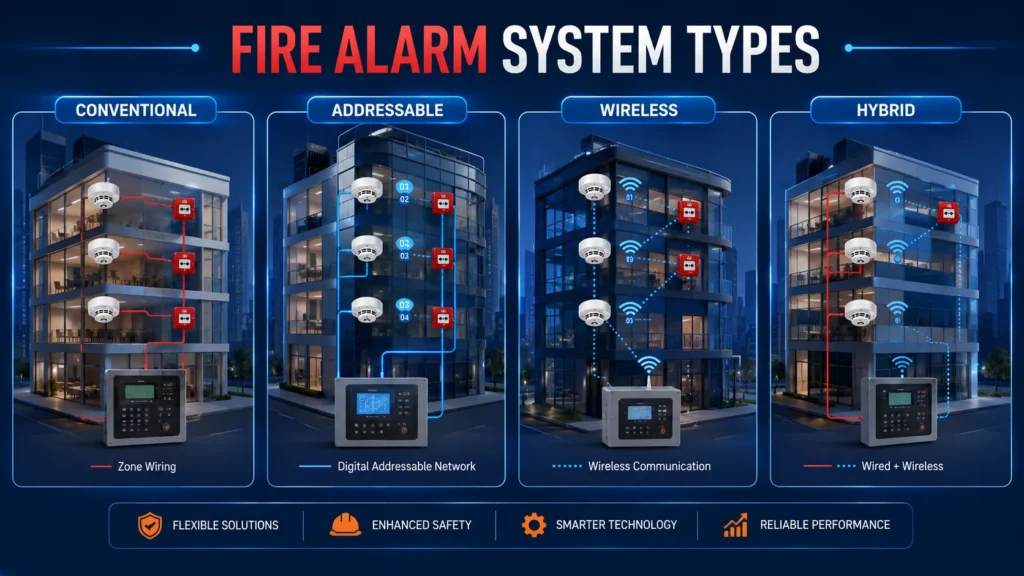
The four main types of fire alarm systems are:
- Conventional Fire Alarm Systems
- Addressable Fire Alarm Systems
- Wireless Fire Alarm Systems
- Hybrid Fire Alarm Systems
Each offers unique advantages and is suited to different applications.
Conventional Fire Alarm Systems
A conventional fire alarm system divides a building into several zones. Each detector and manual call point within a zone is connected to the fire alarm control panel using dedicated wiring.
When a detector activates, the control panel identifies the affected zone but does not pinpoint the exact device that triggered the alarm.
For example, if Zone 3 includes ten offices, the panel will indicate that the alarm originated in Zone 3, requiring staff to inspect that area to locate the fire.
Best Suited For
- Small offices
- Retail shops
- Restaurants
- Small schools
- Residential buildings
- Community centres
Advantages
- Cost-effective installation
- Simple design
- Easy to operate
- Reliable for smaller premises
- Lower equipment costs
Limitations
- Cannot identify the exact detector
- More wiring required
- Less suitable for large or complex buildings
- Longer investigation time during emergencies
Addressable Fire Alarm Systems
An addressable fire alarm system assigns a unique digital address to every connected device. Instead of reporting only the affected zone, the system identifies the exact detector or manual call point that has activated.
For example, the control panel may display:
“Second Floor – Meeting Room 5 – Smoke Detector 12 Activated.”
This precise information allows emergency responders to react more quickly and accurately.
Addressable systems also monitor the health of each connected device, helping maintenance teams identify faults before they become serious.
Best Suited For
- Hospitals
- Hotels
- Universities
- Airports
- Shopping centres
- Office complexes
- Industrial facilities
- High-rise buildings
Advantages
- Exact device identification
- Faster emergency response
- Advanced diagnostics
- Easier maintenance
- Greater scalability
- Reduced downtime
Limitations
- Higher installation cost
- Requires specialist programming
- More advanced maintenance procedures
Wireless Fire Alarm Systems
Wireless fire alarm systems communicate using secure radio signals rather than extensive wiring.
Each detector, sounder, and manual call point transmits information directly to the control panel without requiring traditional cable installations.
These systems are particularly valuable where wiring would be difficult, expensive, or disruptive.
Best Suited For
- Historic buildings
- Listed properties
- Museums
- Heritage sites
- Temporary buildings
- Construction projects
- Building renovations
Advantages
- Minimal installation disruption
- Faster installation
- Flexible expansion
- Reduced cabling costs
- Ideal for occupied buildings
Limitations
- Higher equipment costs
- Battery replacement required
- Radio signal surveys necessary
- Potential interference in certain environments
Hybrid Fire Alarm Systems
Hybrid systems combine wired and wireless technologies within a single fire alarm network.
For example, an office extension can use wireless detectors while the original building continues operating with wired devices.
This approach allows organisations to modernise existing systems without replacing the entire installation.
Best Suited For
- Building extensions
- Large campuses
- Multi-building facilities
- Renovation projects
- Mixed-use developments
Advantages
- Flexible design
- Easier upgrades
- Cost-effective expansion
- Compatible with existing infrastructure
Limitations
- More complex system design
- Specialist configuration required
Conventional vs Addressable vs Wireless vs Hybrid
Choosing the right system depends on your building’s size, complexity, budget, and operational requirements.
| Feature | Conventional | Addressable | Wireless | Hybrid |
|---|---|---|---|---|
| Exact Detector Identification | No | Yes | Yes | Yes |
| Zone Identification | Yes | Yes | Yes | Yes |
| Installation Cost | Low | Medium–High | Medium–High | Medium |
| Maintenance | Simple | Advanced | Moderate | Moderate |
| Scalability | Limited | Excellent | Excellent | Excellent |
| Wiring Required | High | Medium | Very Low | Mixed |
| Best for Small Buildings | Excellent | Good | Good | Good |
| Best for Large Buildings | Limited | Excellent | Excellent | Excellent |
| Building Extensions | Difficult | Easy | Excellent | Excellent |
| Smart Integration | Limited | Excellent | Excellent | Excellent |
Fire Alarm Categories Explained (BS 5839)
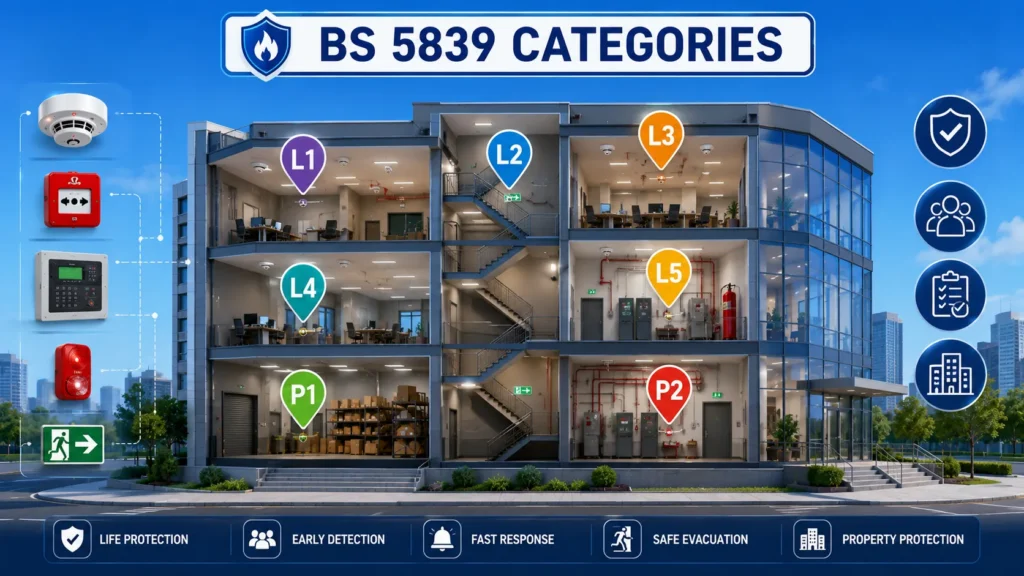
One of the biggest gaps in many beginner guides is understanding fire alarm categories. In the UK, fire alarm systems are classified according to BS 5839-1, helping ensure the appropriate level of protection for different buildings and risks.
These categories fall into two broad groups:
- Life Protection Systems (L Categories)
- Property Protection Systems (P Categories)
Understanding these categories is essential for anyone responsible for fire safety in commercial or public buildings.
Life Protection Categories
Life protection systems focus on safeguarding building occupants by providing early warning and supporting safe evacuation.
| Category | Purpose | Typical Buildings |
|---|---|---|
| L1 | Maximum life protection with detectors throughout the building | Hospitals, hotels, care homes |
| L2 | Additional protection in high-risk areas and escape routes | Factories, HMOs, schools |
| L3 | Protection of escape routes and rooms opening onto them | Offices, commercial buildings |
| L4 | Detection only in escape routes | Low-risk workplaces |
| L5 | Custom-designed protection for specific fire risks | Laboratories, plant rooms |
Property Protection Categories
Property protection systems prioritise reducing damage to buildings and business operations.
| Category | Purpose | Typical Buildings |
|---|---|---|
| P1 | Automatic detection throughout the building | Data centres, warehouses, manufacturing sites |
| P2 | Detection only in high-risk areas | Commercial premises with identified hazards |
Choosing the Correct Category
Selecting the appropriate category depends on:
- Building occupancy
- Fire risk assessment findings
- Building layout
- Number of occupants
- Business continuity requirements
- Insurance conditions
- Legal obligations
For this reason, fire alarm system design should always be based on a comprehensive Fire Risk Assessment carried out by a competent person.
Understanding Fire Alarm Devices
While every fire alarm system contains detectors and sounders, different device types serve different purposes.
Smoke Detectors
Smoke detectors identify airborne smoke particles before flames become fully developed.
They are ideal for:
- Offices
- Bedrooms
- Corridors
- Meeting rooms
- Hotels
- Schools
Heat Detectors
Heat detectors activate when temperatures rise above a preset threshold or increase rapidly.
They are commonly installed in:
- Kitchens
- Boiler rooms
- Workshops
- Plant rooms
- Garages
Multi-Sensor Detectors
These detectors combine smoke and heat sensing technologies, improving accuracy while reducing false alarms.
Common locations include:
- Modern offices
- Healthcare facilities
- Educational buildings
- Hotels
Flame Detectors
Flame detectors respond to ultraviolet (UV) or infrared (IR) radiation emitted by flames.
They are used where fires can develop very rapidly.
Typical environments include:
- Chemical plants
- Fuel storage facilities
- Aircraft hangars
- Manufacturing plants
Manual Call Points
Manual call points allow anyone who discovers a fire to immediately activate the alarm system.
They are typically installed:
- Near exits
- Along escape routes
- At building entrances
- On every floor of commercial buildings
Alarm Sounders
Sounders produce loud audible warnings to alert occupants that evacuation should begin immediately.
Modern systems may use:
- Electronic sirens
- Voice evacuation messages
- Tone alarms
- Public address integration
Visual Alarm Devices
Visual alarms use flashing lights to support occupants who:
- Have hearing impairments
- Work in noisy environments
- Wear hearing protection
- May not hear audible alarms
How to Choose the Right Fire Alarm System
Selecting the right fire alarm system is not simply a matter of choosing the latest technology. The most effective solution depends on the specific characteristics of the building and the risks present.
Before making a decision, consider:
- Building size and layout
- Number of floors
- Occupancy levels
- Nature of activities
- Fire hazards
- Budget
- Future expansion plans
- Maintenance requirements
- Regulatory compliance
Fire Alarm Selection Flowchart
Start
│
▼
Conduct Fire Risk Assessment
│
▼
Identify Building Type
│
▼
Assess Occupancy & Fire Hazards
│
▼
Determine Required BS 5839 Category
│
▼
Choose System Type
(Conventional • Addressable • Wireless • Hybrid)
│
▼
Select Detection Devices
│
▼
Professional System Design
│
▼
Installation & Commissioning
│
▼
Routine Testing & Maintenance
Common Fire Alarm Misconceptions
Many beginners misunderstand how fire alarm systems work. Clarifying these misconceptions helps users make informed decisions and avoid costly mistakes.
| Myth | Reality |
|---|---|
| All fire alarms are the same | Different systems suit different buildings and risks. |
| Smoke detectors are enough for every area | Some locations require heat or multi-sensor detectors to minimise false alarms. |
| Wireless systems are less reliable | Modern wireless systems are highly dependable when correctly designed and maintained. |
| Fire alarms only warn occupants | Many systems also activate fire doors, smoke control, lifts, suppression systems, and remote monitoring. |
| Once installed, no maintenance is needed | Regular inspection, testing, servicing, and battery checks are essential for reliable performance and legal compliance. |
Why Choosing the Right System Matters
The effectiveness of a fire alarm system is determined not only by the technology used but also by choosing the correct system type, category, and devices for the specific building.
A well-designed solution provides:
- Faster fire detection
- More accurate incident location
- Safer evacuation
- Reduced false alarms
- Improved regulatory compliance
- Better protection for people, property, and business operations
- Easier maintenance and future expansion
Fire Alarm System Installation: Why Professional Design Matters
Installing a fire alarm system is more than mounting detectors on ceilings and connecting cables. Every system should be designed to match the building’s layout, occupancy, fire hazards, evacuation strategy, and applicable UK regulations.
A poorly designed system may fail to detect a fire early enough or generate frequent false alarms, both of which can put lives at risk.
A professional installation generally follows these stages:
Step 1: Fire Risk Assessment
Before selecting equipment, a competent fire risk assessor evaluates:
- Building layout
- Occupancy levels
- Escape routes
- Fire hazards
- High-risk areas
- Existing fire protection measures
This assessment determines the most suitable fire alarm category and system design.
Step 2: System Design
The designer identifies:
- Detector locations
- Manual call point positions
- Alarm sounder coverage
- Control panel location
- Power requirements
- Integration with other fire safety systems
Proper detector spacing is critical to ensure complete coverage without unnecessary duplication.
Step 3: Installation
Qualified engineers install:
- Fire Alarm Control Panel (FACP)
- Smoke detectors
- Heat detectors
- Manual call points
- Alarm sounders
- Visual warning devices
- Emergency batteries
- Communication modules
Installation should minimise disruption while ensuring compliance with the approved design.
Step 4: Commissioning
Before the system becomes operational, engineers perform comprehensive testing to confirm:
- Every detector functions correctly
- Alarm sounders operate as intended
- Communication pathways are reliable
- Backup batteries perform correctly
- Cause-and-effect programming works properly
Step 5: Staff Training
Even the best fire alarm system is ineffective if occupants do not know how to respond.
Training should cover:
- Alarm recognition
- Evacuation procedures
- Manual call point operation
- Fire assembly points
- Reporting procedures
Fire Alarm Testing and Inspection
Fire alarm systems require routine testing to ensure they remain operational throughout their service life.
Regular inspections help identify:
- Faulty detectors
- Battery failures
- Wiring issues
- Device contamination
- Communication faults
- False alarm causes
Recommended Testing Schedule
| Activity | Typical Frequency |
|---|---|
| Visual inspection | Weekly |
| Manual call point test | Weekly (rotating points) |
| Alarm sounder test | Weekly |
| Battery inspection | Monthly |
| Detector inspection | Quarterly |
| Professional servicing | Every 6 months (or as recommended) |
| Full system review | Annually |
Routine testing should always be documented in the building’s fire safety records.
Fire Alarm Maintenance Best Practices
Maintenance extends beyond fixing faults—it ensures the system continues to provide reliable protection throughout its lifecycle.
Key maintenance activities include:
- Cleaning smoke detectors
- Replacing damaged devices
- Testing batteries
- Updating system software
- Verifying communication links
- Inspecting wiring
- Checking control panel indicators
- Confirming detector sensitivity
Ignoring maintenance can lead to delayed fire detection, nuisance alarms, or complete system failure during an emergency.
Common Causes of False Fire Alarms
False alarms are a major challenge because they disrupt operations, reduce confidence in the system, and may lead occupants to ignore genuine emergencies.
Common causes include:
- Steam from kitchens or bathrooms
- Dust accumulation
- Insects inside detectors
- Aerosol sprays
- Building renovation work
- Incorrect detector selection
- Electrical faults
- Poor maintenance
Choosing the correct detector type for each environment significantly reduces unwanted activations.
UK Fire Alarm Regulations and Legal Responsibilities
In the UK, fire safety is not optional. Employers, landlords, and those responsible for non-domestic premises have legal duties to provide suitable fire detection and warning systems where required.
Depending on the premises, responsibilities typically include:
- Conducting a fire risk assessment
- Installing appropriate fire detection systems
- Maintaining fire alarm equipment
- Keeping maintenance records
- Training employees
- Reviewing fire safety arrangements regularly
Failure to comply can increase the risk of injury, property damage, legal action, financial penalties, and business interruption.
Understanding BS 5839
One of the most important standards relating to fire alarm systems in the UK is BS 5839.
This British Standard provides guidance on:
- System design
- Installation
- Commissioning
- Inspection
- Testing
- Maintenance
- Detector placement
- Alarm audibility
- System reliability
Following BS 5839 helps organisations ensure their fire alarm systems are designed and maintained according to recognised industry best practice.
While BS 5839 is a technical document, building owners and managers should understand its importance because it influences system performance, legal compliance, and occupant safety.
Smart Fire Alarm Systems: The Future of Fire Safety
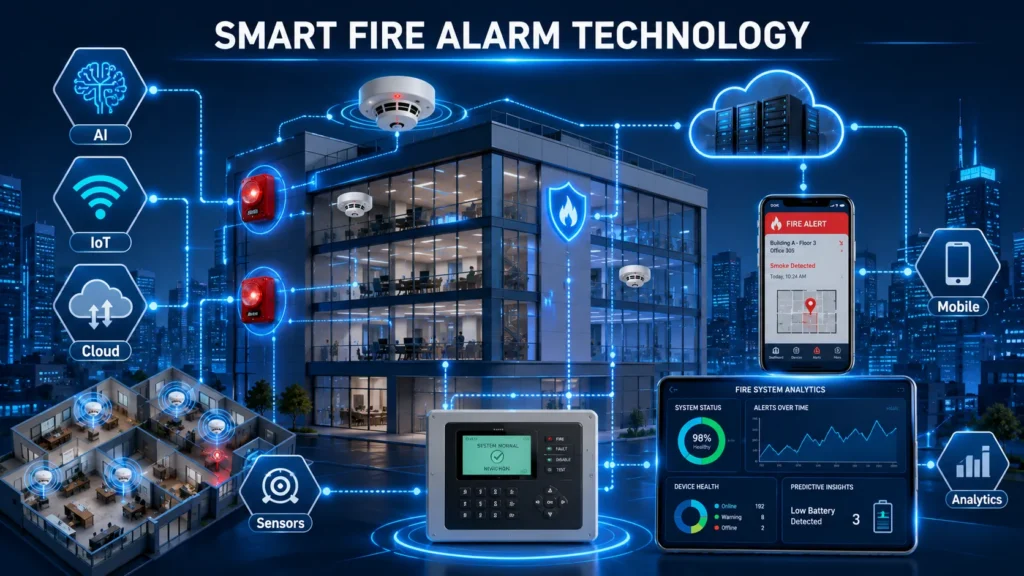
Technology has transformed fire alarm systems from standalone warning devices into intelligent building safety platforms.
Modern systems can provide real-time monitoring, remote diagnostics, predictive maintenance, and integration with other smart building technologies.
Key Innovations
Internet of Things (IoT)
Connected detectors continuously transmit information to cloud-based monitoring platforms.
Benefits include:
- Remote monitoring
- Instant fault notifications
- Real-time status updates
- Faster maintenance response
Artificial Intelligence (AI)
AI analyses detector data to identify unusual patterns and reduce false alarms.
Potential applications include:
- Smoke pattern recognition
- Predictive fault detection
- Risk analysis
- Intelligent alarm verification
Cloud-Based Monitoring
Facility managers can receive alerts on smartphones or computers, enabling quicker decision-making even when off-site.
Building Management System (BMS) Integration
Modern fire alarm systems can communicate with:
- Smoke extraction systems
- Emergency lighting
- Access control
- HVAC systems
- CCTV
- Lift controls
This coordinated response improves evacuation and emergency management.
Common Mistakes Beginners Should Avoid
Many fire safety issues arise from avoidable mistakes rather than equipment failure.
Installing the Wrong Detector
Using smoke detectors in kitchens or dusty workshops often leads to frequent false alarms.
Heat detectors or specialist sensors may be more appropriate in these environments.
Ignoring Maintenance
Even the most advanced fire alarm system requires regular inspection and servicing.
Neglected systems become less reliable over time.
Blocking Detectors
Painting over detectors, covering them with decorations, or placing objects nearby can reduce their effectiveness.
Detectors should always remain unobstructed.
Removing Batteries
Some occupants remove batteries after nuisance alarms.
This leaves the property unprotected and significantly increases fire risk.
Delaying Repairs
Fault indicators should never be ignored.
Small faults can quickly develop into system failures if left unresolved.
Fire Alarm Systems and Fire Risk Assessments
A fire alarm system should never be considered in isolation.
It forms one part of a comprehensive fire safety strategy that also includes:
- Fire risk assessments
- Emergency planning
- Fire extinguishers
- Emergency lighting
- Fire doors
- Evacuation procedures
- Staff training
A fire risk assessment helps determine:
- The appropriate alarm category
- Detector placement
- High-risk areas
- Maintenance priorities
- Additional fire protection measures
Together, these measures provide layered protection that significantly improves life safety.
Career Opportunities in Fire Safety
As organisations continue to strengthen their fire safety practices, demand for qualified professionals is increasing across multiple sectors.
Knowledge of fire alarm systems is valuable for careers such as:
| Career | Primary Responsibilities |
|---|---|
| Fire Risk Assessor | Evaluates fire hazards and recommends control measures |
| Fire Safety Advisor | Develops organisational fire safety strategies |
| Fire Alarm Technician | Installs, tests, and maintains fire alarm systems |
| Fire Marshal | Supports evacuation and workplace fire safety |
| Health and Safety Officer | Oversees workplace compliance and risk management |
| Building Safety Manager | Coordinates building safety systems and compliance |
| Facilities Manager | Manages building maintenance, including fire protection |
| Compliance Officer | Ensures adherence to fire safety legislation |
| Fire Safety Trainer | Delivers fire safety education and practical training |
| Construction Site Manager | Implements fire safety controls during construction projects |
Developing expertise in fire alarm systems can also support progression into broader health and safety, facilities management, and building compliance roles.
Recommended Fire Safety Courses at Inspire College
If you’re interested in building practical knowledge or pursuing a career in fire safety, consider exploring relevant training programmes offered by Inspire College.
| Course Category | Purpose |
|---|---|
| Fire Risk Assessment Courses | Learn how to identify, evaluate, and manage fire risks |
| Fire Safety Training | Develop essential workplace fire safety knowledge |
| Fire Marshal Training | Prepare for emergency response and evacuation responsibilities |
| Fire Safety Advisor Qualification | Build advanced fire safety management skills |
Fire Alarm System Buying Checklist
Before purchasing or upgrading a fire alarm system, consider the following:
| Checklist Item | Completed? |
|---|---|
| Fire risk assessment completed | ✓ |
| Correct alarm category selected | ✓ |
| Suitable detector types identified | ✓ |
| System designed for future expansion | ✓ |
| Professional installation planned | ✓ |
| Maintenance schedule established | ✓ |
| Staff training arranged | ✓ |
| Documentation and records maintained | ✓ |
| Compliance requirements reviewed | ✓ |
| Emergency procedures updated | ✓ |
Using this checklist can help ensure the selected system provides effective protection and supports long-term compliance.
Fire Alarm System Lifecycle
Understanding the complete lifecycle of a fire alarm system helps organisations maintain continuous protection.
Fire Risk Assessment
│
▼
System Design
│
▼
Equipment Selection
│
▼
Professional Installation
│
▼
Commissioning & Testing
│
▼
Staff Training
│
▼
Routine Inspection
│
▼
Preventive Maintenance
│
▼
Periodic Upgrades
│
▼
Continuous Fire Protection
Conclusion
Fire alarm systems are one of the most effective tools for protecting lives, safeguarding property, and supporting business continuity. By detecting fire at its earliest stages, they provide valuable time for evacuation, reduce the spread of fire, and enable a faster emergency response.
For beginners, understanding the different system types, components, alarm categories, and legal responsibilities is the first step towards making informed decisions about fire safety. Whether you are responsible for a workplace, managing a commercial building, or considering a career in the fire safety industry, knowledge of fire alarm systems is an essential foundation.
Modern technology has also transformed fire detection. Smart sensors, cloud connectivity, IoT integration, and AI-powered monitoring are making fire alarm systems more accurate, reliable, and easier to manage than ever before. However, technology alone is not enough. Proper system design, professional installation, regular testing, routine maintenance, and ongoing staff training remain essential for ensuring reliable performance and compliance with UK fire safety standards.
For those looking to deepen their expertise, gaining recognised fire safety qualifications can open the door to rewarding careers in fire risk assessment, fire safety management, health and safety, facilities management, and building compliance. By combining practical knowledge with professional training, individuals and organisations can create safer environments, meet legal obligations, and contribute to a stronger culture of fire prevention and preparedness.