
Construction Site Management Proess: From Planning to Projct Completion
Effective construction site management is the foundation of a safe, organised and successful building project. From initial planning and site mobilisation to daily operations, quality inspections, progress monitoring and final handover, every stage needs coordinated management.
The construction site management process brings people, materials, plant, information, safety controls, quality requirements and project schedules together so that construction work can progress as planned. Poor site management can result in delays, cost overruns, defective work, safety incidents, material shortages and disputes. Effective management, by contrast, helps keep construction activities controlled and aligned with project objectives.
In the UK, site management also needs to account for the responsibilities established under the Construction (Design and Management) Regulations 2015 (CDM 2015). For projects involving more than one contractor, the principal contractor is responsible for planning, managing, monitoring and coordinating the construction phase and must prepare a construction phase plan before construction begins.
This guide explains the complete construction site management process, including planning, procurement, mobilisation, site operations, health and safety, quality control, progress monitoring, documentation, snagging, commissioning and project completion.
What Is Construction Site Management?
Construction site management is the process of planning, organising, supervising, coordinating and controlling construction activities on a project site.
It involves making sure that the right people, materials, equipment and information are available at the right time while construction work is completed safely, efficiently and to the required quality standard.
A site manager may coordinate daily activities across several trades and subcontractors while monitoring:
- Construction progress
- Labour and workforce allocation
- Materials and deliveries
- Plant and equipment
- Site logistics
- Health and safety
- Quality control
- Programme requirements
- Design information
- Subcontractor performance
- Site documentation
- Environmental controls
- Defects and corrective actions
Construction site management is closely connected to construction project management, but the two terms are not identical.
Construction project management focuses on the wider delivery of the project, including scope, cost, programme, contracts, stakeholders and strategic decisions. Construction site management is more focused on what happens on the ground and how construction activities are coordinated and controlled on a daily basis.
Why Is Construction Site Management Important?
A construction project can involve hundreds of individual activities, multiple subcontractors, large quantities of materials and complex interactions between trades. Without effective coordination, one delayed or poorly planned activity can affect several others.
Good site management helps to:
Improve construction safety
Site managers and contractors need to identify hazards, establish appropriate controls and ensure that workers understand site rules and safe systems of work. Under CDM 2015, contractors have duties to plan, manage and monitor the work under their control so that risks are properly controlled.
Control project schedules
Daily site activities need to follow the construction programme. Effective management helps identify delays early and allows corrective action before they significantly affect completion dates.
Maintain quality
Regular inspections, testing, approvals and documentation help ensure that completed work meets drawings, specifications and contractual requirements.
Reduce unnecessary costs
Better coordination can reduce material waste, rework, downtime, idle labour and inefficient plant use.
Improve communication
Construction involves many parties. Clear communication between the client, designers, project manager, site manager, contractors, subcontractors and suppliers reduces misunderstandings and duplicated work.
Manage resources effectively
Labour, plant, materials, storage areas and site space must be coordinated according to the construction sequence.
Support successful handover
Good documentation throughout the project makes final inspections, commissioning, certification and handover more efficient.
The Construction Site Management Process
The construction site management process can be viewed as a continuous cycle rather than a single activity:
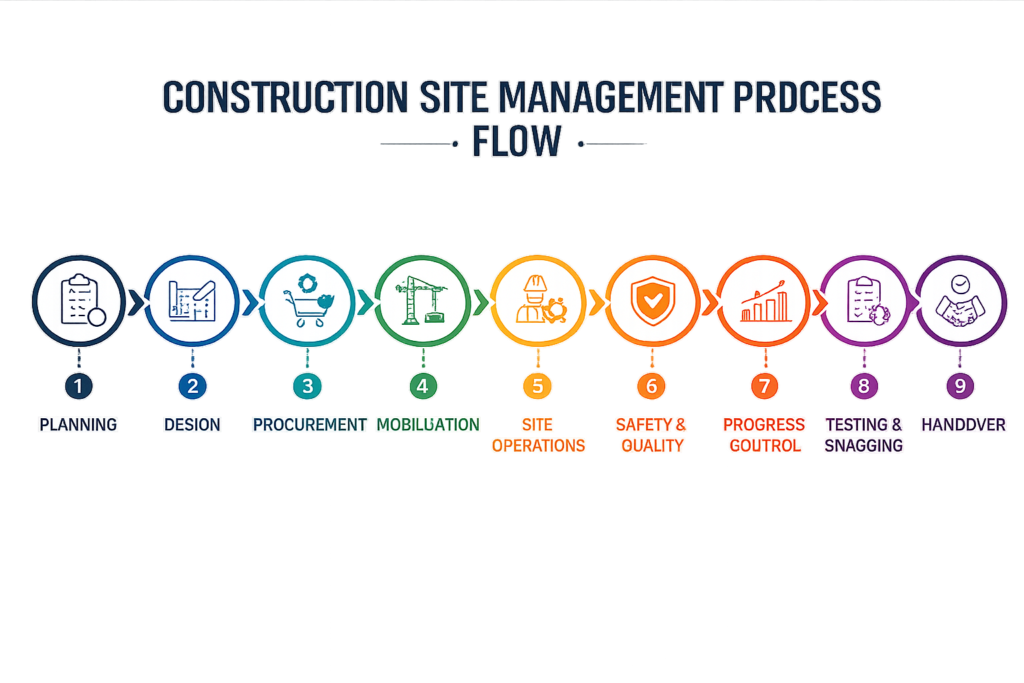
Each stage influences the next. Strong planning makes mobilisation easier, effective mobilisation supports efficient construction, and accurate documentation throughout the project makes completion and handover more straightforward.
1. Project Planning and Pre-Construction
Construction site management begins before physical construction starts.
The planning stage establishes what needs to be built, how it will be delivered, what resources are required and what risks could affect the work.
Important planning activities include:
- Defining project scope
- Reviewing drawings and specifications
- Understanding site conditions
- Establishing the construction programme
- Developing resource requirements
- Identifying construction risks
- Planning procurement
- Reviewing access and logistics
- Establishing quality requirements
- Planning health and safety arrangements
- Identifying statutory and contractual requirements
The site team should review available information about the site and its surroundings before work begins. HSE guidance highlights the importance of gathering information about site history, surrounding conditions, hazards and other factors that could influence construction planning.
Site investigation
Site information can influence the construction methodology significantly.
Depending on the project, the management team may need to understand:
- Ground conditions
- Existing structures
- Underground services
- Access restrictions
- Neighbouring properties
- Existing utilities
- Contamination
- Asbestos
- Flooding risks
- Traffic conditions
- Environmental constraints
Identifying these issues early allows the construction team to develop appropriate controls and avoid preventable disruption.
2. Design and Technical Preparation
Before construction activities progress, the site team needs access to suitable and coordinated technical information.
This may include:
- Construction drawings
- Specifications
- Structural information
- Architectural details
- Mechanical and electrical designs
- Temporary works information
- BIM models
- Product specifications
- Method statements
- Technical submissions
- Inspection requirements
Design coordination is particularly important where different trades interact.
For example, mechanical, electrical and structural installations can conflict if they have not been properly coordinated. Early identification of clashes can prevent expensive alterations during construction.
Constructability review
A constructability review considers whether the proposed design can be built safely, efficiently and practically.
The construction team may review:
- Access for plant
- Installation sequence
- Material handling
- Temporary works
- Working space
- Lifting requirements
- Construction tolerances
- Trade interfaces
- Programme constraints
This provides an opportunity to identify practical problems before they become site problems.
3. Procurement and Contractor Coordination
Procurement ensures that the materials, equipment, plant and specialist services required for construction are available when needed.
Procurement activities may include:
- Identifying material requirements
- Preparing specifications
- Obtaining quotations
- Selecting suppliers
- Appointing subcontractors
- Ordering long-lead materials
- Reviewing supplier information
- Planning deliveries
- Checking product approvals
- Coordinating storage requirements
Procurement should be connected directly to the construction programme.
Ordering a material too late can stop an activity. Ordering it too early can create storage problems, damage risks or unnecessary cash-flow pressure.
Subcontractor coordination
Most construction projects depend on specialist subcontractors. Their work needs to be coordinated around the overall construction sequence.
The site management team may need to coordinate:
- Start dates
- Work areas
- Labour levels
- Access
- Plant
- Materials
- Permits
- Drawings
- Inspection requirements
- Interfaces with other trades
A subcontractor should not simply be given a start date. The site team needs to confirm that the work area, information, materials and preceding activities are ready.
4. Site Mobilisation and Setup
Site mobilisation converts the project plan into an operational construction environment.
Before major construction activities begin, the site needs to be established so that people, materials and equipment can move safely and efficiently.
Typical mobilisation activities include:
- Establishing site boundaries
- Installing hoarding or fencing
- Setting up site offices
- Establishing welfare facilities
- Creating access routes
- Installing temporary services
- Establishing material storage areas
- Creating plant areas
- Setting up traffic management
- Installing signage
- Establishing emergency arrangements
- Setting up security controls
- Preparing waste management arrangements
Construction site welfare
Welfare should be planned from the beginning rather than added later.
HSE states that construction workers must have access to appropriate facilities for toilets, washing, changing, eating and rest, with the required arrangements depending on the nature and scale of the work.
Welfare planning should consider:
- Number of workers
- Site size
- Distance to facilities
- Work duration
- Location of work areas
- Cleaning arrangements
- Drinking water
- Changing facilities
- Rest and eating areas
Good welfare provision is both a legal requirement and an important part of effective site management.
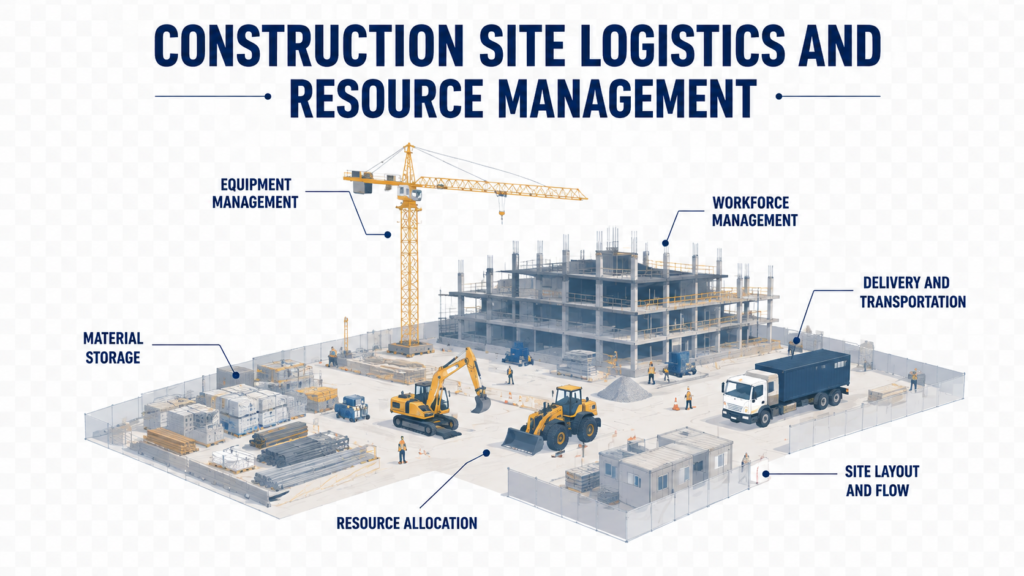
5. Site Logistics and Resource Management
Construction site logistics is concerned with controlling the movement and positioning of people, materials, plant and equipment.
A well-designed site logistics plan can reduce congestion and unnecessary movement.
It should consider:
- Site access
- Vehicle routes
- Pedestrian routes
- Delivery areas
- Crane locations
- Material storage
- Waste areas
- Plant parking
- Temporary structures
- Welfare locations
- Emergency access
Labour management
The site manager needs to coordinate labour according to the construction programme.
This includes:
- Workforce planning
- Trade allocation
- Shift arrangements
- Competence requirements
- Site inductions
- Supervision
- Productivity monitoring
- Coordination between trades
Too few workers can delay activities, while too many workers in a restricted area can create congestion and reduce productivity.
Materials management
Materials should be ordered, delivered, inspected, stored and distributed according to project requirements.
Effective material management helps prevent:
- Material shortages
- Damage
- Theft
- Incorrect products
- Excessive storage
- Wasted materials
- Programme delays
Plant and equipment
Plant selection should reflect the work being carried out.
Management should consider:
- Availability
- Capacity
- Inspection requirements
- Operator competence
- Maintenance
- Fuel or power requirements
- Access
- Lifting requirements
- Safe operating conditions
6. Construction Execution
Construction execution is the stage where planned activities are physically carried out.
The site manager coordinates daily operations to ensure that construction progresses according to the approved programme, drawings, specifications and safe working arrangements.
Daily management may involve:
- Reviewing planned activities
- Allocating work areas
- Coordinating subcontractors
- Checking labour availability
- Confirming material deliveries
- Reviewing plant requirements
- Conducting site inspections
- Resolving site issues
- Monitoring progress
- Updating records
- Communicating changes
Daily site planning
A daily plan should identify:
- What work will be completed
- Where the work will take place
- Who will carry it out
- What materials are required
- What plant is needed
- What permits are required
- What risks need to be controlled
- What inspections are required
This provides the site team with a clear operational plan for the day.
Look-ahead planning
Short-term look-ahead programmes help connect the main construction programme with daily site operations.
A one-, two- or three-week look-ahead can identify:
- Upcoming activities
- Required resources
- Material deliveries
- Design information
- Inspections
- Access requirements
- Subcontractor activities
- Potential constraints
The objective is to identify problems before the planned activity reaches the site.
7. Health and Safety Management
Health and safety must remain an integral part of construction site management.
For projects involving more than one contractor, the principal contractor must plan, manage, monitor and coordinate the construction phase and prepare a construction phase plan before construction begins. The plan should be reviewed and revised as necessary as the project develops.
A practical site safety management system may include:
Site induction
Workers and relevant visitors should understand site-specific hazards, rules, emergency arrangements and expected behaviours.
Risk assessments
Construction activities should be assessed to identify hazards and determine suitable control measures.
Method statements
Method statements explain how specific activities will be carried out safely and in accordance with project requirements.
RAMS
Risk assessments and method statements are widely used to communicate the hazards, controls and safe sequence associated with construction activities.
Toolbox talks
Short safety briefings can address specific risks, upcoming activities, lessons learned or changes in site conditions.
Site inspections
Routine inspections can identify unsafe conditions, housekeeping issues, defective equipment, access problems and other hazards.
Permit-to-work systems
Certain higher-risk activities may require formal permit controls, depending on the project’s risk profile and management arrangements.
Emergency planning
Emergency arrangements should address foreseeable incidents such as:
- Fire
- Serious injury
- Structural instability
- Chemical exposure
- Utility strikes
- Severe weather
- Evacuation
- Security incidents
Safety planning should also consider people outside the immediate workforce. HSE guidance states that construction-phase risk management needs to consider everyone affected by the work, including members of the public.
8. Quality Control and Inspection
Quality management should operate throughout construction rather than being left until the final inspection.
A strong construction quality process can be represented as:
Plan → Inspect → Test → Record → Correct → Verify → Approve
Quality control activities may include:
- Material inspections
- Work inspections
- Dimensional checks
- Testing
- Inspection and Test Plans
- Hold points
- Witness points
- Product approvals
- Technical inspections
- Non-conformance reporting
- Defect correction
- Final inspections
Inspection and Test Plans
An Inspection and Test Plan (ITP) identifies what needs to be inspected or tested, when the inspection occurs, who is responsible and what records need to be retained.
This creates a structured quality-control process.
Non-conformance management
If completed work does not meet the required specification, the issue should be documented and controlled.
A typical process is:
- Identify the non-conformance.
- Record the issue.
- Determine the cause.
- Establish corrective action.
- Complete the corrective work.
- Reinspect the affected area.
- Close the non-conformance record.
This helps prevent repeated defects and creates an auditable quality trail.
9. Progress, Cost and Schedule Control
Construction site management requires continuous monitoring of actual performance against the project plan.
Key performance areas include:
- Planned progress
- Actual progress
- Labour productivity
- Material availability
- Plant utilisation
- Programme milestones
- Cost performance
- Subcontractor progress
- Quality performance
- Safety performance
Planned versus actual progress
One of the most important questions in site management is:
Is the project progressing as planned?
If a planned activity was expected to reach 80% completion but has only reached 60%, the management team needs to understand why.
Potential causes include:
- Labour shortages
- Material delays
- Design changes
- Poor productivity
- Weather
- Access restrictions
- Equipment failure
- Previous work not being completed
- Subcontractor performance
The earlier the cause is identified, the greater the opportunity to recover the programme.
Change management
Construction projects rarely proceed without changes.
Changes may arise from:
- Design revisions
- Client instructions
- Unforeseen site conditions
- Material substitutions
- Regulatory requirements
- Coordination issues
Changes should be documented, assessed and communicated before they are implemented wherever practicable.
Uncontrolled changes can affect cost, programme, quality and contractual responsibilities.
10. Communication and Construction Documentation
Documentation is one of the most important controls within construction site management.
Important records can include:
- Daily site reports
- Site diaries
- Progress photographs
- Drawings
- Specifications
- RFIs
- Site instructions
- Meeting minutes
- Inspection records
- Test certificates
- Delivery records
- Material approvals
- Risk assessments
- Method statements
- Permit records
- Non-conformance reports
- Variation records
- Snagging lists
Why document control matters
The site team should be able to identify which information is current and approved.
Using outdated drawings or superseded specifications can result in defective work and expensive rework.
A controlled document management system should therefore establish:
- Document identification
- Revision numbers
- Approval status
- Distribution
- Access permissions
- Revision history
- Storage
- Archiving
11. Environmental and Waste Management
Modern construction site management also needs to consider environmental performance.
Depending on the project, environmental controls can include:
- Waste segregation
- Dust control
- Noise management
- Water protection
- Spill prevention
- Pollution controls
- Sustainable material use
- Energy management
- Vehicle emissions
- Recycling
- Responsible disposal
Waste should be planned rather than treated as an unavoidable by-product.
Better material planning can reduce both waste and project costs.
12. Digital Technology in Construction Site Management
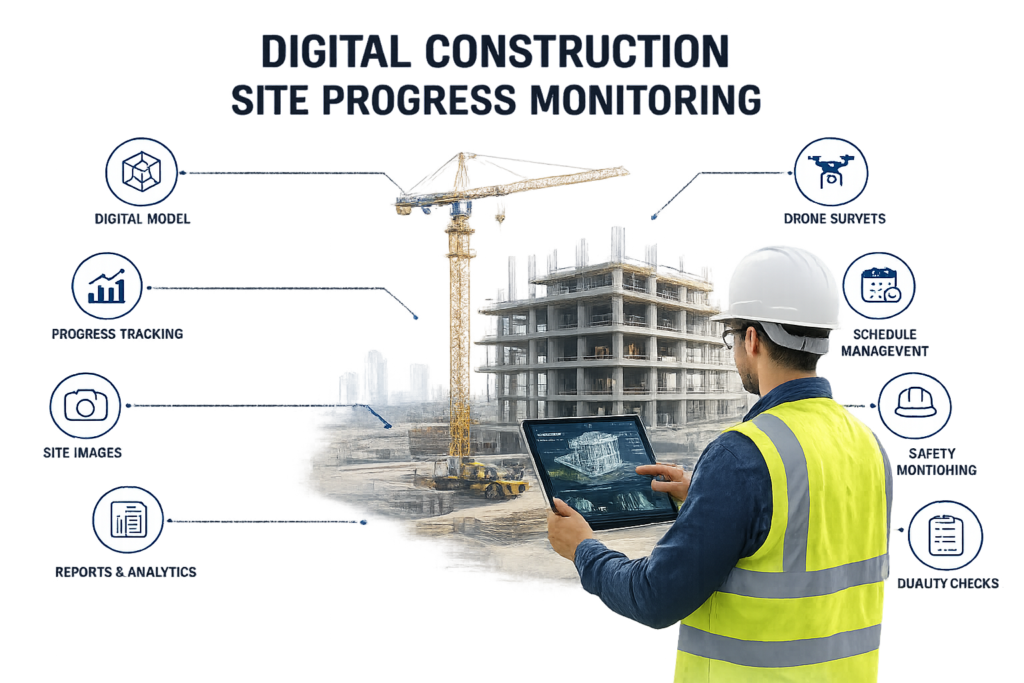
Digital technology is increasingly used to improve construction coordination and information management.
Common technologies include:
Building Information Modelling (BIM)
BIM can support design coordination, visualisation, information management and identification of potential clashes before construction.
Construction management software
Digital platforms can bring together:
- Programme information
- Documents
- Tasks
- Inspections
- Defects
- RFIs
- Progress information
- Communication
Mobile site reporting
Mobile devices allow site teams to record inspections, photographs, observations and progress information directly from the work area.
Digital snagging
Digital snagging systems can assign defects to responsible parties, track completion and maintain an auditable record.
Drones and site photography
Where legally and operationally appropriate, aerial imagery and regular photographs can help document site progress and provide visual evidence.
Digital dashboards
Dashboards can combine project information to provide management teams with a clearer view of:
- Progress
- Safety
- Quality
- Costs
- Defects
- Programme status
Technology should support sound management processes rather than replace them.
13. Snagging, Testing and Commissioning
As construction approaches completion, the management focus shifts from production to verification and closeout.
Snagging identifies incomplete, defective or non-compliant work that needs to be corrected before completion.
Typical snagging activities include:
- Visual inspections
- Finishing checks
- Door and window checks
- MEP inspections
- Surface quality checks
- Functional testing
- Defect recording
- Rectification
- Reinspection
Testing and commissioning
Building systems may require testing and commissioning before handover.
Depending on the project, this can include:
- Electrical systems
- Mechanical systems
- Fire protection systems
- HVAC
- Plumbing
- Security systems
- Controls
- Emergency systems
The management team should ensure that required test results and certificates are collected and properly recorded.
14. Handover and Project Completion
Construction completion is more than finishing physical work.
A successful handover requires the project team to demonstrate that the required work has been completed, defects have been addressed and relevant information has been compiled.
The completion process may include:
- Final inspections
- Completion of snagging
- Defect rectification
- Testing and commissioning
- Preparation of as-built information
- Compilation of operation and maintenance information
- Collection of certificates
- Warranty documentation
- Client inspection
- Practical completion
- Demobilisation
- Final project records
- Lessons learned
- Contract closeout
For projects involving more than one contractor, CDM 2015 also requires appropriate health and safety information to be maintained through the project, including the health and safety file prepared by the principal designer and made available for relevant future work.
As-built information
As-built drawings and records should accurately reflect what was constructed.
This information can be important for:
- Future maintenance
- Alterations
- Repairs
- Facilities management
- Future construction work
- Asset management
A project that is physically complete but poorly documented is not fully successful from a long-term asset-management perspective.
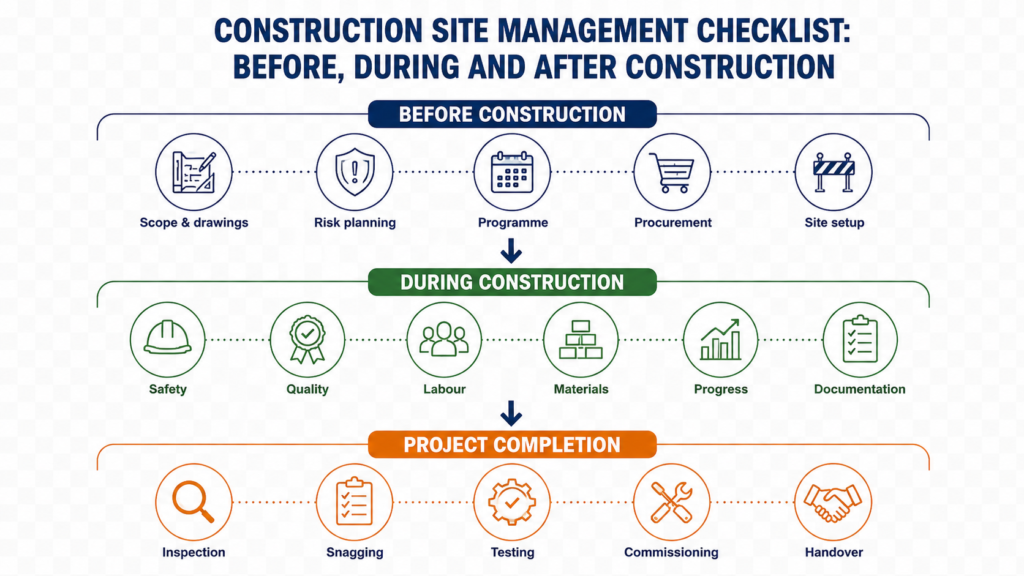
Construction Site Management Checklist
A practical construction site management checklist can be divided into three stages.
Before construction starts
- Confirm project scope
- Review drawings and specifications
- Complete relevant site investigations
- Review risks
- Prepare construction phase planning arrangements
- Establish the construction programme
- Plan procurement
- Appoint contractors and subcontractors
- Establish site logistics
- Set up welfare
- Establish emergency arrangements
- Prepare site rules
- Arrange site security
- Confirm required permits and approvals
During construction
- Conduct site inductions
- Monitor health and safety
- Review RAMS
- Conduct toolbox talks
- Inspect work
- Monitor quality
- Track progress
- Coordinate subcontractors
- Monitor materials
- Manage deliveries
- Maintain site records
- Control drawings and documents
- Manage changes
- Record defects
- Review programme performance
- Maintain housekeeping
- Monitor environmental controls
Before handover
- Complete final inspections
- Close snags
- Complete testing
- Complete commissioning
- Verify defects have been corrected
- Collect certificates
- Compile as-built drawings
- Prepare O&M information
- Complete warranties
- Obtain client approvals
- Complete practical completion requirements
- Demobilise the site
- Archive project records
- Capture lessons learned
Common Construction Site Management Challenges
Even a well-planned project can experience problems. Effective site management depends on recognising issues early.
Material delays
Late deliveries can prevent trades from starting planned activities. Long-lead materials should be identified during procurement planning and monitored throughout the project.
Poor subcontractor coordination
When multiple subcontractors work in the same area, poor sequencing can cause congestion, rework and delays.
Design changes
Late design changes can affect procurement, programme, labour and completed work.
Labour shortages
Insufficient skilled labour can reduce productivity and affect critical activities.
Poor communication
Missing information, unclear instructions or outdated drawings can result in mistakes.
Quality defects
Defective work creates rework, additional cost and potential programme delays.
Safety incidents
Incidents can cause injury, investigation, disruption and significant project consequences. Strong planning and supervision are therefore essential.
Uncontrolled changes
Changes that are not properly assessed or documented can create disputes over cost, time and responsibility.
Inadequate documentation
Poor records make it difficult to demonstrate what was completed, inspected, approved or changed.
Best Practices for Effective Construction Site Management
The following practices can improve construction site performance:
1. Plan before work starts
Do not rely on daily problem-solving as the primary management strategy. Identify resources, risks, logistics and sequencing requirements in advance.
2. Use short-term look-ahead planning
Connect the master programme with daily and weekly site activities.
3. Maintain clear communication
Hold regular coordination meetings and ensure important instructions are communicated to the people responsible for implementing them.
4. Keep drawings and documents controlled
Make sure the workforce has access to current and approved information.
5. Integrate safety into production planning
Safety should be considered when deciding how, when and where work will be performed.
6. Inspect work continuously
Early identification of defects is normally easier and less expensive than correcting problems at completion.
7. Monitor materials closely
Track critical materials from procurement through delivery, storage and installation.
8. Record progress accurately
Reliable progress information allows management teams to make better decisions.
9. Coordinate trades carefully
Understand the interfaces between different subcontractors before activities begin.
10. Use digital tools appropriately
Technology can improve visibility, document control and reporting when supported by clear processes.
11. Address problems early
A small site issue can become a major programme problem if it remains unresolved.
12. Prepare for handover throughout the project
Do not wait until the final weeks to collect certificates, inspection records, as-built information and other completion documents.
What Are the Main Stages of Construction Site Management?
The main stages of construction site management are:
- Project planning and pre-construction
- Design and technical preparation
- Procurement and contractor coordination
- Site mobilisation
- Site logistics and resource management
- Construction execution
- Health and safety management
- Quality control and inspection
- Progress, cost and programme control
- Communication and documentation
- Snagging, testing and commissioning
- Handover and project completion
These stages are interconnected and may overlap throughout the construction project.
What Does a Construction Site Manager Do?
A construction site manager coordinates day-to-day construction activities to ensure work is completed safely, efficiently, on programme and to the required quality standard.
Typical responsibilities include:
- Planning daily activities
- Supervising site operations
- Coordinating subcontractors
- Managing resources
- Monitoring health and safety
- Checking quality
- Tracking progress
- Coordinating deliveries
- Resolving site issues
- Maintaining records
- Communicating with project stakeholders
- Supporting project completion and handover
The exact responsibilities vary according to the project’s size, contract structure, complexity and organisational arrangements.
What Should Be Checked Before Construction Starts?
Before construction begins, the management team should confirm that the project has suitable planning, technical information, resources, risk controls and site arrangements.
Key checks include:
- Approved drawings
- Project programme
- Site investigation information
- Risk assessments
- Construction phase planning
- Site logistics
- Welfare arrangements
- Access
- Procurement
- Labour
- Plant
- Materials
- Emergency arrangements
- Site rules
- Required permissions and approvals
For UK projects, HSE guidance emphasises that construction-phase planning should be completed before construction begins and should be proportionate to the project’s complexity and risks.
How Can Construction Site Management Reduce Project Delays?
Construction site management can reduce delays by identifying constraints before activities begin, coordinating resources, monitoring progress and resolving issues quickly.
Useful controls include:
- Look-ahead programmes
- Procurement tracking
- Daily coordination
- Resource planning
- Design information tracking
- Material delivery schedules
- Progress monitoring
- Constraint registers
- Change control
- Early escalation of problems
The objective is not simply to react to delays but to identify conditions that could cause delay before they affect the programme.
What Is the Difference Between Site Management and Project Management?
Construction project management oversees the wider project, including scope, budget, contracts, programme, stakeholders and overall delivery.
Construction site management focuses primarily on the practical coordination and control of work taking place on the construction site.
There is considerable overlap between the two. A successful project requires both strategic project management and effective site-level management.
How Does Technology Improve Construction Site Management?
Technology can improve construction site management by making project information easier to access, share and update.
Examples include BIM for design coordination, mobile applications for site inspections, digital document management, scheduling platforms, digital snagging systems, progress photography and project dashboards.
However, technology is most effective when it supports well-defined processes for planning, communication, quality, safety and documentation.
Frequently Asked Questions
Final Thoughts
The construction site management process is much more than supervising workers and checking whether construction is progressing.
It is a continuous management system that connects planning, design, procurement, mobilisation, logistics, construction, safety, quality, programme control, communication and project completion.
The most effective approach is to manage the project as an integrated process. Planning should consider site conditions and construction methodology. Procurement should reflect the programme. Site logistics should support productivity. Safety should be integrated into work planning. Quality should be controlled throughout construction. Progress should be measured against realistic targets, and completion documentation should be developed progressively rather than at the last minute.
For UK construction projects, these management arrangements also need to reflect the relevant duties under CDM 2015. HSE guidance places particular emphasis on suitable planning, competent dutyholders, coordination, construction-phase arrangements, site inductions and welfare provision.
Ultimately, successful construction site management means ensuring that the right work is carried out by the right people, using the right resources and information, in the right sequence, under controlled conditions, and with adequate records to demonstrate what has been achieved.