
Construction Site Management Skills Every Professional Should Develop
Construction sites are complex working environments where people, materials, equipment, schedules, budgets, safety requirements and quality standards must work together. Managing these elements effectively requires more than technical construction knowledge. It requires a broad combination of construction site management skills that support safe working, efficient coordination and successful project delivery.
A construction site professional may need to organise daily activities, coordinate subcontractors, communicate with engineers and clients, monitor progress, identify hazards, resolve unexpected problems and maintain quality standards—all while keeping the project moving towards its planned completion date.
This is why strong site management skills are important at almost every stage of a construction project.
Modern construction is also changing. Digital technologies, Building Information Modelling (BIM), sustainability requirements, data-driven reporting and evolving building safety expectations are creating new responsibilities for site management teams. Professionals therefore need to develop both traditional management capabilities and emerging digital and environmental skills.
This guide explores 15 essential construction site management skills, explains why each one matters and shows how these skills can contribute to safer sites, stronger teams and better project outcomes.
What Are Construction Site Management Skills?
Construction site management skills are the technical, organisational, leadership and interpersonal capabilities required to coordinate construction activities safely, efficiently and according to project requirements.
These skills can include planning, communication, leadership, health and safety management, problem-solving, quality control, risk management, commercial awareness and digital construction knowledge.
An effective construction professional does not rely on one skill alone. Site management involves balancing multiple priorities while maintaining control over safety, quality, cost, programme and people.
Why Are Strong Site Management Skills Important?
Construction projects involve numerous interconnected activities. A delay in material delivery can affect the programme. Poor communication can cause rework. Inadequate supervision can create safety risks, while weak quality control may result in defects that become expensive to correct.
Strong construction site management skills help professionals:
- Coordinate site activities effectively
- Maintain health and safety standards
- Communicate responsibilities clearly
- Manage labour, materials and equipment
- Identify and control construction risks
- Monitor workmanship and project quality
- Reduce delays and unnecessary rework
- Support budget and programme control
- Manage subcontractors and stakeholders
- Respond effectively to unexpected problems
- Maintain accurate site documentation
- Support successful project completion
The strongest site managers understand how these areas influence one another rather than managing each in isolation.
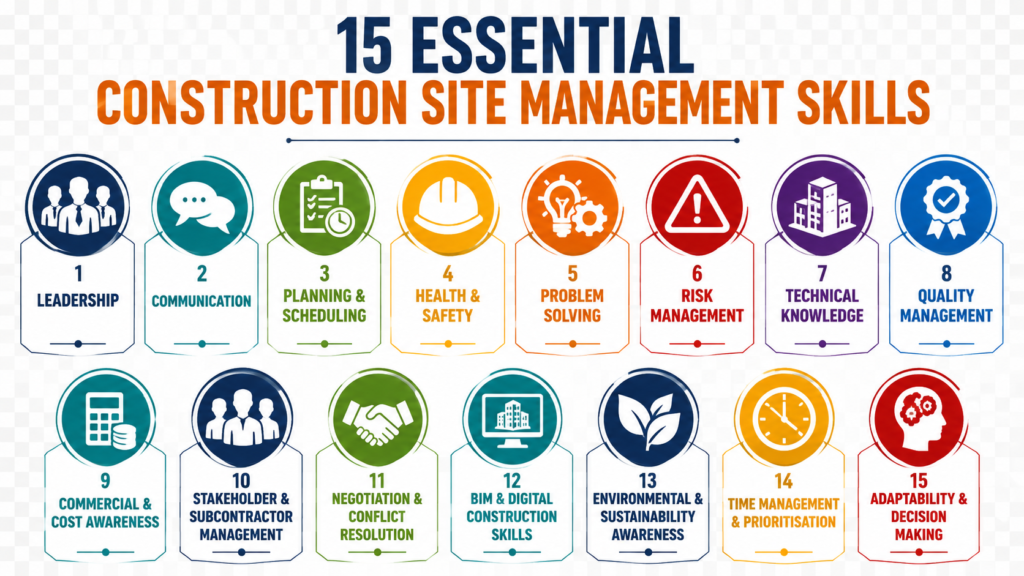
15 Essential Construction Site Management Skills
1. Leadership and Team Management
Leadership is one of the most important construction site management skills because site professionals are responsible for coordinating people with different trades, responsibilities and levels of experience.
Effective leadership involves more than giving instructions. It requires setting expectations, assigning responsibilities, monitoring performance, maintaining professional standards and creating an environment where people understand what is expected of them.
A strong construction leader should be able to:
- Delegate responsibilities appropriately
- Provide clear direction
- Motivate site teams
- Address performance concerns
- Encourage cooperation between trades
- Promote safe working practices
- Maintain accountability
For example, when several subcontractors need access to the same work area, effective leadership helps establish priorities, coordinate activities and prevent unnecessary disruption.
Leadership becomes increasingly important as professionals progress towards senior site management and construction management responsibilities.
2. Communication Skills
Construction depends on clear communication.
Site professionals regularly communicate with workers, subcontractors, suppliers, engineers, designers, project managers, clients and other stakeholders. Each group may require different information and different levels of technical detail.
Effective communication may involve:
- Delivering site instructions
- Conducting briefings and meetings
- Reporting progress
- Discussing design information
- Explaining safety requirements
- Coordinating subcontractors
- Escalating problems
- Recording important decisions
Poor communication can contribute to misunderstandings, delays, unsafe practices and rework.
Good communication should therefore be clear, accurate, timely and appropriate for the intended audience.
Listening is equally important. Site managers need to understand concerns raised by workers, technical specialists and subcontractors before making informed decisions.
3. Planning and Scheduling
Construction activities rarely happen independently. One activity often needs to finish before another can begin.
Planning and scheduling skills help site professionals organise work in the correct sequence while considering labour, materials, equipment, access requirements and project deadlines.
Effective site planning may include:
- Reviewing construction programmes
- Establishing daily and weekly priorities
- Coordinating subcontractors
- Planning labour requirements
- Scheduling plant and equipment
- Checking material availability
- Monitoring milestones
- Identifying potential delays
Consider concrete works scheduled for a particular day. Before the work begins, the team may need reinforcement completed, formwork inspected, labour available, concrete ordered, equipment prepared and access routes confirmed.
Effective planning connects these activities before they become problems.
4. Health and Safety Management
Construction environments can contain significant hazards, including work at height, moving machinery, excavations, electrical systems, lifting operations and hazardous substances.
Health and safety management is therefore a fundamental site management capability.
Construction professionals should understand how to:
- Identify workplace hazards
- Evaluate construction risks
- Follow safe systems of work
- Support site inductions and briefings
- Monitor working practices
- Review relevant risk controls
- Report safety concerns
- Respond appropriately to incidents
Site managers also play an important role in developing a strong safety culture.
When supervisors consistently reinforce safe behaviour, address unsafe conditions and communicate expectations clearly, health and safety becomes part of everyday site management rather than simply a compliance exercise.
5. Problem-Solving
Even well-planned construction projects encounter unexpected challenges.
Materials may arrive late. Drawings may conflict. Weather can disrupt work. Equipment may fail. Site conditions can differ from expectations.
Problem-solving involves identifying the issue, understanding its cause and selecting a practical response.
A useful approach is:
Identify the problem → assess the impact → consider available solutions → consult relevant people → implement the solution → monitor the result.
For example, if a planned installation cannot proceed because another trade has not completed its work, the site manager needs to understand the programme impact and determine whether activities can be resequenced.
Good problem-solving reduces unnecessary disruption while protecting safety and quality.
6. Decision-Making
Problem-solving identifies possible solutions; decision-making determines which action should be taken.
Construction managers frequently make decisions involving competing priorities.
A useful decision-making framework is:
What has happened? → What risks exist? → What action is required? → Who needs to be involved? → How will the decision affect safety, quality, cost and programme?
Not every decision should be made independently.
Technical, contractual, design or safety matters may require consultation with engineers, designers, clients, health and safety specialists or senior management.
An important management skill is therefore knowing both when to make a decision and when to escalate one.
7. Time Management and Prioritisation
A construction site can generate dozens of competing tasks every day.
Managers may need to attend meetings, review work areas, coordinate deliveries, resolve subcontractor issues, inspect workmanship, update records and respond to unexpected events.
Effective time management requires prioritisation.
Tasks can be assessed according to:
- Safety significance
- Programme impact
- Quality implications
- Urgency
- Dependency on other work
- Commercial consequences
A safety-critical issue affecting active work, for example, should normally take priority over routine administrative tasks.
Good time management does not mean doing everything immediately. It means ensuring that the right tasks receive attention at the right time.
8. Technical Construction Knowledge
Site management is not purely administrative.
Professionals need sufficient technical understanding to interpret construction information and recognise whether activities are progressing according to requirements.
Technical knowledge may include:
- Construction methods
- Materials and their applications
- Drawings and specifications
- Building systems
- Structural principles
- Installation sequences
- Inspection requirements
- Construction tolerances
- Relevant standards and regulations
Technical competence also improves communication.
A manager who understands construction processes can communicate more effectively with engineers, supervisors, subcontractors and specialist trades.
However, good management also requires recognising the limits of personal expertise and seeking specialist advice when necessary.
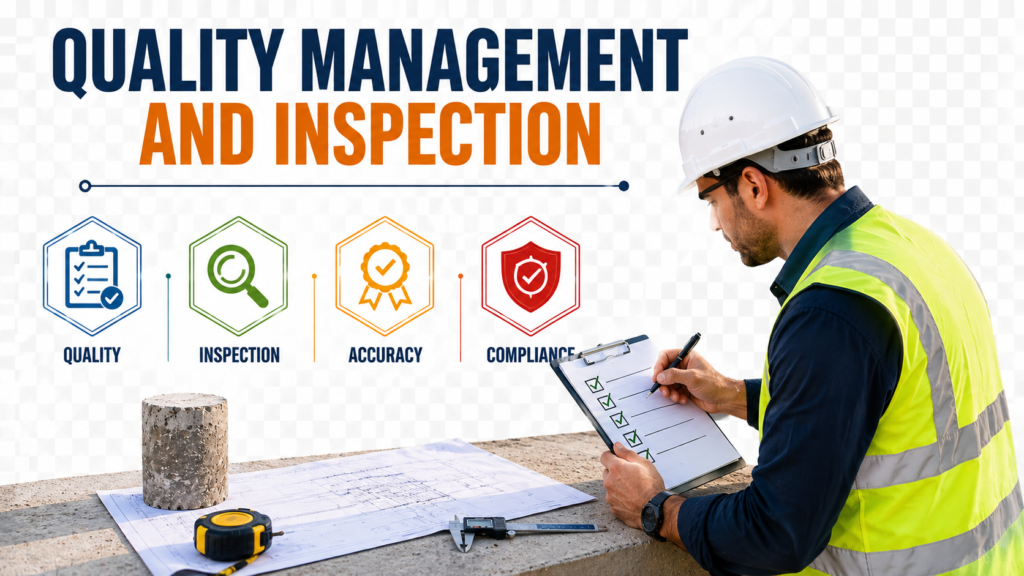
9. Quality Management and Inspection
Completing work quickly has limited value if the work does not meet the required standard.
Quality management helps ensure construction activities comply with drawings, specifications, standards and agreed project requirements.
Site quality management may involve:
- Reviewing specifications
- Checking materials
- Conducting inspections
- Monitoring workmanship
- Maintaining quality records
- Identifying defects
- Managing non-conformances
- Verifying corrective actions
- Supporting handover processes
A useful quality-management sequence is:
Early quality control can also reduce rework.
Identifying an installation problem before subsequent work covers it is generally easier and less expensive than discovering the same issue near project completion.
10. Risk Management
Construction risk extends beyond health and safety.
Projects can face risks relating to programme delays, costs, supply chains, design coordination, weather, quality, resources and stakeholder expectations.
Effective risk management involves:
Identify → assess → control → monitor → review.
For example, if a critical material has a long procurement lead time, the risk is not simply that delivery may be late. The wider consequence could include delayed installation, disruption to subsequent trades and increased project costs.
Site professionals should therefore develop the ability to identify both immediate problems and potential future risks.
11. Commercial and Cost Awareness
Site decisions can have financial consequences.
Construction professionals do not necessarily need to perform the role of a quantity surveyor, but commercial awareness helps them understand how everyday activities affect project performance.
Important areas include:
- Labour productivity
- Material usage
- Waste
- Plant utilisation
- Procurement
- Variations
- Rework
- Programme delays
- Subcontractor performance
For example, repeatedly ordering excess materials may appear to be a small operational issue, but across a large project it can create significant waste and unnecessary expenditure.
Similarly, poor coordination that causes a subcontractor to repeat completed work can affect both cost and programme.
Commercially aware managers consider the wider consequences of site decisions.
12. Stakeholder and Subcontractor Management
Construction projects involve numerous organisations working towards a shared outcome.
Site professionals may interact with:
- Clients
- Main contractors
- Subcontractors
- Consultants
- Designers
- Engineers
- Suppliers
- Local authorities
- Inspectors
- Site workers
Stakeholder management involves understanding responsibilities, maintaining communication and ensuring that relevant people receive the information they need.
Subcontractor coordination is particularly important.
Different trades often depend on one another. Delays or poor workmanship from one subcontractor can affect several subsequent activities.
Effective coordination therefore requires regular communication, clear expectations, progress monitoring and early intervention when problems emerge.
13. Negotiation and Conflict Resolution
Disagreements are not unusual on construction projects.
They may arise over:
- Work priorities
- Access to working areas
- Resource availability
- Programme responsibilities
- Workmanship
- Design interpretation
- Changes
- Site instructions
Effective managers should be able to handle disagreements professionally without allowing them to disrupt project delivery.
Conflict resolution involves listening to different perspectives, identifying the underlying issue, reviewing relevant facts and working towards a practical solution.
Negotiation is closely related.
Site professionals may need to negotiate resources, sequencing, delivery arrangements or corrective actions while maintaining productive working relationships.
The objective should be to resolve the issue while protecting the project’s safety, quality, programme and commercial requirements.
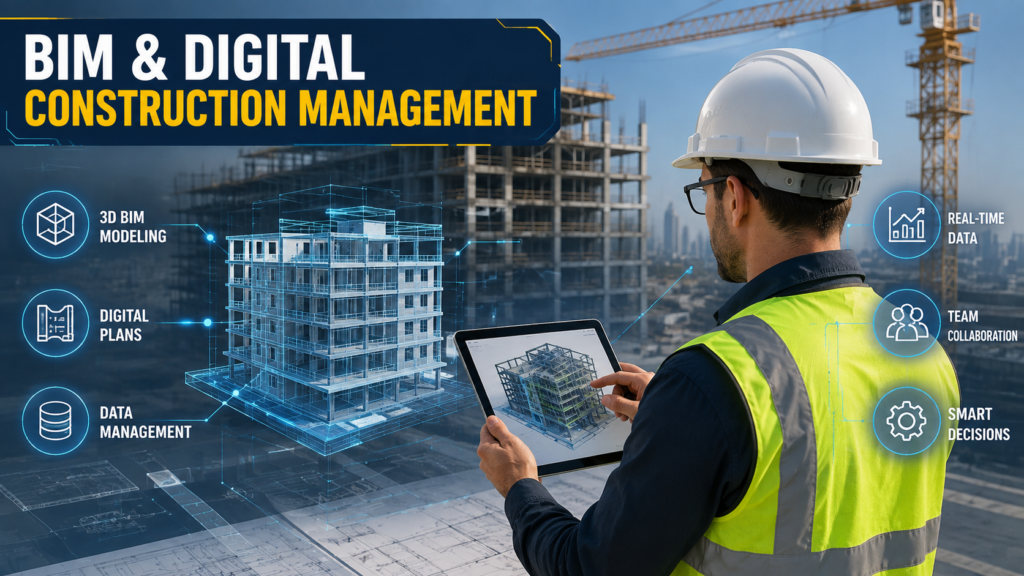
14. Digital Construction and BIM Skills
Digital competence is becoming increasingly important in modern construction.
Many projects now use digital platforms to manage drawings, inspections, progress information, quality records, safety documentation and communication.
Useful digital construction capabilities can include:
- Building Information Modelling (BIM) awareness
- Common Data Environment (CDE) use
- Digital drawing review
- Mobile inspection applications
- Digital progress reporting
- Document management systems
- Scheduling software
- Data interpretation
- Digital quality records
BIM is particularly important because it can improve information coordination between project teams.
Digital tools can also help site managers access current information more quickly, reduce reliance on outdated documents and create more transparent project records.
However, technology only creates value when information is accurate and teams understand how to use the systems correctly.
15. Environmental and Sustainability Awareness
Environmental performance has become an increasingly important part of construction management.
Site activities can affect energy consumption, waste generation, natural resources, neighbouring communities and the surrounding environment.
Construction professionals should understand practical sustainability considerations such as:
- Waste segregation
- Material efficiency
- Pollution prevention
- Responsible resource use
- Water management
- Energy efficiency
- Noise and dust control
- Environmental monitoring
- Sustainable construction methods
Environmental management should be integrated into everyday site planning rather than treated as a separate activity.
For example, careful material planning can reduce waste while also lowering procurement costs, demonstrating how sustainability and commercial performance can support one another.
Technical Skills vs Soft Skills in Construction Site Management
Successful site management requires both technical and interpersonal capabilities.
| Technical Skills | Soft and Management Skills |
|---|---|
| Construction methods | Leadership |
| Reading drawings | Communication |
| Health and safety knowledge | Problem-solving |
| Quality inspection | Decision-making |
| Planning and scheduling | Time management |
| Cost awareness | Negotiation |
| Risk management | Conflict resolution |
| BIM and digital systems | Adaptability |
Technical skills help professionals understand what needs to be built and how construction activities should be controlled.
Soft skills help them manage people, communication, decisions and working relationships.
Neither group should be considered optional.
A technically knowledgeable manager who cannot communicate effectively may struggle to coordinate teams. Likewise, an excellent communicator without sufficient technical understanding may find it difficult to identify construction risks or quality concerns.
How Do Construction Site Management Skills Affect Project Performance?
Site management skills directly influence how efficiently construction activities are coordinated and controlled.
The relationship can be understood as:
Strong management skills → better planning and communication → improved coordination → fewer avoidable problems → stronger project performance.
For example:
Effective planning can reduce delays.
Clear communication can reduce misunderstandings.
Quality management can minimise defects and rework.
Strong safety management can help prevent incidents.
Commercial awareness can reduce unnecessary waste.
Leadership can improve workforce coordination.
Risk management can identify potential problems before they become major disruptions.
These skills therefore work as an interconnected management system rather than separate capabilities.
How to Improve Construction Site Management Skills
Construction management skills develop through a combination of education, training, experience and continuous professional development.
Gain Practical Site Experience
Real construction environments expose professionals to problems that cannot always be fully understood through classroom learning.
Practical experience develops awareness of sequencing, workforce coordination, site logistics, quality issues and day-to-day decision-making.
Learn from Experienced Professionals
Mentoring can accelerate professional development.
Experienced site managers can explain why decisions are made, how problems are escalated and how competing project priorities are balanced.
Undertake Relevant Training and Qualifications
Structured education can strengthen knowledge of areas such as construction management, health and safety, project management, quality control and leadership.
Qualifications can also provide a framework for demonstrating professional competence and supporting career development.
Improve Digital Competence
Professionals should become comfortable using the digital systems increasingly found across construction projects.
Learning BIM principles, document management systems, scheduling tools and digital inspection platforms can improve both employability and operational effectiveness.
Review Project Performance
Reflective practice is valuable.
After completing a project stage or resolving a significant issue, consider:
What happened? What worked? What could have been handled differently? What should be applied next time?
This turns everyday experience into professional development.
Commit to Continuous Professional Development
Construction methods, technologies, regulations and industry expectations continue to evolve.
Continuous professional development helps professionals keep their knowledge current and prepare for greater responsibilities.
Construction Site Management Skills for Career Progression
Strong site management capabilities can support progression across construction supervision, site management, project management and broader construction leadership responsibilities.
Career development often involves moving from responsibility for individual activities towards responsibility for larger teams, complex work packages and eventually entire projects.
As responsibility increases, professionals generally need stronger capabilities in:
technical knowledge → supervision → coordination → leadership → commercial awareness → strategic decision-making.
Developing transferable management skills therefore supports both current job performance and longer-term professional progression.
Future Construction Management Skills Professionals Should Develop
Construction is changing rapidly, meaning the skill set required from future site managers will continue to expand.
BIM and Digital Information Management
Professionals will increasingly need to work confidently with structured digital project information and collaborative construction platforms.
Data-Driven Decision-Making
Digital reporting and project data can help managers identify productivity trends, quality issues and programme risks.
The ability to interpret information will become increasingly valuable.
Artificial Intelligence Awareness
Artificial intelligence is beginning to influence planning, risk analysis, document review, reporting and project monitoring.
Site professionals do not necessarily need to become AI specialists, but understanding how these technologies can support construction management may become an important professional capability.
Sustainable Construction
Environmental expectations are increasing across the built environment.
Knowledge of waste reduction, resource efficiency, low-carbon construction and environmental management will therefore become more relevant.
Modern Methods of Construction
Off-site manufacturing, modular construction and other modern construction methods require different approaches to logistics, coordination and quality management.
Building Safety and Compliance
Construction professionals will continue to need strong awareness of regulatory responsibilities, competence requirements, documentation and building safety expectations.
Future site managers will therefore need to combine traditional construction experience with stronger digital, environmental, analytical and compliance capabilities.
Frequently Asked Questions
Final Thoughts
Successful construction site management requires much more than knowing how buildings and infrastructure are constructed.
Modern professionals need a balanced combination of leadership, communication, planning, technical knowledge, health and safety awareness, quality management, problem-solving, risk management, commercial awareness and digital competence.
These skills are closely connected. Good planning supports productivity. Strong communication improves coordination. Effective leadership strengthens team performance. Quality management reduces defects, while risk management helps identify problems before they become major disruptions.
The future of construction will place even greater emphasis on BIM, digital information management, sustainability, data-driven decision-making, modern construction methods and building safety.
For construction professionals, developing these capabilities is therefore not a one-time exercise. It is an ongoing process of practical experience, training, reflection and continuous professional development.
By strengthening both technical and management capabilities, construction professionals can become better prepared to manage complex sites, support safer working environments and contribute to successful project delivery.