
Construction Site Management Explained: Roles, Responsibilities and Best Practices
A construction project may begin with architectural drawings, engineering calculations and a carefully developed programme, but its success is ultimately determined by what happens on site.
Every working day brings a new combination of activities. Materials arrive, subcontractors move between work areas, equipment is deployed, inspections take place, design questions emerge and deadlines continue to approach. When these moving parts are not properly coordinated, productivity can fall quickly and problems such as rework, unsafe conditions, disrupted schedules and unnecessary costs can follow.
This is where construction site management becomes essential.
Construction site management is the practical coordination and control of construction operations from mobilisation through to completion. It connects project planning with day-to-day execution by ensuring that people, information, materials, equipment, safety controls, quality requirements and schedules work together.
Rather than simply supervising workers, effective site management asks a broader question:
What needs to happen today so that the project can safely and efficiently move to its next stage?
Answering that question requires planning, leadership, technical understanding, communication and constant monitoring.
This guide explores construction site management from a practical perspective, including key roles, responsibilities, workflow, site controls, documentation, performance indicators, common problems, technology and best practices.
Construction Site Management at a Glance
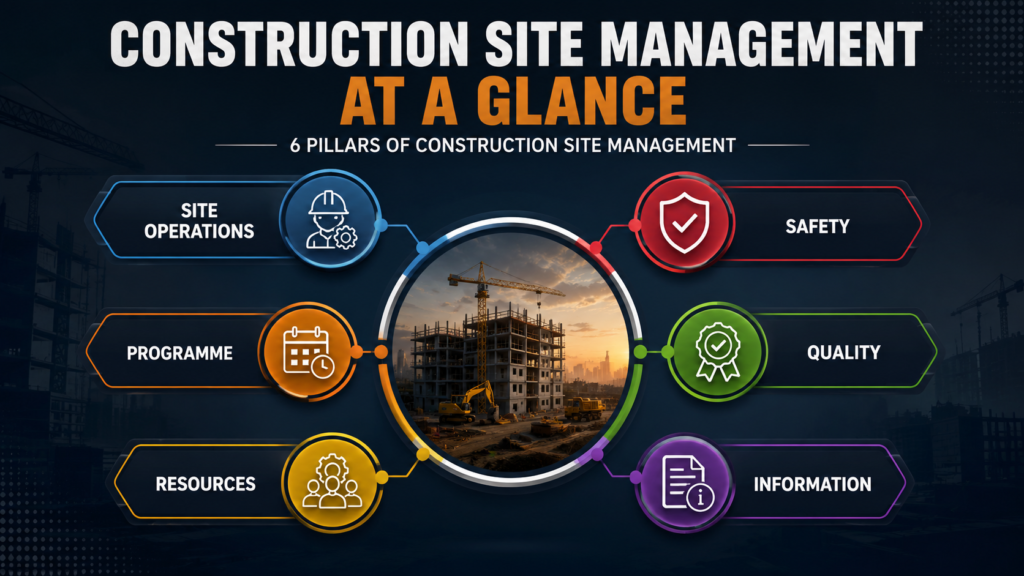
Construction site management can be understood through six interconnected areas:
| Management Area | Main Objective |
|---|---|
| Site Operations | Keep daily construction activities organised |
| Health and Safety | Control risks and maintain safe working conditions |
| Programme | Keep activities aligned with planned milestones |
| Quality | Ensure completed work satisfies project requirements |
| Resources and Logistics | Coordinate labour, plant, materials and site space |
| Information | Ensure teams receive accurate and current project information |
These areas cannot be managed effectively in isolation.
For example, a material delivery may appear to be purely a logistics issue. However, if the delivery is late, the affected subcontractor may lose productive time. The programme can then slip, another trade may lose access to its work area and additional costs may follow.
Good construction site management therefore focuses heavily on interfaces and dependencies, not simply individual tasks.
Why Effective Site Management Matters
Construction sites are dynamic environments. Conditions that were suitable yesterday may change today because of weather, new work fronts, deliveries, temporary structures, excavation activities or the arrival of additional contractors.
Strong management provides the operational discipline needed to deal with this constant change.
It Creates Safer Working Conditions
Construction activities can involve significant risks, including working at height, moving vehicles, lifting operations, electricity, temporary works, excavations and hazardous materials.
Effective management integrates risk control into daily planning instead of treating health and safety as a separate administrative exercise.
It Protects the Construction Programme
Project schedules consist of connected activities.
A delay does not necessarily remain confined to the task where it originated.
Consider this sequence:
Foundation delay → structural delay → services delayed → finishes delayed → commissioning delayed → handover affected
Site teams therefore need to understand both current progress and the consequences that current performance may have on upcoming activities.
It Reduces Rework
Finding a defect immediately is usually easier than discovering it after additional work has covered it.
Quality management during construction allows teams to verify work at appropriate stages, document inspections and correct non-conforming work before it creates larger problems.
It Improves Resource Efficiency
Labour, materials, machinery and site space all have limits.
Good coordination helps ensure resources are available when needed without creating unnecessary congestion, idle time or waste.
It Improves Decision-Making
Reliable site information gives managers a clearer picture of what is happening.
Progress records, inspection results, RFIs, site diaries, delivery information and issue trackers help management decisions rely on evidence rather than assumptions.
The Management Structure Behind a Construction Site
Managing a construction project is normally a shared responsibility. Different professionals control different parts of project delivery.
A typical structure may involve:
| Role | Primary Focus |
| Project Manager | Overall project delivery and strategic coordination |
| Site Manager | Day-to-day management of site operations |
| Site Supervisor | Direct control of specific workers, activities or areas |
| Site Engineer | Technical support, measurements and setting out |
| Health and Safety Professional | Risk management, inspections and compliance support |
| QA/QC Professional | Inspection, testing and quality documentation |
| Quantity Surveyor | Cost, valuation, variation and commercial matters |
| Document Controller | Management of drawings, revisions and project records |
| Subcontractor Supervisor | Delivery of a particular specialist work package |
| Construction Workforce | Execution of planned construction activities |
The precise hierarchy depends on project scale, contract arrangements and organisational structure.
One important distinction in the UK is between a job title and a formal dutyholder role.
For example, “site manager” describes an operational position. “Principal contractor” under the Construction (Design and Management) Regulations 2015 is a defined dutyholder appointment. These terms should therefore not automatically be treated as interchangeable.
What Does a Construction Site Manager Actually Manage?
The site manager sits close to the operational centre of the project.
The role is not simply about checking whether workers are busy. A site manager must maintain visibility across several areas simultaneously.
Daily Construction Activities
The manager needs to know what is happening, where it is happening and whether each activity is ready to proceed.
This can involve reviewing:
- current work fronts
- subcontractor activities
- labour availability
- equipment requirements
- site access
- material availability
- planned inspections
- temporary works
- delivery schedules
- outstanding technical information
An activity should ideally start because it is ready—not merely because it appears on the programme.
From Drawings to Daily Work: How Site Planning Works
A construction programme provides the overall delivery roadmap, but site operations require more detailed planning.
A practical planning hierarchy may look like:
Project Programme → Phase Plan → Look-Ahead Schedule → Weekly Commitments → Daily Work Plan
The closer planning moves towards the actual work date, the more detailed it becomes.
Look-Ahead Planning
Look-ahead planning is particularly useful because it exposes obstacles before an activity reaches site.
Suppose installation is scheduled to start in three weeks.
Instead of waiting until the installation date, the site team can check:
Design approved? → Materials ordered? → Preceding work finished? → Access available? → Labour confirmed? → Equipment available? → Inspection requirements understood?
Any “no” becomes a constraint requiring action.
This shifts site management from reacting to delays to preventing delays.
Creating a Functional Construction Site
Site mobilisation can influence productivity for months afterwards.
Before intensive construction begins, management may need to establish:
- controlled site entrances
- security arrangements
- hoarding or fencing
- offices
- welfare facilities
- pedestrian walkways
- vehicle routes
- unloading areas
- material storage
- waste collection areas
- temporary utilities
- emergency arrangements
- signage and exclusion zones
Space becomes particularly important on congested urban projects.
Poorly located storage areas can increase material handling. Uncontrolled delivery vehicles can obstruct access. Pedestrian and vehicle conflicts can increase risk.
A good site layout therefore considers movement, safety and productivity together.
Managing Health and Safety Through Daily Operations
Health and safety management should influence how construction work is planned, sequenced and supervised.
Depending on the work involved, site-management activities may include:
- reviewing risk assessments and method statements
- arranging inductions
- coordinating toolbox talks
- checking access arrangements
- monitoring work at height
- controlling vehicle movements
- checking lifting operations
- reviewing excavation controls
- managing permits where required
- maintaining housekeeping
- reviewing emergency arrangements
- investigating incidents and near misses
- verifying corrective actions
A risk assessment prepared before work starts is not automatically sufficient for the entire activity.
Conditions may change.
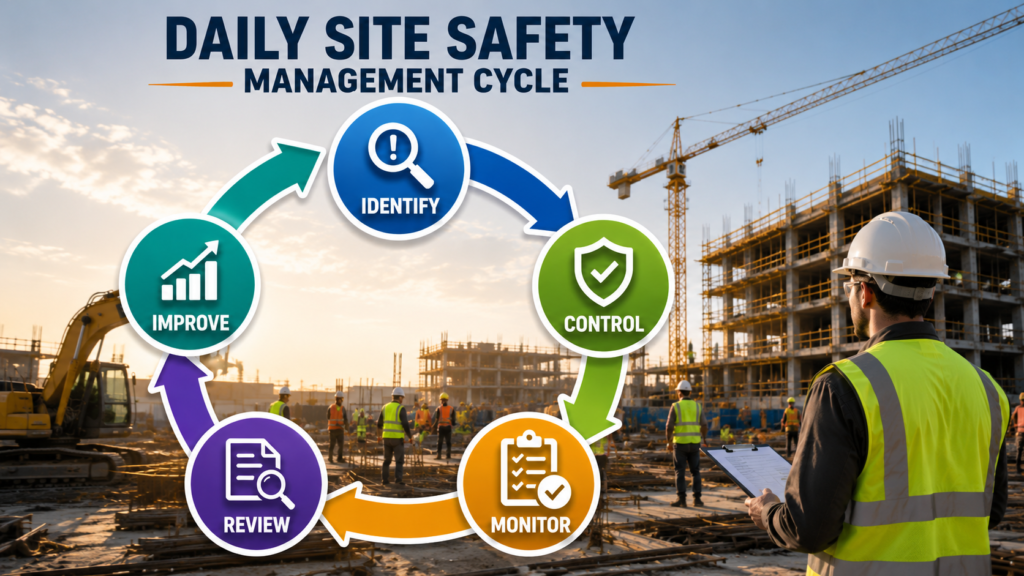
The management cycle therefore needs to remain dynamic:
CDM 2015 and Construction-Phase Management
In Great Britain, the Construction (Design and Management) Regulations 2015 establish duties for organisations and individuals involved in construction projects.
Where a project involves more than one contractor, relevant appointments include the principal designer and principal contractor.
During construction, the principal contractor has important responsibilities relating to planning, managing, monitoring and coordinating health and safety during the construction phase.
For site teams, this reinforces the importance of structured planning, effective cooperation, clear communication and appropriate records.
The actual legal responsibility attached to an individual or organisation should always be determined from the project’s formal arrangements rather than assumed from a job title.
Coordinating Multiple Trades Without Creating Conflict
Construction projects are highly dependent on sequencing.
One team often cannot finish—or even start—until another team has completed its work.
Imagine a ceiling is due to be closed.
Before closure, management may need confirmation that:
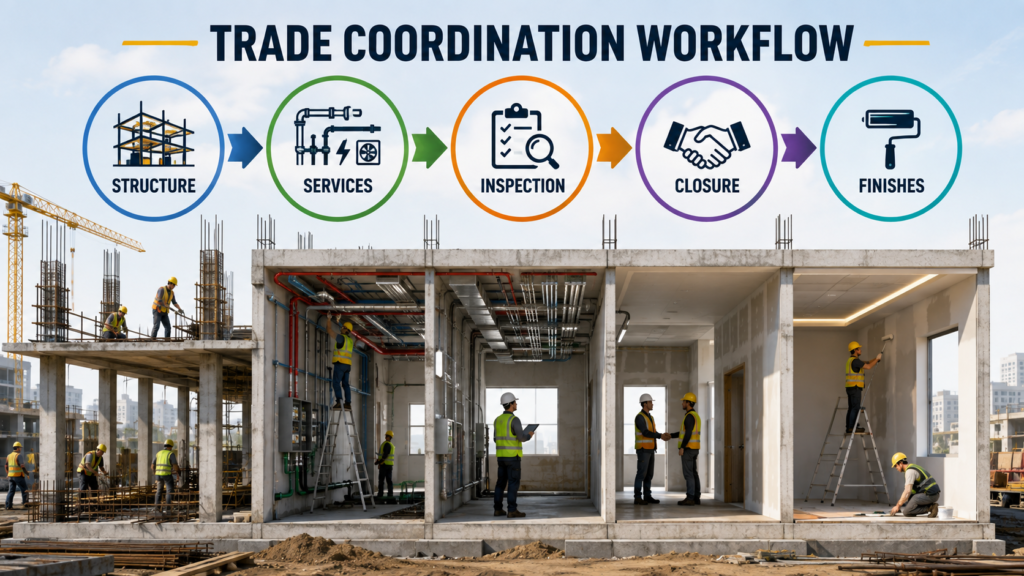
Closing it too early can result in completed work being reopened later.
Trade coordination should therefore address both physical space and construction sequence.
Site teams should understand:
- who requires each work area
- how long they require it
- what must be completed beforehand
- what work follows afterwards
- whether simultaneous activities create risks
- whether access will remain available
- whether inspections are required between trades
Construction Logistics: Getting the Right Resource to the Right Place
Construction logistics involves much more than arranging deliveries.
Managers must coordinate how materials, equipment, people and waste move through the site.
A typical material flow might be:
Order → Confirm → Schedule → Receive → Inspect → Store → Move → Install → Protect
Failure at any stage can affect productivity.
For example, materials delivered early may occupy valuable space or become damaged. Materials delivered late may stop work entirely.
Effective logistics can include:
- booking delivery slots
- coordinating lifting requirements
- separating pedestrians and vehicles
- planning unloading areas
- controlling storage
- protecting sensitive materials
- allocating plant
- managing waste removal
- maintaining emergency access
On space-restricted projects, carefully managed just-in-time delivery can reduce congestion, although it depends heavily on reliable supply-chain coordination.
Quality Should Be Managed Before Defects Appear
Quality management works best when it is built into the construction process.
Waiting until completion to inspect everything can allow defects to remain hidden for weeks or months.
A stronger process is:
Confirm requirements → Prepare work → Build → Inspect → Test → Document → Release next activity
Site quality controls can include:
- current approved drawings
- technical specifications
- approved materials
- inspection and test plans
- checklists
- hold points
- witness points
- test results
- photographs
- non-conformance reports
- corrective-action records
- snagging registers
Particular attention should be given to concealed work.
Once waterproofing, reinforcement, services, fire stopping or other critical elements have been covered, verification may become considerably more difficult.
Managing Construction Information
Modern construction depends heavily on information.
A highly skilled team can still produce incorrect work if it receives an obsolete drawing.
Information control therefore needs to answer three questions:
What is the approved information?
Who needs it?
How do we prevent superseded information from remaining in use?
Important records may include:
| Information/Record | Why It Matters |
| Drawings | Communicate design requirements |
| Specifications | Define technical standards |
| RFIs | Resolve missing or unclear information |
| Method Statements | Explain planned work methods |
| Risk Assessments | Record hazards and controls |
| Inspection Records | Demonstrate verification |
| Site Diaries | Capture daily site events |
| NCRs | Record non-conforming work |
| Permits | Control relevant activities where required |
| Progress Reports | Communicate delivery status |
| Snag Lists | Track incomplete or defective items |
Documents should be current, traceable and appropriately controlled.
The Site Diary: A Small Document with Major Value
Daily records can become extremely important later in a project.
A useful site diary may capture:
- weather conditions
- labour numbers
- subcontractors present
- major activities
- plant in operation
- deliveries
- inspections
- delays
- instructions
- incidents
- unusual conditions
- significant discussions
The purpose is not to create paperwork for its own sake.
It is to create a reliable factual history of project activity.
How Site Managers Control Cost Without Managing the Entire Budget
Commercial responsibility may primarily sit with project managers and quantity surveyors, but site decisions can significantly influence cost.
Common cost leakage includes:
Poor planning → idle labour
Incorrect work → rework
Poor storage → damaged materials
Weak coordination → plant waiting time
Late decisions → programme disruption
Excess ordering → material waste
Site managers can therefore contribute to commercial performance by monitoring productivity, resources, waste, variations, delays and recurring inefficiencies.
Communication: The Hidden Construction Control
Many site problems are not caused by a complete absence of information.
They occur because information is late, unclear, incomplete or sent to the wrong person.
A design change, for example, may need to reach site management, engineering, QA/QC, the relevant subcontractor, procurement and commercial teams.
Simply sending an email does not guarantee that a change has been effectively implemented.
Good communication should therefore establish:
Issue → Responsible person → Required decision → Deadline → Communication → Implementation → Verification
Important decisions affecting safety, quality, programme, design or cost should normally be documented appropriately.
Environmental Control on Construction Sites
Construction activities can affect both the immediate site and surrounding communities.
Relevant environmental considerations may include:
- dust
- noise
- waste
- fuel and chemical spills
- water pollution
- traffic
- emissions
- energy consumption
- material use
Controls can include waste segregation, appropriate storage, spill-response arrangements, dust suppression, noise controls and efficient logistics.
Environmental performance is also becoming increasingly connected with wider sustainability and resource-efficiency objectives.
The Construction Site Management Lifecycle
Instead of viewing site management as a collection of unrelated duties, it is useful to see it as a continuous lifecycle.
1. Prepare
Review project information, constraints, resources, risks and programme requirements.
2. Mobilise
Establish site infrastructure, access, welfare, security, storage and logistics.
3. Make Work Ready
Confirm that labour, information, materials, plant, access and controls are available.
4. Execute
Coordinate construction activities according to approved requirements.
5. Measure
Monitor progress, safety, quality, productivity and resource performance.
6. Correct
Resolve constraints, defects, coordination problems and emerging risks.
7. Verify
Inspect, test and document completed work.
8. Commission
Demonstrate that relevant systems and installations operate as required.
9. Handover
Complete outstanding work, close defects and assemble required documentation.
10. Learn
Capture lessons that can improve future projects.
The full operational cycle becomes:
Prepare → Mobilise → Coordinate → Construct → Monitor → Correct → Verify → Handover → Improve
A Typical Day in Construction Site Management
No two days are identical, but a well-managed site normally follows a recognisable rhythm.
Start of Day
Management reviews the day’s work, labour, weather, planned deliveries, access requirements, permits, high-risk activities and unresolved constraints.
Coordination Period
Supervisors and relevant subcontractors confirm work areas, priorities, interfaces and responsibilities.
Active Site Management
Managers inspect ongoing operations rather than remaining entirely office-based.
They observe:
Safety + Progress + Quality + Logistics + Coordination
Issue Resolution
Problems identified during the day are assigned, escalated or corrected.
Daily Closeout
Actual progress is compared with planned progress, records are updated and readiness for the next working period is reviewed.
The cycle is simple:
Plan → Communicate → Observe → Intervene → Record → Prepare again
Measuring Construction Site Performance
Good management requires more than subjective impressions such as “the site looks busy.”
Performance indicators can provide more objective evidence.
| KPI | Management Insight |
| Milestones Achieved | Programme reliability |
| Schedule Variance | Difference between planned and actual progress |
| Rework | Quality and planning effectiveness |
| Inspection Pass Rate | Conformance of completed work |
| NCR Closure | Effectiveness of corrective action |
| Labour Productivity | Resource performance |
| Material Waste | Resource efficiency |
| Plant Utilisation | Equipment effectiveness |
| RFI Turnaround | Information-flow performance |
| Safety Events | Risk-control performance |
| Near-Miss Reporting | Hazard reporting and awareness |
| Snag Closure | Readiness for completion |
KPIs should be analysed together rather than interpreted in isolation.
For instance, a rising number of near-miss reports does not automatically mean safety performance is deteriorating. It could also reflect stronger reporting behaviour. Context matters.
Why Construction Sites Fall Behind Schedule
Project delays rarely have only one cause.
Common contributors include:
- late design information
- procurement delays
- insufficient labour
- poor sequencing
- unexpected site conditions
- equipment breakdown
- failed inspections
- rework
- weather
- subcontractor underperformance
- slow decisions
- access restrictions
The critical management question is not:
“Why are we late?”
It is:
“Which unresolved constraint is most likely to make the next critical activity late?”
That distinction encourages forward-looking management.
Recurring Construction Site Management Problems
Starting Before Work Is Ready
Beginning an activity without complete information, resources or preceding work often creates stop-start productivity.
Better practice: use readiness checks before releasing work.
Poor Subcontractor Interfaces
Two contractors may individually follow their plans while still interfering with each other.
Better practice: coordinate work areas and dependencies through look-ahead planning.
Late Procurement
Critical materials arriving after their planned installation date can halt work.
Better practice: connect procurement schedules directly to construction requirements.
Repeated Defects
Correcting individual defects without identifying their cause allows the same problem to return.
Better practice: investigate trends and implement preventive action.
Weak Information Control
Teams may unknowingly construct from outdated drawings.
Better practice: establish controlled distribution and remove superseded information.
Closing Work Too Early
Concealed elements may become inaccessible before inspection.
Better practice: establish clear inspection and release points.
Unclear Action Ownership
Everyone knows there is a problem, but nobody owns the solution.
Better practice: every significant action should have an owner and target date.
Best Practices for Better Construction Site Management
The strongest sites tend to operate proactively.
Make Activities Ready Before Their Start Date
Check:
Information + Labour + Materials + Plant + Access + Safety + Quality requirements
before committing to the activity.
Give Every Critical Action an Owner
A task without ownership is easy to ignore.
Action registers should identify who is responsible, when the action is due and what constitutes closure.
Connect Safety with Production Planning
Safety controls should influence work sequencing, equipment selection, access arrangements and resource planning from the beginning.
Plan Several Weeks Ahead
Short-term look-ahead planning allows constraints to be resolved before they become programme delays.
Protect Completed Work
Finishing an activity is not enough.
Completed work should remain protected from damage caused by later trades, weather or material movement.
Verify Corrective Actions
“Closed” should mean the issue has actually been corrected and verified—not simply removed from a spreadsheet.
Analyse Repeated Problems
Recurring NCRs, delays, RFIs or safety observations may reveal weaknesses in planning, design coordination, procurement or supervision.
Maintain Handover Readiness Throughout Construction
Handover should not suddenly become important during the final weeks.
Certificates, inspection records, testing information, manuals and completion evidence should be organised progressively.
Technology Reshaping Site Management
Digital construction tools are improving the speed at which site teams can capture, distribute and analyse information.
Building Information Modelling
BIM can improve visual coordination and help teams understand spatial relationships before installation.
Common Data Environments
A CDE can provide controlled access to current project information and reduce dependence on uncontrolled document copies.
Mobile Inspection Systems
Digital inspection applications can connect observations with photographs, locations, responsible parties and target dates.
Digital Site Diaries
Electronic reporting can improve consistency and simplify retrieval of historical records.
Drones
Where appropriately planned and operated, drones can assist with surveys, visual inspections and progress documentation.
Sensors and Connected Equipment
Connected devices can provide information about environmental conditions, equipment status or selected site risks.
Artificial Intelligence
AI-assisted systems are increasingly being explored for progress analysis, document review, planning support, risk identification and construction-data analysis.
The management principle remains important:
Adopt technology because it solves a defined site problem—not simply because the technology exists.
Site Manager, Supervisor and Project Manager: What Is the Difference?
The three roles often overlap, but their normal focus differs.
| Responsibility | Site Supervisor | Site Manager | Project Manager |
| Direct workforce control | Primary | Significant | Limited |
| Daily site operations | Specific area | Primary | Oversight |
| Trade coordination | Some | Extensive | Strategic |
| Programme management | Task level | Site level | Project level |
| Quality oversight | Operational | Site-wide | Overall |
| Client coordination | Limited | Regular | Extensive |
| Commercial involvement | Limited | Some | Significant |
| Strategic decisions | Limited | Moderate | High |
The exact division depends on the project’s scale and organisational structure.
Skills That Separate Effective Site Managers from Average Ones
Site management requires more than construction knowledge.
A competent manager combines technical awareness with the ability to coordinate people and make decisions under changing conditions.
Important capabilities include:
- leadership
- planning
- communication
- problem-solving
- organisation
- technical understanding
- health and safety awareness
- quality management
- commercial awareness
- negotiation
- conflict resolution
- decision-making
- digital literacy
- time management
- attention to detail
Perhaps most importantly, effective managers develop situational awareness.
They understand not only what is happening now but also what today’s activities could mean for tomorrow’s work.
Routes into Construction Site Management
There is no universal pathway into the profession.
Depending on the role and employer, development may involve:
- construction-related vocational qualifications
- NVQs
- apprenticeships
- higher education
- professional development
- site-management training
- health and safety training
- practical supervisory experience
In the UK construction sector, the Site Management Safety Training Scheme (SMSTS) is widely recognised for people with site-management responsibilities.
However, one qualification or training programme should not be viewed as proof of competence for every project.
Effective construction management depends on an appropriate combination of knowledge, training, skills, experience and organisational capability.
A Practical Site Management Control Framework
Site teams can use the following framework when reviewing an activity:
| Question | What Management Should Confirm |
| What are we building? | Approved scope and current information |
| Who will build it? | Competent and available workforce |
| What is needed? | Materials, tools, plant and equipment |
| Where will it happen? | Safe and accessible work area |
| What could go wrong? | Risks, constraints and interfaces |
| How will quality be verified? | Inspection and testing requirements |
| When must it finish? | Programme commitment |
| What follows next? | Downstream dependency |
| What evidence is required? | Records, inspections and approvals |
This creates a simple readiness test:
Defined + Resourced + Accessible + Controlled + Verifiable + Scheduled = Ready for Work
Construction Site Management Checklist
Before releasing or reviewing construction activities, management should confirm:
- Current approved information is available.
- Work responsibilities are clearly allocated.
- Relevant risks have been assessed.
- Required controls are in place.
- Labour resources are sufficient.
- Materials are available and suitable.
- Plant and equipment are ready.
- Access is available.
- Interfaces with other trades have been coordinated.
- Required inspections are planned.
- Environmental controls are appropriate.
- Completed work is protected.
- Progress is being measured.
- Programme constraints are visible.
- Changes are formally communicated.
- Site records reflect actual conditions.
- Defects are assigned and tracked.
- Corrective actions are verified.
- Handover documentation is being developed.
- Lessons from recurring issues are being applied.
Final Perspective: Managing the Site as a Connected System
Construction site management is best understood as the discipline that converts project intent into controlled physical delivery.
Drawings alone cannot coordinate subcontractors.
A programme alone cannot remove constraints.
A safety plan alone cannot supervise changing site conditions.
An inspection checklist alone cannot guarantee workmanship.
Success comes from connecting these elements.
Effective site managers continuously align:
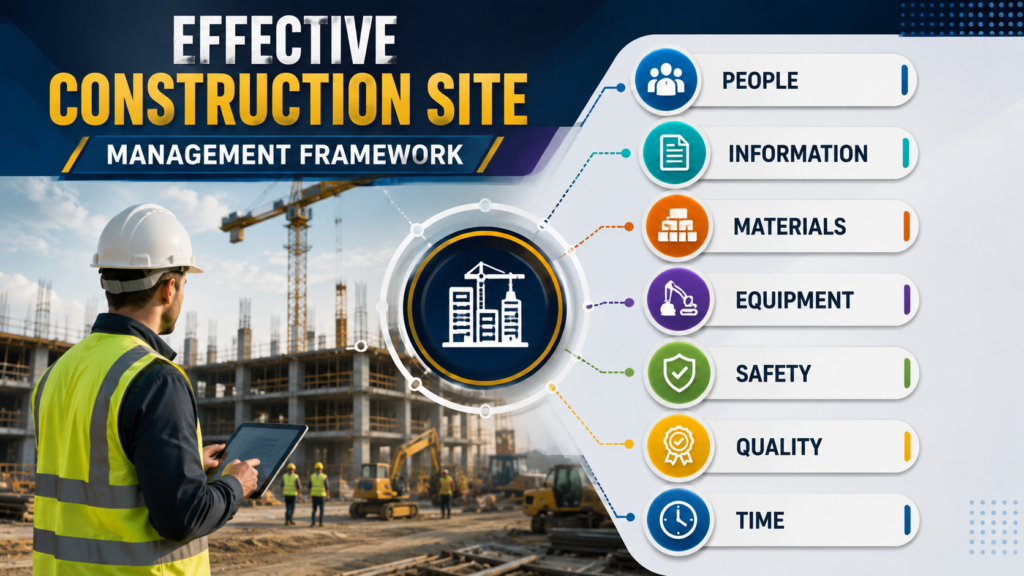
The most successful management approach is therefore proactive rather than reactive. Work is made ready before it begins. Interfaces are resolved before trades clash. Materials are coordinated before labour is waiting. Critical work is inspected before it disappears behind finishes. Problems are assigned before they become delays, and records are maintained before information is forgotten.
Technology can strengthen this process, but it does not replace competent management, professional judgement or effective communication.
When planning, supervision, coordination, verification and continuous improvement operate together, construction site management becomes more than day-to-day supervision. It becomes the control system that helps move a project from an approved design to a safe, compliant, efficient and successfully completed construction outcome.
Conclusion
Effective construction site management is essential for turning project plans into safe, organised and successful construction outcomes. By coordinating people, materials, equipment, information, safety requirements, quality controls and project schedules, site management helps reduce delays, prevent costly rework and maintain consistent progress from mobilisation to handover. The strongest approach is proactive: identifying constraints early, assigning clear responsibilities, monitoring performance and resolving issues before they disrupt construction. When experienced leadership is combined with structured planning, reliable communication, accurate documentation and appropriate digital tools, construction teams are better positioned to deliver projects efficiently, safely and to the required standards.