ProQual NVQ Level 3 Construction: Guided Template Walkthrough
Table of Contents
Introduction and Purpose
This Knowledge Providing Task (KPT) has been developed specifically for learners undertaking the ProQual Level 3 NVQ Diploma in Testing, Inspecting and Thorough Examination Occupations (Construction). The task supports the unit Confirming work activities and resources for an occupational area in the workplace and focuses on the practical documentation used on UK construction sites.
Testing and inspection operatives are required to confirm work activities, assess resources, and adapt work programmers using accurate documentation. Incorrectly completed risk assessments, inspection records, or environmental registers can result in unsafe work, delays, or non-compliance with UK legislation.
The purpose of this KPT is to:
- Demonstrate how key workplace documents are completed correctly
- Support learners in identifying work activities and required resources
- Show how documentation helps plan and sequence work
- Explain how changes in circumstances are recorded and justified
- Build competence in meeting legal and organisational requirements
This task uses step-by-step, line-by-line model examples so learners understand both how and why forms are completed.
Occupational Context and Competency Focus
Within the construction industry, testing, inspecting and thorough examination operatives are expected to work independently while following site systems and procedures. At Level 3 NVQ, competence is demonstrated by the ability to:
- Identify work activities before they start
- Assess whether labour, plant, equipment, and materials are available
- Recognize when work activities affect each other
- Seek clarification where resources are missing
- Adjust work programmes due to changed circumstances
- Record decisions accurately using workplace documentation
The documents demonstrated in this task are commonly used to confirm work activities and resources on UK construction sites.
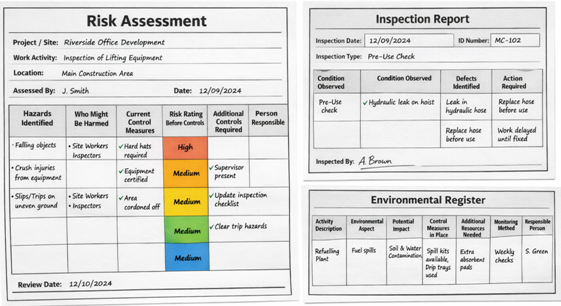
Step-by-Step Demonstration of a Risk Assessment Template
Purpose of the Risk Assessment
A risk assessment is used to identify hazards associated with work activities, assess risks, and confirm that suitable controls and resources are in place before work begins. It supports compliance with:
- Health and Safety at Work etc. Act 1974
- Management of Health and Safety at Work Regulations 1999
- Construction (Design and Management) Regulations 2015
Model Risk Assessment – Line-by-Line Explanation
Project / Site Name
Enter the official site name as stated on site documentation.
Common mistake: using informal or shortened site names.
Work Activity
Clearly describe the activity, for example “Inspection of lifting equipment prior to use”.
This supports identification of work activities required by the unit.
Location
Specify the exact area of the site.
This helps identify risks that may differ across locations.
Hazards Identified
List realistic hazards such as falling objects, moving plant, manual handling.
Do not use generic hazards that do not apply to the activity.
Who Might Be Harmed
Identify workers, inspectors, visitors, or members of the public.
This shows understanding of who is affected by the work activity.
Existing Control Measures
Record controls already in place such as exclusion zones, PPE, inspection certificates.
These confirm availability of resources.
Risk Rating Before Controls
Use the organisation’s approved risk scoring system.
Do not guess or leave blank.
Additional Controls Required
Identify actions such as additional barriers, supervision, or revised sequencing.
This links to planning the sequence of work.
Person Responsible
Record the role, not just a name, such as “Site Supervisor”.
Review Date
Set a realistic review date or note “Review if circumstances change”.
This completed risk assessment confirms work activities, resources, and safe sequencing.
Step-by-Step Demonstration of an Inspection Sheet
Purpose of the Inspection Sheet
Inspection sheets are used to record the condition and compliance of plant, equipment, or structures. They support:
- Provision and Use of Work Equipment Regulations 1998
- Lifting Operations and Lifting Equipment Regulations 1998
- CDM Regulations 2015
Model Inspection Sheet – Line-by-Line Explanation
Inspection Date
Enter the actual date of inspection.
Avoid pre-filling dates.
Item Inspected
Clearly identify the equipment or structure being inspected.
Identification Number / Serial Number
Use the correct reference from site records.
Inspection Type
State whether it is pre-use, periodic, or thorough examination.
Condition Observed
Describe the condition factually, not subjectively.
Avoid terms like “seems OK”.
Defects Identified
Record defects clearly or state “None identified”.
Action Required
State what must be done, such as repair, isolation, or re-inspection.
Explain whether the defect affects planned work or sequencing.
This directly links to the unit learning outcome.
Inspector Name and Signature
Sign to confirm responsibility and competence.
This inspection sheet supports decisions about resource availability and work planning.
Step-by-Step Demonstration of an Environmental Register
Purpose of the Environmental Register
An environmental register records environmental risks associated with construction activities and supports compliance with:
- Environmental Protection Act 1990
- Control of Substances Hazardous to Health Regulations 2002
- Site environmental management procedures
Model Environmental Register – Line-by-Line Explanation
Activity Description
Describe the activity creating environmental risk, such as plant inspection or refuelling.
Environmental Aspect
Identify aspects like oil use, waste generation, noise.
Potential Impact
Describe impacts such as soil contamination or water pollution.
Control Measures in Place
Record spill kits, trained staff, drip trays.
Additional Resources Required
Note if additional equipment or advice is required.
Monitoring Method
Explain how controls are checked, for example daily inspection.
Responsible Person
State who monitors environmental controls.
Review Requirements
Note when the register must be updated, especially after incidents.
This register helps identify changed circumstances and resource needs.
Using Documentation to Manage Changes and Dependencies
Documentation plays a key role in identifying when circumstances change. For example:
- Failed inspection results
- Equipment breakdown
- Environmental incidents
- Staff shortages
Testing and inspection operatives must update documentation and justify changes to decision makers using evidence recorded in risk assessments, inspection sheets, and environmental registers.
This demonstrates competence in:
- Identifying dependent activities
- Adjusting work sequences
- Making best use of available resources
- Communicating changes clearly
Learner Task
You are required to complete the following as part of your NVQ evidence:
- Review the sample risk assessment, inspection sheet, and environmental register
- Complete blank versions of each document based on a real or simulated workplace activity
- Explain:
- How you identified the work activities
- How you assessed required resources
- What action you would take if resources were not available
- How changed circumstances would affect the work programme
- Reference relevant UK legislation in your explanations
Your work must demonstrate practical competence at ProQual Level 3 NVQ standard.
Submission Guidelines
- Evidence format: Completed templates with written explanations
- Language: Clear, professional, and workplace-focused
- Content: Must relate directly to testing, inspecting, and thorough examination activities
- Legal references: UK legislation only
- Authenticity: Work must be your own
Assessment will focus on:
- Accuracy of completed documentation
- Understanding of work activities and resources
- Ability to manage changes and dependencies
- Compliance with UK legal and organisational requirements
Sample Workplace Documentation for Confirming Work Activities and Resources