
Photo & Diagram Interpretation Guide
Photo & Diagram Interpretation: Identifying, Assessing and Controlling Fire Hazards
Table of Contents
Introduction
This task is designed to develop learners’ ability to observe, interpret, and evaluate fire hazards in real-world or simulated site environments. By studying assessorprovided photographs and technical diagrams, learners will practice identifying potential fire hazards, assessing the associated risks, and recommending appropriate control measures. This strengthens the learner’s practical competence in site inspection, hazard recognition, and risk mitigation, ensuring compliance with fire safety standards and best practices.
Purpose:
- Enhance practical observation and analytical skills for fire safety management.
- Reinforce knowledge of fire hazard identification and assessment.
- Support professional judgment in recommending corrective actions to reduce fire risks.
- Link theoretical knowledge to realistic workplace scenarios.
Task Instructions
You will be provided with five site photographs and two technical diagrams. Each image/diagram contains potential fire hazards, defects, or non-compliances.
Your task is to:
- Identify all fire hazards present in each photo or diagram.
- Assess the level of risk associated with each hazard (consider likelihood, potential impact, and severity).
- Recommend appropriate control measures to mitigate or eliminate the hazard.
- Indicate whether the hazard should be reported immediately, monitored, or rectified within a set timeframe.
- Where relevant, link the hazard and control to fire safety management practices or legislation (e.g., Regulatory Reform (Fire Safety) Order 2005).
Photo / Diagram Interpretation Scenarios
Scenario 1 – Storage Area
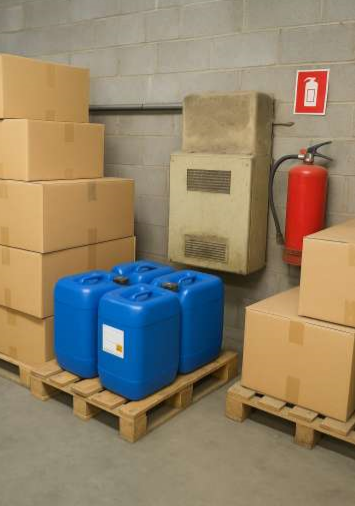
A photograph shows a warehouse with flammable liquids stored on wooden pallets, near a heater with a visible dust build-up on the vent. Fire extinguishers are present but blocked by stacked boxes.
Learner Tasks:
- Identify all fire hazards in the image (e.g., improper storage of flammables, blocked fire extinguishers, dust accumulation).
- Assess the risk level (e.g., high risk of ignition due to heat source and flammable liquids).
- Recommend corrective actions (e.g., move flammable liquids to approved storage cabinets, ensure access to fire extinguishers, implement routine cleaning).
- Specify urgency and responsible personnel for each control.
Scenario 2 – Electrical Panel Room
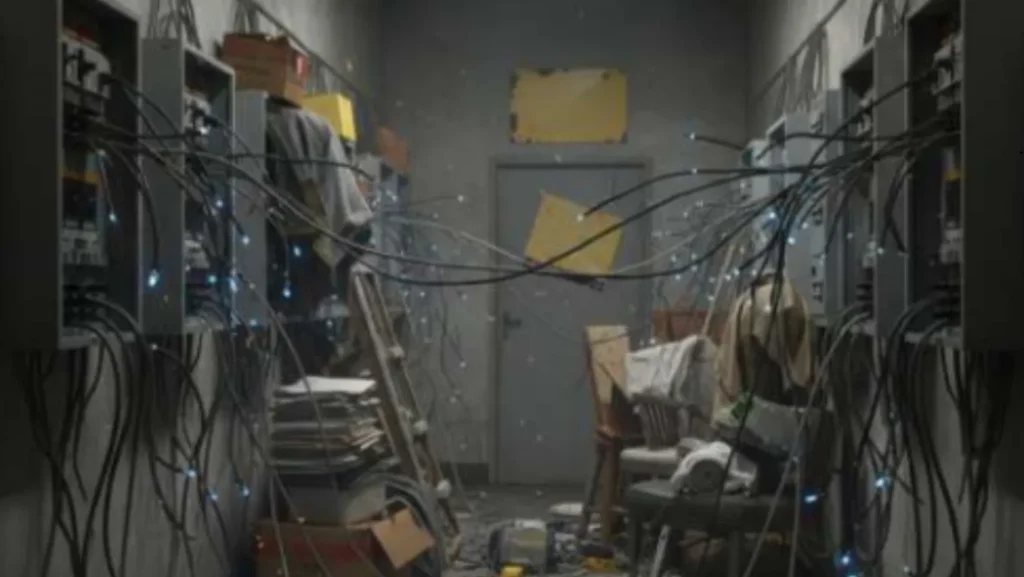
A diagram of an electrical room shows overloaded circuits, exposed wiring, and no clear fire exit signage. Combustible materials are stored close to the panel.
Learner Tasks:
- Identify hazards (overloaded circuits, exposed wiring, poor signage, combustible storage).
- Assess risks (e.g., potential electrical fire, difficulty evacuating).
- Recommend controls (e.g., redistribute electrical load, repair wiring, clear combustible materials, improve signage).
- Explain reporting procedures and monitoring requirements
Scenario 3 – Office Space
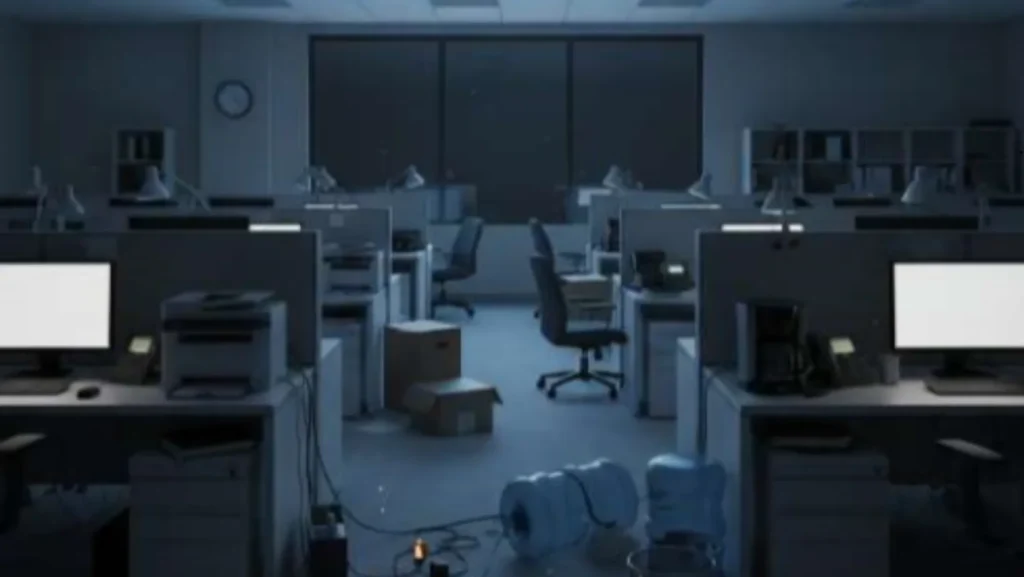
A photograph shows an office with electrical appliances left on overnight, blocked escape routes by office furniture, and inadequate smoke detection coverage in one area.
Learner Tasks:
- Identify hazards (e.g., electrical fire risk, blocked egress, inadequate fire detection).
- Assess risk levels and potential consequences.
- Suggest remedial actions (e.g., implement appliance switch-off policy, rearrange furniture, install additional smoke detectors).
- Determine which hazards require immediate action versus ongoing monitoring.
Scenario 4 – Industrial Workshop
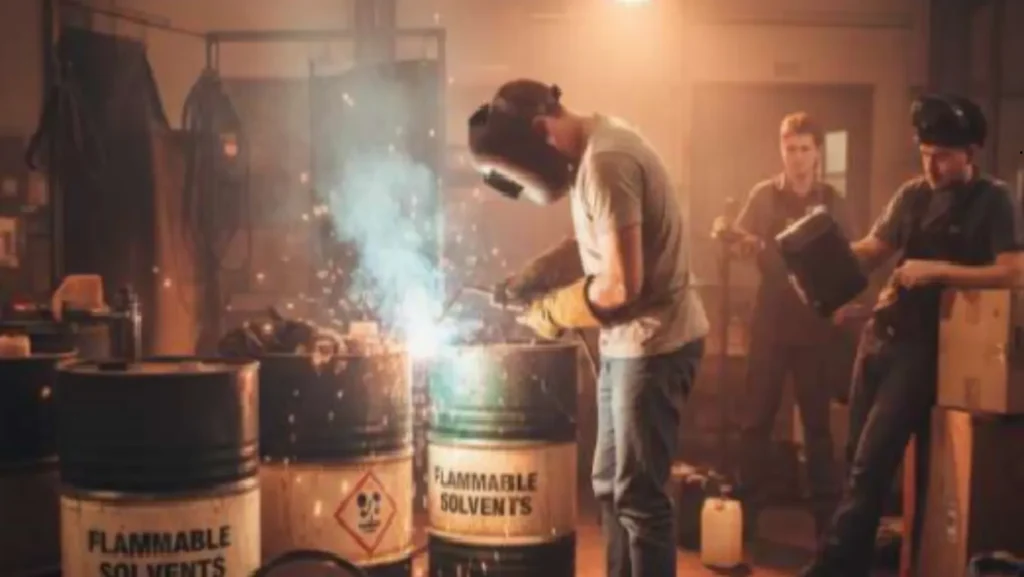
A photograph shows welding operations near flammable solvents, no fire-resistant curtains, and staff not wearing PPE.
Learner Tasks:
- Identify hazards (hot work near flammables, absence of protective barriers, lack of PPE).
- Evaluate risk of ignition and injury.
- Recommend controls (e.g., hot work permits, fire-resistant screens, mandatory PPE).
- Link controls to fire safety management procedures.
Scenario 5 – Commercial Kitchen
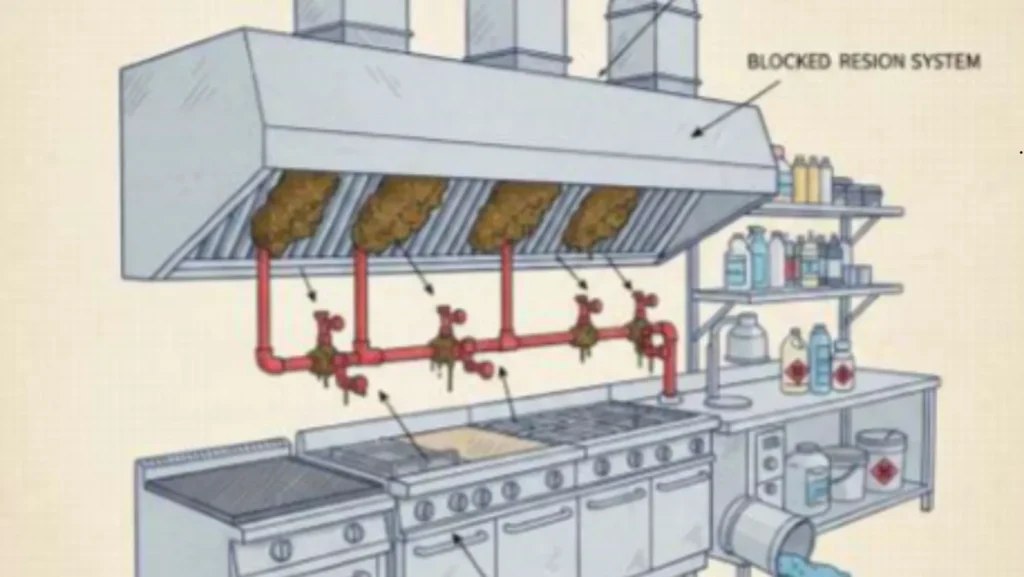
A diagram of a commercial kitchen shows grease accumulation in extraction hoods, blocked fire suppression system, and inappropriate storage of cleaning chemicals near heat sources
Learner Tasks:
- Identify hazards (grease build-up, blocked suppression system, chemical storage).
- Assess fire risk.
- Recommend corrective actions (regular cleaning schedule, maintain fire suppression system, relocate chemicals).
- Indicate urgency and ongoing monitoring
Scenario 6 – High-Rise Building Plan
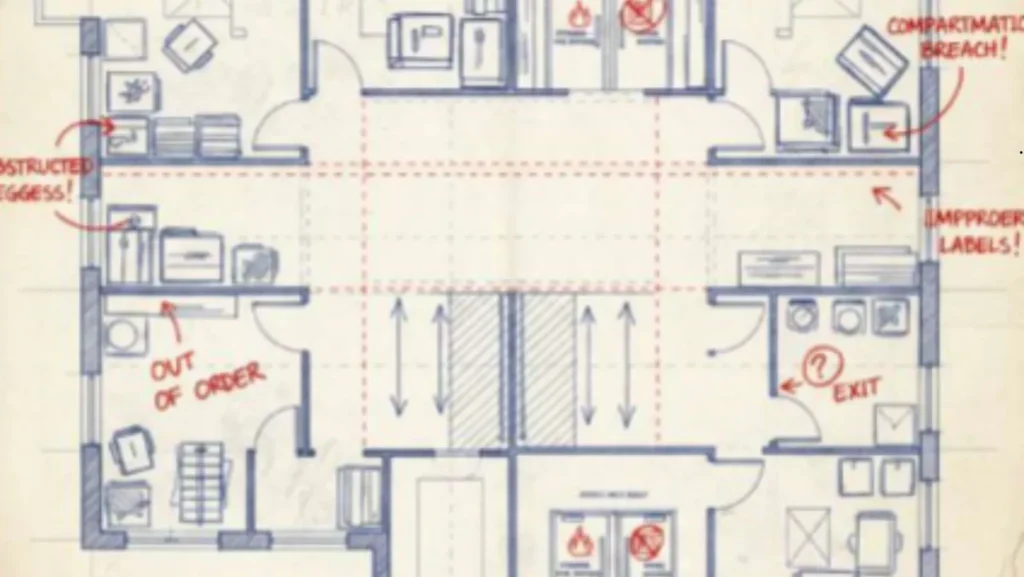
A technical floor plan shows fire exits partially obstructed, inadequate compartmentation between floors, and improperly labeled fire doors
Learner Tasks:
- Identify non-compliances.
- Assess risk to occupants in the event of fire.
- Recommend corrective measures (clear exits, improve compartmentation, label and maintain fire doors).
- Relate hazards to fire safety management responsibilities
Scenario 7 – Chemical Laboratory
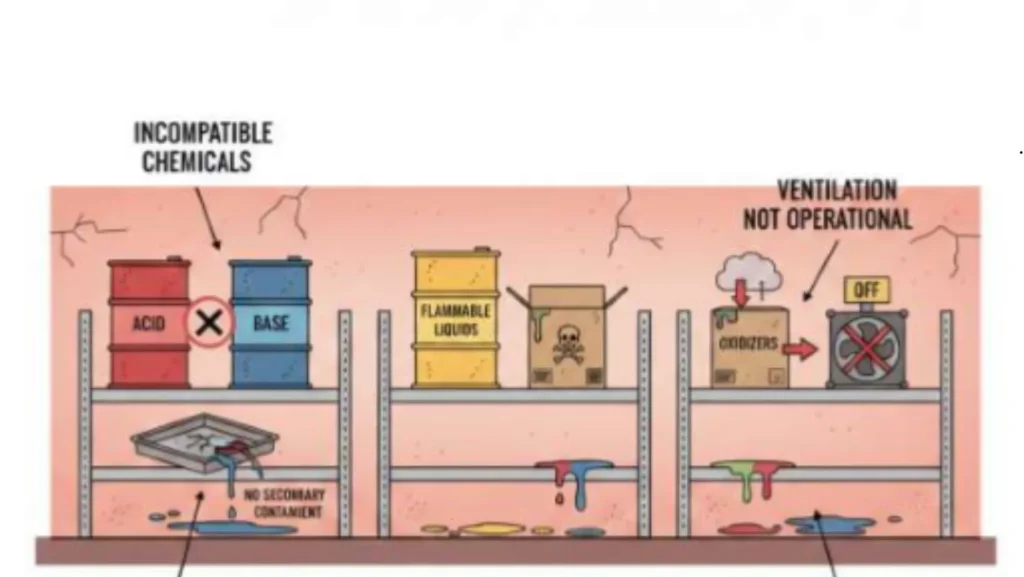
A diagram shows incompatible chemicals stored together, absence of secondary containment, and ventilation not operational.
Learner Tasks:
- Identify hazards.
- Evaluate risks of fire, explosion, or toxic exposure.
- Recommend control measures (segregate chemicals, install secondary containment, repair ventilation).
- Report required actions and responsible personnel.
Assessment Guidance for Learners
Your responses will be evaluated based on:
- Accuracy of hazard identification.
- Appropriateness and practicality of risk assessments.
- Feasibility and compliance of recommended control measures.
- Ability to link hazards to fire safety management and legislative requirements.
- Clarity and completeness in reporting urgency and responsibilities.