
Photo and Diagram Interpretation in Safety Systems
ProQual Level 7 Diploma: Visual Interpretation for Strategic Safety Leadership
Table of Contents
Purpose
This task trains learners to analyse photographs or diagrams showing workplace hazards, defects, or non-compliances. Each scenario helps learners strengthen observation, risk interpretation, ISO-aligned system thinking, and clear communication.
The task links directly to the learning outcomes by:
- Supporting ISO 45001 implementation through structured hazard identification and control planning.
- Developing quantifiable risk evaluation by requiring scoring, prioritisation, and justification.
- Improving risk communication by requiring clear written responses suitable for workers, supervisors, and management.
Scenario Image Description (Assessor-Provided Photo)
Scenario: Indoor maintenance area with multiple unsafe conditions
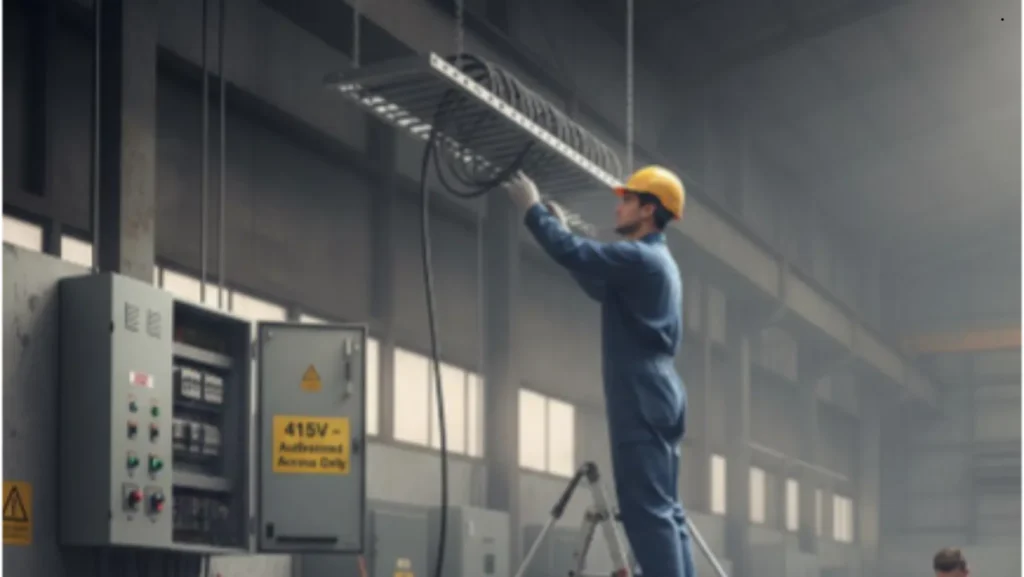
The image shows a maintenance workshop inside a facility. A technician is seen standing on the top rung of an A-frame ladder, leaning sideways to reach a ceiling-mounted cable tray. The ladder is not fully opened, and the locking bars are hanging loose. A power cable from a portable grinder runs across the floor, creating a trip hazard. Nearby, a stack of paint cans is placed next to a wall-mounted electrical distribution board with its panel door left open. A warning label on the board reads “415V – Authorised Access Only,” yet the technician is unsupervised. No barricades or warning tags are visible around the work area. A spill of oil is seen under a bench, with no absorbent materials or spill kit in sight. A coworker is walking through the area while using a mobile phone, unaware of the ongoing maintenance task.
Part A — Observation Task
You must make immediate, medium-term, and strategic decisions aligned with:
- ISO 45001 safety leadership expectations
- Organisational risk appetite
- Quantifiable risk assessment models
- Effective risk communication principles
- Legal and due-diligence requirements
Decision-Making Questions (In-Depth / Level 7 Standard)
Learners study the scenario description and list all hazards they can identify. The purpose is to improve observation accuracy.
Example hazard types learners should detect:
- Unsafe ladder use
- Fall from height potential
- Electrical exposure
- Slip and trip hazards
- Poor housekeeping
- Uncontrolled work area
- Lack of supervision
- Fire risk from chemicals near electrical installations
- Worker distraction in hazard zone
Learners must record the hazards in simple factual language.
Part B — Interpretation Task
Learners explain what each hazard means in terms of risk and system failure. This links the scenario to ISO 45001 clauses on:
- Hazard identification
- Operational control
- Worker participation
- Emergency preparation
- Performance monitoring
Learners evaluate:
- What could happen? (Injury type, damage, business impact)
- Which controls are missing?
- Which system element failed? (training, supervision, permit-to-work, inspection regimes, housekeeping policy, energy isolation)
Each explanation is written as professional analysis without emotional language.
Part C — Quantifiable Risk Assessment Task
Learners choose five major hazards and score them using a numeric matrix. Required fields:
- Hazard
- Potential consequence
- Likelihood (1–5)
- Severity (1–5)
- Risk rating (L × S)
- Priority level
- Recommended control measures (aligned to hierarchy of controls)
Learners must justify why they selected the likelihood and severity levels.
Quantifiable Risk Assessment Table (Model Answers):
| Hazard | Consequence | Likeli hood (1–5) | Sever ity (1– 5) | Risk Rating | Priority | Controls Required |
| Unsecured ladder use | Fall causing fracture/head injury | 4 | 4 | 16 | High | Replace ladder with MEWP; ladder training; supervisor checks |
| Trailing power cable | Trip leading to injury | 3 | 3 | 9 | Medium | Cable management; use overhead cable hooks |
| Paint cans near electrical panel | Fire/explosion | 3 | 5 | 15 | High | Remove chemicals; isolate panel; lock required |
| Oil spill under bench | Slip injury | 3 | 3 | 9 | Medium | Clean spill; introduce spill-control procedures |
| Open electrical board | Electric shock | 3 | 5 | 15 | High | Secure panel; restrict access; electrical permit required |
Risk ratings scored using (Likelihood × Severity).
This step reinforces the outcome:
“Be able to evaluate strategic risks using a quantifiable risk assessment system.”
Part D — Corrective Action and ISO Alignment Task
Learners propose detailed corrective actions for each hazard. Responses must align with ISO 45001 requirements such as:
- Hazard elimination
- Engineering controls
- Safe systems of work
- Competency requirements
- Permit-to-work
- Supervision and monitoring
- Emergency planning
- Consultation and worker involvement
Actions must be realistic, site-specific, and linked to operational control.
Examples learners may include:
- Replacing ladder work with a MEWP (elimination/substitution)
- Locking electrical panels with controlled access
- Deploying spill kits and establishing housekeeping audits
- Implementing exclusion zones during maintenance
- Introducing toolbox talks linked to observed behaviour patterns
This demonstrates the outcome:
“Be able to develop and implement current ISO standards for occupational health and safety.”
Part E — Risk Communication Task
Learners must write two communication messages for the same scenario:
Worker-Level Message (Simple Site Language)
“This area is unsafe. The ladder is unstable, the electrical board is open, and there are trip and slip hazards. Please stop work, secure the area, and use proper access equipment. Keep phones away during maintenance and follow the exclusion-zone rules.”
Management-Level Message (Strategic Focus)
“The scenario shows multiple system weaknesses: unsafe work-at-height practice, poor housekeeping, uncontrolled access to live electrical equipment, and lack of supervision. This indicates gaps in operational planning, workforce competency, and inspection regimes. Investment in MEWP access, enhanced supervision, and stricter control-of-work procedures is required to meet ISO 45001 obligations and reduce high-risk exposures.”
This proves the outcome:
“Be able to articulate risk communication strategies in various situations.”
Part F — Assessor’s Model Example (Short Sample)
Below is a brief model to show the expected style. Learners must produce their own full version.
Hazard Identified: Technician standing on top rung of unsecured ladder
Risk Score: Likelihood 4 × Severity 4 = 16 (High)
Interpretation: High probability of fall due to unstable ladder and overreaching. Represents failure of safe work at height procedures.
Corrective Action: Replace ladder use with MEWP; re-train technicians on ladder safety; introduce supervisor sign-off for elevated work.
Communication to Workers: “Use only secured ladders and never stand on the top rung. Stop work immediately if stability cannot be confirmed.”
Communication to Management: “A systemic failure in work-at-height supervision has been observed. MEWP purchase or rental is recommended, alongside refresher training.”
Part G — Learner Submission Requirements
Learners must submit:
- A hazard list from the scenario
- A full interpretation of each hazard
- A quantified risk assessment table
- ISO-aligned corrective action plan
- Two communication messages (worker + management)
The assessor evaluates clarity, accuracy, risk reasoning, and communication skill.