
Guide to Process Flow Construction Task
Knowledge Providing Task: Process Flow Construction in ProQual Level 7
Table of Contents
Context & Rationale
At the Level 7 strategic leadership stage, incident investigation is not merely a reactive
procedure but a critical input into the organization’s overarching Safety Management
System (SMS). This task requires you to construct a sophisticated process flow diagram
that maps the detailed steps of an incident investigation while also demonstrating how
the findings feed into strategic risk review concerning various hazards covered in this
unit.
Task Requirements
You are to create a Process Flow Diagram that outlines the procedure for
Implementing an Accident Causal Analysis Model for a Physical Hazard Incident
and critically links the identified root causes to four distinct strategic follow-up/review
processes.
1. Flow Diagram Construction:
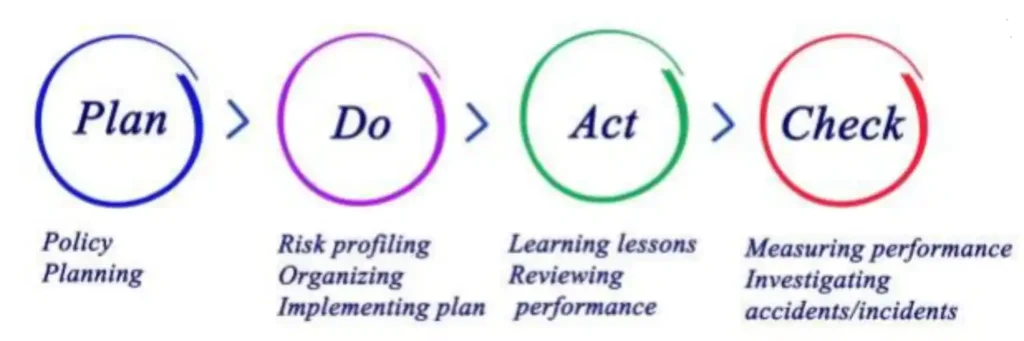
Health and Safety Managing Process
o Construct a detailed, sequential flow diagram (using standard flowchart
symbols: Ovals, Rectangles, Diamonds, Arrows).
o The flow must cover the process from Incident Notification through to
Systemic Action Implementation and Strategic Review.
o The diagram’s core must detail the application of an Accident Causal
Analysis Model (e.g., RCA, MORT) for a significant physical hazard (e.g.,
a major fall or equipment failure).
2. Enhanced Integration of Digital Technologies & Data:
o Incorporate and label at least four specific points where digital
technologies are used to significantly enhance accuracy, speed, or
strategic insight.
o Show a clear step for Data Integration and Visualization—explaining
how data from the investigation (e.g., interview transcripts, sensor logs) is
aggregated and presented for leadership review.
3. Strategic Linkage & Systemic Review (The Crucial Addition):
o The flow must conclude with a series of distinct parallel or sequential
steps illustrating how the root cause findings trigger a Strategic Systemic
Review across other hazard domains, even if the primary incident was a
physical hazard.
In-Detailed Process Flow Stages (Mandatory Inclusion)
Your diagram must include the following stages, with the Strategic Review stage being
the major enhancement:
| Stage | Key Steps & Focus | Mandatory Integration |
| I. Immediate Response & Triage | Securing the scene, initial notification, evidence preservation. | Digital Tech 1: Rapid digital notification system. |
| II. Formal Investigation & Causal Analysis | Team appointment, evidence gathering, interviewing, applying the causal model (e.g., identifying failed barriers/systemic weaknesses). | Digital Tech 2: Cloudbased platform for geotagging and storing all evidence |
| III. Root Cause Identification & Action Planning | Final determination of systemic root causes, development of initial corrective/preventative action plan (CAP). | Digital Tech 3: AI/Machine Learning tool for clustering findings or cross-referencing with past incidents. |
| IV. Strategic Systemic Review & Action | The crucial step where the physical hazard root cause (e.g., inadequate training, poor maintenance system) forces a review across other critical areas. | Digital Tech 4: Dashboard/System for leadership to track strategic CAPs across multiple hazard domains. |
Mandatory Strategic Review Outcomes
Stage IV must include distinct pathways addressing the following unit learning
outcomes, triggered by the systemic failure identified in the investigation:
- 1. Review of Ergonomic Controls: Systemic failure in maintenance or design
(root cause) triggers a review of Engineering Solutions for Ergonomic
Hazards across the organization. - 2. Review of Biohazard Risk: Systemic failure in procedural compliance or
training (root cause) triggers a review of the Biohazards Risk Assessment and
Control Measures implementation process. - 3. Review of Chemical Failure Scenarios: Systemic failure in management
oversight (root cause) triggers a review of the Likely Failure Scenarios for
Chemical Hazards and Control Measures. - 4. Review of Biological Outbreak Preparedness: Systemic failure in rapid
response or communication (root cause) triggers a review of the organization’s
Risk Assessment for Biological Outbreaks and Control Measures.
Deliverables
- The Process Flow Diagram: A visual representation of the entire procedure,
clearly showing the four mandatory Strategic Review outcomes branching from
the Root Cause Identification stage. - Strategic Justification Report (Maximum 650 words): A detailed report
justifying the strategic components:
o a. Causal Model & Digital Impact: Identify the Causal Analysis Model
used and explain how the four integrated digital technologies
specifically support a Level 7 strategic goal (e.g., data-driven decision
making, proactive risk profiling).
o b. Linking Root Causes to Broader Risk: Choose one specific
systemic root cause identified in the investigation (e.g., “Inadequate
Change Management Process”) and explain in detail how this single root
cause could compromise the organization’s control measures for
Biohazards and Engineering Solutions for Ergonomic Hazards
(addressing two core learning outcomes).
o c. Strategic Value of Systemic Review: Explain why a strategic leader
must mandate the review of seemingly unrelated hazards (Chemical,
Biological) after a physical incident, focusing on the concept of systemic
risk and the impact of Digital Technologies on Strategic Management.