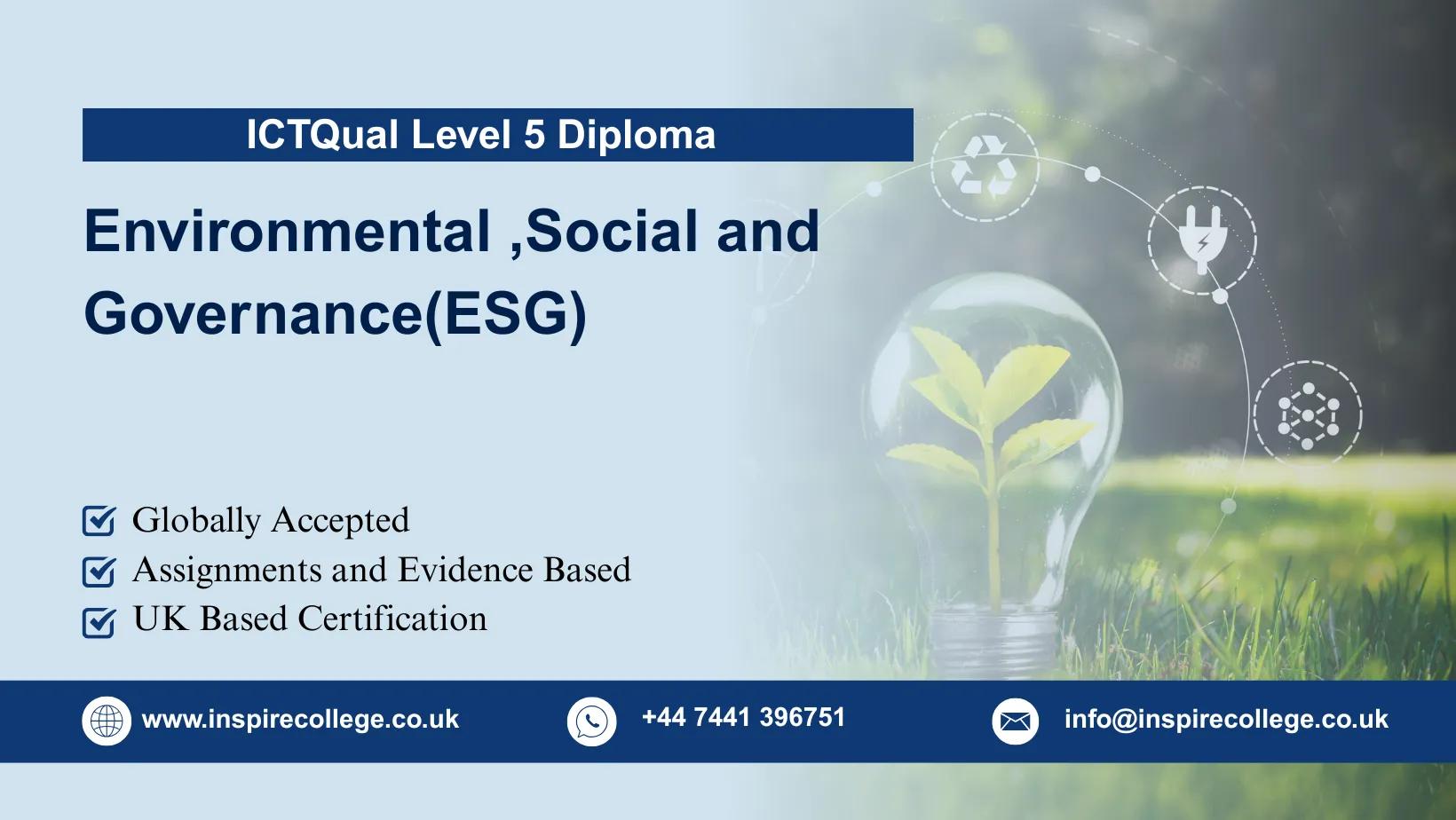
ICTQual Level 5 Diploma in Environmental ,Social and Governance (ESG)
The ICTQual Level 5 Diploma in Environmental, Social and Governance (ESG) is a specialized 60‑credit qualification designed to provide learners with intermediate‑level expertise in sustainability, corporate responsibility, and governance practices. Building on foundational knowledge, this program equips participants with the skills to critically analyze ESG frameworks, implement ethical strategies, and contribute to responsible business decision‑making.
Learners will explore key areas such as sustainable development, stakeholder engagement, ESG reporting, compliance, and ethical investment, gaining practical insights into how organizations can align with global sustainability standards. The diploma emphasizes applied learning, combining theoretical concepts with case studies and digital reporting tools to prepare learners for real‑world challenges.
Ideal for graduates, professionals, and aspiring leaders, this qualification strengthens career prospects in industries where ESG priorities are increasingly essential. It also serves as a pathway to advanced study, including Level 6 Diplomas or postgraduate programs in sustainability and governance.
By completing the ICTQual Level 5 Diploma, learners demonstrate their commitment to driving transparency, resilience, and long‑term value creation in today’s evolving business landscape.
To ensure learners are well-prepared for the programme, the following entry requirements apply:
- Age Requirement: Applicants must be 18 years or older at the time of registration.
- Educational Background: Candidates should hold a Level 4 Diploma or an equivalent qualification in a relevant discipline such as business, management, engineering, sustainability, or social sciences. Individuals with substantial professional experience in ESG, compliance, or corporate responsibility may also be considered.
- Work Experience: While not compulsory, prior exposure to sustainability, corporate governance, quality management, or social responsibility will strengthen applications and help learners engage more effectively with advanced course content.
- English Language Proficiency: Since the program is delivered in English, learners are expected to demonstrate a solid command of written and spoken English to understand technical material and complete assessments successfully.
- Technical Aptitude: A genuine interest in sustainability, ethical governance, and social responsibility is essential. Familiarity with compliance frameworks, reporting standards, or corporate practices will be advantageous.
Mandatory Units
This qualification, the ICTQual Level 5 Diploma in Environmental ,Social and Governance (ESG), consists of 10 mandatory units.
- Advanced Concepts in Environmental Sustainability and Climate Risk
- Social Responsibility, Diversity and Stakeholder Engagement
- Governance, Accountability and Ethical Leadership
- ESG Auditing, Compliance and International Standards
- Strategic ESG Risk Management and Reporting Frameworks
- Applied ESG Practices in Global Industries
Learning Outcomes for the ICTQual Level 5 Diploma in Environmental ,Social and Governance (ESG):
Advanced Concepts in Environmental Sustainability and Climate Risk
- Analyze advanced theories of environmental sustainability and their application in global industries.
- Evaluate climate change impacts on organizational operations and long‑term resilience.
- Apply frameworks for carbon footprint measurement and reduction.
- Assess environmental risk management strategies in line with international standards.
- Integrate sustainability principles into corporate decision‑making and project planning.
- Critically examine renewable energy adoption and resource efficiency practices.
- Develop policies that align with global environmental sustainability goals.
- Demonstrate awareness of ethical and legal responsibilities in climate risk management.
Social Responsibility, Diversity and Stakeholder Engagement
- Explain the role of social responsibility in modern corporate governance.
- Evaluate diversity and inclusion strategies within organizational structures.
- Apply stakeholder engagement models to build trust and transparency.
- Assess the impact of CSR initiatives on community development and brand reputation.
- Analyze ethical challenges in social responsibility practices.
- Develop frameworks for measuring social impact and reporting outcomes.
- Integrate human rights considerations into ESG strategies.
- Demonstrate effective communication with diverse stakeholder groups.
Governance, Accountability and Ethical Leadership
- Understand principles of corporate governance and accountability.
- Evaluate ethical leadership practices in organizational contexts.
- Apply governance frameworks to strengthen transparency and compliance.
- Assess the role of boards and committees in ESG oversight.
- Analyze case studies of governance failures and corrective measures.
- Develop strategies for ethical decision‑making in complex environments.
- Integrate governance principles into risk management systems.
- Demonstrate awareness of anti‑corruption and integrity standards.
ESG Auditing, Compliance and International Standards
- Explain the importance of ESG auditing in global industries.
- Apply auditing methodologies to assess compliance with ESG standards.
- Evaluate international frameworks such as ISO, GRI, and SASB.
- Develop audit reports that meet professional and regulatory requirements.
- Assess risks associated with non‑compliance in ESG practices.
- Integrate ESG audits into organizational quality management systems.
- Demonstrate knowledge of certification processes and accreditation standards.
- Critically analyze evolving global ESG compliance trends.
Strategic ESG Risk Management and Reporting Frameworks
- Identify key risks associated with environmental, social, and governance factors.
- Apply risk management models to ESG challenges.
- Evaluate reporting frameworks such as GRI, CDP, and TCFD.
- Develop ESG risk registers and mitigation strategies.
- Assess the role of transparency in ESG reporting.
- Integrate ESG risk management into corporate strategy.
- Analyze stakeholder expectations in ESG disclosures.
- Demonstrate ability to prepare professional ESG risk and reporting documents.
Applied ESG Practices in Global Industries
- Apply ESG principles to real‑world industrial case studies.
- Evaluate sector‑specific ESG challenges in construction, energy, manufacturing, and finance.
- Develop practical solutions for integrating ESG into operational processes.
- Assess the impact of ESG practices on organizational competitiveness.
- Implement monitoring and evaluation systems for ESG performance.
- Demonstrate collaboration skills in multidisciplinary ESG projects.
- Critically analyze global best practices in ESG implementation.
- Reflect on professional growth through applied ESG learning.
The ICTQual Level 5 Diploma in ESG is designed for learners who already have a foundation in sustainability, governance, or business management and want to advance their expertise. It is particularly suited for:
- Graduates and professionals with a Level 4 qualification or equivalent experience who wish to deepen their knowledge of ESG practices.
- Managers and team leaders seeking to integrate sustainability, compliance, and ethical governance into organizational strategies.
- Consultants and practitioners working in corporate responsibility, quality management, or compliance who want to strengthen their credentials.
- Career changers motivated to enter the growing field of ESG with a recognized intermediate‑level qualification.
- Aspiring leaders preparing for progression to advanced diplomas or postgraduate study in sustainability, governance, or business management.
This diploma is ideal for individuals committed to driving responsible business practices, transparency, and long‑term value creation, while positioning themselves for career growth in industries increasingly shaped by ESG priorities.
Register Now
FAQs for ICTQual Level 5 Diploma in Environmental ,Social and Governance (ESG)